

Writing a book is like falling in love. You have high hopes, fears you push aside, and a deep longing to connect, bring joy, and be understood. You’re at your most vulnerable and sometimes you swear you’ll never do it again. But you do.
When my publisher put out a request for monster novels set in college, the professor in me couldn’t resist. Not only was I still in the classroom, my students were reading and writing a lot of monster fiction, with heavy doses of mythology added in. I’d already longed to write about a gorgon main character. I can identify with being cursed, having been a cute child until my gnarly* permanent teeth came in. (*Yes, some of the novel is set in the 80s and 90s.) This was my chance.
I could come up with plenty of college problems. Outsiders make things up about campus life, political types will try to cut funding, and a small school in the boonies might not attract students like it used to.
But what about something to make life as a gorgon worth living? My class told me about man-snakes and that settled it. A campus romance was in the works. The result: Snakes in the Class.
I learned a disturbing piece of history as I wrote this book. I read about the Bacchanalian purge of 186 B.C. In a nutshell, the cult of Dionysus as brought to Southern Italy from Greece, had grown quite popular. The female based cult, more of which can be read here, upset the sexist Roman Senate, which placed restrictions on the members and eventually killed them, but not before portraying them as wild haired baby killers. Oh, and they liked snakes. Nothing new here–many religions appreciate snakes. Not only that, Dionysus was a liberator, a symbol of equality for all in a hierarchical society. His festivals were fun and women could be free of the male dominated society during them.
The Roman Empire was fueled by inequality, which lead it its ultimate downfall. Too bad they wiped out all of the diverse ideas and populations and let the corrupt upper-class call the shots. They even started doing away with polytheism because one male god was so much more like them! The Visigoths came in and finished the job.
Today, if you find yourself surrounded by drab, sexist, snake haters, you have the ancient Romans to thank for it.
The cult of Dionysus was wiped out, although many secretly stuck with their festivals and practices. The Romans were good at stirring up hatred for free thinkers. It was much like what happened to the Cathars.
The two groups, Bacchanalians and Cathars, had little in common, one being freewheeling partiers and the other, pious vegetarians. Other than being extinguished by forces out of Rome, the groups had female equality as an important societal norm.
We see a lot of these same tactics today, often lead by women who have embraced ambivalent sexism—you know, the whole good woman bad woman Madonna vs whore ideal. There have been a slate of hate lawspassed in many states, often sparked by fears of promiscuity, particularly by people who married young and embraced strict gender roles. Women who gave up education to marry are often at the forefront, worried their partners will cheat. Men who feel stuck in society try to gain social status in their own eyes by being self-appointed morality police. It is politically strategic to target these insecure people and to find another group to scapegoat. Traditionally, scapegoats were physically ugly people beaten and driven out of a town to ward off bad luck—monsters of a sort. Thus, creating an unequal society where some feel they’ve had adversity in life is a way to keep the powerful in their cushy positions. It’s not nice, but it works.
This is a long discussion to illustrate the historical and current problems a college for monsters in a small rural town might face, even if the monsters are as well-behaved as they can be. And what could be more frightening than a gorgon professor—educated, female, and deadly?
Despite all of the heavy problems, the novel is funny, even whimsical. It’s for college fans and equality fans and monsters everywhere. If there is anything about you that put snakes on your head, it’s for you!
In any case, here’s my shortened pitch:
Professor Gormley Grimn didn’t choose the Gorgon life—the Gorgon life chose her…sort of. When she was cursed by the jealous fiancée of her study partner, Gormley fled, leaving those she loved behind to become a professor of chemistry at Manster College. It’s a safely secluded life, devoid of sex–until she falls into a lusty affair with Dean Ormr Snaakemon—half smooth-skinned man, half smooth-scaled snake, one hundred percent hottie. Life as a cursed Gorgon finally doesn’t seem so bad. Gormley’s a lover, not a killer.
When the local Purity League vows to stamp out all monsters, she’s pushed to a decision. Should she and her students stick with her no-killing principles, or join forces with the anti-Purity League Knobbers—a group of demigods, including the woman who cursed her? When all you need is love and a college education, does anything make fighting worth it?
Snakes in the Class is a monster romance novel featuring steamy snakes and a touching HEA. It is the first book in the Monster College Chronicles series.
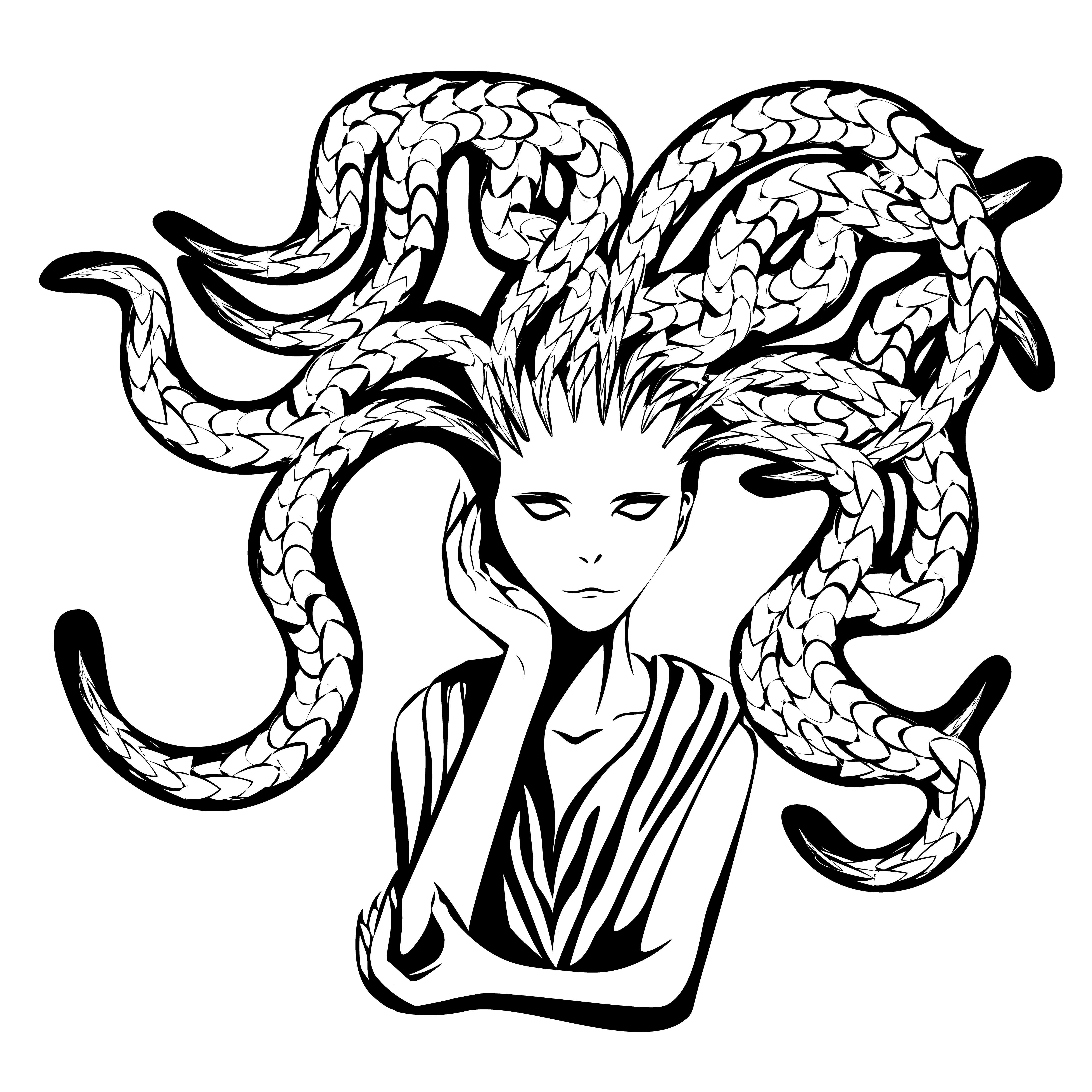
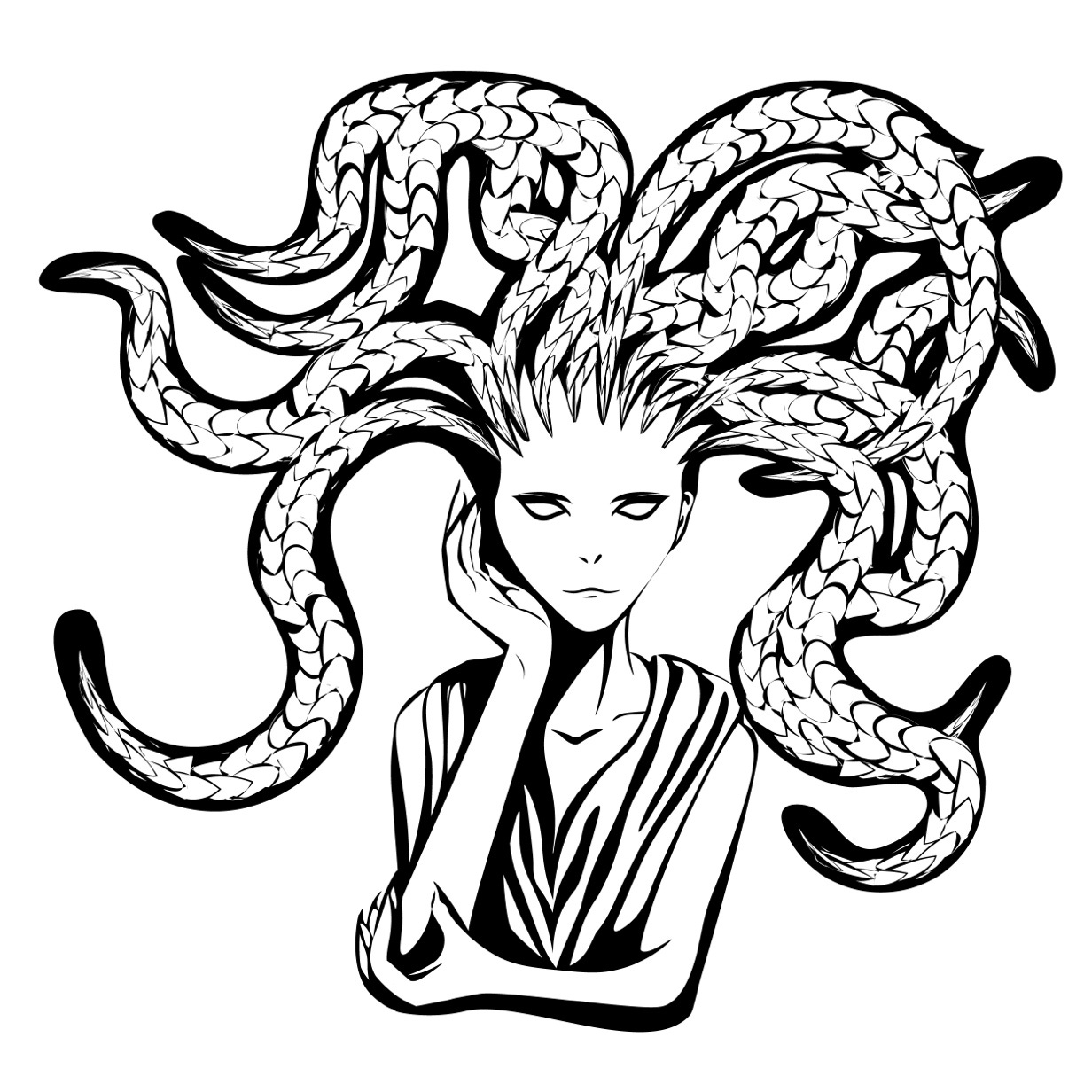
In the next post, I’ll show the cover and talk about how it came to be. (The illustration for today’s post is clip art, not the cover.)
Snakes in the Class will be out this August 29, in time for back to school. I’ll be giving a reading at Beaverdale Books on Sept. 11. I’d love to talk more about it with anyone!
 Catherine Haustein
congrats on the book, reactionary snake-haters in the US probably have more to do with the Garden of Eden than life B.C.
LikeLike
But did the Garden of Eden story arise from snake hating aka being put off by other religions? I’ve always wondered.
LikeLike
people have tried to make some weak links to Canaan or Mesopotamia but nothing very convincing, not hard to see why vipers might be feared in those parts of the world I think.
LikeLike