
A short time ago, I was helping make a movie about water testing at Big Rock Park. One thing I tested for was nitrates. As I was testing, I mentioned that nitrates are a sign of fertilizer in the water. We didn’t find any fertilizer in the water that day but one of the videographers mentioned he was surprised to learn that nitrates are in fertilizer since they are also in food. Yes indeed they are and it might be giving people in the corn belt cancer.
Nitrate is an ion with a negative charge. The formula is NO3– which looks harmless enough. Nitrogen is an important part of proteins and is needed for life. Nitrates are a water-soluble way for living things to get nitrogen. Nitrogen is an element that can take many oxidation states, meaning it forms a myriad of compounds.
The nitrate ion occurs naturally in some foods such as spinach, beets, celery, and many other vegetables. It is found as an additive in processed meats. If it’s in food, why is it harmful? Why should a water chemist check the nitrate levels in water?
Nitrates will bind to hemoglobin, displacing oxygen, causing blue baby syndrome. They also react with organic compounds in water to form nitrosamines which are similar to nicotine and cause cancer.
Nitrates in food aren’t always bad. When you eat things containing nitrate, your saliva can turn it into something useful, nitric oxide, NO. Having slightly low oxygen such as when a person lives at high altitude or exercises until muscles ache can also help create NO. NO can help blood vessels expand and function. This reduces resting blood pressure and improves vascular function.
Saliva is an important factor in the conversion process and eating slowly will allow for time to boost the conversion to NO. Dry mouth, caused by anxiety, medications, or other imbalances, impedes the process. If you find you need to sip a lot of liquids to help you swallow your food, you might have dry mouth. Other nutrients in fruits and vegetables, including Vitamin C, can help this NO conversion process occur. In the absence of the boost from saliva and food antioxidants, the nitrates will react with other components of foods to form a class 1 carcinogen—nitrosamine. Cooking-nitrate rich foods speeds the nitrosamine formation. Here’s the information in a simple chart form.
It should be noted that nitrates in water, even at low levels, and eating a vegetable rich diet isn’t all it’s cracked up to be. This was associated with thyroid cancer and low thyroid function, especially in older women. One reason for this is that nitrate is suspected of interfering with iodine uptake. (Getting enough vitamin C might possibly help mitigate this. )
Chlorination of water also helps nitrate form nitrosamines. We don’t want bacteria laden water and disinfection of drinking water is necessary. Additionally, the food components which inhibit the formation of nitrosamines are not present in the drinking water. Thus, nitrates in water are more dangerous and high levels of nitrates in water are associated with cancer. In fact thousands of cancer cases in Iowa alone have been linked to nitrate in water.
Bacteria can break down nitrates but when water is overloaded with nitrates, they can’t keep up. Sources of excess nitrate in water include fertilizer and manure. The EPA limits nitrate in drinking water but the nitrate limit here in the US might be too high. Even low levels of nitrate in water are thought to be harmful and have been linked to colorectal cancer and preterm births.
You may want to turn to purified water but be careful. It doesn’t always contain the healthy minerals we need,
What areas of the US are vulnerable to high nitrate levels and nitrate contamination of groundwater? Click here for a map. (Hint: lots of places.) Why should our water grow gross with nitrates at our expense? In any case, be wise about nitrates.


A bad combination: low altitude, meat consumption—especially processed meat, dry mouth, not chewing your food enough, and low exercise. Will the orange juice be enough to counteract the rest of this breakfast? Ham, bacon, and sausage get you both ways—through water pollution and nitrates.
If you want to test your water for nitrates (and nitrites, an intermediate between ammonia and nitrate) there are several ways to do it. Using ultraviolet absorption, using a meter, or using test strips. Test strips are the cheapest and easiest method and you can find them on-line. It looks like my drinking water doesn’t contain nitrates. Hooray!
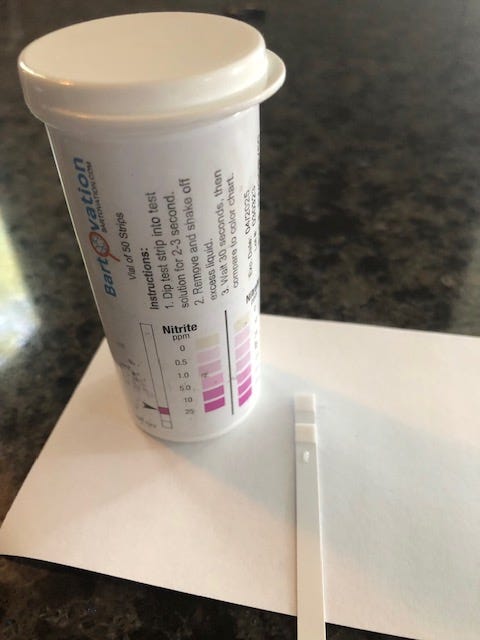
If you test your drinking water and find nitrates, you’ll have to invest in a water purification system. In other words, you’ll have to pay to protect yourself from the greedy few.
 Catherine Haustein
Many thanks for your post. Are you aware of the issues of sodium nitrite (E250)? I have a facial palsy due to it via bacon I ate. I wrote about it if you are interested.
LikeLiked by 1 person
Yes. Where is your link?
LikeLike