

You might have read the news. People are obsessed with the Roman Empire. Last year when I taught a course in short story writing, I noticed student fixation on gods, goddesses, and gladiators. To be part of the trend, I wrote a novel in which there are demigods and goddesses , minor deities based on those worshiped in the Roman Empire. Why did I include elements of modern day paganism in a novel set in the recent past simmering in the United States? My main character was a gorgon! For those unfamiliar with gorgons, the first one, Medusa was originally a beautiful priestess to Athena (aka Minerva to the Romans.) Medusa was seduced, probably raped, by Poseidon (aka Neptune to the Romans) at the temple of Athena, creating a sacrilege. Athena, of course, blamed the woman and turned Medusa into a monster, a gorgon with snakes for hair and a gaze which turned others to stone.
If this is all Greek to you, and you’re wondering how it relates to the Roman Empire, the ancient Romans copied almost everything about their polytheist religion from the Greeks. Likewise, I copied the Roman/Greek myth of Medusa my book Snakes in the Class, adding my own twists of course. I also left out the rape because I don’t find rape entertaining. I took great liberties. I didn’t stick with the legend. The protagonist is is NOT Medusa. Medusa’s legend is what provoked me. The unfairness of the whole curse! Women have been blamed for things men do to them since antiquity. It’s time for gorgons to have their due and to get their revenge.
Have you ever related to Medusa? Being a female scientist in the 1980s, I did feel gorganish and on the outs from society. But I didn’t want to live In the world as it was–a world somewhat similar to the Roman Empire. Why do I say that?
The Colosseum, pictured below, was built by slave labor.
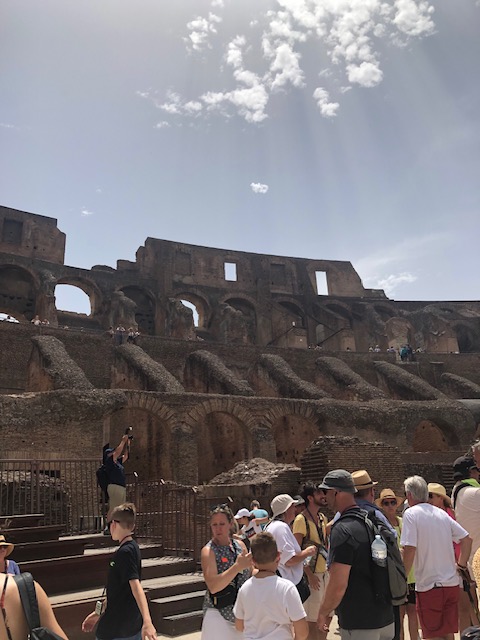
The Roman Empire was NOT a democracy. In the words of historian Michael Parenti, it was “A Republic for the Few” and also an Empire. “As with other imperial powers before and since, the Roman Empire brought immense wealth to its ruling class and imposed heavy burdens on its common citizenry.”
The rich paid little in the way of taxes. The ruling class took over public lands, including public farmlands, and divided them up amongst the upper class. The upended farmers moved to the cities to become the proletariat, the working class, or they remained on the land, working on farms and in mines which were no longer theirs. The environment was ignored. And once the rich took over the land, the voting block was shifted to the rural population through what we might call gerrymandering today.
The wealthy controlled the Senate and influenced the laws and judges. The poor and lowly were portrayed as having only themselves to blame for their poverty. Senate and government proceedings became private and secretive. There’s more of course, enough to fill books. Let’s leave it with this Mel Brooks clip from the history of the world.
As for women, their role in Roman society has largely been ignored by historians. Most were married off young (median age 12) and kept under the rule of their husbands. It’s notable that rich husbands and wives were afforded some permitted promiscuity. At the time of her curse, Medusa was held to a higher standard, as was expected for a priestess or a vestal virgin. Women had a choice: baby machine or virgin. Virginity is the price women paid for independence for much of recorded history. But that’s whole different tale.
If you hear anyone calling the US a Republic, know what it means. It means a place not for everyone. Who are the modern day Medusas? My list would include feminists, single women with cats, aging celebrities and older women in general, men without beards, drag queens, scientists, learned people, public schools, heck, anything public. We proletariats are always being lobbied about what to consider cursed and terrifying.
I’m not sure how all of this seriousness sprung like Pegasus from a post about the Roman Empire. I’d apologize but I didn’t create this Medusa-punishing-world. I only want to talk about it.
 Catherine Haustein
Girls were married around the age of 12?! I had no idea.
Your descriptions of the Roman rich & poor and taxation practices sound very familiar somehow…
LikeLiked by 1 person