
Nearly 200 years ago, a group of men in the Netherlands were separatists. They wanted to reject the “rationalism of the enlightenment” that was creeping into religion in the Netherlands. As far as I can understand this, the Enlightenment values included liberty, progress, and separation of church and state. The latter was important to Europeans for things like abolishing wars and moving science forward without the dogma of a church looking over. But the Dutch Separatists rejected this.
The religious separatists wanted none of that Enlightenment nonsense. Starting in 1834, they began their movement to restore what might be called fervor and dogma of the Calvinists into religion. (For those not up on religion, Calvanists think God saves some and others are really sinful.) The Dutch Reformed Church had become far too liberal for them. When they were opposed by the government, the separatists decided to leave. They debated where to go and settled on the US in the farm belt. Not many in the Netherlands were sorry to see the Afscheiding—the Successionists– go.
The first band to set out was lead by Alburtus Van Raalte, a poor preacher’s kid who was last in his seminary class. His followers were also poor and never made it to the rich farmland they expected. They settled in the woods of Michigan and there they stayed, founding my hometown of Holland, on the shores of Lake Michigan which had frozen when they got there and was impossible to cross. His impoverished group was at home in the woods and saw the trees as a gift from God, ready to be exploited. More on how that worked out for some of the locals can be found here.
The other leader, Hendrick Scholte was delayed because his infant son sickened and died. He soon followed with a more wealthy group of settlers and Scholte himself had plenty of money. He didn’t want to join Alburtus, as he found the Michigan land too swampy and unhealthy. As family lore said, “the rich kept going” and founded Pella, Iowa, where I live today.
The two groups later vied for immigrants, causing some resentment. They parted further when Scholte, who was fond of trying new things, set up an independent church. He staunchly opposed any sort of Christian school because public school was vested in the “sovereignty of the people.” He even supported the anti-slavery movement and became friends with Lincoln! Van Raalte clung to the mantel of being God’s chosen and remained more orthodox in preaching. There was even a movement in the church at large to oust independent Scholte from the Reformed Church but it failed. Those who were mad about this had other grievances. These somewhat later immigrants even found the Van Raalte style church too liberal and Americanized with at least 800 hymns they didn’t like. Much to Van Raalte’s chagrin, the malcontents created a new church, the Christian Reformed Church.
The Christian Reformed Church might be best known to outsiders as giving us Betsy DeVos and her brother Erik Prince. Van Raalte came around to see the value in public education after this.
Being of Dutch decent, I have been aware of these things, but vaguely. My point is, ancient history is today’s history. People still fight over which church doctrine is the most pure, who is a heathen, which Enlightenment values to embrace or reject, and if school should be public or private. They even fight over hymns. And for us in Iowa, a former aide to Betsy DeVos is now Iowa’s education director. If you don’t think this will influence public education in Iowa, you don’t know history. Or maybe now, you do.
More complete background can be found here and in the Van Raalte Institute in Holland, Michigan.
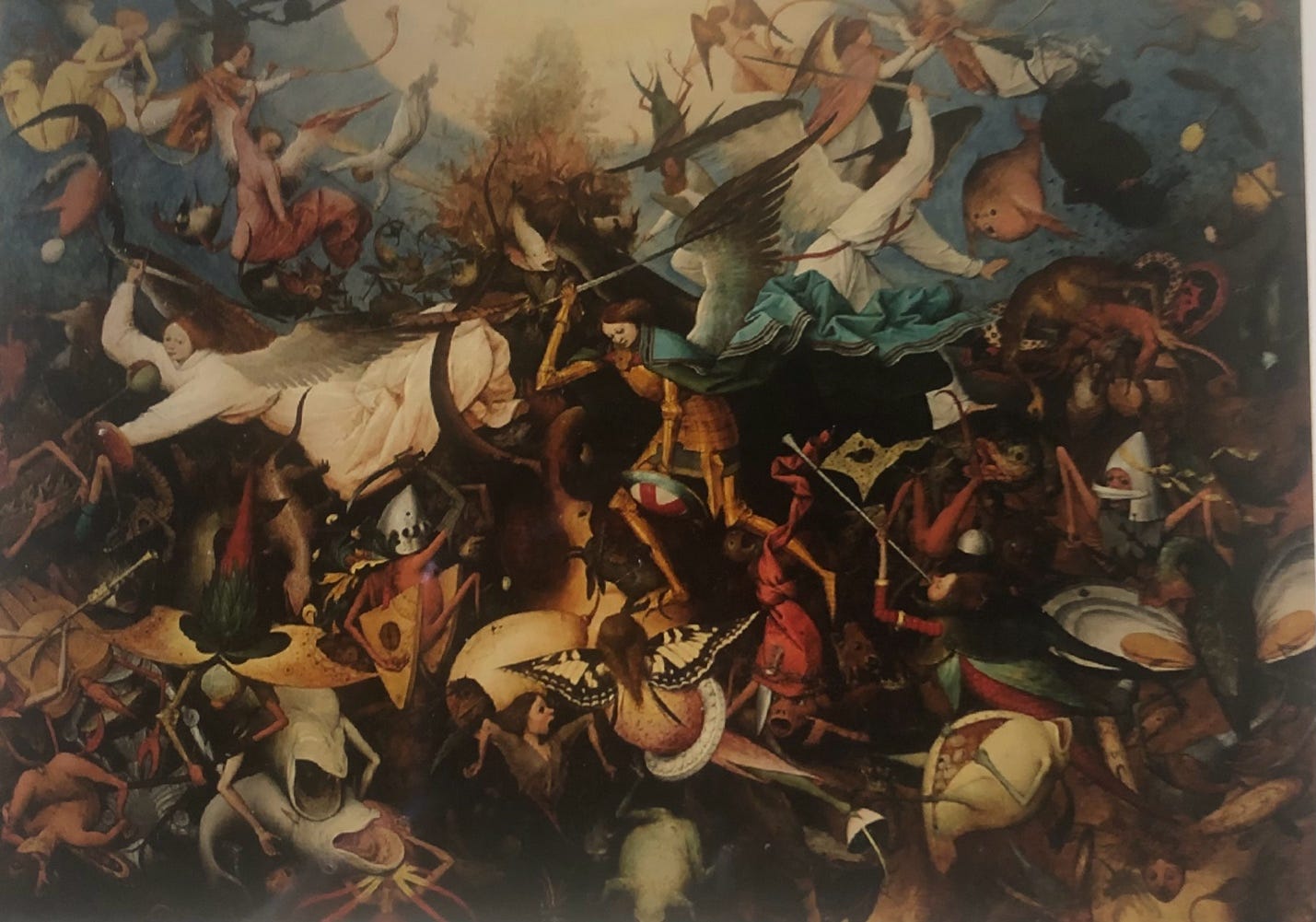
The Fall of the Rebel Angels by
1562
- Rights: Royal Museums of Fine Arts of Belgium, Brussel
 Catherine Haustein