

Saturday, I felt really draggy. The temperature hovered a little below 40 degrees and the skies were grey. I needed to do some housecleaning but current events plus not wanting to bow to my role in the patriarchy kept me unmotivated. Then it dawned on me, I needed to freshen my house air.
This idea is nothing new: open windows and sometimes doors (if your dog won’t run out) every day to release build up smells, pollution, and carbon dioxide from breathing and cooking. The concept of “house burping” is allegedly common in Germany.
Sources vary for how to burp a house. One suggested opening two windows in a room for fifteen minutes. Another suggested 30 minutes in the summer and 5-10 minutes in the winter with as many doors and windows open as you can muster. One of my grandmothers used to subscribe to the second method and would do it before bed each night. What method gives the best results? I decided to test it.
I have a two-story house with an attic and a basement. Getting up to the attic involves scaling some steep Dutch stairs so I decided to leave those windows out of the equation.
I got out my carbon dioxide meter and took some measurements in an upstairs bedroom. Indeed, the carbon dioxide levels were elevated. No wonder I was groggy. I opened two windows in the bedroom, two in other bedrooms, bathroom windows, a downstairs transom , a kitchen window, and a basement window. The carbon dioxide levels plunged immediately, leveling out after a half hour and bottoming to near outside levels after 75 minutes.
The temperature in the house dropped two degrees. Revived, I spent the time cleaning the upstairs bathroom, floors, and windowsills as I periodically checked the meter. I also put away laundry. Instead of resenting the patriarchy, I was rewarded with a sense of accomplishment—I’d picked up the house and collected data. I concluded that airing the house out for a longer period was the most helpful. Fifteen minutes gave good results, but a half hour and more cleared the air even more effectively.
Here is my data in graphic form:
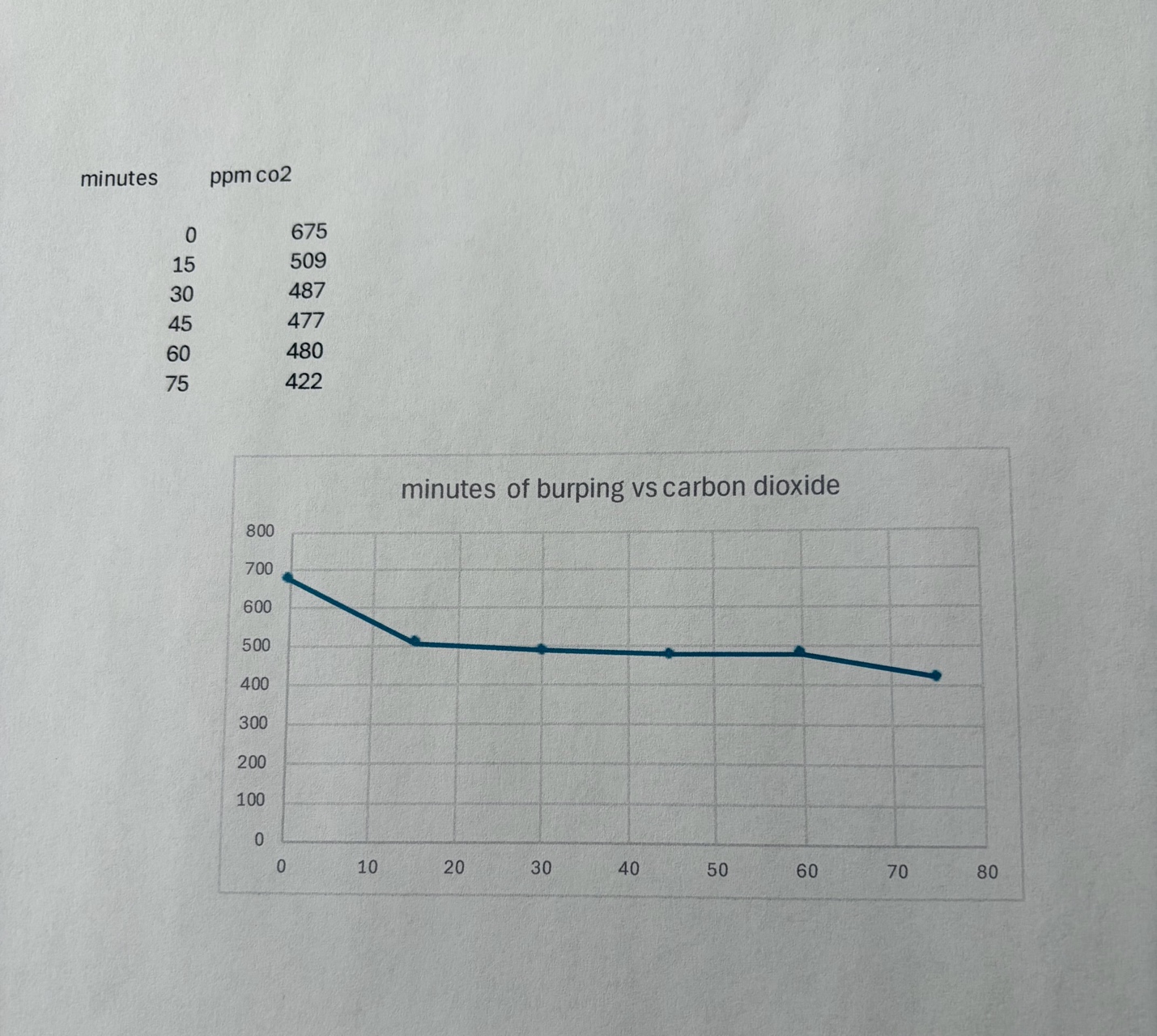
Of course, to make this a valid study, it had to be repeated. Here’s the repeat in graphic form. Results will vary depending on atmospheric conditions, but the pattern is similar.

The first fifteen minutes give the steepest drop but if you can hold out for an hour or more, you’ll get the best results. Once you hit near 400 ppm, you get diminishing returns.
How fast will the carbon dioxide return? It depends on how many breathers and fires are in the house. In my windowless poorly ventilated classroom, it takes about a half hour for 20 students to spike the carbon dioxide above 800 ppm, which is considered poor air quality. In my house, the levels remained lower even into the next day.
House burping in the winter should be more effective than in the summer. Gases move from a hot area to a colder one. Taking air out of the house into the icy surroundings is thermodynamically favorable. When the outside air isn’t colder than the inside, house burping will be less efficient. Without a fan, the carbon dioxide and other pollutants in your house will trickle out by diffusion from a high concentration to a lower. Another thing to consider, 50 years ago, the outside carbon dioxide levels were only 330 ppm. More carbon dioxide in the air means less will leave your house, although other indoor pollutants will move out. I’ve written about carbon dioxide and its effects on people and plants here.
After I burped my house, the sun came out. Birds sang. Robins hopped in the grass. A friend came over and we split a beer. I walked the dog. The drowsy feeling was long gone, even after the beer. The next day was even brighter and more filled with birdsong.
 Catherine Haustein