When I was a schoolgirl in Rockville Maryland, someone, a group of teachers I think, asked the students to decide if they wanted a new national anthem. I like new things and was enticed by the idea. We sang all sorts of patriotic songs as part of our research on the proposal. This was a DC suburb, and many kids were from military families. In the end, most of us decided that we could do better as a nation than the Star-Spangled Banner (SSB). It wasn’t fun to sing and since we’d all been irradiated by the above ground nuclear testing, the bombs bursting in air was a pointed reminder of the health effects of bombs.
Yes, a flag is a symbol and people tend to think symbolically, but to my child’s mind, it was a limited symbol. I really gravitated towards the “wilder” songs with references to the beauty of the national landscape such as God Bless America or the collective love of country as in This Land is Your Land. The idea of a new national anthem never got much traction but let it be known, I have never enjoyed singing the Star-Spangled Banner.
Corporate profits are up, way up, but have you noticed how just about everything you buy breaks right away? I’m not talking about minor purchases like that Mainstay humidifier I just put in the garbage. I’m talking about big things we rely on. For example, have your glasses been shucking out faster than usual?
The first time, my wire rims sprang apart while I was on vacation. Thank you to the man in Detroit who fixed them for free. I moved on the plastic frames, but it wasn’t long until I thought I was losing my eyesight. Everything was blurry. I couldn’t even read. I’d been wearing glasses for most of my life. I was used to them. Initially, I had no idea it wasn’t my eyes. It was my glasses. They were crisscrossed with tiny scratches, even though I’d bought scratch coating.
The second time, two years later, I was driving 100 miles. I had a hard time focusing on the road. I thought I was getting a brain tumor or something. I’d gotten the extra coating of scratch prevention and anti-reflection coating. But the glare and reflection were terrible. I could even drive a little bit better if I put my glasses on my head. When I got to my destination, I looked at my glasses. There were scratched along the center like my previous pair. There was also some kind of weird cloud forming at the top as if sweat dripped down on them over the hot summer. I took them to the eye doctor as soon as I got back from my trip. Ironically, someone else was there with the very same problem. The clerk told us both how we should be cleaning our glasses.
The glasses clerk confessed that those coatings that you put on your glasses to protect them are only guaranteed for a year and then they start breaking down. It wasn’t my error that had caused the scratch coating and the anti-reflective coating to create some kind of a weird maze resembling corn borers through a row crop.
Glasses aren’t my only problem. I have a new refrigerator, a Bosch, a medium-expensive brand, and already the handle has gotten a crack. It looks like some kind of plastic fatigue.
But the Bosch company says it’s cosmetic and not covered by the yearlong warranty, so I can’t get it replaced for free. Should I have just bought a really cheap refrigerator? This one was not at the bottom of the line or anything and although it has many aspects I like, it’s still breaking.
Let me show you the front panel of my dishwasher.
A piece of plastic broke off. This dishwasher is a KitchenAid, so not the cheapest brand. It’s 3 1/2 years old. That’s all. According to the place that sold me the dishwasher, to replace the plastic would cost $300 plus labor. I think that seems high for a slab of plastic. I contacted KitchenAid and the help-line people were nice but even after talking to them, I can’t figure out what the part number for it is. For now, let’s hope the super glue we used holds. And curses to the plastic manufacturer. Maybe it was outsourced like the door plug on the Boeing.
On a happy note, my Kohler kitchen faucet started corroding after ten years. It had a lifetime warranty.
My plumber got to work and helped me arrange a replacement faucet. I couldn’t get the exact same one but I did get a new faucet, arriving earlier than promised.
In recent years, the US Consumer Protection Bureau has been weakened. (We don’t have to even guess who did this. We know, don’t we?) Things are made cheaply now. One way to fight back is to learn to fix your own stuff. My vacuum cleaner, a Dyson, is pretty easy to fix. A hose attachment got a hole in it and the replacement was $5. I even got some help installing it.
The Iowa caucuses will take place this Monday, January 15. A caucus is a party meeting and both the Democrats and the Republicans will meet separately to discuss who should run for president and what their party goals and beliefs should be.
In case you haven’t followed the Republican caucuses here, candidates have been crisscrossing the state trying to prove which one is the biggest, toughest bully. Ever since Joni Ernest won a Senate seat with an ad about castrating pigs and shooting Obamacare, Iowa has been racing towards the bottom of the valley of incivility. We have an attorney general who never tried a case, so understandably needs an extra million dollars to run her office. But she wanted to give Biden the Bird and this mean message won over the hearts of Iowans.
In a local election, the library was disparaged to the extent that some highly sheltered people became afraid to go there. The worry? They were lead to believe porn was sitting out in the childrens’ section. When a library crack-down referendum lost in a local election, the head of the group pushing for the oversight called those who didn’t support her views porn loving Marxists for government spending. And on matters of book censorship, my own state senator implied I was a pervert when I pointed out that for books, context was important.
Our governor ignored the urging of medical professionals on several issues numerous times, yet took the advice of Moms for Liberty, even posing with them. It really doesn’t matter if people in these groups have kinky sex or shoplift. There’s money to be made from endorsements after all.
What happened to Iowa? I’d credit money pouring into misinformation. Take a look at the local county website. It’s filled with conspiracy theories and misinformation. Their antics have been reported, yet people still vote for them. It’s no secret that money has fueled their opinions and packed the Supreme Court. Iowans are no match for the conservative media sites popping up, many of which inflame stories and harass people they disagree with. Studies have shown that conservative people are more susceptible to misinformation, more likely to repeat it, and that conservative news sites spread more misinformation.
The Democrats are having a caucus but not voting for the presidential candidate. The vote will be done through a mail in ballot. According to the Marion County Democrats:
On November 1, 2023, the window opened for Iowa Democrats to request their Presidential Preference Cards for the 2024 Iowa Caucuses. The IDP Disability Caucus was instrumental in this process. This is a major change in our Caucus; however, it’s definitely more inclusive and something that many will appreciate this year with the extreme weather that we’re experiencing. It enables participation by those who are sick, don’t drive at night, work evening shifts, stuck at home due to nasty weather, babysitting or elderly sitting and the list can go on and on.
If you’ve not requested your Presidential Preference Card, please note that February 19th is the last day to make your request. The on-line process is the easiest and quickest way to ensure your request is received in a timely manner. The online submission form meets accessibility needs and does provide an option for Spanish translation. If there are questions regarding the online process, they’ve created a helpline to call (515-216-3893) and if necessary, leave a message and they’ll call you back as soon as possible.
Another option to request a Presidential Preference Card, is to print & complete the attached IDP Request Form.pdf and mail it to the address on the form.
The bold is my addition. I always liked the caucus and the discussion with neighbors. However, I find the “discuss now, vote later” approach more appealing than I thought I might. It’s true that it’s more inclusive. Additionally, COVID is on the rise again, and although Iowan’s don’t like to admit having it, wastewater don’t lie and our level right now is “very high.” Not everyone can afford to be exposed.
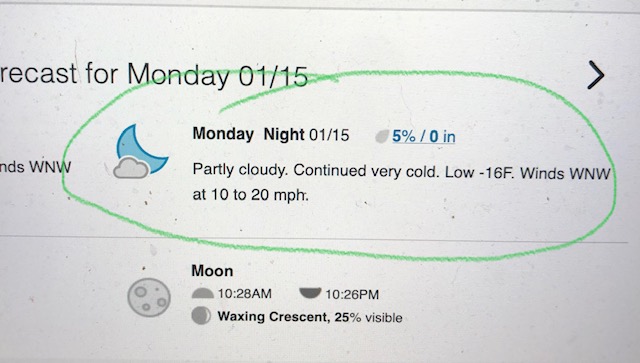
If that’s not enough to show that an in-person vote isn’t inclusive, get a look at the weather forecast!
It’s not just cold.
It’s windy!
It’s too bad the weather won’t allow more people to attend because one useful thing that will happen is to discuss the party platform.
In an under the radar announcement, the EPA has decided to rebuild the endocrine disruptor screening program. I’m pretty happy about this. It’s an example of the kind of protection I expect from the government.
Endocrine systems, aka hormone systems, are found in all mammals, birds, fish, and many other animals. Hormones are chemical messengers and they regulate many biological processes.
Many modern synthetic chemicals can act as hormones or interfere with their workings. Chemists have blessed us with over 85,000 synthetic chemicals. About 1000 of these are thought to be endocrine disruptors. These chemicals range in use from plasticizers to explosives. The EPA is the agency charged with testing and regulating these chemicals. Testing requirements began in 1998. The idea was to make sure people and animals weren’t being exposed to disruptors. It stalled out and then stopped altogether in 2015. The program is one of those that doesn’t get funded, depending who is in charge of the government. In particular, the EPA staff received little to no support and direction from the Trump Administration.
Why would the average person care at all about endocrine disruption?
Here are a few reasons:
Endocrine disruptors, or EDs, can harm the thyroid. These chemicals can exhaust the thyroid, resulting in conditions such as obesity, heart problems, and insulin resistance. In fact, this harm can begin when a person is a small fetus– your mother’s exposure might give you obesity and fertility problems.
Endocrine disruptors harm testicles, decreasing sperm function and testicular health. Being exposed to disruptors before birth can cause a short testicle to anus distance which is often associated with male infertility. They can also create hypospadias, in which the opening to the penis isn’t at the tip.
Other problems which can result are cancer, including childhood, thyroid, breast, and prostate cancers along with decreased immune function, including a lowered response to vaccines.
The newly announced study focuses on endocrine disruptors found in pesticides. Since the year 2000, data from across the globe has been collected on people living in and near agricultural areas and those employed in agriculture and gardening. These populations experience high rates of birth defects, especially genital defects, along with higher rates of hormone dependent cancers, and poor semen quality. Most prior studies have been epidemiological, meaning they look at overall health of populations.
Although people living and working on and near farms bear a lot of pesticide exposure, people can get exposure from foods and manufacturing sites as well. The chemicals can get into air and water and travel long distances. Besides humans, wild animals are affected by endocrine disruptors. And epidemiological studies take years to complete which is why the new study is needed. (Information comes from this source.)
The new study will systematically look at the pesticide chemicals themselves and screen them for endocrine disrupting properties.
Thirty pesticides will get added scrutiny in this project. The EPA has 403 pesticides to review in total and of this, 86 have enough data to be shown as not concerning. Additionally, 161 look to be safe from endocrine disrupting properties. This study will by no means forbid pesticide usage—it aims to do what the companies did not and test for safety of chemicals widely distributed in our environment.
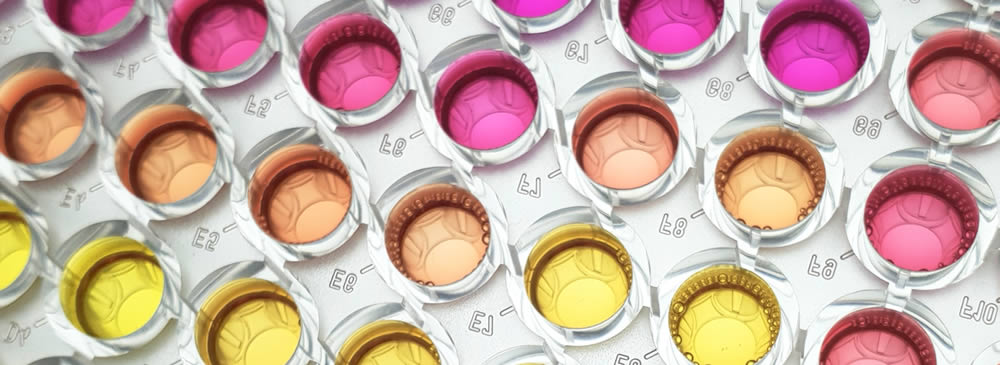
The screening tests mix cells with the possible endocrine disruptors and look for reactions between them. Often times, the chemicals being tested will fluoresce or change color when they interact. This new study will help look at pesticides and their by-products in an efficient way. Getting politicians to care enough to protect us will be a whole different challenge. Thankfully, the Biden administration has begun the process.
In order to keep us safe from synthetic chemicals, we need studies of their safety and most often the government, must do these studies. A color changing or fluorescence screening is an efficient way to look for Eds.
German monks developed an easy to ship powdered beer. It’s environmentally friendly but at least for now, non-alcoholic.
2. You get a pesky itch but your skin looks perfectly normal. Why? Bacteria overgrowth may cause itching. A new study discovered Staphylococcus aureus can activate itch enzymes without causing inflammation.
3. On a more serious note, a Sickle cell treatment has FDA approval. The Sickle Cell mutation affects hemoglobin and the blood’s ability to carry blood. It’s a painful, debilitating condition that shows up in adulthood. The new therapy is a gene editing technique and reverts red blood cells to their adolescent form. There is a catch for females. The treatment destroys egg cells and causes infertility.
When I was a shiny new scientist, I worked for a company. It was my dream job, or so I thought. It was a place where scientists were proud to work. But a new company leader wanted something different. He wanted to be able to say he did something new. Projects that could have made plenty of money were cut, research was halted, people were laid off, and incentives were offered for resigning. The older scientists weren’t ready to retire. They had kids in college and getting married. They weren’t 65 and couldn’t go on Medicare. They needed a job. I applied to resign but was turned down. I was too young. They only wanted to get rid of the older people. I saw my future there. It wasn’t secure. I had no real research project and nothing to focus on. I did have a new baby. What nightmare! I left to be a professor, a job that offered tenure, which I got. The company never was as innovative as it had been. Ironically, a person responsible for the short-sighted cuts in new products went on to be an “expert” in “education reform.’“
The US has so many small, private colleges in part because they were seen as a way to make your town in the middle of nowhere seem smart and cultural. Many of these small schools catered to the middle class and their students, being not too rigorous and having plenty of sports and things like fraternities. Those who found education to their liking and wanted more challenge could always go on the graduate school. Believe it or not, this proved very successful to the United States. Colleges were expanded and well-funded in 1958 as part of National Defense following the launch of Sputnik. (That link leads to a great essay on the dismantling of higher education funding and the motivation behind it.) The United States was on a roll. Even students who only wanted to go to college for sports and “mating opportunities'” were nurtured and went on to help make the U.S. an intellectual powerhouse. It was patriotic to be smart, informed, and a college supporter. You didn’t have to have a college education to be these things. You could attend college events.
This autonomy, driven by the professors, resulted in world class research. The US has more Nobel prizes than any other country and is home to over half of the world’s top educational institutions.
Tenure gives the professors the autonomy they need to be both secure and creative. It helped grow the college and university system. It remains a benefit to attract and retain the best faculty. It creates people with a vested interest in their college and the quality of the education it offers. In general, good students become professors and the notion that they would “slack off” because of tenure shows a lack of understanding of teaching and of being a motivated learner.
Tenure creates stability, even in unstable times. Tenure is a benefit and with the benefit, comes cost savings for the college. Nearly every tenure track job pays less than what the person would earn in a non-academic job. I personally took half the salary of my industry job to seek a tenure stable life where I could do my research without having a higher up decide I needed to move on to something new. Being able to follow my own curiosity and that of my students was part of my “pay.”
A perk of tenure is being able to see a research or creative project through.
Freedom to do my own research and have the stability of tenure came with a move to higher education.
“I have come to believe that a great teacher is a great artist … Teaching might even be the greatest of the arts since the medium is the human mind and spirit.” —John Steinbeck
For a post with more photos, click the link above.
A while back I got a question about soap. Specifically, what kind is best in hard water so as not to leave a scum? A quick reading said glycerin soap, but it seemed easy enough to test. I set up my own experiment with regular soap, glycerin soap, vegetable soap with goat milk, and body wash. I placed a half tablespoon of each into separate glasses and then added ¼ cup of mineral water to each. The mineral water contained 345 ppm calcium and 100 ppm magnesium. This gave a total hardness of 445 ppm, considered very hard. Minerals in water react with soaps to form scum.
The pH of the water was 8.4 which is alkaline.
Ten minutes in: differences are noticeable.
To make soap you need to mix fat and an alkali, usually lye.
Different types of soaps may have different fats in the kettle so to speak. In the case of my experiment, the “regular soap” was made from a combination of tallow, palm oils and many other things including glycerin, which is a by-product of soap making.
The goat milk soap was made from olive oil, castor oil coconut, and palm oils in goat milk. Castile soap may also be made from olive oil but isn’t always 100% olive oil. Check the label.
Glycerin soap has glycerol for its fat. Glycerol is a smaller molecule than the other fats and is related to “triglycerides.”
Here’s a list of fats used in soap making for those interested.
Body wash works the same as soap but it isn’t made from fat and lye. It’s derived from oil, palm or coconut usually, and is chemically modified. Since it is sold as a liquid, body wash can have added moisturizers and be pH adjusted. However, bar soap is more compact and has less plastic waste. There really is no best product.You need to use what works for you. If what works for you is the one that leaves the least scum, read on!
I let the soaps sit for five hours.
I filtered each glass. I was going to compare the amount of soap retrieved from each glass but the glycerin soap had fully dissolved. I let the glasses dry for three hours and then took a photo of each.
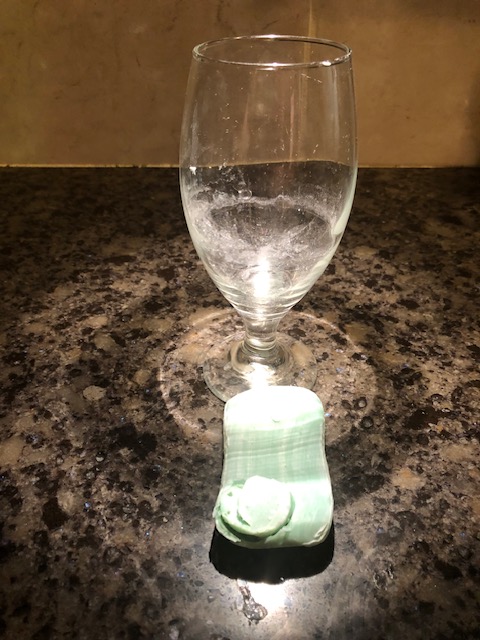
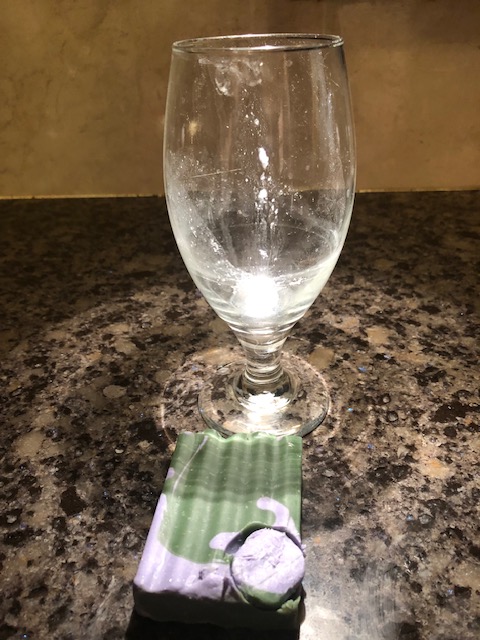
Here is the regular, conventional soap (Irish Spring) with the remaining soap returned to its divot. You can see the familiar soap scum ring.
Here is the glycerin bar. It has a filmy layer of deposit.
Next is the goat milk Zum Bar (above). The plant-based soap left a deposit.
The body wash left a sludge.
My next step was to clean each glass. Getting rid of soap scum means making it soluble. I added a ¼ cup of water to each glass, swirled it around, and let it sit for the length of a shower, 10 minutes. The water had a pH of 8 and a hardness of 100 (low). I tested the pH of the water and scum. Only the body wash had an acidic pH of 6.8. Your skin likes the pH to be around 5.5 and no higher than 8, which means the body wash has a slight win on this one. The glycerin soap had a pH of 7.4 (7 is neutral) and the other two soaps had a pH of 8.
I let each glass dry.
Here they are (below) in my sunny window. The traditional soaps still have their soap scum with the Irish Spring “regular” soap having the most visible ring. The body wash still looks very slimy.
Next, I added a half of a cup of vinegar to each glass and let it sit for ten minutes. Following this, I rinsed with water and gave each a perfunctory scrub with a brush, trying to clean the crusty spots but not going overboard, because who wants to spend countless minutes scrubbing soap scum? The conventional soap and glycerin soap seemed easiest to clean. Here are the results:
For the last test, I squirted each glass with bathroom cleaner which said it removed 100% of soap scum. Each glass got two squirts and sat for ten minutes. The body wash obliterated the scrubbing bubbles.
Next, I added a half cup of water and let it sit for ten minutes. After that, I scrubbed the glasses and rinsed them. Here are the results, with a little bit of glass sparkle tossed in.
The “regular soap” still had some residue.
The glycerin soap had a little scum near the top but much of the glass was sparkling clean.
The goat milk soap had some scum.
The body wash had some residue.
For the last step, I rinsed all glasses in the dishwasher (without soap but with a rinse aid) for 20 minutes.
They all came out looking clean.
If I study the photos, I’d have to agree that the glycerin soap left the least scum and the conventional soaps the most. However, soap scum is inevitable. My advice would be to keep your bar soap as dry as you can between usage because it will dissolve, especially glycerin, and as it dissolves, scum will form.
This experiment wasn’t quantitative enough to make me fully happy with it. I’d considered weighing the glasses before and after scumming them, but I don’t think the conventional kitchen scales would have caught the differences. Plus, glass can attract water from the air so I would have had to dry them in the oven before and after to get a proper weight. If I had a lab, I’d do this. Or if you have a lab, you can try it.
For those still curious about soap scum and soap, keeping reading.
Remember the old chemist adage, like dissolves like? A soap molecule can go both ways. It has a long greasy tail and a charged head. Think of it as organic and inorganic combined. The head helps the molecule dissolve in water and the tail lifts away the grease and grime from your skin. (illustration here). But here lies the scum problem.
Soap scum was discussed in a long scholarly article.
Itsadanont, Sawwalak, et al. “Dissolution of Soap Scum by Surfactant Part I: Effects of Chelant and Type of Soap Scum.”Journal of Surfactants and Detergents, vol. 17, no. 5, 2014, pp. 849-857
It forms when the calcium and magnesium in the water—the minerals that make the water hard–make a complex with the soap’s charged head. They are charged, they are ions, and they hook up with the charged head of the soap molecule and make it less attracted to the water because the head now has them to hang with. The attraction is undeniable!
This can be prevented by water softening, which removes calcium and magnesium ions and replaces them with sodium ions. Sodium ions don’t hang on so tightly. They like to stay in the water. They won’t make insoluble scum. But soft water is high sodium and low mineral. You really don’t want to be drinking high sodium-low mineral water, so a softner for just the shower would be the key to using this tactic.
Soap scum can be cleaned with vinegar or other pH lowering product, with a surfactant (a cleaning agent), or with a chelating agent. Chelating agents work by stealing away the calcium and magnesium from the scum. However, they only work well at a high pH and this isn’t useful for household products.
In the 90s there was a flurry of products released to keep soap scum from forming and sticking to showers and tubs. They didn’t work great, the interest died down ,and nothing new seems to be forthcoming. I did learn that ants will eat soap scum!
Machosky, Michael. “Keep tiny pests from becoming space invaders.” Tribune – Review / Pittsburgh Tribune – Review, Jun 10, 2006.
If I was being a prudent scientist, I’d repeat the experiment. But this scummy tale is getting long enough! Perhaps everyone reading can try a similar experiment and report back.
This blog was in response to a reader’s question about soap scum and hard water. Thanks for asking!
The old chemist adage goes like this, “Store organics in glass and inorganics in plastic.” Will following this advice make you more healthy? Perhaps, because it applies to your food and drinks.
Organics are materials with carbon bonds and this category would include nearly all foods and other consumables. You may have heard the phrase opposites attract but when it comes to organic chemicals, chemists say “like dissolves like.”
Therefore, most foods really should be stored in glass. Glass will have less interaction with food and beverages. What kind of interactions are we talking about? Here’s an example of what happened when a student put the vitamin riboflavin into plastic flasks. Riboflavin, Vitamin B2, has an orange color that tells the tale. You can see it was highly attracted to the plastic. Plastic used incorrectly can mess up science experiments.
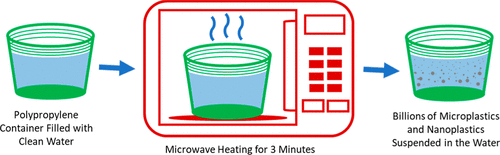
But what about the other scenario? Will plastic stick to things stored in it? Scientists have been on the job, answering this question.
Setting a plastic bottle in the sun and then drinking from it is a recipe for a high source of microplastics. Unfortunately, even foods considered healthy such as seafoods are high plastic level foods as the ocean is utterly contaminated with plastic.
The big question is, “So what? Are these particles causing any health problems?”
Studies indicate, yes. For one thing, they alter the digestive systems of animals across the globe. Seabirds for example, when exposed to plastic laden foods, had fewer commensal bacteria, which help the birds digest their food and recover the nutrients in the food. Even worse, the birds had more harmful bacteria in their digestive tracts when they had eaten microplastics.
Here’s the question: what am I, a chemist, going to do about it? Staring at the bare minimum, I’m going to:
Think small when it comes to foods that are used repeatedly and stored in plastic such as condiments. It’s a well-known chemist rule to get the smallest bottle of a chemical you can reasonably use up and not the jumbo economy size. A big bottle sitting on a shelf or in the refrigerator can easily collect contaminants.
Stick with stainless water and food bowls for my dog. As an aside, on my last post, people responded with comments about washing a pet bowl to keep pink slime away. Bacteria love plastic. Another reason to avoid it for food storage and serving.
Use metal and/or glass for making my coffee and no plastic cups. No Styrofoam! Paper is much safer for to go cups, as long as it doesn’t include a plastic lining.
Avoid high fat foods and milk products stored in plastic. Maybe I’ll go back to making my own yogurt.
Retire my bedside plastic water glass.
Synthetic plastics have been around since 1907. The first plastic bottle was used in 1973. There’s a lot that can be said for their affordability and flexibility. When it comes to food storage and preparations, other options are better.
This post is a response to a question asked by a reader. Thanks for asking!
You might have read the news. People are obsessed with the Roman Empire. Last year when I taught a course in short story writing, I noticed student fixation on gods, goddesses, and gladiators. To be part of the trend, I wrote a novel in which there are demigods and goddesses , minor deities based on those worshiped in the Roman Empire. Why did I include elements of modern day paganism in a novel set in the recent past simmering in the United States? My main character was a gorgon! For those unfamiliar with gorgons, the first one, Medusa was originally a beautiful priestess to Athena (aka Minerva to the Romans.) Medusa was seduced, probably raped, by Poseidon (aka Neptune to the Romans) at the temple of Athena, creating a sacrilege. Athena, of course, blamed the woman and turned Medusa into a monster, a gorgon with snakes for hair and a gaze which turned others to stone.
If this is all Greek to you, and you’re wondering how it relates to the Roman Empire, the ancient Romans copied almost everything about their polytheist religion from the Greeks. Likewise, I copied the Roman/Greek myth of Medusa my book Snakes in the Class, adding my own twists of course. I also left out the rape because I don’t find rape entertaining. I took great liberties. I didn’t stick with the legend. The protagonist is is NOT Medusa. Medusa’s legend is what provoked me. The unfairness of the whole curse! Women have been blamed for things men do to them since antiquity. It’s time for gorgons to have their due and to get their revenge.
Have you ever related to Medusa? Being a female scientist in the 1980s, I did feel gorganish and on the outs from society. But I didn’t want to live In the world as it was–a world somewhat similar to the Roman Empire. Why do I say that?
The Colosseum, pictured below, was built by slave labor.
The rich paid little in the way of taxes. The ruling class took over public lands, including public farmlands, and divided them up amongst the upper class. The upended farmers moved to the cities to become the proletariat, the working class, or they remained on the land, working on farms and in mines which were no longer theirs. The environment was ignored. And once the rich took over the land, the voting block was shifted to the rural population through what we might call gerrymandering today.
The wealthy controlled the Senate and influenced the laws and judges. The poor and lowly were portrayed as having only themselves to blame for their poverty. Senate and government proceedings became private and secretive. There’s more of course, enough to fill books. Let’s leave it with this Mel Brooks clip from the history of the world.
As for women, their role in Roman society has largely been ignored by historians. Most were married off young (median age 12) and kept under the rule of their husbands. It’s notable that rich husbands and wives were afforded some permitted promiscuity. At the time of her curse, Medusa was held to a higher standard, as was expected for a priestess or a vestal virgin. Women had a choice: baby machine or virgin. Virginity is the price women paid for independence for much of recorded history. But that’s whole different tale.
If you hear anyone calling the US a Republic, know what it means. It means a place not for everyone. Who are the modern day Medusas? My list would include feminists, single women with cats, aging celebrities and older women in general, men without beards, drag queens, scientists, learned people, public schools, heck, anything public. We proletariats are always being lobbied about what to consider cursed and terrifying.
I’m not sure how all of this seriousness sprung like Pegasus from a post about the Roman Empire. I’d apologize but I didn’t create this Medusa-punishing-world. I only want to talk about it.















 Catherine Haustein