HPV —human papillomavirus—has been around a long time. Modern humans possibly even gave it to the Neanderthals. HPV is a category of viruses, some of which cause genital and throat cancers. It’s responsible for most cervical, mouth, and throat cancers. It spreads most easily through sexual contact but can theoretically be spread simply by contact with surfaces. Around 80% of sexually active humans will carry a form of HPV at some point in their lives.
Not all forms of HPV cause cancer, although they do cause warts. Some humans, especially younger people, will clear the virus on their own. Many HPV infections cause no symptoms at all. Sometimes cancer is the first and only symptom. Vaccines for HPV have been available since 2006. They prevent infection from the more deadly, cancer promoting forms of HPV.
Scientists recently discovered that Otzi, Europe’s most famous mummy, carried a deadly form of HPV, HPV 16. Otzi, also known as the Iceman, is 5000 years old, and was discovered frozen in the alps in 1991.
I’m interested in Otzi because a DNA test revealed that he and I had the same mitochondrial DNA. Mitochondrial DNA is inherited from the mother in nearly all animals. Thus, at one point, Otzi and I were related. Otzi and I also, allegedly, have the same mitochondrial DNA as Mary Magdalene.
Friends of Big Rock Park here in Pella Iowa held their first event of the season–a walk lead by ecologist Dr. Paul Weihe. We learned to identify and appreciate trees without leaves. Several of the walkers were new to Iowa and wanted to learn what trees are native to our state.
Iowa’s most common type of timber are oak-hickory forests.
Oaks are slow growing but strong with “ski slope” bark, sometimes taking on different colors.This red oak tree, shown below, with bark shading of white, black, green, and red is older than Pella!
Oaks hang onto their leaves longer than many other deciduous trees, keeping them well into winter. It’s thought that this might serve as a buffer against winter winds and also help the trees warm up when spring comes. I’ve long felt slight resentment for my oak trees when they drop leaves onto the snow which makes them inconvenient for raking. Now, I’ll understand them better.
One identifying feature of an oak is the starburst pattern within the branch.
This star pattern translates into waves when oak is used for building.
Oaks are hardy and even a half dead one will provide plenty of habitat for forest creatures.
The Shagbark Hickory is hard to miss with its bark looking like a league of wild cats attacked a favorite couch.
This poor shagbark, below, was killed during the growing season and unable to undergo seasonal abscission and shed its leaves.
The distinctive ridged bark of the hackberry:
Large, in charge and near water. It must be an Eastern Cottonwood! These are fast growing with weak branches that drop a lot of wood. They aren’t good yard trees. My mom always claimed she was allergic to their fluff—which is their seeds—and I guess she wasn’t alone. Other people say the same. In the wild, the trees have plenty of uses to foragers including as arthritis wraps.
The characteristic burst of thorns is found in a Honey Locust.
Shaggy bark and a leak of sap help identify this as a black cherry. These trees grow small cherries with pits and aren’t generally used by humans, but many wild critters including birds and butterflies love them.
It’s even possible to identify a tree from just a stick. Look for leaf scars and check if they are opposite each other or alternated. A big bud such as shown below means a big flower is wintering in there. If it’s wrapped in a fuzzy coat, it’s a magnolia.
For New Year’s Eve, I watched Wicked with family. It was good, especially in the coziness of a family living room with loved ones and snuggly pets. Some parts left me on the edge of my seat. The scene where the professor was hauled away was a little too believable. It’s happened before and it can happen again. Anti-intellectualism is a tool of dictators and we’ve see it crop up in the US, as shown in the historical movie Oppenheimer.
The story of Jay Robert Oppenheimer is well known to scientists my age. Many people have mused about why the movie Oppenheimer didn’t show the destruction of the bomb. Clearly a terrible weapon was created but the film is about the people and what came after in the US.
The movie did a good job of showing the motivation of the scientists. Germany had discovered fission, the atom smashing power of the bomb. How was fission, the splitting of the atomic nucleus discovered? At the time, uranium was the heaviest naturally occurring element. German scientists at Otto Hahn, Fritz Strassman, and Lisa Meitner were trying to make a heavier element by knocking heavyweight uraniumwith a neutral particle—a neutron–to make it heavier. There were probing the secrets of the inside of an atom. When hit with a nucleus, the uranium didn’t get bigger. It broke into bits and released a lot of energy. (Read more here)
An aside here. Most atomic action occurs on the outside of the atom, the electron cloud. Electrons move around to create bonds and break bonds, and that’s most of what happens in a chemistry lab. It causes rust and powers our cells. But with nuclear reactions, we deal with the inside of the atom, and the inside of the atom is held together with the tremendous force. Einstein’s famous equation E equals MC squared dictates the immense force that’s holding the inside of an atom together. And all of this was being studied at the time of World War 2.
Hitler was a bad guy and a lot of the scientists in Germany were Jewish. They either fled to another country in Europe, as Lisa Meitner did, or they, emigrated to the US. They came with a lot of understanding and people were scared. I can kind of understand working on a horrible weapon. And as the movie Oppenheimer points out, scientists were not 100% sure how destructive this might be or how the US government would use it.
There was tremendous fallout from the bomb, pun intended. And. It created a lot of sickness. A lot of doubt. The movie doesn’t really cover that. It starts and ends with Oppenheimer being grilled by dim bulb senators. Why? He did everything his country asked of him and he did it well. However, he dared to go to a couple communist meetings. His brother was for a while a communist and he’d had a communist girlfriend. Clearly, that didn’t stop him from helping his country. It didn’t stop him from stepping up and using his genius to create this deadly weapon for his country. If you watched carefully the Senators are the villains. The Conservative senators are the villains. They use science. And scientists. And then? They dismissed them. Like any narcissist would do.
I’ve written before about hate mail I’ve personally gotten as a scientist in Pella, Iowa. You can never be conservative enough for conservatives unless you 100% agree with them. You can be their friends. You can build a weapon for them, but they’ll turn on you because these are all or nothing people. As a scientist, I once felt obligated to point out inconsistencies in public policy to elected officials. And I’ve gotten some pretty mean comments and letters from more than one of them. I’ve given up thinking that they write these crazy bills and say these crazy things because their staff hasn’t informed them enough. These are all or nothing people. They don’t tolerate any opposition to their values without totally smearing the people who are questioning them.
Science, on the other hand moves forward when scientists put ego aside and admit some uncertainty and ignorance as they argue about evidence gathered according to the sanctioned best practices of the time. Moving forward needs some questioning the reigning values and building on them.
Many US scientists worked on the bomb. You know who didn’t? Lisa Meitner, the person who first recognized the fission reaction, who’d fled to England. And here’s another thing to think about: Germany wasn’t close to developing an atomic bomb. A lot of their scientists had left the country. (That’s what you get when you don’t appreciate intelligence and diversity.) They couldn’t enrich uranium. The scientists thought such a weapon would be a bad look for Germany. And Hitler was basically too dumb to appreciate the science. Naziism was anti-intellectual and experienced a brain drain.
(Kind of like Iowa is seeing.) The German scientists saw the destructive power and restrained themselves. It should be pointed out that Nazi doctors did nothing of the sort.
Scientists are curiosity driven and they like to have a project. They are somewhat mission oriented in their research. Fundamental questions really fascinate them. Messing with the inside of an atom when the outside had been what was studied was like catnip to scientists. This is a criticism of scientists—they look at their accomplishments with rose-colored glasses. This means we as citizens need to elect thoughtful leaders, too. Leaders can make bad science decisions. Leaders influence the morality of a society. As this article points out, it’s not the scientists who shape the ethics of a nation, it’s the leaders. History (and fiction) shows that having a mad-man for a leader will give scientists (and sorceresses) pause, or, as in Wicked, will drive away your best talent. They might even take a few of your secrets with them. And that is a ray of sunshine.
My first novel is out of print but my second novel is on sale at Kobo. Like most of my fiction, it satirizes the ethical problems scientists face as they search for romance and try to understand society.
What makes a kid like science? It isn’t information or government edict, advanced courses, or religion. Yes, a promise of a good job helps kids like me who grew up middle class. but it can’t be all it is, because there are times when science is routine, boring, and demands repetition, because some of the joy of science is being able to predict.
One of my favorite exercises in high school was the bug collection, which had been done for eons. I’m not sure it’s done anymore but I remember just being so fascinated with catching the bugs and classifying them. I needed to add a twist so future chemist me had this thought that instead of sticking the bugs on pins and putting the pins on a piece of Styrofoam or cardboard, I incased them in plastic. Each bug was set in transparent resin. Giving them a category and finding their scientific name was a whole new language, and an interesting one at that. I remember one kid getting in trouble for turning in an old collection, one his brother had done. The evidence? He had a cicada in his collection that didn’t emerge in the year we were supposed to be catching our bugs. Science triumphed. Why would you ever want to cheat in science?
What’s missing in the STEM education discussion these days is curiosity, and the sense of wonder about and the respect for the whole vast natural world as compared to the engineered world of humans. In fact, respect for scientists themselves is missing from our political landscape in Iowa.
I was just about to put this old book in the Little Free Library near the park. I paused because I wanted to read it one more time. I don’t think enough people understand what it takes to really, really be a scientist and to persist in it. I thought I might, for a post, just go through a few of the entries in that old book and see what scientists had to say about what brought them to science.
The scientists interviewed pointed to a few factors which helped them along the way—financial assistance and autonomy of thought. Neither of these things will the average kid get from a right-wing authoritarian. What are we getting from our state education department?
In the science homework that I’m seeing in the schools, there’s a whole lot about evidence. What’s the answer? How do you know? And that’s fine. Science is evidence based. But there’s a whole swath of it that’s missing.
Likewise, long ago the now Iowa Governor came to visit my private school science department to tell us how much she likes science and private schools. I am seeing through a glass dimly here but I didn’t like her because she didn’t get science and was not there to listen to what we had to say.
Now, she acts as if she’s done miracles with STEM education. She might even be the next Secretary of Education, all while ignoring doctors and scientists. In other words, she ignores the informed opinions that scientists with autonomy of thought have given her. This is not anything to model if you want to promote science. She is a Trump supporter and Trump said that listening to scientists is something “only a fool would do.” Instead, you have to listen to the money.
Few people on the Iowa STEM council are working scientists, especially sparse are the natural sciences and basic sciences such as chemistry and biology. I’ve seen some of the curriculum and it has a heavy emphasis on design and engineering. And of course, there are corporate partners and a focus on jobs. It should be called a sTEM Council with a lower-case s. Current science focuses on methodology which many older scientists point out, can be boring. And I really, truly worry about a future where the only people paying for science are people that are making money from it. In the past, the government and universities have been drivers in basic science, the foundation of scientific discovery.
Instead, politicians publicly bash scientists. This in turn causes a public distrust, especially among Republican voters. It’s unlikely that Iowa’s Republicans will look at the evidence. They will instead, create a science-hostile climate for the foreseeable future, making a mockery of STEM education.
For a post with more photos, click the link above.
A while back I got a question about soap. Specifically, what kind is best in hard water so as not to leave a scum? A quick reading said glycerin soap, but it seemed easy enough to test. I set up my own experiment with regular soap, glycerin soap, vegetable soap with goat milk, and body wash. I placed a half tablespoon of each into separate glasses and then added ¼ cup of mineral water to each. The mineral water contained 345 ppm calcium and 100 ppm magnesium. This gave a total hardness of 445 ppm, considered very hard. Minerals in water react with soaps to form scum.
The pH of the water was 8.4 which is alkaline.
Ten minutes in: differences are noticeable.
To make soap you need to mix fat and an alkali, usually lye.
Different types of soaps may have different fats in the kettle so to speak. In the case of my experiment, the “regular soap” was made from a combination of tallow, palm oils and many other things including glycerin, which is a by-product of soap making.
The goat milk soap was made from olive oil, castor oil coconut, and palm oils in goat milk. Castile soap may also be made from olive oil but isn’t always 100% olive oil. Check the label.
Glycerin soap has glycerol for its fat. Glycerol is a smaller molecule than the other fats and is related to “triglycerides.”
Here’s a list of fats used in soap making for those interested.
Body wash works the same as soap but it isn’t made from fat and lye. It’s derived from oil, palm or coconut usually, and is chemically modified. Since it is sold as a liquid, body wash can have added moisturizers and be pH adjusted. However, bar soap is more compact and has less plastic waste. There really is no best product.You need to use what works for you. If what works for you is the one that leaves the least scum, read on!
I let the soaps sit for five hours.
I filtered each glass. I was going to compare the amount of soap retrieved from each glass but the glycerin soap had fully dissolved. I let the glasses dry for three hours and then took a photo of each.
Here is the regular, conventional soap (Irish Spring) with the remaining soap returned to its divot. You can see the familiar soap scum ring.
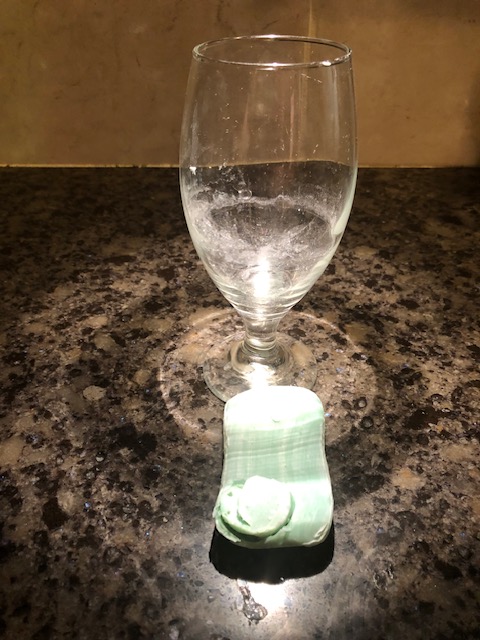
Here is the glycerin bar. It has a filmy layer of deposit.
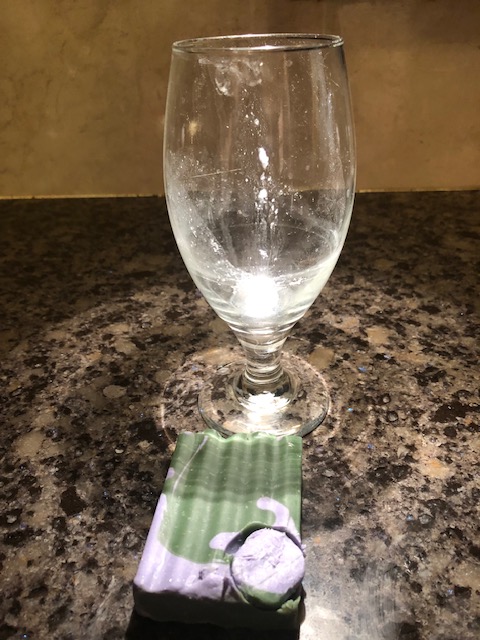
Next is the goat milk Zum Bar (above). The plant-based soap left a deposit.
The body wash left a sludge.
My next step was to clean each glass. Getting rid of soap scum means making it soluble. I added a ¼ cup of water to each glass, swirled it around, and let it sit for the length of a shower, 10 minutes. The water had a pH of 8 and a hardness of 100 (low). I tested the pH of the water and scum. Only the body wash had an acidic pH of 6.8. Your skin likes the pH to be around 5.5 and no higher than 8, which means the body wash has a slight win on this one. The glycerin soap had a pH of 7.4 (7 is neutral) and the other two soaps had a pH of 8.
I let each glass dry.
Here they are (below) in my sunny window. The traditional soaps still have their soap scum with the Irish Spring “regular” soap having the most visible ring. The body wash still looks very slimy.
Next, I added a half of a cup of vinegar to each glass and let it sit for ten minutes. Following this, I rinsed with water and gave each a perfunctory scrub with a brush, trying to clean the crusty spots but not going overboard, because who wants to spend countless minutes scrubbing soap scum? The conventional soap and glycerin soap seemed easiest to clean. Here are the results:
For the last test, I squirted each glass with bathroom cleaner which said it removed 100% of soap scum. Each glass got two squirts and sat for ten minutes. The body wash obliterated the scrubbing bubbles.
Next, I added a half cup of water and let it sit for ten minutes. After that, I scrubbed the glasses and rinsed them. Here are the results, with a little bit of glass sparkle tossed in.
The “regular soap” still had some residue.
The glycerin soap had a little scum near the top but much of the glass was sparkling clean.
The goat milk soap had some scum.
The body wash had some residue.
For the last step, I rinsed all glasses in the dishwasher (without soap but with a rinse aid) for 20 minutes.
They all came out looking clean.
If I study the photos, I’d have to agree that the glycerin soap left the least scum and the conventional soaps the most. However, soap scum is inevitable. My advice would be to keep your bar soap as dry as you can between usage because it will dissolve, especially glycerin, and as it dissolves, scum will form.
This experiment wasn’t quantitative enough to make me fully happy with it. I’d considered weighing the glasses before and after scumming them, but I don’t think the conventional kitchen scales would have caught the differences. Plus, glass can attract water from the air so I would have had to dry them in the oven before and after to get a proper weight. If I had a lab, I’d do this. Or if you have a lab, you can try it.
For those still curious about soap scum and soap, keeping reading.
Remember the old chemist adage, like dissolves like? A soap molecule can go both ways. It has a long greasy tail and a charged head. Think of it as organic and inorganic combined. The head helps the molecule dissolve in water and the tail lifts away the grease and grime from your skin. (illustration here). But here lies the scum problem.
Soap scum was discussed in a long scholarly article.
Itsadanont, Sawwalak, et al. “Dissolution of Soap Scum by Surfactant Part I: Effects of Chelant and Type of Soap Scum.”Journal of Surfactants and Detergents, vol. 17, no. 5, 2014, pp. 849-857
It forms when the calcium and magnesium in the water—the minerals that make the water hard–make a complex with the soap’s charged head. They are charged, they are ions, and they hook up with the charged head of the soap molecule and make it less attracted to the water because the head now has them to hang with. The attraction is undeniable!
This can be prevented by water softening, which removes calcium and magnesium ions and replaces them with sodium ions. Sodium ions don’t hang on so tightly. They like to stay in the water. They won’t make insoluble scum. But soft water is high sodium and low mineral. You really don’t want to be drinking high sodium-low mineral water, so a softner for just the shower would be the key to using this tactic.
Soap scum can be cleaned with vinegar or other pH lowering product, with a surfactant (a cleaning agent), or with a chelating agent. Chelating agents work by stealing away the calcium and magnesium from the scum. However, they only work well at a high pH and this isn’t useful for household products.
In the 90s there was a flurry of products released to keep soap scum from forming and sticking to showers and tubs. They didn’t work great, the interest died down ,and nothing new seems to be forthcoming. I did learn that ants will eat soap scum!
Machosky, Michael. “Keep tiny pests from becoming space invaders.” Tribune – Review / Pittsburgh Tribune – Review, Jun 10, 2006.
If I was being a prudent scientist, I’d repeat the experiment. But this scummy tale is getting long enough! Perhaps everyone reading can try a similar experiment and report back.
This blog was in response to a reader’s question about soap scum and hard water. Thanks for asking!
A short time ago, I was helping make a movie about water testing at Big Rock Park. One thing I tested for was nitrates. As I was testing, I mentioned that nitrates are a sign of fertilizer in the water. We didn’t find any fertilizer in the water that day but one of the videographers mentioned he was surprised to learn that nitrates are in fertilizer since they are also in food. Yes indeed they are and it might be giving people in the corn belt cancer.
Nitrate is an ion with a negative charge. The formula is NO3– which looks harmless enough. Nitrogen is an important part of proteins and is needed for life. Nitrates are a water-soluble way for living things to get nitrogen. Nitrogen is an element that can take many oxidation states, meaning it forms a myriad of compounds.
The nitrate ion occurs naturally in some foods such as spinach, beets, celery, and many other vegetables. It is found as an additive in processed meats. If it’s in food, why is it harmful? Why should a water chemist check the nitrate levels in water?
Nitrates in food aren’t always bad. When you eat things containing nitrate, your saliva can turn it into something useful, nitric oxide, NO. Having slightly low oxygen such as when a person lives at high altitude or exercises until muscles ache can also help create NO. NO can help blood vessels expand and function. This reduces resting blood pressure and improves vascular function.
Saliva is an important factor in the conversion process and eating slowly will allow for time to boost the conversion to NO. Dry mouth, caused by anxiety, medications, or other imbalances, impedes the process. If you find you need to sip a lot of liquids to help you swallow your food, you might have dry mouth. Other nutrients in fruits and vegetables, including Vitamin C, can help this NO conversion process occur. In the absence of the boost from saliva and food antioxidants, the nitrates will react with other components of foods to form a class 1 carcinogen—nitrosamine. Cooking-nitrate rich foods speeds the nitrosamine formation. Here’s the information in a simple chart form.
Bacteria can break down nitrates but when water is overloaded with nitrates, they can’t keep up. Sources of excess nitrate in water include fertilizer and manure. The EPA limits nitrate in drinking water but the nitrate limit here in the US might be too high. Even low levels of nitrate in water are thought to be harmful and have been linked to colorectal cancer and preterm births.
You may want to turn to purified water but be careful. It doesn’t always contain the healthy minerals we need,
What areas of the US are vulnerable to high nitrate levels and nitrate contamination of groundwater? Click here for a map. (Hint: lots of places.) Why should our water grow gross with nitrates at our expense? In any case, be wise about nitrates.
A bad combination: low altitude, meat consumption—especially processed meat, dry mouth, not chewing your food enough, and low exercise. Will the orange juice be enough to counteract the rest of this breakfast? Ham, bacon, and sausage get you both ways—through water pollution and nitrates.
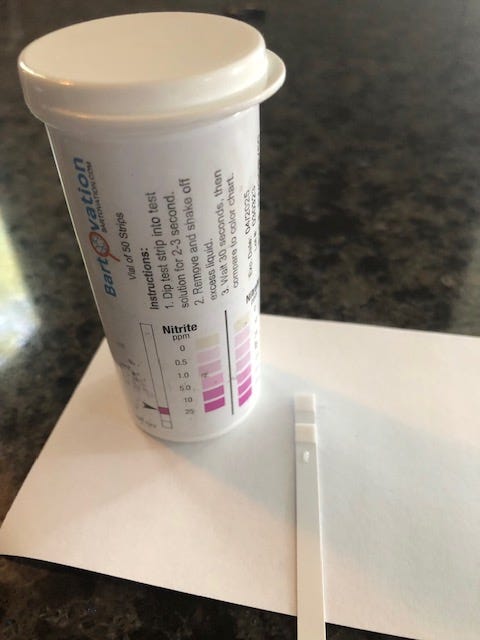
If you want to test your water for nitrates (and nitrites, an intermediate between ammonia and nitrate) there are several ways to do it. Using ultraviolet absorption, using a meter, or using test strips. Test strips are the cheapest and easiest method and you can find them on-line. It looks like my drinking water doesn’t contain nitrates. Hooray!
If you test your drinking water and find nitrates, you’ll have to invest in a water purification system. In other words, you’ll have to pay to protect yourself from the greedy few.
I was outside in the heat pushing my granddaughter on a swing the other day and saw this:
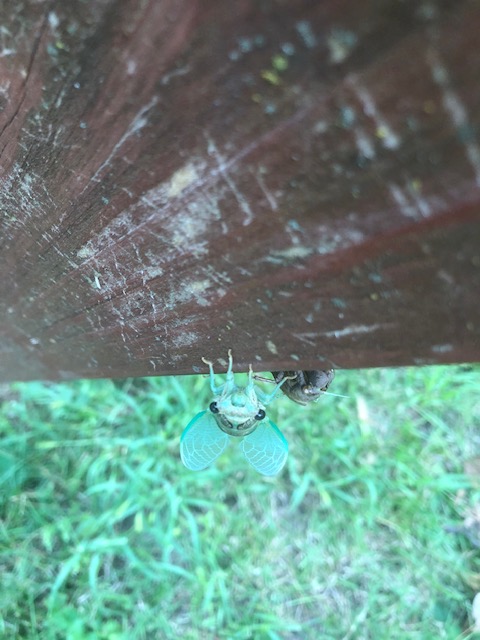
An annual cicada was popping out of its shell. At first, I thought it had died that way. It was so still and of course, with an exoskeleton, it didn’t look like it was breathing. Gradually, it struggled until its wings were out.
Getting all the way out of the shell took a while, around twenty minutes or so.
Hello sunlight!
Cicada wings are made of many compounds and take about a half hour to dry and harden. The underside of the wing contains proteins and lipids, much like skin, and the outer part of the wing is polymerized hydrocarbons, a plastic. The wings are heavy and cicadas aren’t great fliers. No surprise then that the new cicada flew to the ground and took off walking, looking for a tree to climb.
Cicadas are a favorite symbol in France, especially in Provence. They symbolize rebirth and ecstasy because of their enthusiastic singing. Only the males sing; they have drums on their undersides. You can see the tan drums here on this cicada corpse.
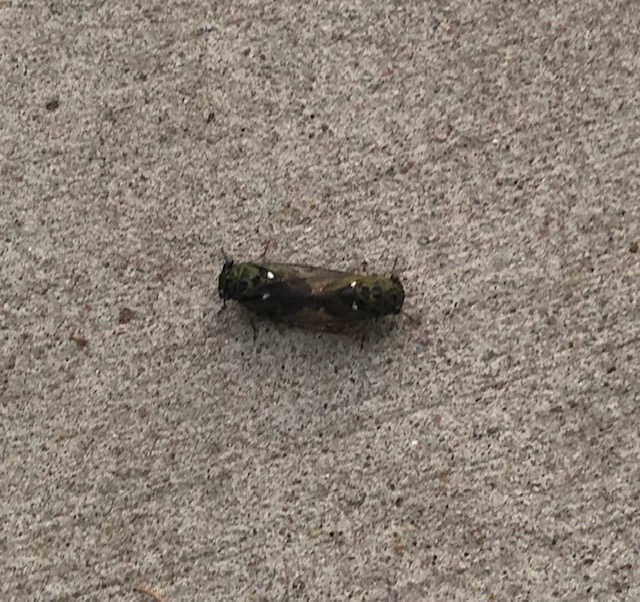
August is the prime month for cicadas. Once they emerge from their shells, cicadas live for 4-6 weeks, time enough to find a mate. The mating takes about a half hour.
The female will lay her eggs in a nearby tree. In about six week, they’ll hatch and the nymphs will fall to the ground and burrow in.
I have to admit, the struggle is real for me, too, as summer ends and we go back to normal time and its flurry of activity.
The cicadas will soon be underground, silently sipping on tree roots, and burrowing deep to escape the cold. Enjoy them and the last sips of summer while you can!
A few weeks ago on the eve of Tulip Time, I saw this hanging from my pine tree in the back yard near the clothesline. At first, I thought a shirt had blown off the clothesline and ended up in the tree.
On closer inspection, I saw it was a swarm of honeybees! I was scared of them at first, especially since the dogs thought they might be worth jumping at. The Klompen Classic was set to begin in an hour with the path going right past my house. Would the runners be greeted with bee stings? And the next day was Tulip Time.
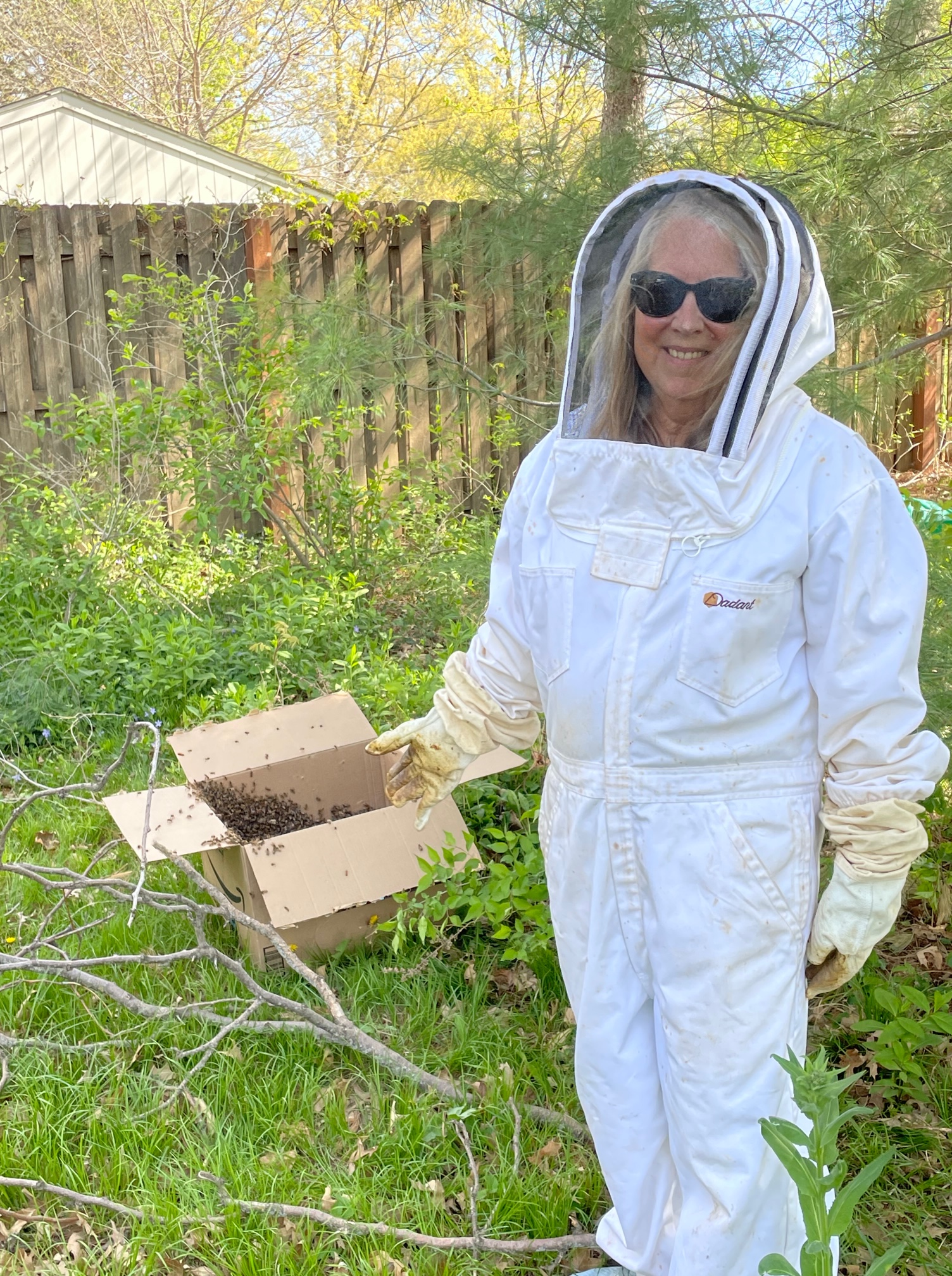
Not sure what to do, I texted a few people. Dr. Paulina Mena assured me that bees are only aggressive when they have their own hive. These bees had left a too full hive, following the queen who wanted a new house. Paulina had the perfect place, a bee box at Central College was empty. The next morning, her student, Lauren, came to get the swarm. She brought bee suits, duct tape, and a cardboard box.
Yes. I did want to put on a bee suit. She’d never collected a swarm before and I’d never seen one. We had so much in common! I did NOT want two active hives in my yard. The queen inside of the swarm, directing her subjects with pheromones, was well-fed and fat. She wouldn’t be going far. The other hive was still somewhere nearby, probably in a tree, with a new queen ready to emerge.
One of the first things Lauren did was drop the bees into the box. She used her hands and I had a big dipper used for water testing for her to use for scooping them. Once most bees were in the box, she looked for the queen. Yes, she was there.
Lauren identifies the queen bee.
As yard bees, these were always friendly, not aggressive. In order to collect all the bees, I snipped the branch they’d swarmed on into the box.
I look like I’ve done a lot but in reality, it was a lot of watching.
Lauren taped up the box and drove them to their new location, a mile away.
The queen was put into the bee box and fed some honey to keep her happy. Otherwise, she might have taken off to find better digs. Her subjects followed her into the new palace; even the few who were left behind would be able to fly a mile, following her pheromones.
Here’s more about the ethics of capturing swarming bees. Basically, if they don’t like the new home, they’ll just leave. Bees are never truly domesticated. And the best chance of success comes when bees are not moved far from the climate and location they are used to.
I went to visit the bees today, exactly three weeks after I first encountered the swarm. A few bees flew over, as if to greet me. They looked happy in their new box. I must admit, I feel a little guilty in not letting them find their own new home, but they wouldn’t have gone far and my yard is an active place. One they established a colony they might not be so kindly. What if they found a place only to be sprayed with insecticides?
If you look closely, you’ll see a good number of bees at the bottom of the hive box.
There seem to be plenty of bees left in my yard coming from a now smaller population with a new queen in a place unknown. I do miss those swarmers. If it happens again, I’m going to let them stay.
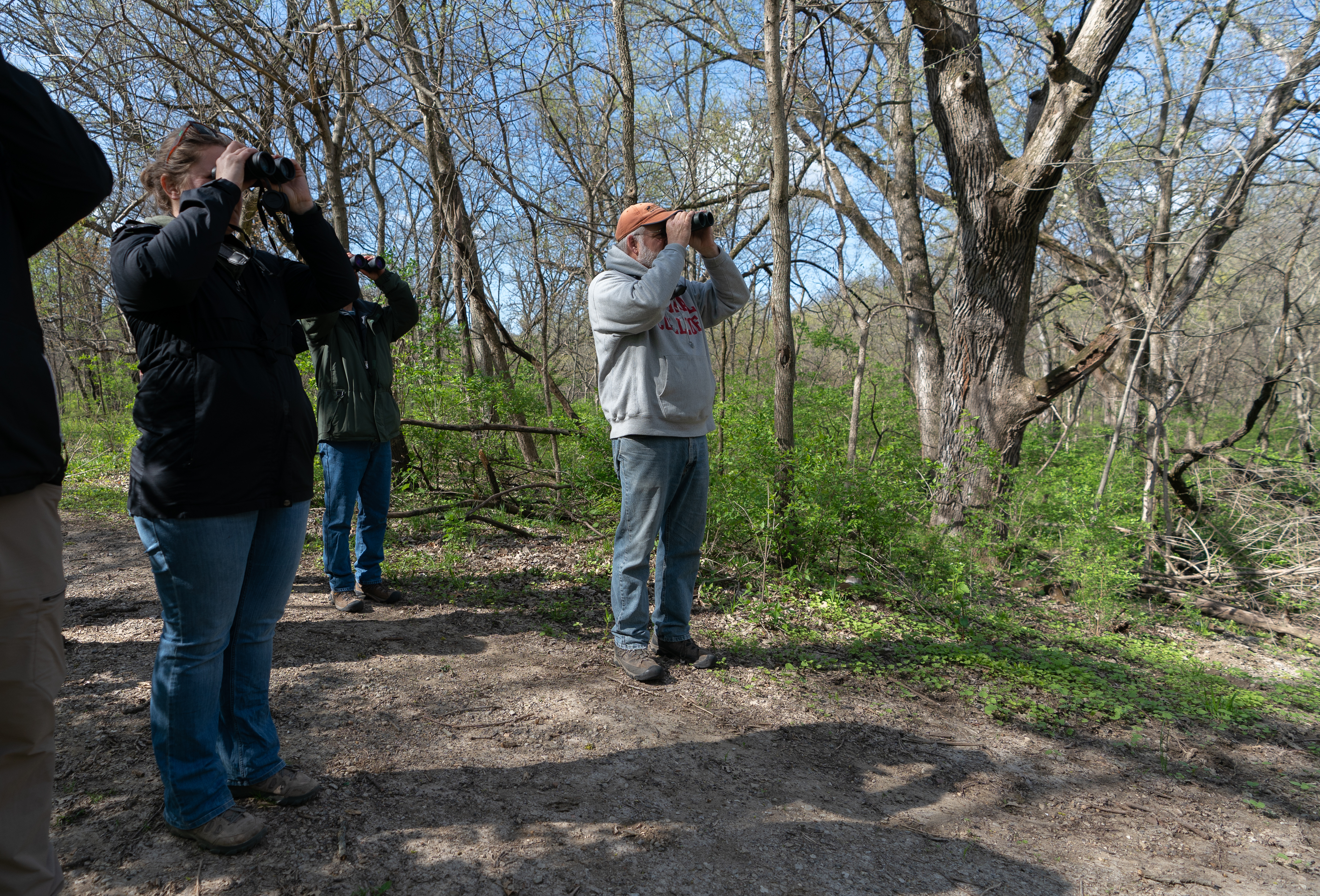
On April 29, a band of nature lovers met with Dr. Russ Benedict to learn about the birds of Big Rock Park. The Central College naturalist began with a lesson on how to use binoculars and then led us on a mile walk around the woodsy exterior of the park while he talked about avian migration patterns and all things bird. Some birds such as robins are generalists and will live anywhere. Others such as the tufted titmouse, are very picky about their habitats and will only nest in diverse oak forests as found at Big Rock Park. Spring migration is a race against time and weather to establish territory.
Below: Binoculars Up! Focus binoculars, spot the bird, quickly raise the binoculars. Photo by -Kayla Lindquist www.kaylalindquistphotography.com
One prevalent bird was the Yellow-rumped warbler or butter butt—one of the few birds that can eat waxy fruit such as bayberries and will even eat candles! This helps them survive brutal winters.
It was a beautiful and sometimes noisy walk. Carolina wrens popped up and scolded while hairy woodpeckers worked on making their holes in soft wood. A woodpecker will make a new hole every year!
In terms of migration, the over 400 species of Iowa birds fit into one of these categories:
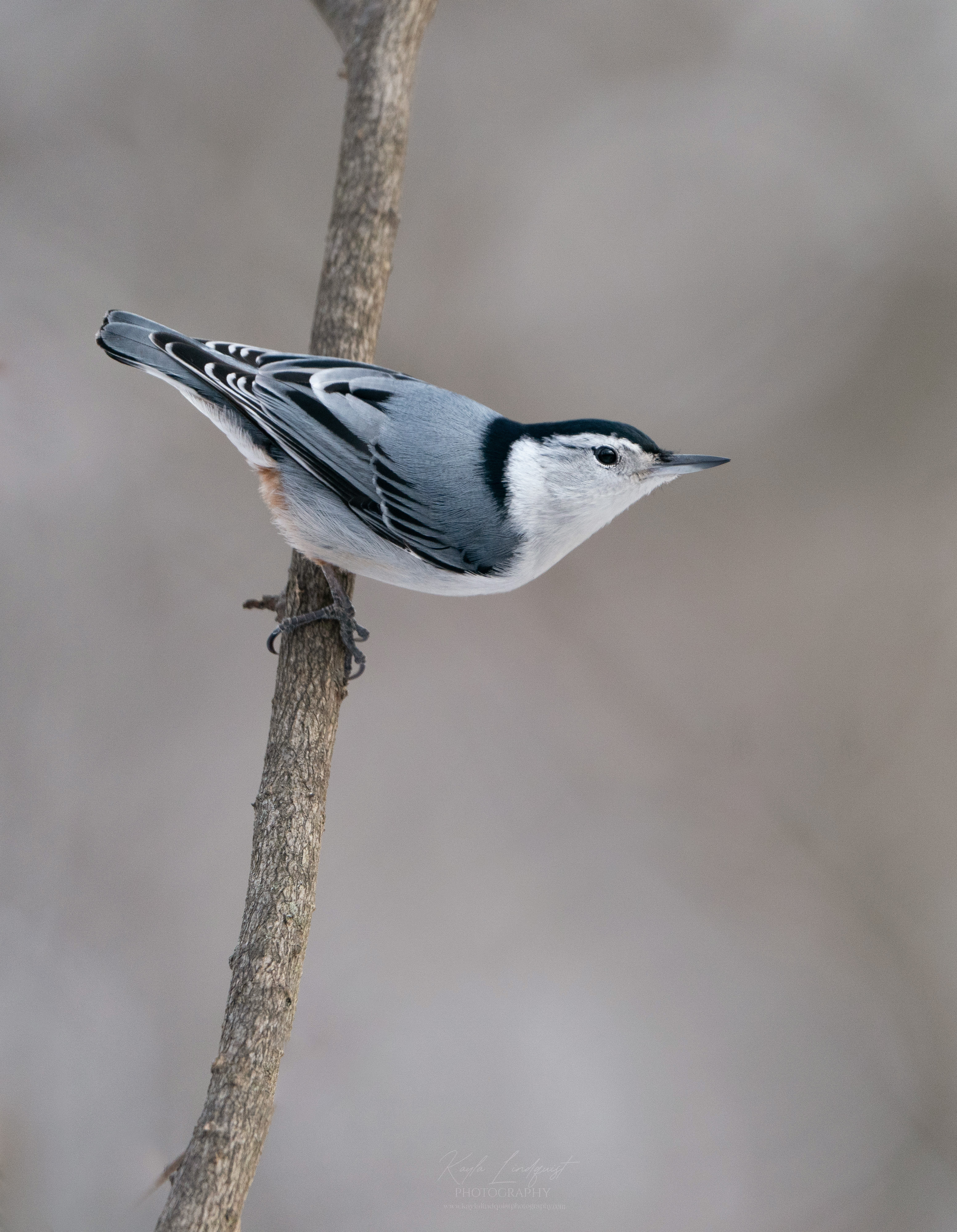
Permanent residents such as cardinals, blue jays, owls, crows, and nuthatches. Chickadees not only are permanent residents, they rarely move more than three miles from their place of birth. Another fun fact about chickadees is their call. The more “dees” you hear, the more alarmed they are about their situation.
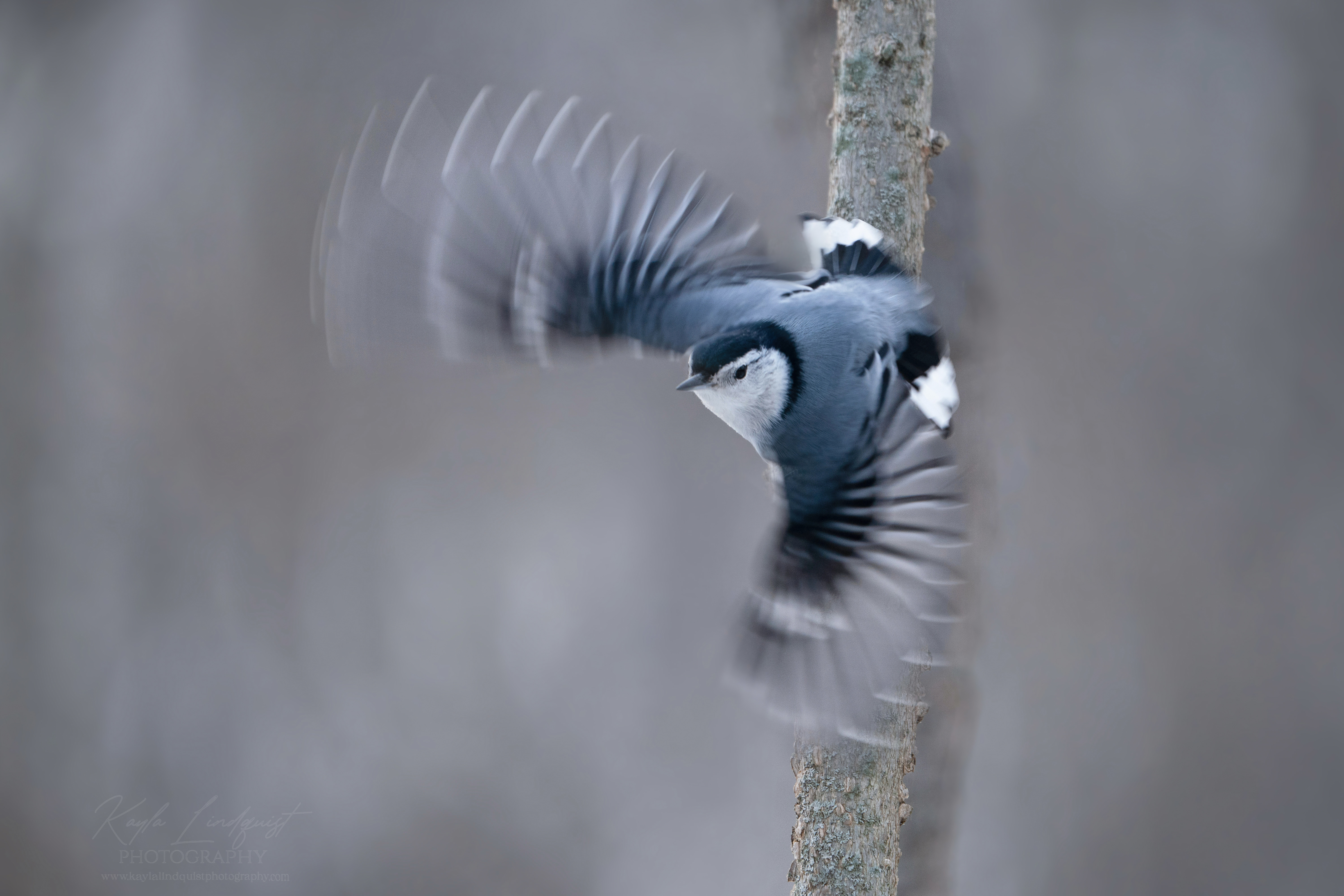
Nuthatches, as shown below, usually don’t migrate and prefer to live near mature trees as found at Big Rock Park. These photos were taken by Central College student Kayla Lindquist. Be sure to take a look at her other photos at www.kaylalindquistphotography.com
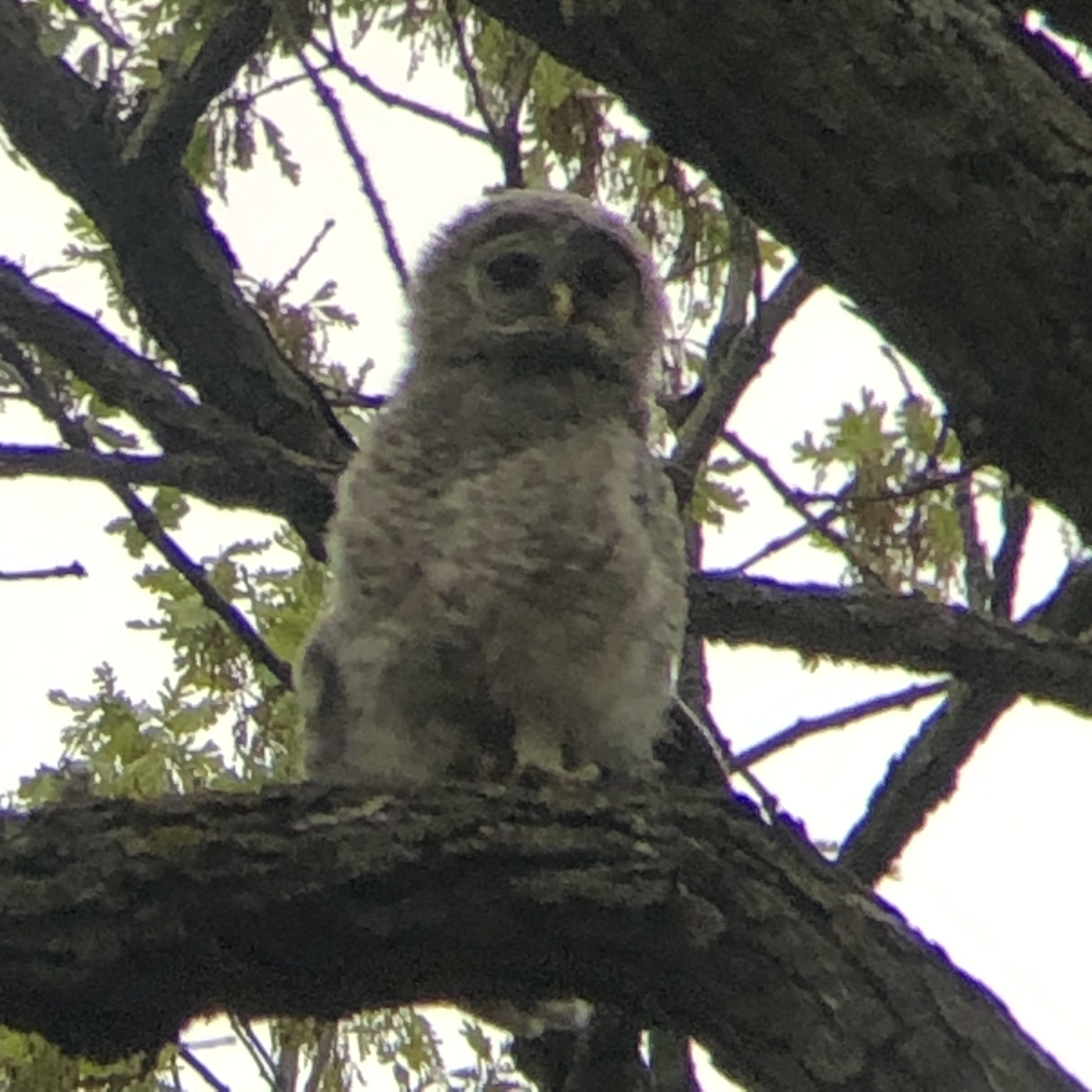
Barred owls rarely move from their roost. They can be seen in Big Rock Park year around.
(photo by Sheril Graham)
Regular Breeding residents who migrate here for the spring and summer as seen with many song birds including warblers and thrushes (such as robins), hummingbirds, bluebirds, and catbirds. These birds usually fly at night and stop to eat and rest in daylight. Turkey vultures migrate into Iowa in the spring since they can’t eat frozen roadkill. Turkey vulture watchers say the big birds are arriving earlier and earlier due to climate change.
Snow birds who winter here and fly north to breed such as eagles, juncos, gold finches, and tree sparrows.
Passage birds who fly through on their way to someplace else including many water birds and grackles.
When birds migrate, the males usually take flight first. They want to establish a territory. In the first wave of migrators, you’ll find the seed eaters, followed by insectivores, and lastly, caterpillar eaters. Usually, daylight patterns (photoperiods) prompt birds to migrate. In the spring, some might try their luck and migrate earlier or farther north than usual. This poor male Summer tanager came here too early and starved.
Females pick males based on territory, but courtship plays a role, too. Birds will have specific behaviors such as twittering their wings and singing to attract a mate. The most appreciated males croon for a long period of time. In birds such as blue jays, catbirds, and mocking birds, the most virile are those who sing up to five minutes without repeating a pattern.
Bird populations are declining in the US and across the globe. Grassland birds such as meadow larks are suffering the biggest loss while water birds are faring the best. Here in Iowa, loss of habitat and CRP fields due to ethanol are big contributors to the decline along with fewer insects.
Ways to save birds include putting up nest boxes which was highly successful with bluebirds. Turning off lights and putting up curtains to keep birds from hitting windows and buying shade grown coffee are a few more ways to help birds. Keeping wild places like Big Rock Park is one of the best ways to help keep bird populations alive. (Click the link for more ideas.)
Birdwatching is inexpensive and hip. A helpful resource for newbies and experienced birders is the All About Birds site. Big Rock Park offers an easy walk. Come fall, the migratory birds will leave the park at a much more leisurely pace than they arrived. If you want to hear the chorus and watch their spring frenzy, now’s the time.
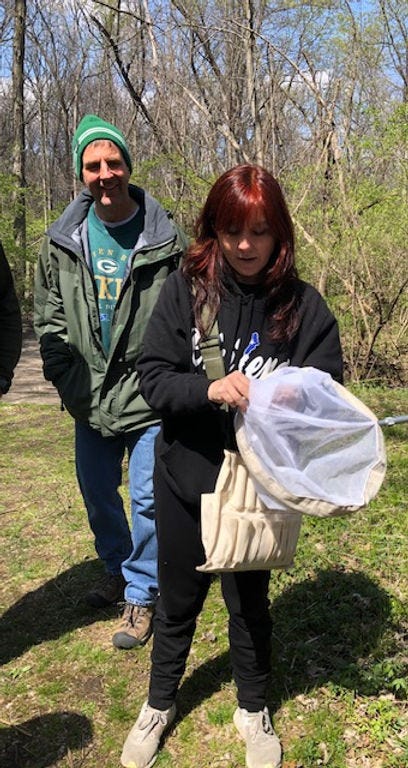
If you want to see bees, find a flowery meadow above 50 degrees F with no wind. April 23 was not one of these days. It was cold and breezy. Despite this, the session on Native Bees of Big Rock Park lead by Dr. Paulina Mena was well-attended and the bees were there for it.
Above: Dr. Mena teaches attendees the proper bee netting technique.
Iowa has over 400 species of native bees, all better pollinators and more well-adapted to our climate than the well-known but non-native honeybee. Iowa bees have co-evolved with native Iowa plants. They are important to our Big Rock old growth savannah ecosystem and to the overall ecosystems of any place that has bees.
Even better, most native bees are mild mannered, having no hives to protect. Unlike honeybees, they can sting many times but without venom, making the stings less painful. Aggressive honeybees and wasps will tag intruders with pheromones and the hive will follow them in attack mode. You’ll get none of this aggression with native bees. 75% of US plant species require pollinators and even those that don’t have higher yields with visits from bees.
Many native bees are specialized pollinators, fitting in well to their plant niches. Squash bees for example are early risers, pollinating the morning blooming squash blossoms and napping in the withered blossoms. Most native Iowa bees are buzz pollinators.
Buzz pollinators such as bumble bees and mason bees are essential for the pollination of plants with deeply held pollen. Food crops such as eggplant, tomatoes, and blueberries rely on these bees to produce fruit. These calm bees are not likely to sting. Bumble bees nest in the ground and the magnificent queens can chose the sex of each egg as they lay it. Each queen will make a honey pot filled with nectar as a food storage for herself as she incubates her eggs and for the emerging young.
Our Big Rock Park group found a beautiful, fertilized bumble bee queen looking for a nesting place. After admiring her, we released her.
It’s incredibly difficult to identify most native bees by sight. People who can do this, taxonomists, are older and retiring. Modern bee enthusiasts use DNA testing to help identify bees.
Over thirty unique species of bees who call Big Rock Park home have been identified by Dr. Mena and her students. The most prevalent bees catalogued have been Augochlora pura, a common bee that nests in rotting wood and is a walnut pollinator, Calliopsis adreneformis, a ground nesting bee and important pollinator of many flowers, including phlox, and Coelioxys modesta, a parasitic species and pollinator which nests in the soft soil in the park. Another common bee is Megachile companulae, also known as the Bellweather resin bee is a special pollinator of tall American Bellflower.
One of Dr. Mena’s exciting findings is that Big Rock Park may be the home of a formerly undiscovered species of bees! This species would be in the genus Andrenaand was first found by Dr. Steve Johnson. This type of bee is an important native pollinator, especially for apples, cherries, strawberries, and blueberries.
Here’s a link to a presentation about the science behind discovering the bees of Big Rock.
Honeybees may be well-known but our native bees are hard-working pollinators and we need them. Ways to help them in your yard are to refrain from planting pesticide treated seeds and to not burn downed wood in the early spring when the young Augochlora bees are emerging. Although they don’t produce commercial honey or wax, native bees are better pollinators and pollen collectors than honey bees and are more friendly. As we found out last Sunday, they are more active on non-sunny, windy days than are honeybees. Since these bees nest in the ground and in old wood, we must preserve their habitats—wild spaces like Big Rock Park—or we’ll lose these splendid, valuable creatures.




















 Catherine Haustein