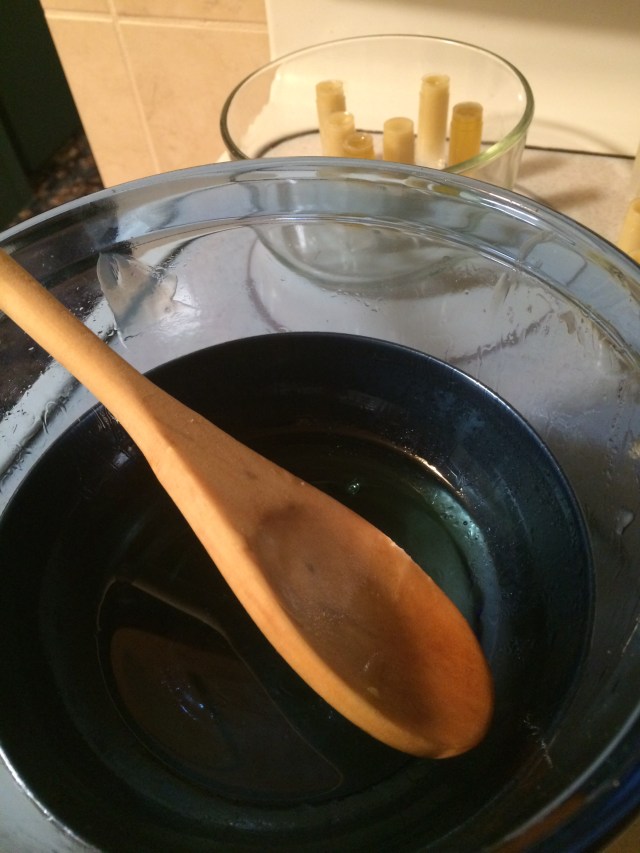
How much mess will you make? Here’s a shot of my bowl & spoon with some of the tubes in the background. I didn’t think this was too bad, just takes some patience with the mixing and the filling of the tubes.
It’s chapped-lip season and I decided to make some lip balm. It was easier than I expected it to be. I decided to use Shea Butter due to its moisturizing properties. Beeswax is added so that the butter doesn’t melt in warm weather and I added a little coconut oil to help it glide on smoothly.
Here is my formula:
1 tbs coconut oil
1/4 c shea butter
1/4 c beeswax pellets
Place in a pyrex bowl.
Heat the bowl on a pan of hot water. The ingredients will melt in the order listed above. Stir with a wooden spoon. When the mixture is fully melted–about ten minutes– add to containers using a disposable transfer pipet. (I bought containers for lip balm.) If you want to get creative, add 1/4 tsp of either Vitamin E or mint extract to each container before adding the mixture. Allow to cool for at least 15 minutes before capping.
The recipe above made 21 tubes of lip balm.
Clean up note: To avoid clogs, do not pour the mixture down the drain. Wipe out bowl with paper towels, follow with hot water and wipe again. I will save my mixing spoon for the next time.
The widely circulated recipe for bath bombs is pretty simple and goes something like this
8 oz baking soda (1 cup)
4 oz citric acid (between 1/2 and 2/3 cup)
2 oz corn starch (A little less than half cup)–optional
4 oz Epsom salts ( about a half cup)
Mix dry ingredients together.
2 tbs plant oil–anything from olive or coconut oil to Jojoba or almond oil
3/4 tsp water. Do not over measure this!
2 tbs essential oil (this is an oil to add a fragrance; lemon eucalyptus, tea tree, etc.)
2 drops food coloring (optional)
Mix together wet ingredients
Slowly add wet ingredients to dry until they begin to clump.Add more plant oil if needed.How much extra oil you’ll need to add depend on what plant oil you use. I had to add quite a bit more jojoba oil!
Maybe I’ll get better at this but one messy kitchen and plenty of trial and error later, I was able to make some imperfect bath bombs.
Wipe both halves of a bath bomb mold with oil. Fill both half with your mixture.Push into both halves of a bath bomb mold. Press together firmly, tap with a spoon or on the side of the sink to loosen, open mold. If halves don’t fuse, add a tiny sprinkle of water and try again. Allow bomb to dry for a day.
Super easy bath muffins
1/4 cup each baking soda, corn starch, citric acid , epsom salts. Mix together.Add 1/2 tsp water and 1 tsp essential oil.
Add coconut oil until malleable. (Olive oil can be used also. but will make a flatter muffin.)
I added some dried ingredients such as lavender, ginkgo leaves, passion flower leaves, or and even a coffee bean)
Pack into tiny muffin cups.
Artistry lacking but top left is made with a tiny bit of coffee extract, top right with tea extract, bottom two contain bits of dried lavender and ginkgo leaves.
I started considering this– do I want corn starch? What do I really like? The mild scent and the epsom salts are what I’m after. I came up with this recipe that can be put into a plastic test tube with a screw top ( yes, you can find them on line) and has ingredients you can find in a grocery store.
Test tube grocery store bath potion
2 packages true lemon or true lime
1 tablespoon epsom salts
1/2 tsp baking soda
1 or 2 drops scented oil
Mix. Make a little funnel from a slip of paper and add mixture to your test tube. Will add a slight fizzy boost to any bath. Can be doubled depending on size of test tube. This is something kids can make!
This is more my style. A great bath toy too. Just remember that epsom salts can be a laxative so no drinking the potion! I added a tiny spring of dried lavender.
Misogyny exists in all parts of the human world. Child brides are common and face a life of abuse and even death in childbirth. Sex-Trafficking is a world wide concern, but unless citizens everywhere take a stand against misogyny in all its forms, it will continue. Widow-burning has seen rises and falls in popularity but even when it is not practiced, the low status of a woman without a man is pervasive across cultures. Being forced to marry your rapist because now you are an adulterer is a nightmare of other countries, but there have been religious books here in the US that romanticize this and some lawmakers have pushed laws for rapist visitation rights. In fact, rapist visitation and custody rights are legal in 31 states. No one in the US would find honor killings palatable, yet we do place heightened emphasis on the virtue of girls.
The men in Sambia hate women so much that they plug their nostrils with cloth when they have heterosexual sex so that they don’t breath the woman’s “vapors.”
Seeing misogyny is not difficult. But what can be done about it? Look up “how to stop misogyny” and you’ll find that not much is out there.
So here’s a quiz. Which one of these things do you think will help? Or add your thoughts below:
In all of my novels, a woman must navigate through a world awash with misogyny–societal prejudice against women. I asked an anthropologist friend for some outward signs of misogyny in a culture and she had numerous examples.
One obvious one is that the man is the model for normal. We see this in our culture when pants are the normal attire. Women fought for the right to wear pants but have men ever fought for the right to wear dresses? No. Another example of this is the plethora of male protagonists. In many books, particularly in the 50s, every single character was a male, even in children’s books. In Winnie the Pooh the one female character was a mother. I one time even read a children’s book where a cow was called “he.” I saw this at work several years ago when three scientists stepped up to voice concerns about a health and safety issue. The three were all female and a higher up labeled this “the women’s problem.” Would this have been called the “men’s problem” if the scientists had been male?
Another sign is how women modify their bodies to please men. We might think of feet binding as a terrible thing and not understand it but here we have breast augmentation surgeries, anorexia, and since older men are thought of as attractive and knowledgeable but older women not so much, we have facelifts and chemical peels. I am tempted to try them! I can’t say that men do not work out to attract women. However, look at some of them who think they are good looking such as our president. Would a woman with that hair and figure and chin flab consider herself God’s gift to men, even if she was wealthy? No.
Of course we have wage dichotomy–the so called pink collar jobs that are a staple of our society but carry lower wages–teacher, social worker, nurse, hair dresser.
No doubt most of us have thought about the different standards of acceptable sexual behavior for men and women–men can be players (although younger people call then “man-sluts”) while young girls wear purity rings.
We have accepted or at least discussed as a society the previous examples and adjusted to them in our culture but what are some that are more subtle? Below are some telltale signs of misogyny:
Assuming that feminism is anti-men, Thinking that women’s rights hurts men’s. (Keep in mind that women can be misogynists. Queen Victoria was one.)
Assuming that women are more emotional and irrational than men.
Dictating what women do with their bodies.
Asking for more proof from women than from men before you will believe them. My anthropologist friend says “As a scholar, I am asked for more citations when in fact it was my original research.”
Expecting women to pick up at work. (There’s a reason so many offices have gone to individual serving coffee makers.)
Expecting women to dress up more than a man in the same job.
Assuming that feminists don’t want to be wives and mothers. Or that everyone must be a wife or mother to be respected.
These are happy free range hogs, but most Iowa hogs are in confinement operations.
Iowa is an agricultural state with 40% of our land used for highly fertilized crops.It takes over a pound of fertilizer to produce a bushel of corn and Iowa will produce around 2.7 billion bushels of corn this year. Some of that fertilizer will be taken up in the corn, but some will also run off into Iowa waters, creating blooms of algae. Some of this algae will produce toxins and remove oxygen from water, killing aquatic life and making the water unfit to drink.
We also have hogs here. Iowa is a state that has more hogs than people. There are about 21 million hogs in Iowa and 3 million people. That’s right. For each person there are almost seven hogs at any given day. Iowa is #1 in hog production nationwide. We also have more turkeys than people here in Iowa. We lead the nation in egg production. As you might imagine, we produce a lot of manure here–10 billion tons per year! You’d think this would make the state a power player in the GDP of the nation but no, we are responsible for 1% of the nation’s wealth.
With all of our manure and fertilizer and the water-soluble nutrients, you can imagine that we cause problems for ourselves and others in terms of water quality. Polluted water is a public health issue here in Iowa. Who is accountable for Iowa’s water pollution? This is the question and with this question comes a lawsuit. The Des Moines Water Works is suing counties upstream, saying they need to be regulated and accountable for their pollution. The point of the lawsuit is that these counties run pipes of agricultural pollution into state and federal waters and no one is stopping them.Those downstream pay the price for this unregulated drainage, much like a sewer pipe. The pollution is associated with cancer, birth defects, blue baby syndrome, toxic cyanobacteria, and blooms of algae downstream. The Des Moines Water Works spends over a million dollars per year cleaning up this drainage.
Why doesn’t the pollution, caused by manure and fertilizer, just soak into the ground? The counties that are being sued are naturally swampy and must be drained with plastic tiles. These are connected to pipes and the pipes drain the swampy pollution into the Raccoon and Des Moines Rivers.
There are things that can be done to prevent this such as crop rotation, planting cover crops, bioreactors, and other conservation practices. The problem is, the polluters don’t like the city folk telling them what to do and have no incentives to clean up their pollution. Appealing to their human decency isn’t working. Manure can be used as fertilizer and in fact, it is underused according to our agricultural college, Iowa State. But do we use it this way? Not much. Fertilizer is cheaper and Iowa has even given a new fertilizer plant billions of dollars to set up shop here.
The lawsuit has been called “a war on rural Iowa.” This isn’t accurate or helpful. The lack of compassion for those downstream is problem here in Iowa and in our nation. The lawsuit will begin this June 2017. If the Des Moines Waterworks loses the lawsuit, it will need to spend up to $100 million dollars on a new denitrification plant in order to be able to make their water safe enough for their consumers to drink. Even sadder, the pollutants are water soluble so even if removed to make the water of Des Moines safer, they will find their way back to the water supply.
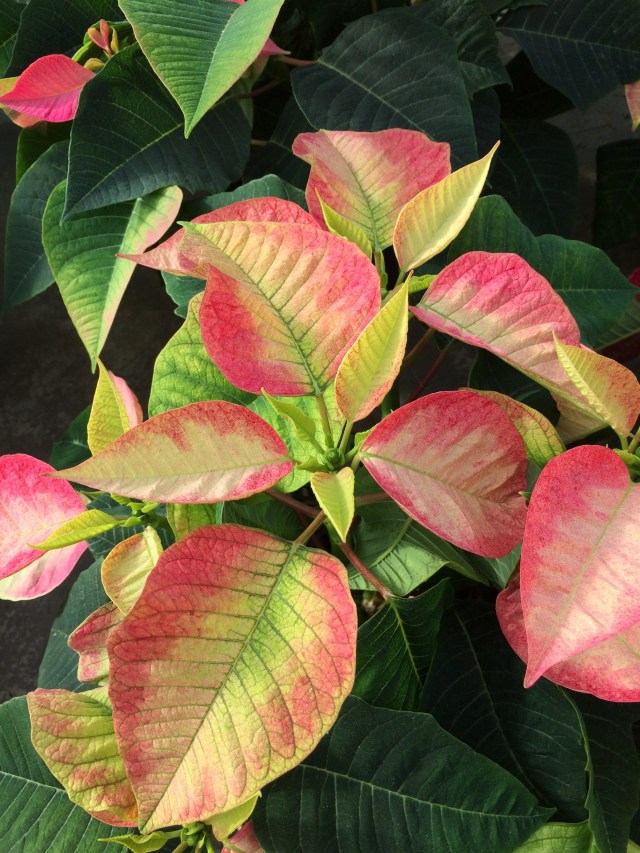
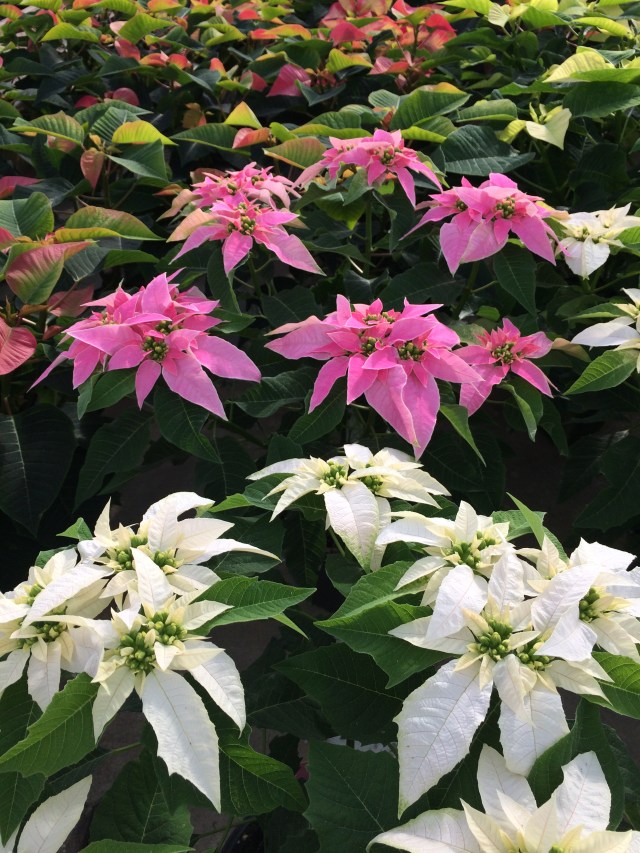
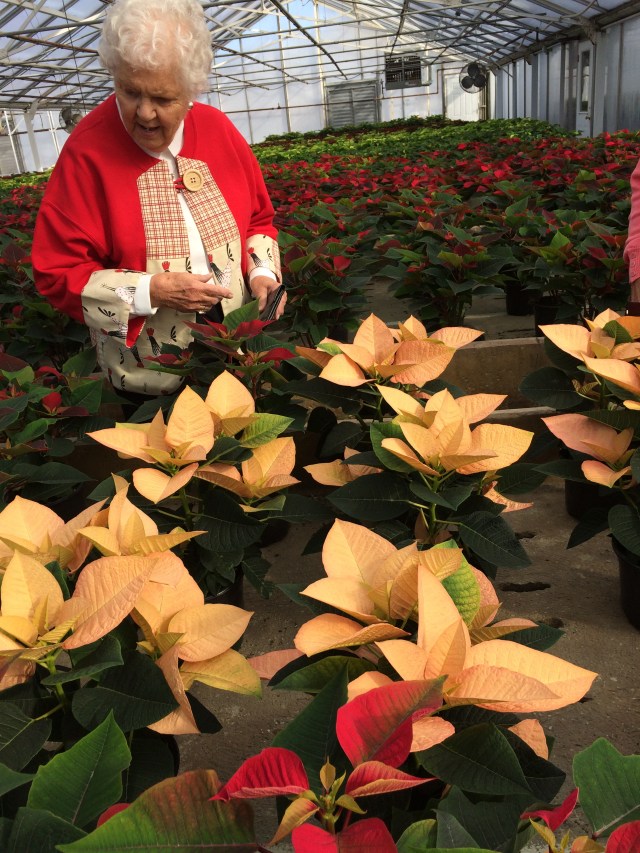
In an Iowa greenhouse–Nick’s in Pella– poinsettias wait for the holidays.In a week or two, this healthy plant will be ready for retail.
A close look at the stems shows what color they will become.
The friendly grower gives my aunt advice: plant the whole pot in the spring, dig it in the fall, trim the roots and you can enjoy this beautiful plant for another year.
A new variety with tiny bursts of color.The top leaves of the plant change color when the days are short and the nights are long. Look at these–apricot!
It’s National Novel Writing Month and I have been challenged to put up something from my work in progress. My work in progress is still at a delicate stage but I’d love to share the opening of my novel Mixed In, a tale of chemicals and dystopia. It will be released this spring by City Owl Press. Until that time, here’s a sample. (Danger,naughty word included!)
CHAPTER ONE
Creating a beer is much like breeding a dog. Dogs have that one tricky gene, number fifteen, that can cause height variation between 5 inches and 7 feet, more than any other land vertebrate. (Imagine humans ranging from 2 to over 30 feet tall.)Hops are complicated, having intricate aromas, regional differences, and changing chemistry upon brewing.
Sipping the dark and sylvan house ale, I studied the wavy haired bartender. A pretty man with smooth skin, a dark mustache, and little sideburns, he resembled Nikola Tesla, who despite his love for frequency and vibrations, was said to have died a virgin.
I’d taken refuge in the Union Station bar after my bus broke down as I rode it home from work. Officials in black bomber jackets and belts covered with devices that hung like pine cones walked past the window. I hadn’t seen that black uniform before. Those belts loaded with technology told me something. I was in what Cochtonville considered a bad neighborhood.
I wasn’t a citizen of this city-state, carved out of Iowa, with a name pronounced “Cock-Ton” like an enormous penis. I was a chemist from Michigan on a work visa and didn’t worry about the officers. I had a permit to be here and, unlike most of the population, to have seeds. This was my first month in the country and I was struggling to understand my new home and connect with the people here.
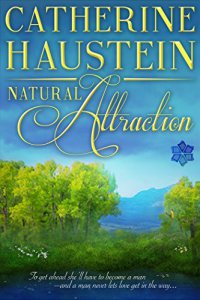
Two years ago I signed a contract for Natural Attraction with Penner Publishing. I’d written numerous short stories over the years but this is my first novel. I’d taken a break from writing fiction to write non-fiction because
1. I needed money and
2.. I didn’t feel very wise.
Having teenagers will do that–make you feel broke and not very wise. And we don’t have dowries now but we do have weddings to pay for. Not that I didn’t adore those years. Quite the contrary. They were a rush of emotions and activity. Bottom line. I didn’t write unless it was for solid money. That meant I wrote about science. I wrote the truth about science. From this I learned at least one thing–don’t argue with editors. They have a tough job and a vision. Plus they won’t pay you if you don’t follow their directions.
I have an MFA in fiction writing and as a child I wrote prolifically. A writer needs something to be passionate about and for me that was science.I like how science changes perceptions. My best advice for those wishing to get into an MFA (Master of Fine Arts) program is this–have an angle. For me, it was science. Writing about science wasn’t enough. I wanted to be a scientist. I honestly love the hands on aspect of laboratory research. I even like fixing equipment–perhaps because my grandfather was a plumber. I like scientists. They’re quirky and unbelievable humble before Mother Nature.
How did I turn back to fiction? I was encouraged to do so by other fiction writers. I sat down to write a short story and it became a quirky novel about a scientist in 1871 who takes a tonic to become a man and falls in love with a preacher. The novel takes a humorous look at gender and class roles in the Victorian Society when they were absurdly strict. My goal was to de-romanticize that time period because in many ways, it was terribly cruel. It also explores how science gradually changed ideas about slavery and human equality. As I said before, that’s what I love about science.
I thank Penner Publishing for taking a chance with this book. I am grateful for its acceptance because it contains a diverse set of characters. The Kindle version is on sale right now. Tomorrow I’ll be at the Pella Author Fair selling copies. Yes, you do have to get out and sell your books and promote yourself as an author. You need to be on social media.
I also thank everyone who has purchased a copy and thank those who have put up a review to help those who might enjoy it.
Did my life change dramatically in the past two years? Not really. I do now get to teach a fiction writing course. My students never fail to impress me with their passion and creativity. And every day –often in the morning and before bed–I spend some time with a new story to tell–weaving in my experiences as a scientist and a female. The bottom line for me now is this: there are not enough diverse stories about the female experience out there. I’m doing the best I can to tell these stories. Once again, to everyone: Thank you!
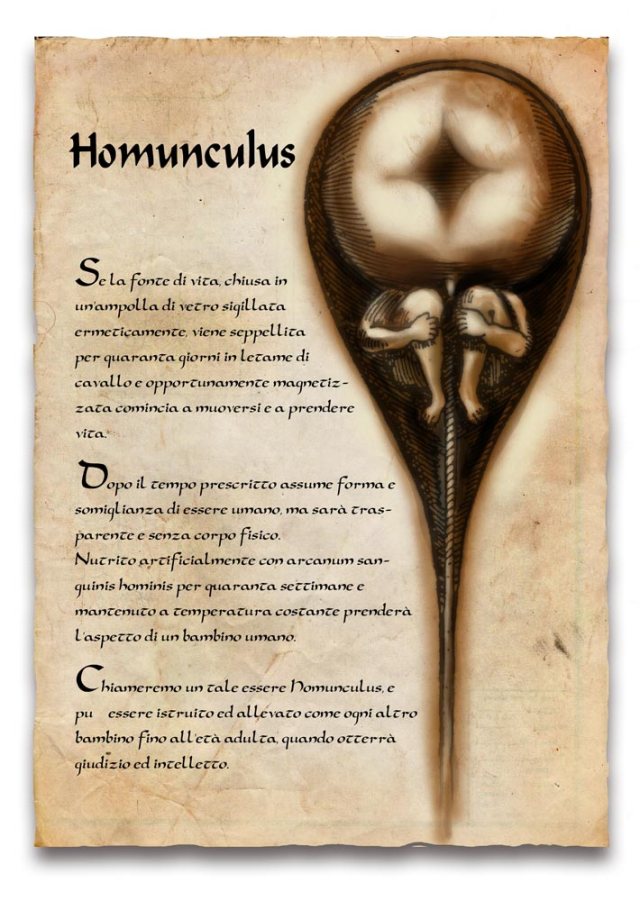
Wouldn’t this Homunculus be a great Halloween costume?
Just store it in glass, feed it blood and keep it warm for forty weeks and you too can have your very own human child!
The idea that a tiny person could be made by a man without help from woman is as old as Plato. The no-woman-required homunculus appeared in alchemical writings around 1530. It was wishful misogyny. How dare women do something men could not! But even as late as the 1920s, many people believed that the sperm contained a tiny person and the woman was no more than dirt for the seed to grow. This thought gave people permission to see women as lesser beings who didn’t deserve property rights or the right to their own children. It explains misplaced disdain for older women and women who don’t have children. Even the religious figure Martin Luther questioned if women had souls. Fortunately, science put a halt to this inequality.
The idea of inheritance from both parents, genetics, was first proposed in 1866 by Mendel who determined that peas contained traits from each parent in the same proportion. His work wasn’t widely known until 1900 and his clear evidence that both parents contribute equally to the offspring wasn’t accepted until 1925. The notion that the mother was an equal in the creation of offspring is less than 100 years old. This means that for eons past, a woman was blamed for barrenness or even for being too fertile. Charles Dickens, that great champion of humanity, brought this charge against his own wife as he abandoned her.
Genetic equality gave women more credibility but even still, James Watson, who is a discoverer of DNA, was a sexist man. Old ideas hang on even against clear evidence that they aren’t true. Fortunately, with time, the idea that women are lesser beings and a form of dirt because they bear children is on the way out.
One great thing about being a chemist is, well, chemicals. I was looking through a catalogue the other day and saw Vitamin C serum. Allegedly it’s good for the skin and being an antioxidant, slows down the aging process. Here’s an aside–I have also read that oxidants are useful in getting rid of wrinkles so there’s conflicting advice out there. However, in my case, I just wanted to make and try my own serums and knew that Vitamin C is cheap. (Make sure to get the L form as in L-ascorbic acid.)
I store my Vitamin C serums in brown bottles and try to use them within two-three weeks.
Super Simple Recipe
1/4 tsp Vitamin C (L-ascorbic acid)
1 tbs water + 1/2 tsp
2. Moisturizing recipe
1/4 tsp Vitamin C
1/2 tsp glycerin
1 tbs Water
3. Super Moisturizing recipe
1/4 tsp Vitamin C
1/2 tsp glycerin
1/4 tsp Vitamin E
1 tbs water
Shake before using
4. Oil-Vitamin C
1/4 tsp Vitamin C
2 tsp water
1/2 tsp Almond oil
1/4 tsp Vitamin E
1 tablet Coenzyme Q with lechithin –cut open and add contents
If desired, add 1/8 tsp Vitamin A. Also optional 1/8 tsp orange oil
As you can imagine, you will need to try a tiny bit first to make sure you don’t have a bad reaction to any of the ingredients.Vitamin C is an acid and niacin (B3) can make some people look flushed so use with caution.
I also purchased a skin cream kit from Lotion Crafters. Here’s a warning on that–the lower volume kits need amounts so small that you can’t easily weigh them out with a kitchen scale.
All in all, I enjoyed making creams and lotions.Here’s what mine looked like when I was done:
Left to Right: Vitamin C formula 4, Vitamin C formula 3, Eye/Night Cream, Lotion Crafters Cream
Now the real question: did I save money? On the serums yes, probably. However, my formulas don’t have the emulsifiers needed to make them super smooth. They are low budget items. On the kit from LotionCrafters, I’m not certain. Unless you are into mixing chemicals, it might not be worth it. If you don’t enjoy careful measuring, it might not be safe. But I’m into mixing and probably will make these things again.




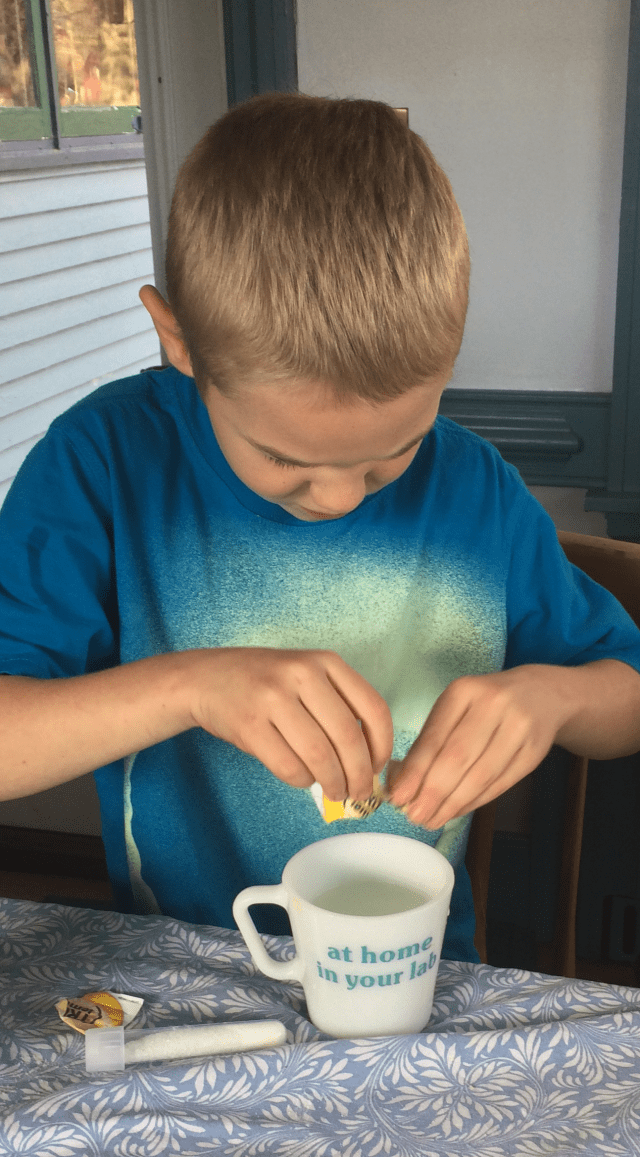 Future scientist tries out the potion receipe.




 Catherine Haustein