Campus stress–all the BS from the outside

I’m writing a novel series about a college for monsters from the perspective of the faculty and this gives me a reason to reflect on what college is about and what creates stress for faculty.

If you look up what colleges do, you’ll read that they are intended to give broad training in arts, humanities, and sciences with an emphasis on intellectual development. Intellectual development strengthens critical thinking skills and personal growth, or at least we can hope.

Faculty guide students in these pursuits. Despite what outsiders will tell you, respecting student differences of opinion is important to colleges and their faculty in creating an environment where learning can take place. However, students ned to learn the material.

Faculty serve as mentors or masters to their apprentices, the students. Faculty mentors, drawing upon their expertise and experience, provide students with invaluable insights into their chosen fields of study. They offer personalized guidance, tailored to each student’s unique strengths, challenges, and learning styles. Through everything from imparting up to date information, career counseling, and “navigating the complexities of academic writing”, faculty work to help students grow and adapt to the modern world.

Faculty often make less than their industry counterparts but are motivated by factors such as commitment to learning and the ability to work with autonomy Most are passionate about their fields, want to contribute to new knowledge, want to help others learn, and thrive on intellectual challenge. I moved to academia from industry because I had research ideas not supported by my industry. In academia, I was allowed to follow my curiosity, engage both sides of my brain, build relationships, and work towards something important to my family—equality.

Stressors on faculty include increased workload, lack of funding, variability in student ability and background knowledge, and constantly needing to learn new technology, including learning platforms. Stressors come from the outside, too. It seems like a lot of people want to remake college to suit their own image and to punish all those unruly faculty members out there.

You’ve probably heard about outside groups which put professors on watch lists. You can scroll through these watch lists and find out that transgressions might include calling out racism, signing a petition, and recognition of pronouns. There might be one incident, reported on a social media platform, and that will be enough to put the offending professor on a list of the damned. 

However, outside groups maybe more covert (as reported by students) and direct their members on how to fill out faculty evaluations. There are also rate my prof sites which are not monitored for accuracy and might even feature evaluations for courses the professor doesn’t teach.

Teachers put up with a lot of BS and not much comes from students.

When you consider that the brain remains in adolescence until the age of 30, it can be reasonable to view these outside groups as predatory. They encourage students to not trust or communicate with their professors and to put faith in their group instead. Some even call themselves ministries. There is one thing they lack: scholarship.

For those who care about scholarship, intellect, and quality of thought, the Iowa Legislature has handed us what could be a state expense lacking scholarship: The Center for Intellectual Freedom at the University of Iowa.

The University of Iowa is my alma mater and like many, I’m not enthused by this center. It seems somewhat haphazard, not particularly scholarly, and possibly too debate focused. Mostly what leads me to these opinions, besides its description and current course offerings, is what those who are involved have to say. Another red flag is that it was dictated by the Legislature, not scholars. It isn’t even an original idea.

At a recent inaugural event paid for by the public, lots of chests were beaten and accusations made. The whole idea of teaching civics isn’t bad, it’s done in intermediate school, high school and even college. The unscholarly part is accusations that the liberals are somehow terrible and need to be replaced. This makes the whole “freedom” idea confusing. At the recent celebratory event, a campus shooting was given as an example of conservative speech being censored but a professor didn’t shoot the man.

Another antecdote hinting at a huge bias problem in higher ed was “the example of former U.S. Treasury Secretary Larry Summers, who stepped down from his Harvard University presidency after suggesting women were less represented in STEM fields because of “intrinsic aptitude.” Summers, who was teaching at Harvard …has stepped away from the university again due to his ties with convicted sex offender Jeffrey Epstein.” (quote is from here.) Personally, sticking up for that particular man doesn’t cast a good light on intellectual freedom.

At the inaugural event (paid for by taxpayers) a speaker from the American Enterprise Institute, a group that advocates for trickle-down economics and limited regulations, was quoted thus,: Katz separated those responsible for higher education’s issues into two categories — “sheep” and “crazies.” The sheep are “almost everybody,” he said, with the crazies at the fringes of both ends of the political and ideological spectrums. Nearly all university faculty fall into the sheep category, and if they follow a bad idea things can, and have, gone very wrong. Crazies used to be a small minority of academic units, Katz said, but now there are more of them and they are “malevolent.”“Don’t hire crazies, don’t be a sheep, and let’s hope that the Center for Intellectual Freedom at the University of Iowa can fix whatever problems there are,” Katz said.

What grade would you get if you gave a speech like that in high school or college?

To quote a student at the event, the speakers didn’t “provide any sort of solid, consistent argument to support the creation of the center.” And “Other(s)… have expressed disappointment in the center’s structure, as its director will have near-total control of hiring professors, inviting guest speakers and other actions…I think that it’s very clear that folks here are not actually interested in freedom of expression,”

Those who have forced this on our state allege college professors are too liberal and not fostering debate. I have news— scholarship depends on new ideas and new creations. Complaining that conservatives don’t have a voice on campus is implying that they can’t engage in scholarship. As for debate as a desirable means of learning, it is not always a useful learning tool and can lead to oversimplification and an oversized emphasis on winning. Debates can cater to the best BSers and create polarization. Dialogue is a better learning experience for most people.

As a parent or student paying tuition for scholarship, intellectual development, and training, I’d be damn mad about these speakers and their baseless claims. I’d be mad about outside organizations preying on students and watch-listing professors.

On the other hand, should you want to do your own research, you can sign up for one of the courses offered at the new Institute. It’s pass/fail and according to the course description, papers will not be graded. Even better, you get a whole class credit and only have to attend 5 of 7 lectures! Another quote associated with the inaugural panel is “Admissions must also be controlled to ensure students “are on board with the mission” of the center.” Looks like this course could be an easy pass for all those who need one.

Bloom’s taxonomy of learning

The Power to Think

At the beginning of the semester, I asked students what aspect of writing they thought they needed to work on. Many said VOCABULARY, which was somewhat of a surprise. Or maybe not. We read writing tips from well-known authors and to quote Madeline L’Engle :  “As our vocabulary expands, so does our power to think.”

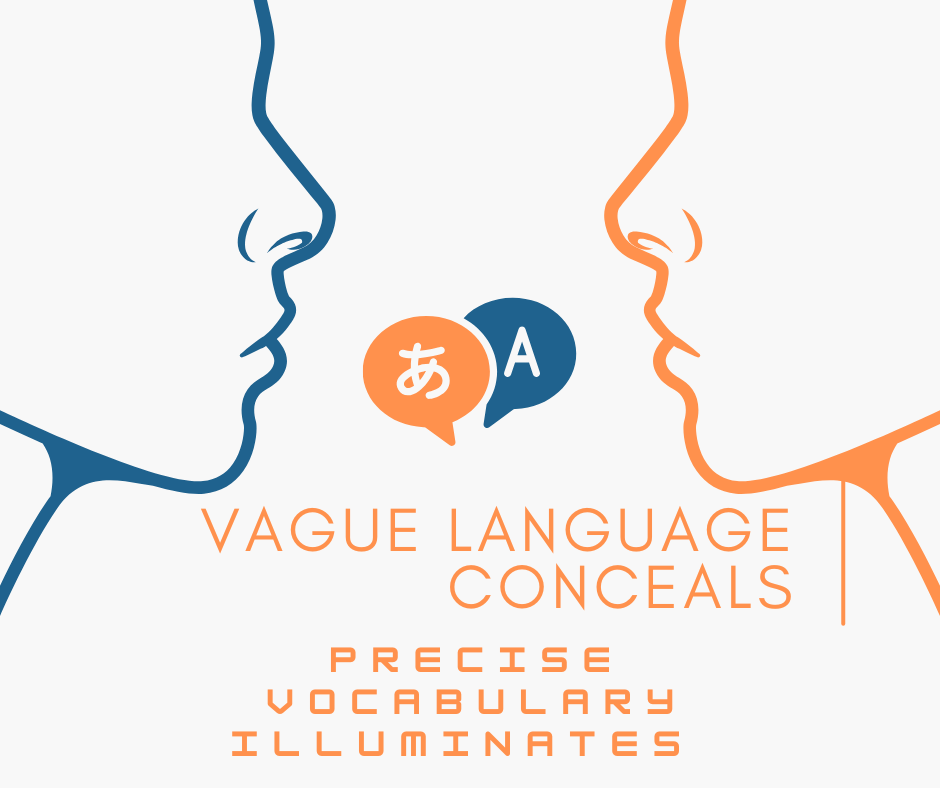
Vague language conceals. Rich language illuminates. In order to be able to communicate, you need a decent vocabulary. Vague language could convey being unintelligent and not able to grasp nuance. It might be a sign of not knowing as when I used “pretty many” to describe a number and my thesis adviser had a fit. It could be a sign of aphasia, a loss of language due to a brain injury.

 Precise language: It’s the difference between a parrot and a pet. It’s the difference between “they” and local government. Vague language can be used to deceive.

You can see vague language when Supreme Court justices pulled  a fast one when asked about Roe vs Wade. Before confirmation they said everything from “It is an important precedent that’s been reaffirmed many times” to saying that taking a position “would undermine my ability to be impartial.”

Here’s where recent news fits in. In my brief viewing of Turning Point USA, the group used vague language. It is more of a slogan spitter than an honest debater. Here is another person’s encounter with them. From what I gathered, TP is more about zingers and bumper stickers than common ground.  That’s why it is vague.

I was once acquainted with someone who worked for a “think tank” and learned that these debates can be ways to test slogans. They are not always for true debate. “Debaters” search for slogans that require some nuance to refute. Those slogans are the best slogans to use when winning is the objective. To quote Goerge Lakoff “an opponent may be disingenuous if his real goal isn’t what he says his goal is.” This disingenuousness can be infectious. It can teach students bad discussion skills and narcissistic arguing that can disrupt a classroom or even education itself.

There are a few tell-tale signs of narcissistic arguing that we should be aware of if an argumentative group like TP or Moms for Liberty comes to town. (And click this link for more about Moms for Liberty. These moms are mean. So mean they are considered an extremist group.) Keep in mind that antagonism is a narcissist’s tool. Shifting blame and bringing up unrelated topics and prior grievances often dominate. And of course, projecting or accusing others of doing what you’re doing is standard for some. Intentional vague language is a hallmark for narcissists.

Not all speech is quality speech. Some is vague. Some is manipulative. And some is just plain mean. If the purpose of an institution is to educate, then organizations promoting vague speech—which limits our ability to think– and narcissistic antagonism should not be allowed near learners.

Vague is the difference between seeing a show and seeing Rocky Horror Picture Show. I recall working at Pella’s Holland Theater when that movie was shown. Pella citizens, one identifying as a minister, came and told us young kids works there that they were sinners going to hell.  That wouldn’t happen with any show. Or in any town.

Honing language takes practice and education. After my adviser threw up his hands at the vague statement I made, I worked harder to be prepared with accurate and precise information.

Kudos to my students for claiming an education in a world trying to un-educate them. Education is a gift. Illumination is worth more than vagueness. To think for yourself, you first have to think.

What’s the missing element in science education?

What makes a kid like science? It isn’t information or government edict, advanced courses, or religion. Yes, a promise of a good job helps kids like me who grew up middle class. but it can’t be all it is, because there are times when science is routine, boring, and demands repetition, because some of the joy of science is being able to predict.

One of my favorite exercises in high school was the bug collection, which had been done for eons. I’m not sure it’s done anymore but I remember just being so fascinated with catching the bugs and classifying them.  I needed to add a twist so future chemist me had this thought that instead of sticking the bugs on pins and putting the pins on a piece of Styrofoam or cardboard, I incased them in plastic. Each bug was set in transparent resin. Giving them a category and finding their scientific name was a whole new language, and an interesting one at that. I remember one kid getting in trouble for turning in an old collection, one his brother had done. The evidence? He had a cicada in his collection that didn’t emerge in the year we were supposed to be catching our bugs. Science triumphed. Why would you ever want to cheat in science?

What’s missing in the STEM education discussion these days is curiosity, and the sense of wonder about and the respect for the whole vast natural world as compared to the engineered world of humans. In fact, respect for scientists themselves is missing from our political landscape in Iowa.

A book on a table

Description automatically generated

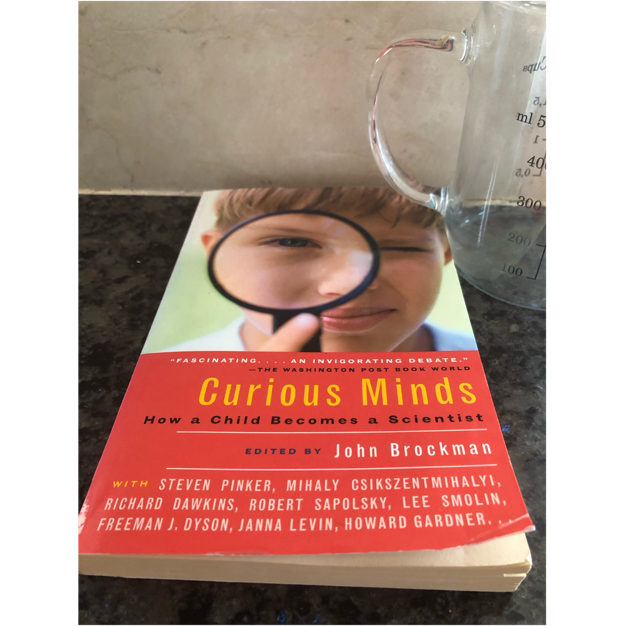
I was just about to put this old book in the Little Free Library near the park. I paused because I wanted to read it one more time. I don’t think enough people understand what it takes to really, really be a scientist and to persist in it. I thought I might, for a post, just go through a few of the entries in that old book and see what scientists had to say about what brought them to science.

For many, it was being in nature itself. One scientist recalled being at a summer camp in Wisconsin and becoming fascinated with amoebas. Looking at the stars was the key for another. One scientist grew up in the California mountains, surrounded by nature. As an aside, Iowa has very few public lands to allow for exploring nature. The state has severely cut back the DNR. One strike against us.

The DNR budget has been cut back for years. Our state parks have fallen into disrepair. This isn’t a great way to encourage science.

According to the book, playing with batteries and wires in a family shed and constructing tic-tac-toe machines gave another his start. Some were from families of scientists, others had parents who never finished high school. There wasn’t a standard path to science. “Scientists are people of very dissimilar temperaments doing different things in very different ways. Among scientists are collectors, classifiers and compulsive tidiers-up; many are detectives by temperament and many are explorers; some are artists and and others artisans. There are poets–scientists and philosopher–scientists and even a few mystics. … and most people who are in fact scientists could easily have been something else instead.”

The scientists highlighted their curiosity,  physical discomfort when there was incomprehension and the ability to be both free and skeptical.

The scientists interviewed pointed to a few factors which helped them along the way—financial assistance and autonomy of thought. Neither of these things will the average kid get from a right-wing authoritarian. What are we getting from our state education department?

In the science homework that I’m seeing in the schools, there’s a whole lot about evidence. What’s the answer? How do you know? And that’s fine. Science is evidence based. But there’s a whole swath of it that’s missing.

Iowa has gotten overly practical about educating kids for jobs, especially ones the state—and no doubt the parents– want them to have. These are often STEM jobs. Manufacturers are even hitting up grade school kids, telling them to work for them when they grow up. But in some cases, I’ve heard students express doubts about a life making poisons and making people fat.

Likewise, long ago the now Iowa Governor came to visit my private school science department to tell us how much she likes science and private schools. I am seeing through a glass dimly here but I didn’t like her because she didn’t get science and was not there to listen to what we had to say.

Now, she acts as if she’s done miracles with STEM education. She might even be the next Secretary of Education, all while ignoring doctors and scientists. In other words, she ignores the informed opinions that scientists with autonomy of thought have given her. This is not anything to model if you want to promote science. She is a Trump supporter and Trump said that listening to scientists is something “only a fool would do.” Instead, you have to listen to the money.

Few people on the Iowa STEM council are working scientists, especially sparse are the natural sciences and basic sciences such as chemistry and biology. I’ve seen some of the curriculum and it has a heavy emphasis on design and engineering. And of course, there are corporate partners and a focus on jobs. It should be called a sTEM Council with a lower-case s. Current science focuses on methodology which many older scientists point out, can be boring. And I really, truly worry about a future where the only people paying for science are people that are making money from it. In the past, the government and universities have been drivers in basic science, the foundation of scientific discovery.

Instead, politicians publicly bash scientists. This in turn causes a public distrust, especially among Republican voters. It’s unlikely that Iowa’s Republicans will look at the evidence. They will instead, create a science-hostile climate for the foreseeable future, making a mockery of STEM education.

A Lesson in (IN)civility

black and silver fountain pen
Photo by Álvaro Serrano on Unsplash

One sad reality of living in Iowa is that our elected ones do not respond positively to all of their constituents. Some of us get what has been described as “scorching” replies. Our elected ones are known for not replying or when they do, they lose their cool.

A Twist on the Everyday is a reader-supported publication. To receive new posts and support my work, consider becoming a free or paid subscriber.

They also seem to have an axe to grind against the public schools. This story begins with elected one Steve Holt, who came to Iowa from South Carolina and owns a Tropical Snow. No doubt this makes him an expert on Iowa schools because he accused public schools of harboring employees who abuse children and teach the hatred of America. Ironically, his wife is a public school teacher who prompted students to walk out in protest—of her! She didn’t mean to offend but from what I can gather, isn’t seeking out any DEI courses to help her understand the students’ point of view. I took an (on-line) DEI course and learned some things about myself that needed to be adjusted. Why be ignorant, even if it’s unintentional? This backstory might help explain the outburst which follows later. The Iowa Governor backs Holt up on his dim view of the schools. You can read the entire story here.

A journalist sent what she intended to be an uplifting message about the local schools to Mr. Holt and copied her representatives.

Here’s what she had to say:

to steven.holt, barb.kniffmcculla, ken.rozenboom

Good morning!

As I watched the news last night and this morning, I was moved to share a couple of experiences with you, Mr. Holt, regarding the way our young people today feel about their country and their patriotism. I have two stories.

Story #1 involved the return of a Pella soldier from his basic training in Alabama just before Christmas. He has a great relationship with his sister, a third grader at Madison Elementary in Pella. She was expecting his return on the weekend, but under the guise of celebrating her half birthday with her classmates, she received a very special gift … her brother all wrapped up in a big birthday box. Here’s the rest of the story. One of the students asked if they could ask Levi some questions. “Of course,” said the teacher. Hands shot into the air, and Levi patiently answered each and every question they asked. Students were excited about his adventure. He was very positive about his training. I heard nothing but positive thoughts coming from all in the room regarding our country, our military, and his young man’s service. It certainly illustrated a love for our country and what those serving us are doing. 

Story #2 happened just last week. As a part-time reporter for the Marion County Express, I was invited to Jefferson Intermediate in the Pella Community School District and Pella Christian Grade School to cover the presentations of the local American Legion post honoring the fifth graders – over 200 of them – who had written essays about the United States flag. Every single one of those students received a folder containing a certificate recognizing their participation, and, along with that, a miniature flag. Several American Legion members were present for this occasion and enthusiastically shook hands with each and every student as they were presented their awards. Respect was shown at both schools for those gentlemen, and the students exploded with cheers of appreciation as the three essay winners were announced. They waved their flags proudly as the gatherings concluded. Patriotism and appreciation for those who have served was evident. 

These two examples are just the tip of the iceberg. Please be careful about making judgments about today’s schools and today’s youth. There’s all kinds of good taking place. And, if you’d like to catch the winners reading their work, they’ll be presenting them at the next Legion meeting on March 25 at 7:30 p.m. at the Legion Hall in Pella. The meeting is open to the public. 

Holt sent a brief note of thanks. She didn’t hear from McCulla. Her Senator, Ken Rozenboom, wasn’t exactly thrilled with her glowing letter. Here is his response:

Thanks for the message.  I agree that so much good is going on in our schools.  But you’re obviously  trying to drive a point home.  I wish we could always deal with schools who are doing the right thing.  But please consider the school issues that have been dumped on us since I was first elected to the Senate 12 years ago:

  • Boys in girl’s bathrooms and locker rooms
  • Boys competing against girls in athletic events 
  • Gender transition surgery for teens 
  • Pure pornography in our school classrooms and libraries, including graphic illustrations of pedophilia 
  • Teaching first graders that the gender listed on their birth certificate was just a guess
  • Schools refusing to open as Covid slowly came under control
  • Masking and mandatory vaccinations of children with off-label, experimental drugs
  • Teaching kids that they were racist just because of the color of their skin  

I didn’t create those controversies.   Some schools and some teachers did.  Are you suggesting that we are supposed to ignore those issues? Please don’t confuse action on those problems with “judgments about today’s schools and today’s youth”.

Respectfully,

Ken

I’d like to address a few things from his list. A few I’ve already covered.

  • Schools refusing to open as Covid slowly came under control

He wrote his letter to a woman whose sister, a teacher, died from COVID before the vaccine became available. Iowa Republicans even banned mask mandates. I was a teacher myself and it was terrifying. And teachers died. People died.

Below: the governor and her mask advisory team of not scientists.

A group of women holding signs

Description automatically generated
  • Pure pornography in our school classrooms and libraries, including graphic illustrations of pedophilia 

Who knows what he is talking about?!  He has barely been in a public school except to show his face campaigning. The aforementioned “cool loser” has never attended a public school. I wish he’d given some peer reviewed citations for his bullet points. Without evidence, I’m left with the impression that the porn accusations can’t be verified.

Porn, it seems, is on a lot of screensScreens. Often people who watch porn have an issue: it might be age, isolation, OCD, or bedroom boredom. Most people don’t watch it for an extended period of time. Exposure to porn has minimal negative consequences, especially when coupled with scientifically accurate sex education, as seen in the Netherlands. For those worried about their porn viewing, reading erotica is sometimes offered as an alternative. That being said, I share some concerns about porn. But I have more curiosity about people who are terrified by porn to the point where they need therapy. Some argue that these people are confusing pornography with sexual abuse, and they really need to focus on the later.  

I’m not a therapist or a porn watcher but I’m trying to understand why a nice letter would elicit a diatribe with many points about sexuality and porn. Some say that fear of porn has roots in childhood trauma and powerlessness. “Unlike erotic scenes in a movie or nude sculptures in a museum, pornography generally involves power dynamic, humiliation and a distortion of the reality around body and sexuality.”     

 The truth is, most abusers are parents or relatives. Teachers are much more likely to report abusers and suspected abuse.The tall tales about schools are part of the scheme to funnel money and minds to private, conservative schools, like the ones who taught Senator Ken all he knows.

The journalist sent specific examples. Senator Ken replied with unverified rumors and repeated blame. In other words, he was disrespectful of the letter writer, our schools, and of knowledge itself. Without documented evidence, we can’t say who created these controversies. Clearly, there are enough people in Iowa who have had trauma and are moved to vote for authoritarians who blame and stoke fear about the public schools and the libraries, evidence or not.

What can be learned from this exchange?