
Efficiency vs people and other living things

We’re hearing a lot of hot air about efficiency lately and as a concept, efficiency isn’t all bad.

For example, chemists talk about atom efficiency which compares the atoms in the starting materials with those in the product. If all atoms are used in the product and none are left, the reaction has 100% efficiency. This is a way to assess waste in chemistry.

A Twist on the Everyday is a reader-supported publication. To receive new posts and support my work, consider becoming a free or paid subscriber.

When I look for a car, I take fuel efficiency into account. Efficiency is great, isn’t it?

Sometimes it is, but the concept hasn’t always been with us. When and where did this idea come from?

In the 1900s the idea of efficiency, a near worship of it, pervaded society. This idea first came from studies of brewing and of machines. An efficient process lost less heat and did more work. Heat wasn’t lost to the surroundings in an efficient process. For example, an efficient engine got less hot and produces more work. Get your motor running with an efficient engine in 1916.
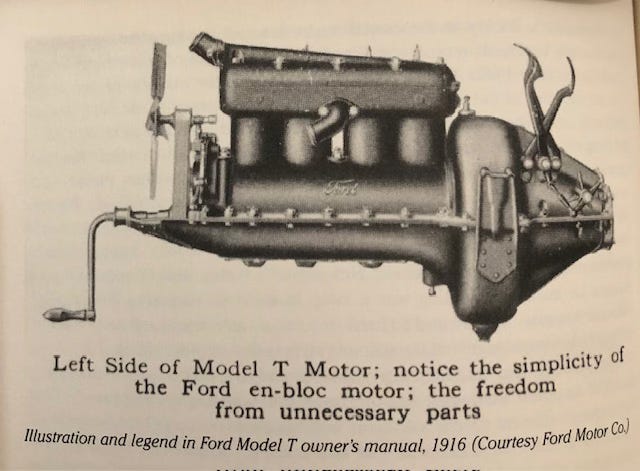
Thermodynamics began in England with James Joule, the son of a wealthy brewer, who studied thermodynamics but efficiency lurched to life in the juggernaut that was American culture. It even bled into management theory.

Everyone had to work and be useful. The idle rich were a problem. Inefficiency in buildings was a problem. According to literary critic and munitions engineer Hudson Maxim, inefficient prose was a problem as well. Take a look at some of these photos and advertisements.
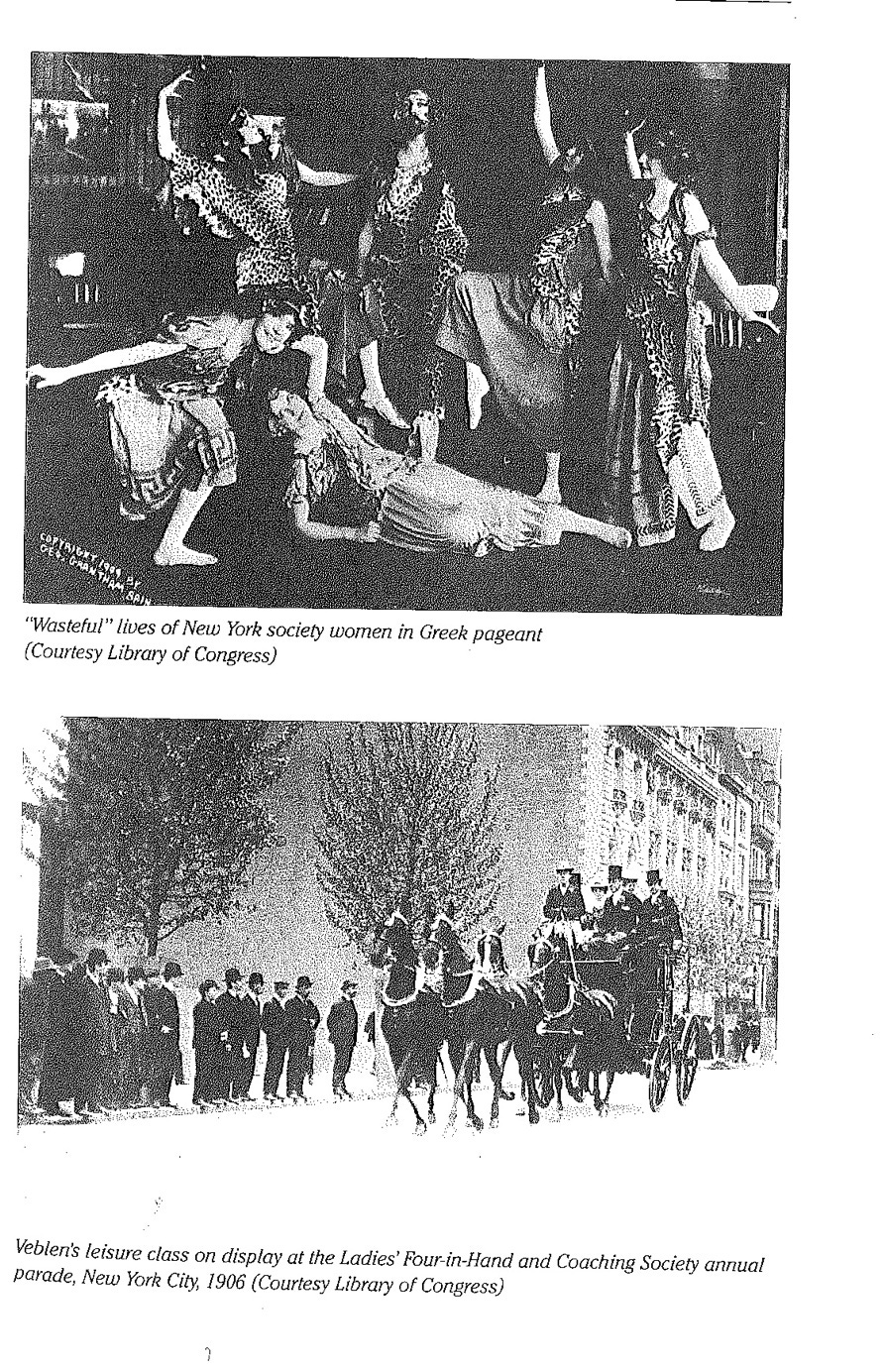
idle rich

One Grecian urn, two Grecian urns, three Grecian urns and a fountain. The inefficient lives of the idle rich, women in particular, were held in contempt.
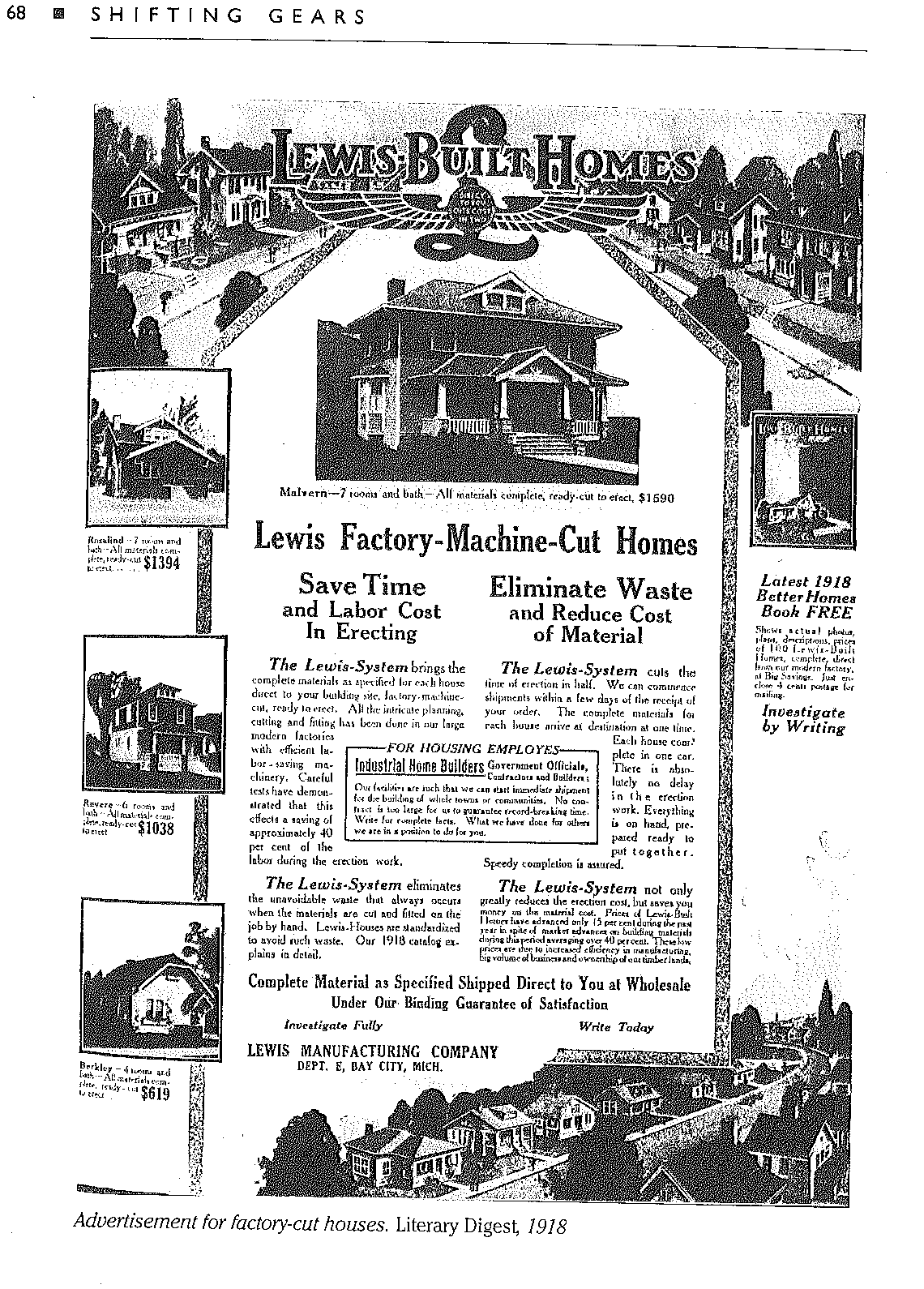
house

I grew up learning that Hemingway was a great writer. His prose was so simple and unadorned–just like a punch in the gut. There were characters barely described and given names like “the woman.” He was in a word, efficient. Believe it or not, this whole notion came from science and technology.

Hemingway came about his efficient prose in an honest way. He was a war journalist and telegraphed his stories back to the U.S.. The telegraph coded letters as dots and dashes and each one cost money. And with the advent of photography, people didn’t need or want the long descriptions of scenery that punctuated older fiction. They only needed enough to set the mood and ground the fiction.

Today, the century old efficiency movement is still with us. We are told to want writing to be sleek, like an Apple product. Some publishers even remove the Oxford comma. Professor Cecili Tichi called this new prose “machines made of words,” adopting the phrase from poet William Carlos Williams. The photos I’m using are from her book Shifting Gears.
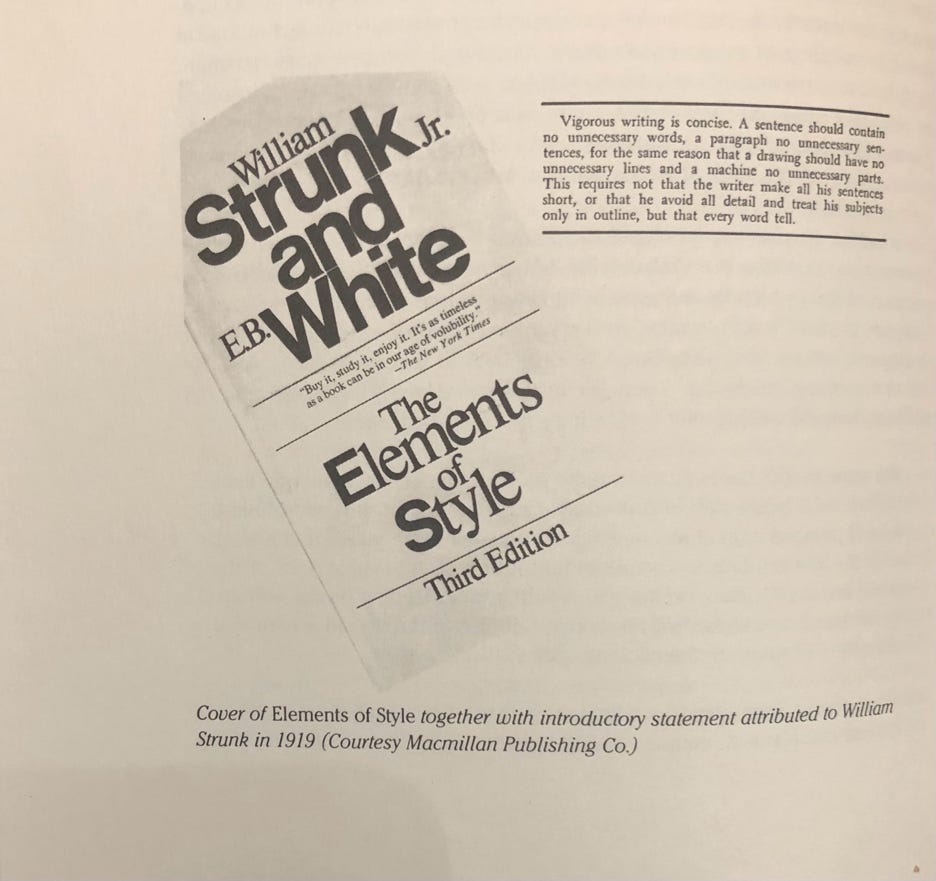
A book with a label

AI-generated content may be incorrect.

I like machines. I get frustrated with rambling and babbling. But sometimes, I want something more delicious. I want the rush of pleasure from abundant words and the keen insights of metaphors and turns of phrase, the dappled light of a brilliant day as was today.
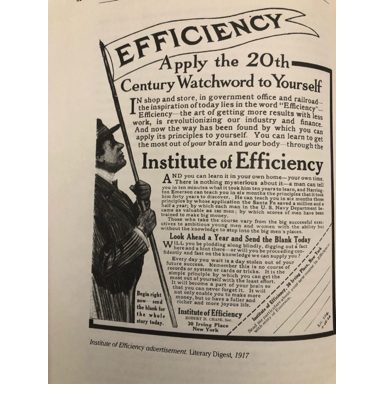
A black and white page of a book

AI-generated content may be incorrect.

Forget long, flowery letters. With the invention of the telegraph and telephone, words counted, ten cents for the first ten words and five cents for the next ten words, and communication was instantaneous. People began writing shorter prose as a result of “telegram style.” Today’s text message style is much the same. Write someone a long, embellished text an see how they react. Long sentences aren’t coming back any time soon.
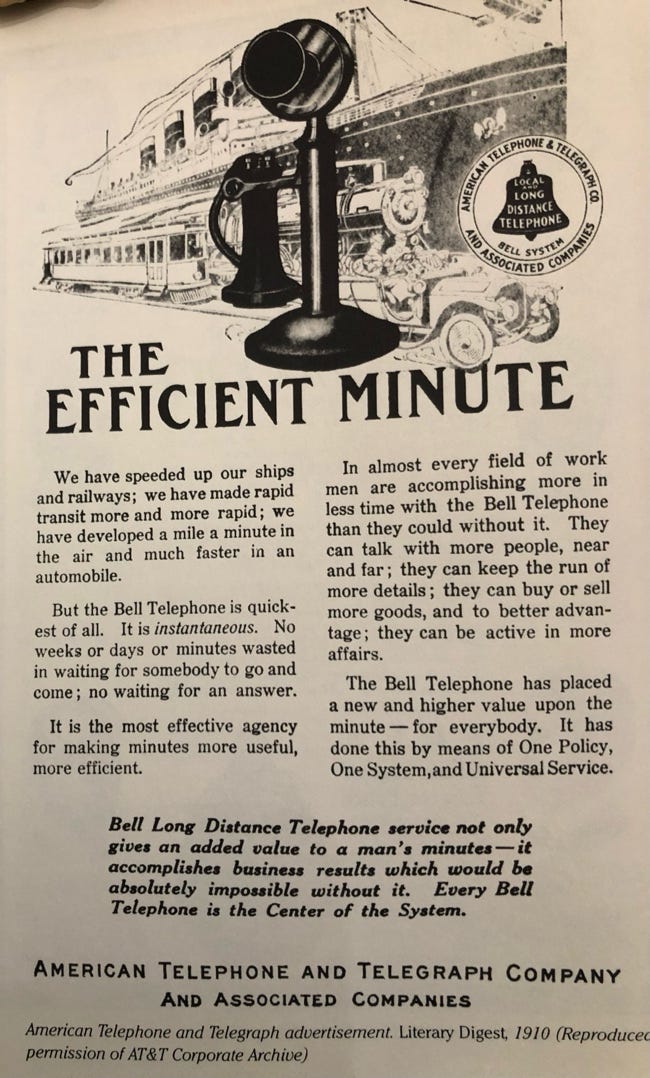
A advertisement for a telephone

AI-generated content may be incorrect.

Here’s what the efficiency experts have gotten wrong—not every engineering principal applies to living things. It isn’t efficient to cut back a workforce and make the people left work 120 hours a week at too many tasks.

A person holding a box and pointing at another person

AI-generated content may be incorrect.

Above: CEO wants to show he’s doing something efficient so he gets rid of people.

Efficiency can be soul sucking, killing inspiration, and innovation. Over-work goes against the Bible. Inefficiency can be as simple as hanging out, building relationships, looking at the sky and wondering. In other words, it can enhance the workplace and our lives.

Efficiency can be dangerous. As companies pursue profit and efficiency, they lose the ability to adapt to change. An example of this over-efficiency can be seen in the almond industry, concentrated in one area of California, or the corn and eggs industries in the Midwest. And if you haven’t read yet about bananagedon, click this link. Consolidation of sources and lack of diversity (monoculture) leaves the food sources vulnerable to disease, bad weather and other forms of instability. Bananas for example, can no longer reproduce on their own. 

Consolidation, while efficient, gives the few producers the ability to raise prices, even when not necessary. We already have seen covid and bird flu blamed for egg price hikes, as markets shifted and the types of chickens remained the same, making them even more likely to experience epidemics. And we only need to look at the dinosaurs or pandas and their limited diet to see that bigger and more specialized isn’t always better. 

Let’s also considering who is telling us to be efficient. It’s often people who themselves have wasteful private jets, boats, and excessive real estate holdings. Additionally, the release of hot air into the environment is a sign of poor efficiency. It’s where the term for insincere speech comes from. There are a few prominent figures who could take a lesson from efficiency and cool off. All those hot takes aren’t doing any work. 

More importantly, society is not thermodynamics. People and other living things are much more complicated than brewing–even if it does involve yeast. Where is the morality in efficiency? When it comes to people, The Bible warns against haste. Applying STEM principals to every facet of our lives won’t make them better, only more stressful. It might even kill us. So embrace those inefficient moments at times, and don’t take personal advice from the opulent hot air emitters. Chill. 
Who’s here for the apocalypse? (My neighbor for one)

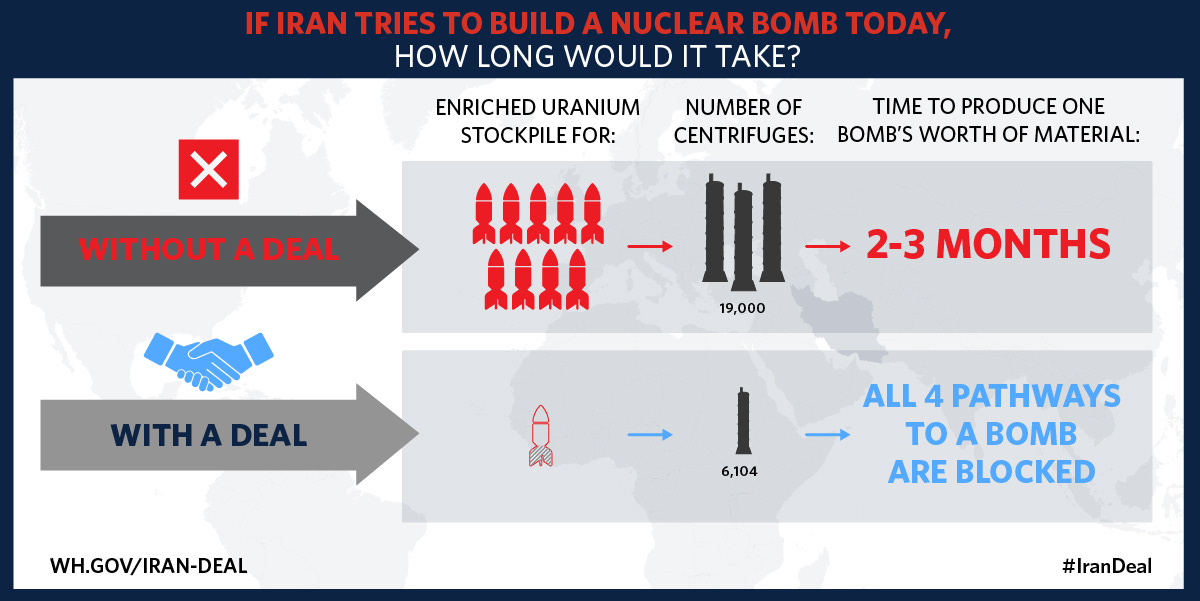
You may have heard of a consequence of the US, in 2018 under Trump, getting rid of the Iran Nuclear Deal. The deal, made by the Obama Administration, limited and surveilled Iran’s nuclear capacity. Netanyahu, Israel’s Prime Minister, did not like the nuclear deal—saying it could bring another Holocaust. The reason he had for his qualms was sanctions on Iran were lessened and they got financial relief for their concession. Israel had approved the deal but he represented new leadership. As a consequence, he wouldn’t negotiate with Biden (who did not bring back the deal) for peace in Palestine and is happy Trump won. Trump has a policy of maximum retribution to Iran.

The above graphic is from the Obama White House

The outcome of the having no nuclear deal is maybe a bust. Iran’s nuclear program is getting no surveillance. They don’t care about our feelings and thus, Iran has made enriched uranium. They are close to making it weapon-grade. What is that and why should anyone care? Sit back for a science lesson. (or skip to next paragraph with a bold font if you want to avoid it)

Uranium is a dense heavy metal that decays–meaning it’s radioactive and gives off particles and energy and transforms into a slightly lighter metal, thorium, which is also radioactive

It emits an alpha particle, the Mac truck of subatomic particles, which is also a helium nucleus. This is where earthly helium comes from! All forms of uranium are radioactive, but not the helium it emits. Don’t worry, your party balloons are safe. (If you want to learn more about sub-atomic particles, let me know!)

Uranium is unstable and thus radioactive. The word radioactive was coined by the Curies in 1898, with radio being related to ray as in a ray of light Many radioactive elements and nuclear reactions cause their surrounding to glow due to their energy. Uranium is slowly radioactive with all isotopes having long half-lives. It can be found in deposits across the globe.

Uranium can be made into a source of power when it undergoes fission. During fission, the core of the atom (the nucleus) is hit with a neutron and split into smaller pieces and new lighter elements are made. The lighter elements are more stable and the energy needed to hold the large unstable uranium together is released. More neutrons fly out and if enough atoms of the right isotope of uranium are nearby, they split other uranium atoms. A chain reaction ensues and this keeps the energy release going. If the reaction is fast enough, a bomb is created

Here’s the catch, not all forms of uranium undergo fission. Only the isotope with 92 protons and 143 neutrons in the nucleus, uranium 235 or U-235, is unstable enough to be broken in this fashion. And it’s not very plentiful. Only 0.7% of naturally occurring uranium is this isotope. And to allow for the chain reaction to occur, you need to concentrate this form of the metal. This is needed for both weapons grade and power reactor uranium but weapons grade uranium needs more concentration aka enrichment. This is not easy. Why does it take so much work? Chemical reactions occur with the outside of the atom–the electron cloud. This is an easy way to separate chemicals–by their different reactivities due to different electron clouds surrounding them. 

All isotopes of uranium have the same cloud of 92 electrons. This means the isotopes have to be separated by mass. The uranium is reacted with fluoride and forms a gas, then is passed through a porous membrane which only lets the smaller 235 isotope through. Alternately, it might be centrifuged. There are a few other less efficient methods of enrichment. This process demands lots of energy. Monitoring the energy use of enrichment facilities is one way to watch to see if a country is working on producing weapons grade U-235. 

What’s going on in Iran? After the Iran-Nuclear deal was trashed, they used centrifuge technology to enrich uranium to a concentration of 4.5%. The allowed limit with the Nuclear Deal was 3.67%. However, it takes 90% enrichment to make a bomb because a bomb reaction must go faster with more U-235 atoms close to each other. Getting to this level is a huge challenge needing a high tech centrifuge. Yes, Iran can get there if the nuclear deal remains sour for years and apparently, it will.

Right now, the world has a surplus of enriched uranium because of the many enrichment plants world wide. This is why tech billionaires want to use nuclear-powered AI. It will be fairly cheap. What country has a surplus of weapons grade uranium? The United States. We are sitting on a “gold mine” so to speak. Germany, the Netherlands, and Japan also have plenty of the stuff.

Scientists worked hard to create the bomb. Some did it unknowingly and others suffered remorse at how it was used. Scientists approved the Nuclear Deal, they supported it, and scientific collaboration is suffering at its end.  The end of the nuclear deal helped Trump achieve victory by gaining support from Arab-Americans and from his overseas pals, who are willing to make others suffer to achieve power. 

I suppose that’s nothing new but disappointing for idealists everywhere. People are terrible—they will draw out a war to get their way. Fortunately for me personally, I’ve been a scientist for so long, I no longer score in the idealist category on personality tests. That influence came from my educator parents. I’m one of those pattern seekers. I play the long game.(click for vacation photos). 

You know who also plays the long game, Christian Nationalists. They now have the president who has promised to bring the apocalypse. Yes, he did. And some of them are here for it, as this flag in my neighborhood shows. It says: The final chapter God Wins.

Here’s a view of a similar one.

It might seem harmless but look up Christian Nationalism. They are planning on seeing the Final Chapter, as in the final chapter of Revelations, which ends in destruction and god and angels coming down. The Apocalypse. You can read about these folks cheering on the apocalypse here. And by the way, they hate Jimmy Carter. 

I saw apocalypse flag flying homeowner today as we both walked our dogs. We look similar when out walking. Our paths didn’t quite cross or I would have asked her to explain more about the flag.

Do I really think the apocalypse is at hand? No. It would ruin the world economy and that’s the last thing the autocrats want. But according to the Bulletin of Atomic Scientists, it’s 90 seconds to doomsday. Better stock up on necessities, maybe a water purifier, and get your vaccines while you can! And personally, I’m going to cut back on social media because it’s full of inaccuracies and products I don’t/won’t need.