

I’m really lucky that my kids took me to Missouri and into the center of the path of the total solar eclipse. I sometimes get the hint that they aren’t sure I’ve had enough adventures yet, having been a lowly professor who was dedicated to my job. Until this time. I was sure that eclipse viewing close to totality was good enough. I was wrong.
We went camping at the Sam A Baker State Park. It’s not close to any major city and the crush of people they expected didn’t show up in force, although the campgrounds were full. We camped and although I’d prefer a luxury hotel, it was worth it. The park was pretty and well kept. The spring ephemerals were in bloom.
We attended a lecture about the eclipse given by a retired astronomy professor. We learned that one special thing about this eclipse is that the moon was very close to the Earth (perigee) and the sun far away (apogee). This made it possible for the moon to totally cover the sun. (An annular eclipse doesn’t meet this requirement). I also had no idea that the moon has a titled elliptical orbit, as does the earth, which is why an eclipse occurs in so many varied places. This also explains why they are more likely to occur when the Earth is titled towards the sun, which means they are rare in winter. Here’s a map of upcoming eclipses. He stressed that we needed to wear eclipse glasses to prevent us from going blind, but at totality, we could take them off.
He also told us to look for Baily’s Beads and talked a little about solar ejections (coronal mass ejections.) The later has the potential to disrupt telecommunications and navigation devices. This is called a Carrington Event –one melted telegraph lines and sparked railroad tracks during the US Civil War. The world is anticipating another one, with a scary scenario. Using their best predictive powers, scientists are working to predict the next super storm.
We had no cell service and hadn’t gotten a weather update in days. Starlink traveled overhead but we couldn’t get a connection, only a reminder not to subject ourselves to the whims of billionaires. People asked the wise professor the inevitable. “What’s the weather going to be like?” He echoed what a man selling firewood had predicted. “It’s going to be perfectly clear.”
Poking fun at conspiracy theories, we donned our tinfoil hats as we waited for the eclipse—totality was to occur about 2 pm.
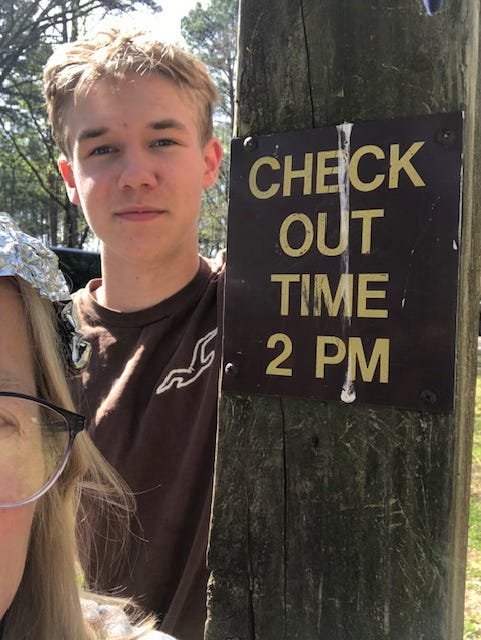
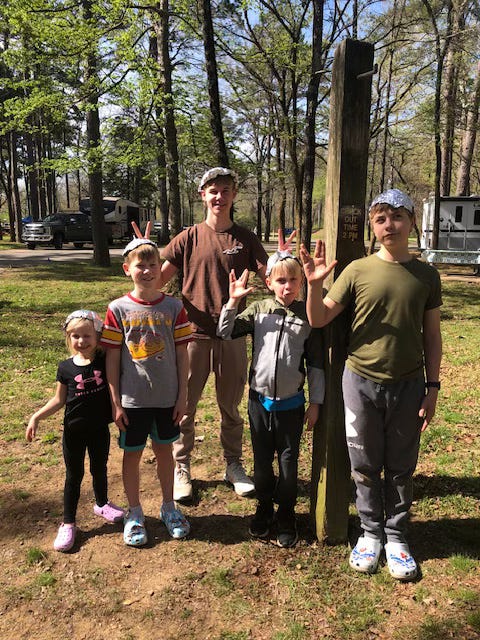
Sometimes, it’s hard to muster a sense of awe, but with cool breeze and eerie shadows, the eclipse caught us in its snare.

Moon-shadow basking.
We weren’t prepared for the weird and surreal moment of totality. Without a sunset, darkness fell as if a switch was thrown. We dropped our glasses, under the spell of the darkened sun with its dazzling corona. Had I been alone, I might have cried. Stars came out. Crows cawed. A frog chirped. Humans yelled at the raw moment of cosmic wonder. Within 4 minutes, the sun peeked out and the light came back in a rush.
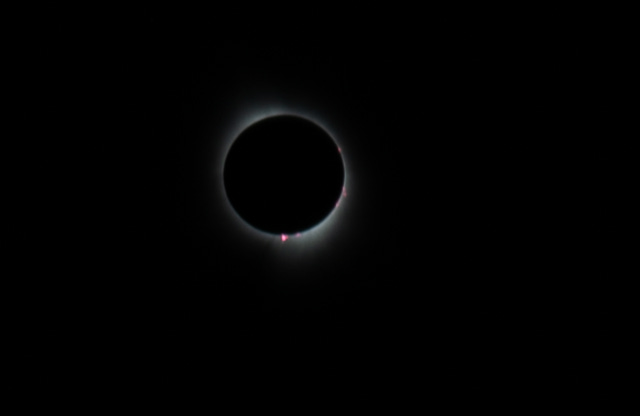
(photo on location by Paul Van Zante)
We headed for home, avoiding St. Louis and its traffic. Back roads put us behind an hour, not bad considering all-nighters experienced by some.
During the long car ride, I sat there thankful for the experience. I was grateful to the professor and his insights. It made me proud to have been a professor. Without understanding of an eclipse, it would have been a frightening experience. It’s good to be reminded that we really are at the mercy of the universe. Science has helped make nature appear less capricious, but every bit as magnificent.
 Catherine Haustein