Lessons from the redwoods

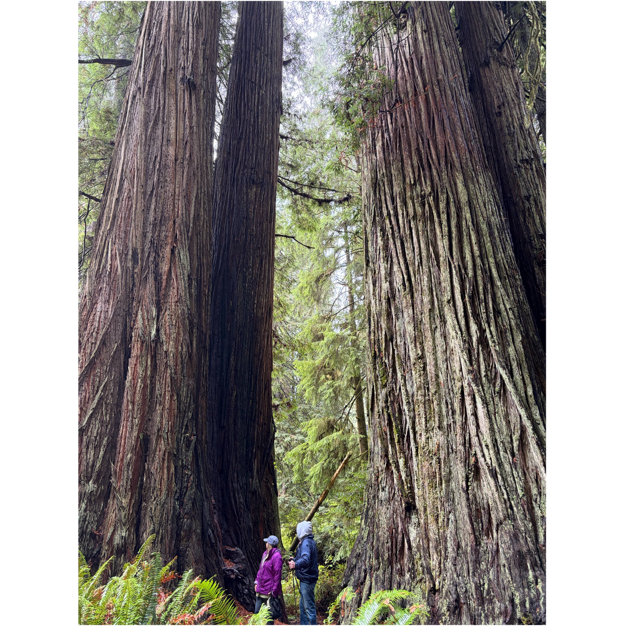
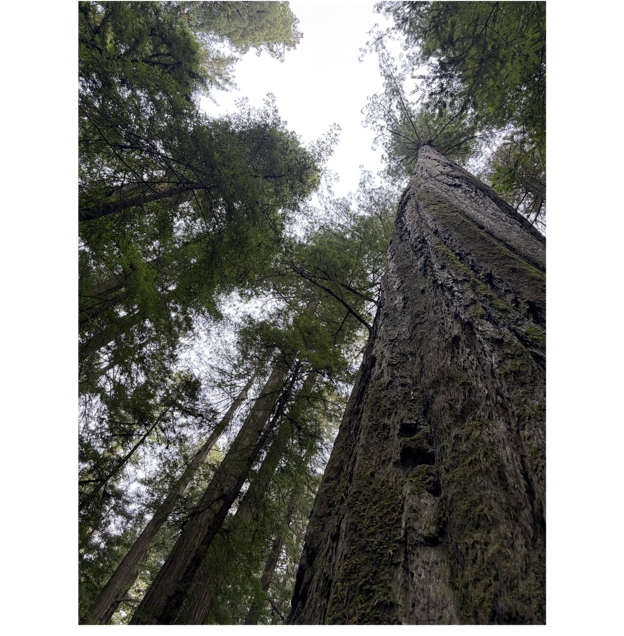
I went to see the redwoods and if you haven’t been there, you must go. Breath in their magnificence —the air around them is so fresh. In the redwoods, my harvest weary sinuses cleared and my jumbled mind unraveled. These trees don’t live near a major city—the coast of California with the coastal redwoods is punctuated with small towns and harbors. A feeling of peace and majesty descends on you there along with the fog. The trees have an intimate relationship with the fog. It provides up to 30% of their water.
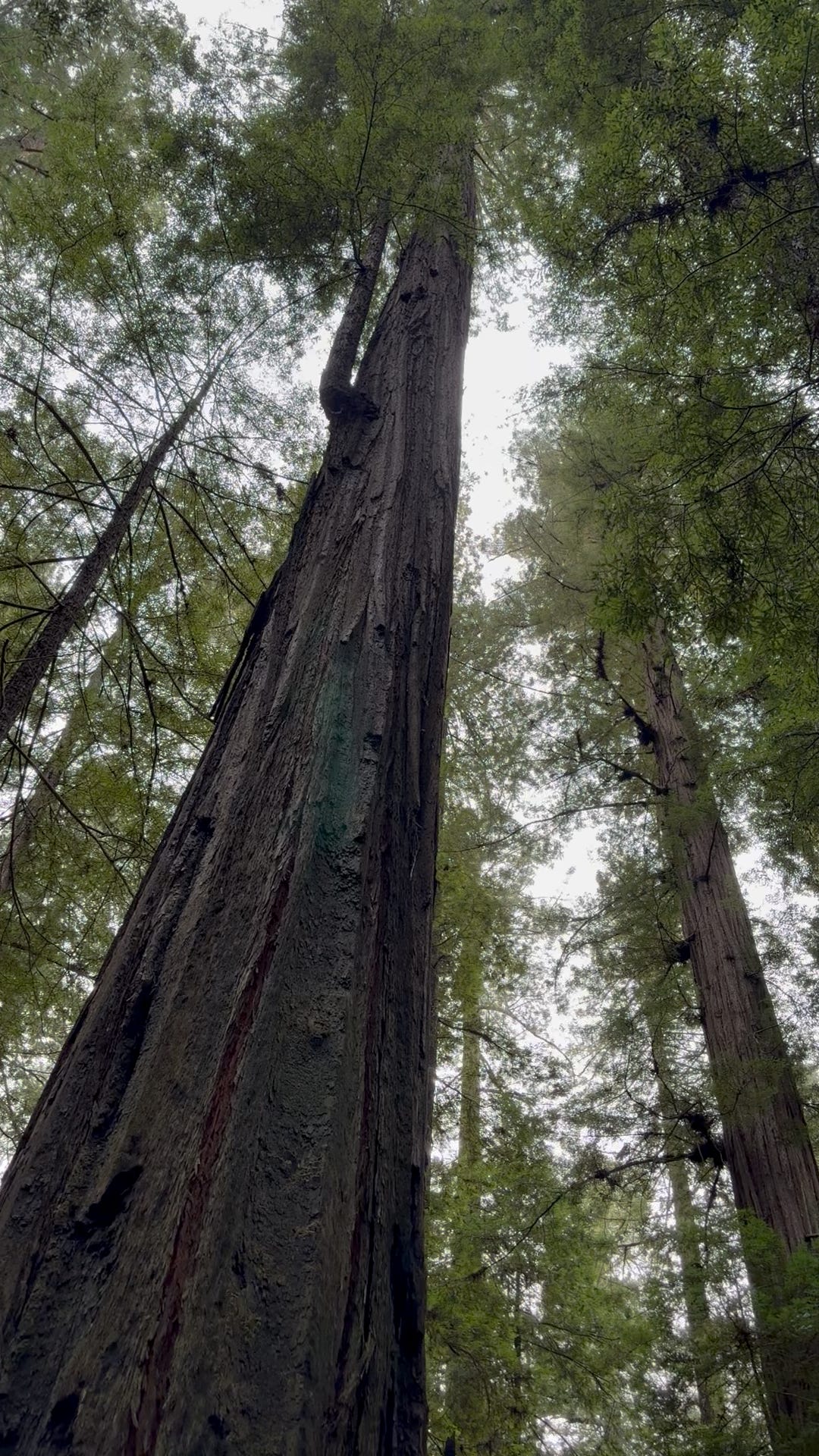
A group of trees in the forest

AI-generated content may be incorrect.

Big Tree is a favorite stop and one of the trees that helped promote awareness of the need to save the redwoods from logging. By the time people began working to protect the coastal redwoods 100 years ago, 95% of them had been cut down.
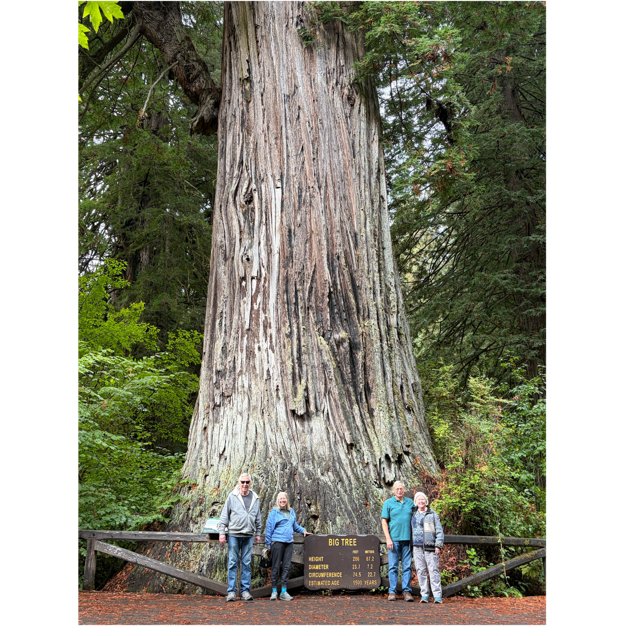
A group of people standing in front of a large tree

AI-generated content may be incorrect.
A book on a wood surface

AI-generated content may be incorrect.
A close-up of a sign

AI-generated content may be incorrect.

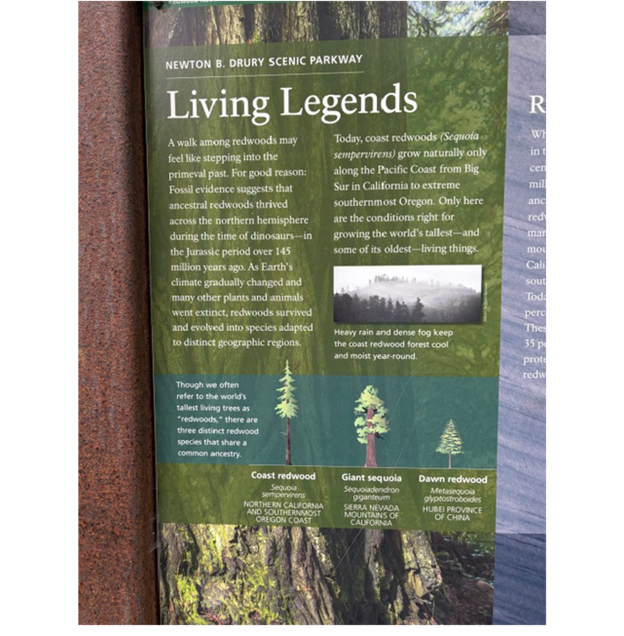
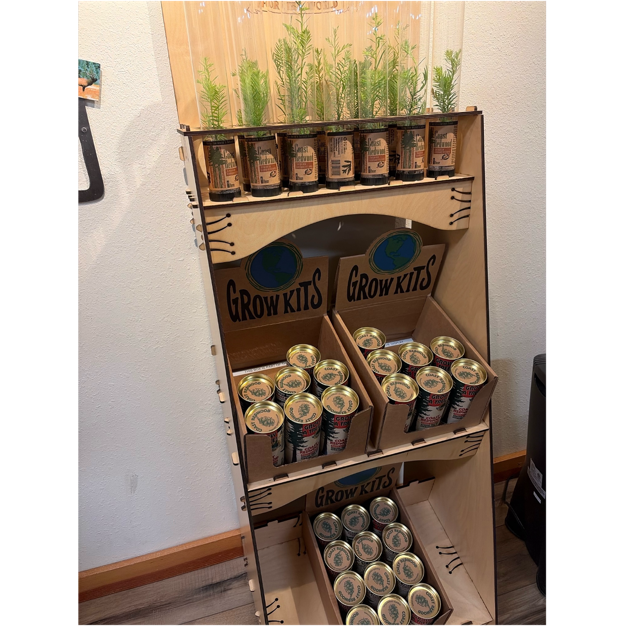
There are three varieties of redwoods. The coastal redwoods are the tall ones, the giant sequoia have fatter trunks, and the dawn redwood, found in China, is a smaller version of these glorious trees. Various ranger stations and tourist traps sell seeds and baby trees. I wasn’t confident I could bring a coastal redwood back to Iowa and keep it happy, so I opted for a dawn redwood seed.
Humbolt Redwoods State Park features the Avenue of the Giants Auto Tour just off of Highway 101 and contains trees up to 2000 years old that have never been logged. These trees have stood up to fires, insects, and floods. We traversed the Northern most part of it and took time to visit some of the picturesque small towns along Highway 101as well.

One tourist trap, Trees of Mystery, has a notable collection of native pottery and information about the tribes that once inhabited the redwoods and this continent.

The area also has casinos and gas stations owned by the local tribes. It wasn’t until the 1960s that the redwood forests became state and national parks and the tribes were able to recover land ownership.

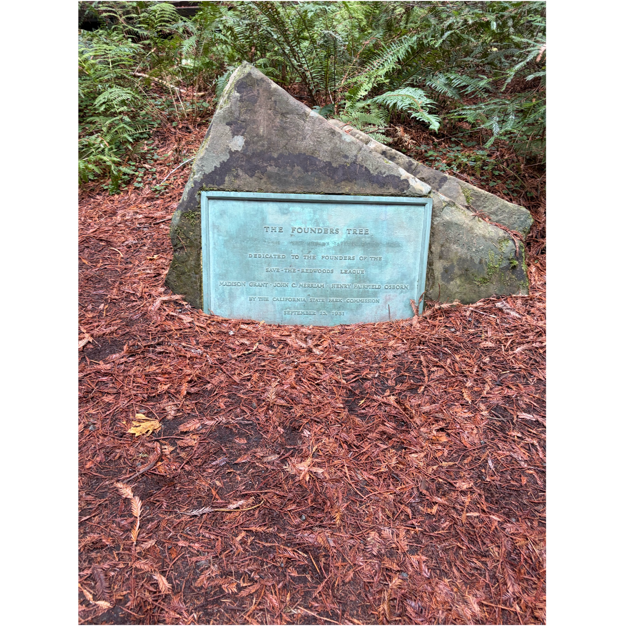
Saving the trees took an immense amount of effort by all sorts of people—some standing in front of logging equipment and taking companies to court, others buying up the forests and donating them back to the state. Women’s groups in California were at the forefront of the effort early in the 1900s, but people have been working to save the trees, including the founders of the GAP, even into this century.
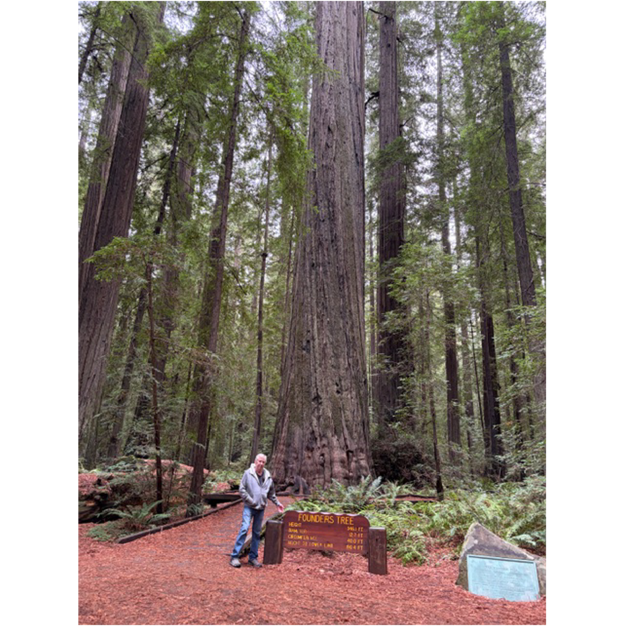
A person standing in front of a sign in a forest

AI-generated content may be incorrect.
A plaque on a rock

AI-generated content may be incorrect.
A tall tree in the forest

AI-generated content may be incorrect.

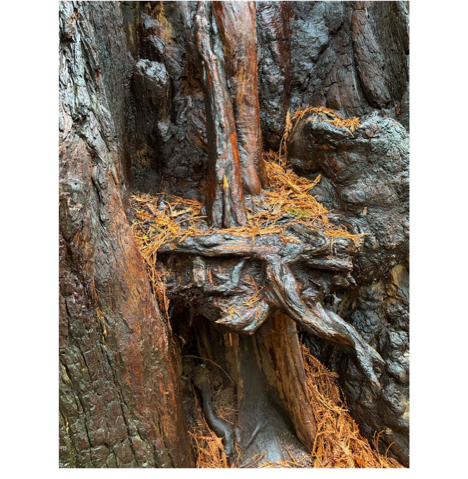
These huge trees grow burls when injured and stressed. You can see how red the wood is when looking at this burl. The tree litter is known as duff or sorrel.
A close-up of a tree trunk

AI-generated content may be incorrect.

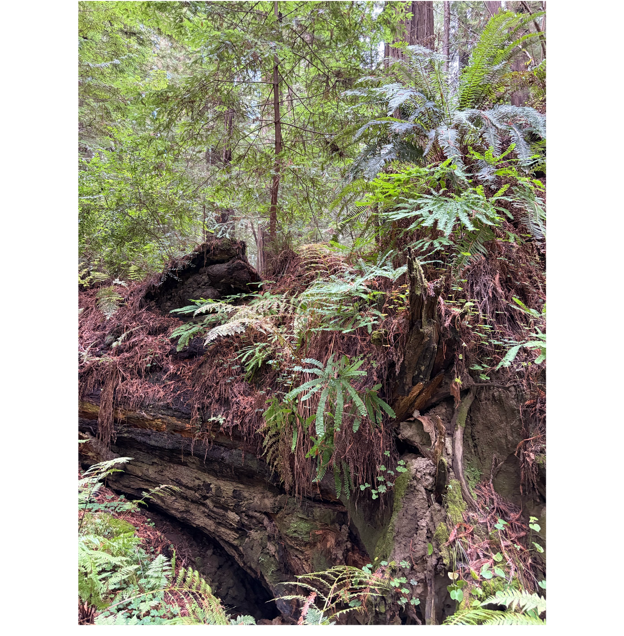
As shown below, the roots of the coastal redwoods are fairly shallow. Over the centuries, the trees sustain some damage and still they persist.

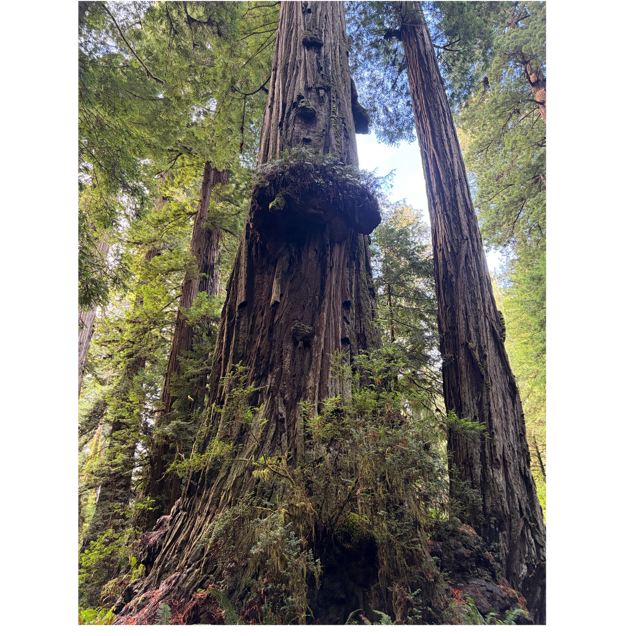
Redwoods have shallow, intertwined roots and although they produce seeds, sprouts from burls are the major way they reproduce.

A large tree stump in the woods

AI-generated content may be incorrect.
A large tree with moss growing on it

AI-generated content may be incorrect.

Above, sprouts pour from a burl.

A group of plants and trees

AI-generated content may be incorrect.

Take a look at some of the cross sections and see the passage of time.
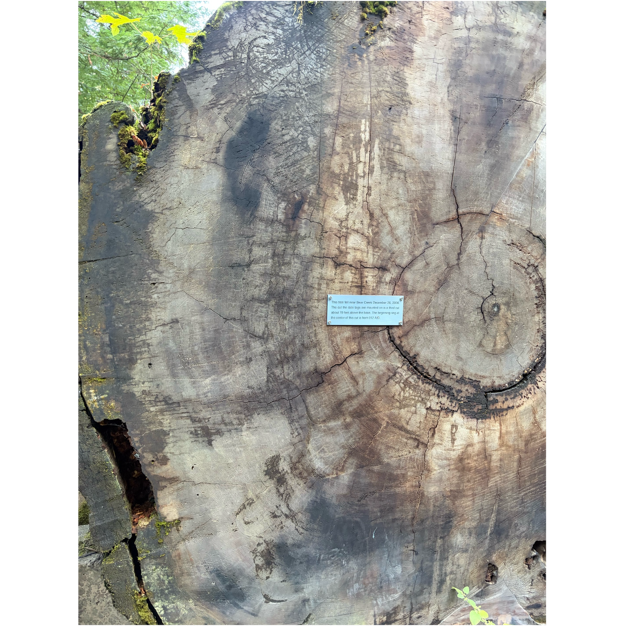
A piece of paper on a tree stump

AI-generated content may be incorrect.

Thanks to the collective will of the people of California and elsewhere, these trees persist and reproduce. But it takes constant vigilance, and appreciation of them.
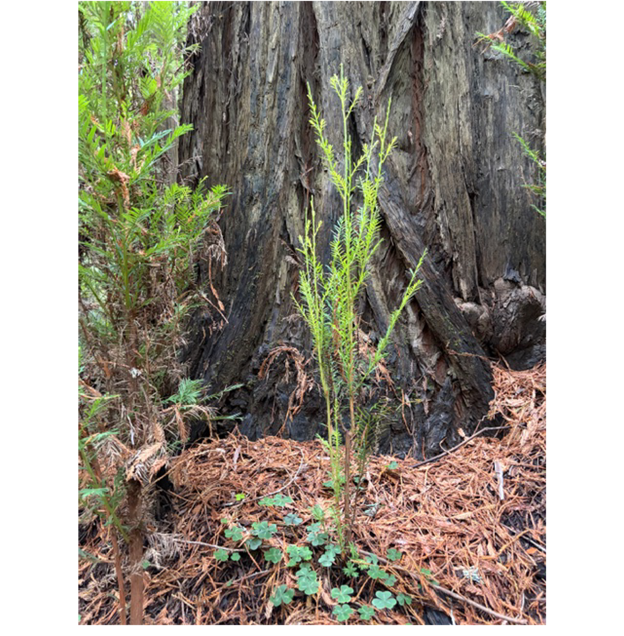
A tree stump with a small plant growing out of it

AI-generated content may be incorrect.

We have relatives from Portland who came with us and guided us on the trip. We drove along Oregon’s beautiful coast, staying in the small town of Bandon. Sadly, we had to walk out of a diner there because Fox News was on tv but we found a great seafood place and had a lovely seaside view.

A view of a parking lot from a balcony

AI-generated content may be incorrect.

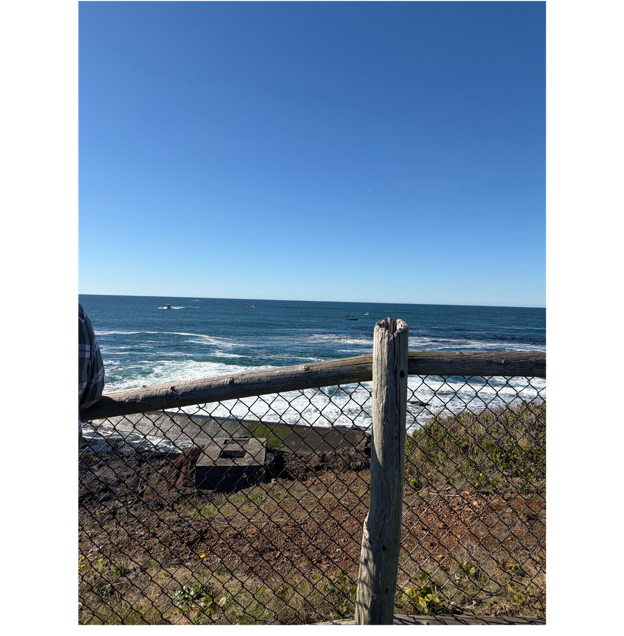
We stopped at a light house/Coast Guard facility, had more seafood at Newport (home of Rogue Brewery) and even though it was early in the season, we saw some whales at a distance.

A bowl of soup with shrimp and spices on a table

AI-generated content may be incorrect.
A white lighthouse with a truck parked in front of it

AI-generated content may be incorrect.
A fence with a wooden post and a body of water

AI-generated content may be incorrect.

We flew in and out of Portland. Portland has a beautiful airport (see photo below) and is not a war zone. (Although possibly someone is trying to make it so. On the return trip, the air national guard was flying obnoxiously.) It’s horrible to have whole cities, and even states, lied about and subjected to unwanted occupation. Fortunately, people in this country know how to work together to save the trees and even democracy.

In praise of unisex and how to achieve prime monogamy

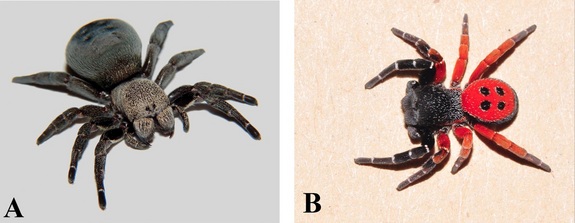
I’m not the first one to wonder why in humans, it’s often the females who adorn themselves. It’s not natural and you need to look no further than newly discovered Eresus hermani

to see yet another example of this.  Which one do you think is the female?

You guessed it. The one on the left. According to biologist Paulina Mena “Evolutionarily speaking, sexual selection has to do with investment in reproduction. The mode in nature is that females invest more in making gametes and in many cases in parental care than males. This means that females maximize their reproductive success by being choosy. This is what leads to the elaborate adornments, bird songs, dances, etc. in males. They are trying to be picked.”

Of course, as my anthropologist/sociologist friends point out, not all human cultures put an emphasis on female adornment. In some cultures, males and females are equally adorned or not and in others, the men are the fancy ones.  Jeff Bass points out that “There is a general observation that there tends to be less gender equality (or more female dis-empowerment) in societies based on intensive agriculture.” This possibly comes as women are less central to economic production, and is less of a factor in industrialized countries where there’s plenty of work for women to do. In this case, adornment is less important.

When males and females look different, it’s called sexual dimorphism. (Sexual dichromatism is the term for different coloration between males and females.) As far as humans go, we don’t have exaggerated sexual dimorphism. Some studies have suggested that when males and females look similar to each other, there is less fighting and competition among males. Is grooming oneself, trying to look different, encouraging competition? If we were a gender neutral society, would we be more peaceful?

Ever since Darwin brought it up in 1871, there’s been debate on WHY certain mates are chosen over others. Sometimes, it depends on parental involvement. If the female invests more, she’s the picky one. If males invest more (as in seahorses), it’s the male who is picky. Evolutionary biologist Paulina Mena says, “Biologically speaking, it’s not so clear-cut where humans stand in this spectrum. We see females adorning themselves but the fact that males don’t wear makeup doesn’t mean they aren’t trying to get females to choose them by showing something off. They just do it in a different way. Working out to have a very athletic body could be considered the equivalent. For example it has been proposed that even intelligence and artistic expressions like music may have evolved as a way to impress females and be chosen as mates. This offends some people because they don’t want to think that cultural expressions may have its origin in sexual selection. But then again, the idea that females are driving evolution through being choosy was also something that upset people until kind of recently. They had a hard time accepting that.”

Like many animals without distinctive dimorphism, white storks are monogamous–for a while.

Monogamy is the primary type of pair bond for humans, and this is prevalent across societies. When looking back at our ape ancestors, monogamy is more prevalent when the males and females have less physical differences. To quote: in primates, minimal levels of sexual dimorphism in body weight and canine size are generally associated with monogamy and low rates of male antagonistic competition (e.g., gibbonsHarcourt, 1981) Gorillas on the other hand, where males are twice as big as females, are not monogamous.

Smaller testicles related to body size is also correlated with monogamous species.

There’s been speculation on the driving factor behind some of today’s weirder cosmetic surgery trends. One theory is that the participants are trying to enhance sexual dimorphism and have taken it to the extreme. It could follow then, that those who take their procedures seriously would be more antagonistic and less faithful.

As an author, I sometimes have to make a choice for my characters: settle down or be libertine. Most readers of novels do not like unfaithfulness. The idea of romance especially is to successfully pair bond. I will make sure to avoid having any heroes with big balls or surgery and take it from there.

For more discussion, go here.

Dune Days of Summer

I spent my childhood in the Great Lakes dunes, climbing them and watching the dune creatures including numerous spiders and ant lions. Mostly what I remember is the joy (and challenge) of climbing and the feeling of being isolated, except for the company of my best pal, Kathi, who shared my love of nature and curiosity.

My son inherited the dune joy and when he and his family proposed a trip to Western Michigan including my hometown of Holland (and beloved relatives) and Sleeping Bear Dunes, I jumped at the chance.

For those unfamiliar, the dune ecosystem is characterized by shifting mounds of sand. It was formed by glaciers and can be parabolic or perched.

The Holland area features the parabolic dunes which extend all the way to the shore and provide beautiful beaches.

.

People on a beach

AI-generated content may be incorrect.

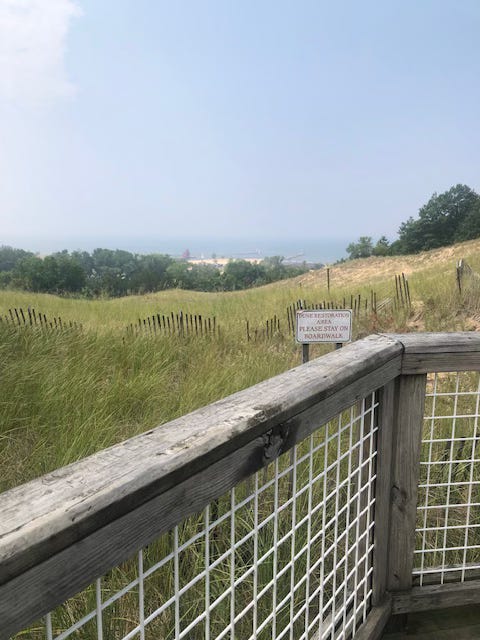
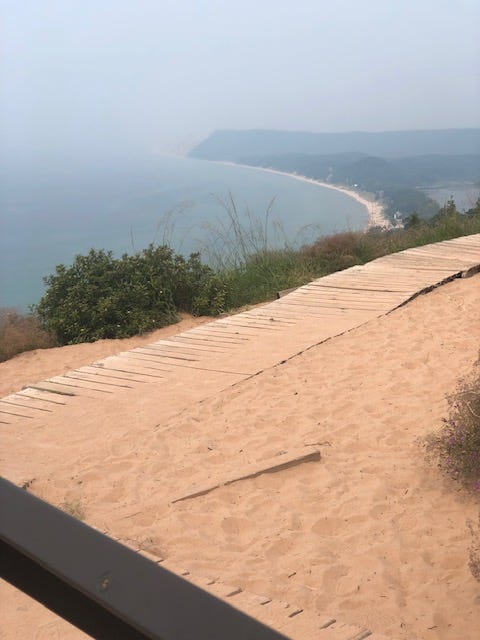
We did more hiking in the Sleeping Bear Dunes, perched dunes with some rigorous and beautiful hikes.

A wooden path on a hill with a body of water in the background

AI-generated content may be incorrect.

Skies were hazy. Thanks Climate Change fires.

Some trails are easier than others and well stabilized. This is a National Park after all.

A person standing next to a sign

AI-generated content may be incorrect.

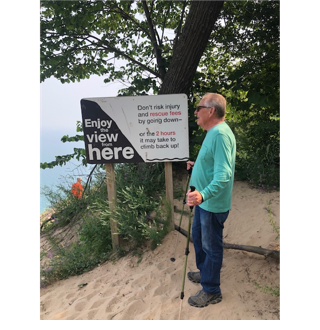
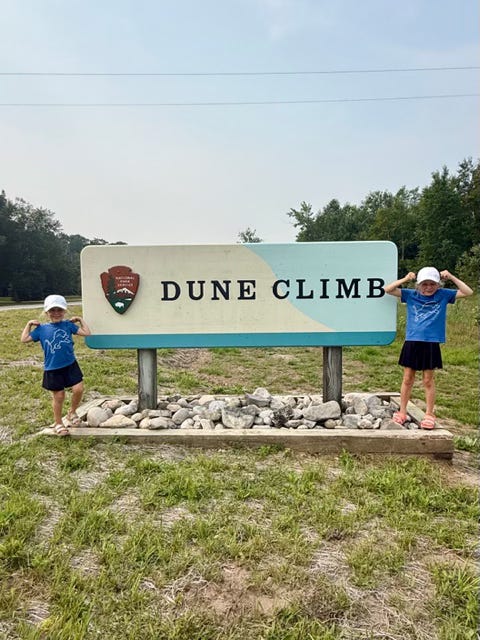
The dunes range from 200 to 450 feet tall (on the Dune Climb shown in the next photos. Don’t go down if you can’t climb up. Sand isn’t easy to climb on because it isn’t stable. If you need a rescue, the rate is rumored to be $3,000. Here I am below (front), displaying my dune climbing skills.

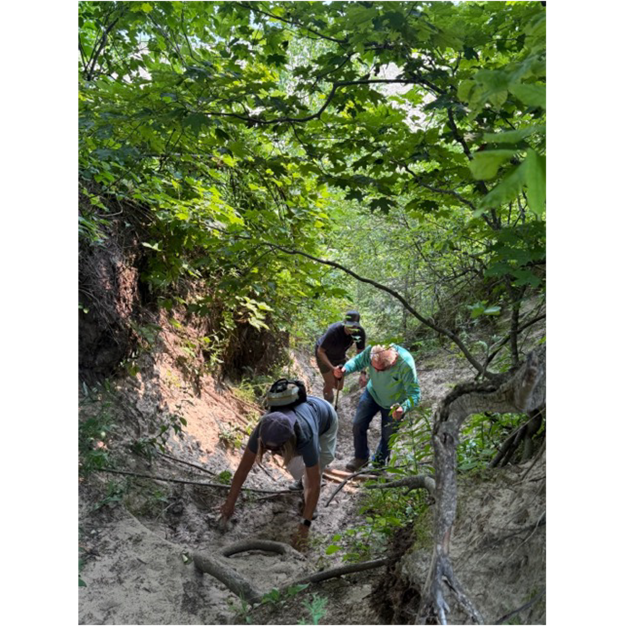
We made it back after taking a less easy path.

A group of people walking through a forest

AI-generated content may be incorrect.

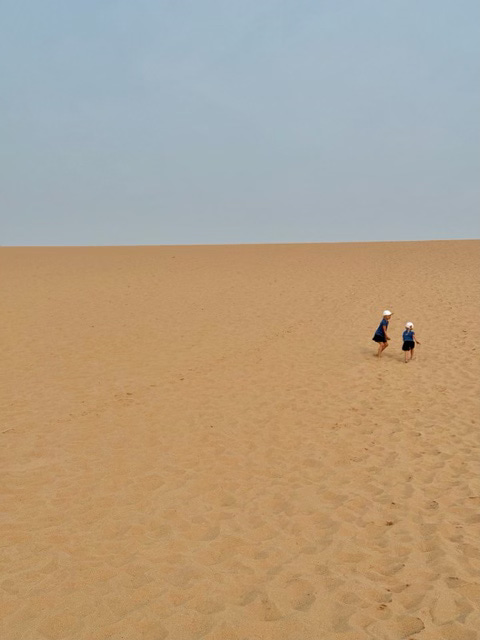
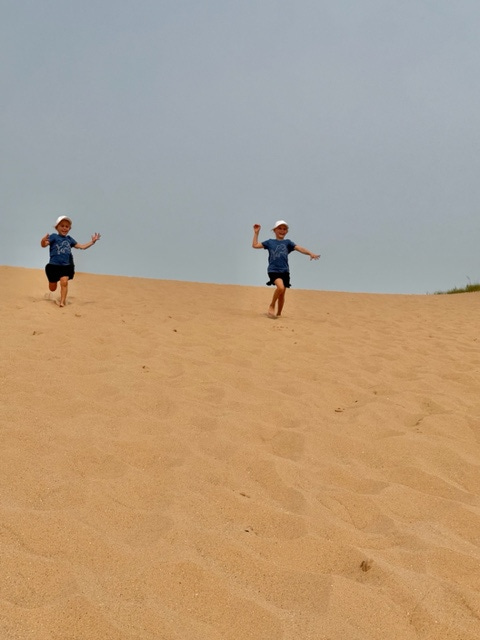
The most challenging hike was the “double dunes” or as it is officially called, Dune Climb. Not all of us participated but for those who did, the two plus hour walk rewarded them with an otherworldly view and a fun run to the bottom.

A couple of kids running down a sand hill

AI-generated content may be incorrect.

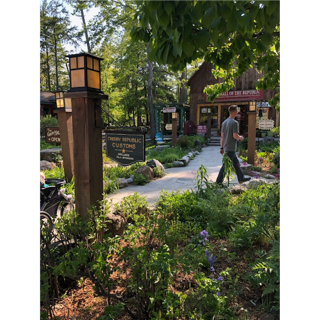
After a day of duneing, stop by Cherry Republic, for a large assortment of cherry products, ice cream and sit down casual dining.

A person walking in a garden

AI-generated content may be incorrect.

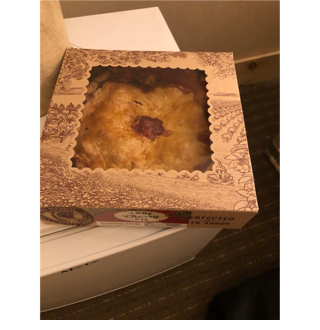
And don’t forget the pie!

A box of pastries on a table

AI-generated content may be incorrect.

Currently the dunes are protected by “The Sand Dune Protection and Management Act of 1976 designated these as sand dune areas, and the Act was amended in 1989 to designate 74,000 acres (29,600 ha) as Critical Dune Areas, which were characterized as “a unique, irreplaceable, and fragile resource.”

Only 25% of the Great Lakes dunes are in public, protected hands and the way things are going, we might lose access to them forever.

Washington Does it All

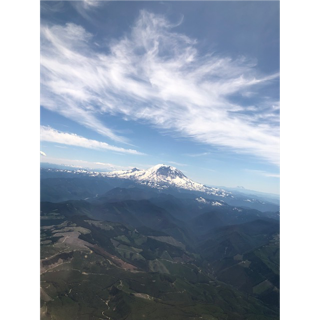
No, I don’t mean Washington DC, I recently took a trip to the Pacific Northwest to hang out with family in Washington State. I was greeted by a view of Mt. Rainier, an active, but beautiful, volcano.

A view of a mountain range from an airplane

AI-generated content may be incorrect.

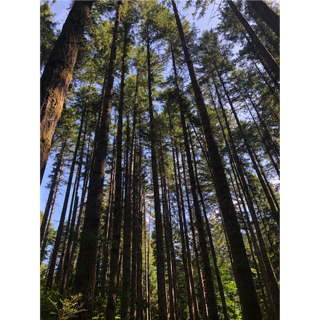
There’s plenty to do in the Pacific Northwest and we stuck close to where we were staying on Hood Canal. If you haven’t been to the area, it’s filled with hiking trails and for a Midwesterner, otherworldly sights.

A group of tall trees

AI-generated content may be incorrect.

We travel with kids, and this was a kid friendly, casual adventure—no passport or make-up required. As a bonus, we encountered few mosquitos.

We stocked up at Costco and a seafood market,

A plate of seafood and watermelon

AI-generated content may be incorrect.

My dreams of a new life owning a family oyster farm were dashed when I actually had an oyster slider (not shown above. )The water is cool enough that Vibrio was unlikely (more of a Florida thing) but I won’t be doing it again.

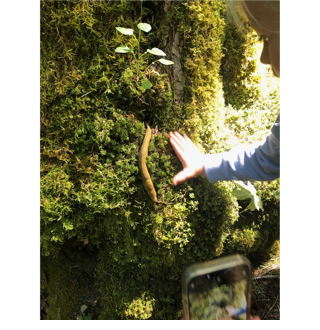
We started our hiking at Guillemot Cove. The kids were delighted by the stump house and all the baby crabs on the shore. It’s the dry season right now but we managed to see a few banana slugs.

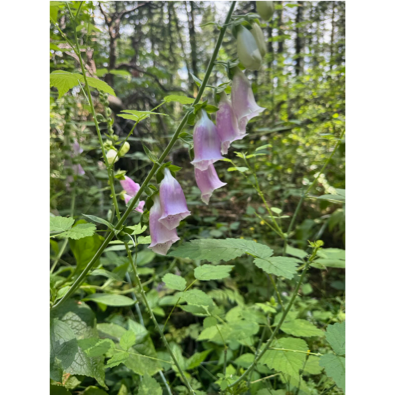
This area had lots of toxic but pretty foxglove.

A group of purple flowers on a plant

AI-generated content may be incorrect.

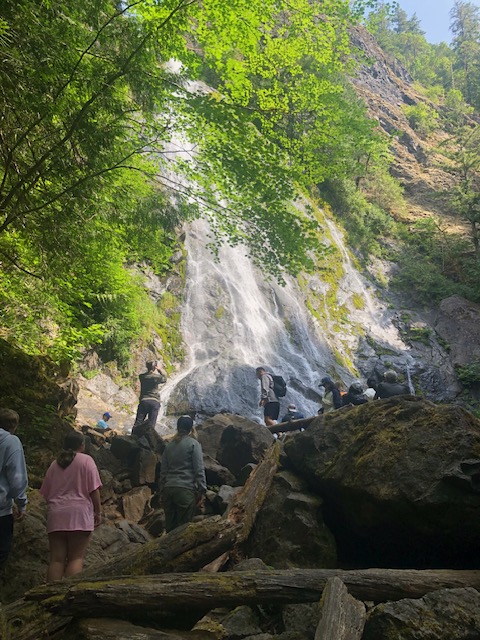
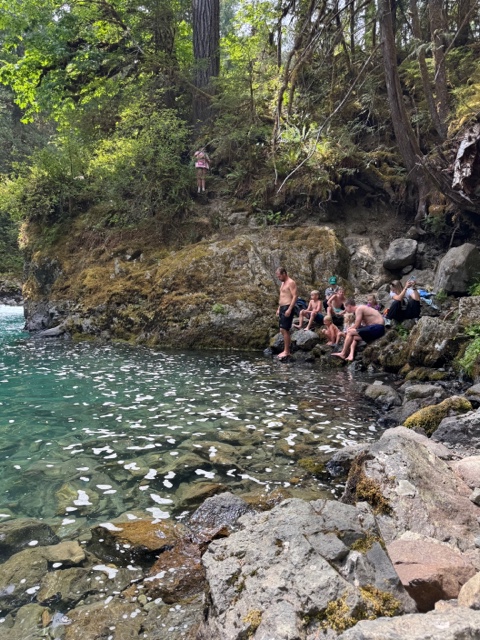
The next day we traveled to Ranger Hole Trail and saw a glacial waterfall. Some of us took a cold plunge. I did not.

.

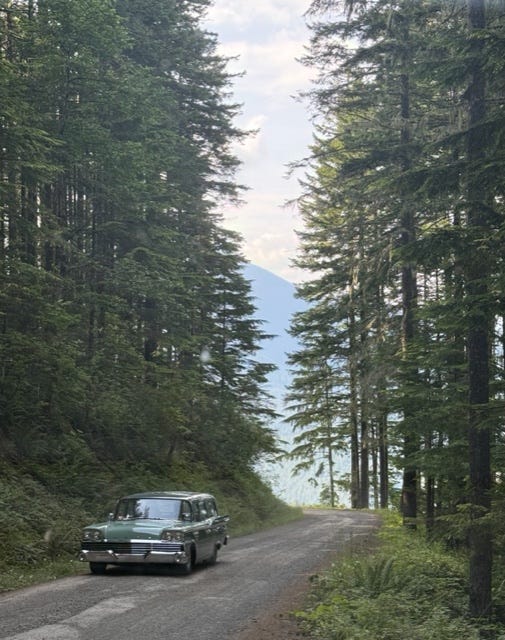
From there we traveled to Mount Walker to look across Hood Canal, a western lobe of Puget Sound, and view the eastern Olympic mountains and Mt. Rainier. It was a narrow, bumpy road to the top. My DIL captured this brave classic car ascending.

A car on a road with trees

AI-generated content may be incorrect.

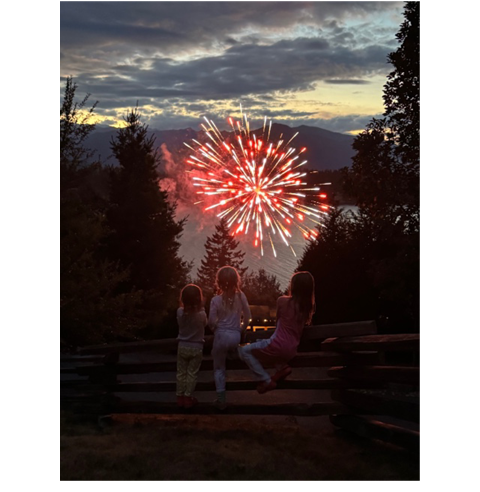
We celebrated the 4th of July in a very US way, with fireworks and unexpectedly viewing a protest. One child didn’t know why ICE would be dangerous.

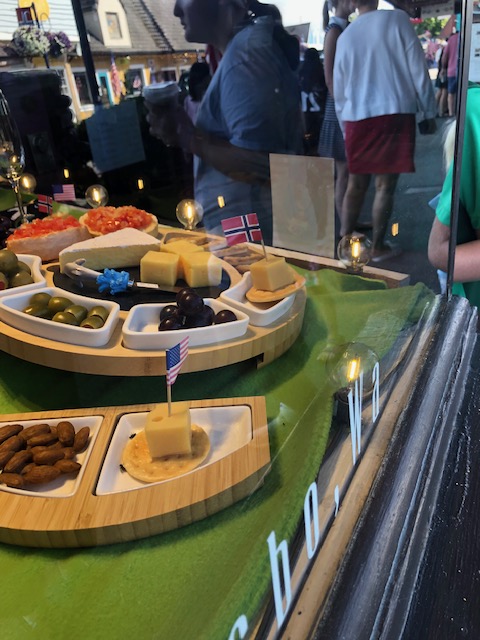
And let’s be honest, why would we achieve independence from a mad king with divine rights, only to let flies die around our cheese?

A group of kids looking at fireworks

AI-generated content may be incorrect.

The following day, we hiked a small portion of the vast Olympic National Park, viewing Lake Cushman and hiking at Staircase for yet another cold plunge and a climb on a downed Western Cedar.

(The following week, this area was closed due to fire.)

We ended our trip by taking a commuter ferry (from Bremerton) to Seattle for sightseeing and shopping. One of the kids thought the ferry ride was the best part.

A person looking out a window

AI-generated content may be incorrect.

Here are a few other details, should you wish to avoid the weak dollar and just stay in the country for an upcoming vacation to Washington. We used the All Trails app to find our hiking spots and our trails were designated as easy. That doesn’t mean they were flat or rock free. We flew into SeaTac and rented a car. The nearest big town was Silverdale. Washington has no income tax but other taxes, including gas taxes, make up for it. I’m not a fan of this tax structure but look at all this beauty ready to be publicly accessed!

Sadly, I returned to Iowa to find out the state was abandoning one of the last shreds of public lands. Outdoorsy folks here have to leave to get satisfaction. I bet every Iowan knows someone who is going to Canada, Michigan, the Smokies, or the West Coast this summer. Meanwhile, I’m back in Iowa itching my new mosquito bites and cursing the stressful corn sweat. Once again, the kids are turning to their screens. Hopefully, Iowa will get new leadership, and our state will stop taking things from the public to reward the private.

Struck by Lightning

The US became strong by investing in science. Now it will lose ground to China. Cuts to agencies like NOAA, the CDC, and EPA will leave the average citizen less able to protect themselves. Is the intent of this to create a crisis or to set up another expense we all must shoulder such as private weather information or a medical treatment? I’ve got to wonder, especially given the assault on science.

Below, a recent headline:

We’ve long seen lies about science arising from politicians, there is even a whole book about it. In Iowa, evolution has become unmentionable. A group of politicians recently went against the findings of a group of scientists and declared that covid came from a lab, which most scientists don’t see evidence for. Yet most in the US believe this lie and it is being pushed, along with spooky graphics, by the White House.

Here is a somewhat thoughtful reporting on why this might be occurring. In a few words: xenophobia, racism, seeding doubt about science.

Heck, we are even seeing some challenges to long established scientific views such as germ theory and the efficacy of vaccines, as if someone somewhere is prepping for another pandemic. After all, the rich got richer during the last pandemicFifty-four percent richer. Why not set us up for another?

I was wondering about this, the why of it, when I saw a lightning stuck tree. As we now know, lightning is a static charge that forms when winds push ice in clouds around. The top of the cloud becomes positive and the bottom negatively charged. The negative charge in the clouds pulls positive charges on the ground towards it. The positive charges move up, using tall objects as their path. (Thank you to NOAA for this great video about it.) Tall trees that contain a lot of moisture will be prone to lightning strikes.

For most of human history, lightning was associated with deities, and often were an expression of the deities’ anger at how humans were acting. Isaac Newton had some doubts about this but it wasn’t until 1752-3 that Ben Franklin convinced humanity of the natural origins of lightning.

What does this have to do with the defunding of science?

If things have a natural cause, leaders, who perhaps consider themselves sent by god, don’t have the leverage they once had. Even back to the time of Galileo, religious leaders have been threatened by science. When natural phenomenon explains tragedies, it makes it tough for these anointed ones to scare people and control them. They can even create a crisis and fix it, or keep us in a constant state of panic, like good narcissists. Science can remove the fear by offering logical explanation. 

Fortunately for the rich people, they’ve found a workaround: fund politicians and set up phony news sources (including the White House itself) to spread lies about science and to top it off, fire scientists and defund education. They are well on their way to becoming the deities they think they deserve to be. After all, lightning does strike twice.

Hope and a Hop-hornbeam

There is so much on my mind right now, I had to take a break from thinking and I had to plant a tree to replace one I lost. The problem is, of course, thinking through what tree to plant took some thinking.

First of all, did I want to plant a tree at all? I live near the hospital, and I do like where I live. The hospital is ambitious but it has a lot of nice trees including ginkgoes, oaks, and apples. Will they someday take my house and kill the tree? Despite this worry, I like being near the hospital. Several members of my family have been in the health care profession and the pulse of the ambulances and medical helicopters is familiar to me, and not as noisy as you might think. When my neighbor got stabbed by his wife, he was quickly saved by the quick emergency responders and ER docs and the hospital was close at hand. He’s back home now, sans wife. Additionally, I’m a short walk from Pella’s beautiful downtown and gardens.

But will the hospital buy up my house someday and cut down the trees? I didn’t want to doom another tree, having recently murdered one.

Several people mentioned how nice my house looked—they hadn’t noticed when the tree blocked the view. I agreed but also found the expanse of yard bare. I pushed through my fears about the hospital someday killing my trees. And since I don’t like to kill my dandelions, I wanted something else out there to detract from them, something medium sized with non-invasive roots.

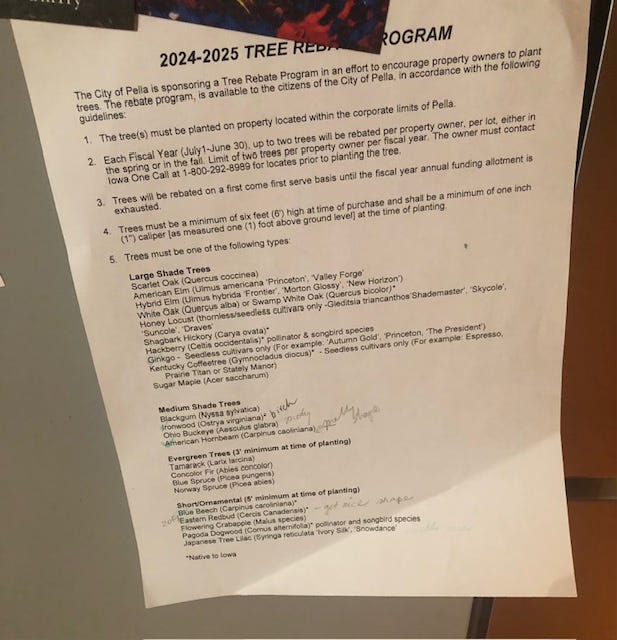
The city of Pella has a tree planting program, now probably in its final year. They’d pay you back if you planted a desirable tree and followed their rules. Here’s the list of trees and my notes, in case you live in Pella and want to plant a tree.

My friend and neighbor, Elise, provided me with several books about trees and I studied them. I decided on a deciduous tree. Even though most evergreens are mostly non-invasive, they can grow bigger than I wanted for that space. I fixated on the Ironwood (hop hornbeam) and hornbeam. They are varieties of birch, and I liked the photos of their little catkins. Plus, they are strong trees. We all know it’s windy here these days. They were on the Pella tree list.

The problem was, to get paid back I had to buy the tree in town and those two trees weren’t available in town. Oh well, I was focused on these trees now and I’d foot the bill. Elise mentioned a nursery near Des Moines. I thought she said it was in Norwalk but really she’d said Johnston. In any case, I found a place in Norwalk, Bedwell, that had these trees. They even called me back to confirm that yes, they did have hop-hornbeams.

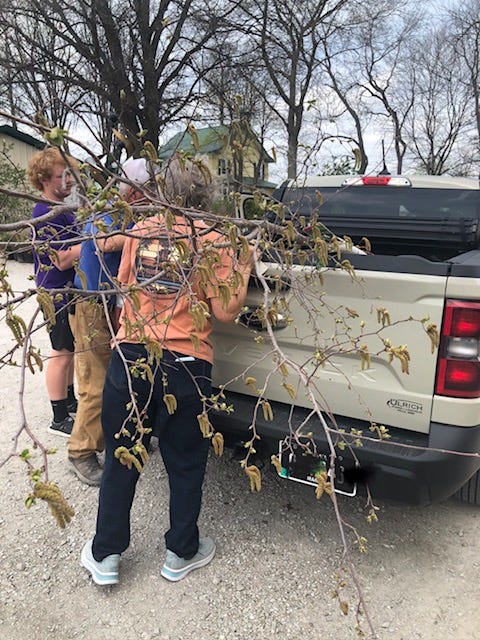
Elise and I, in her pickup, drove to look at the trees. If I had acres of land, I’d fill it with all of the beautiful trees we saw. In the end, yes, I bought a sturdy looking hop-hornbeam with its catkins popping out. Hop-hornbeams are hermaphrodites, monoecious in plant talk, having both male and female on the same tree. We drove it home very slowly.

A group of people standing next to a tree branch

AI-generated content may be incorrect.

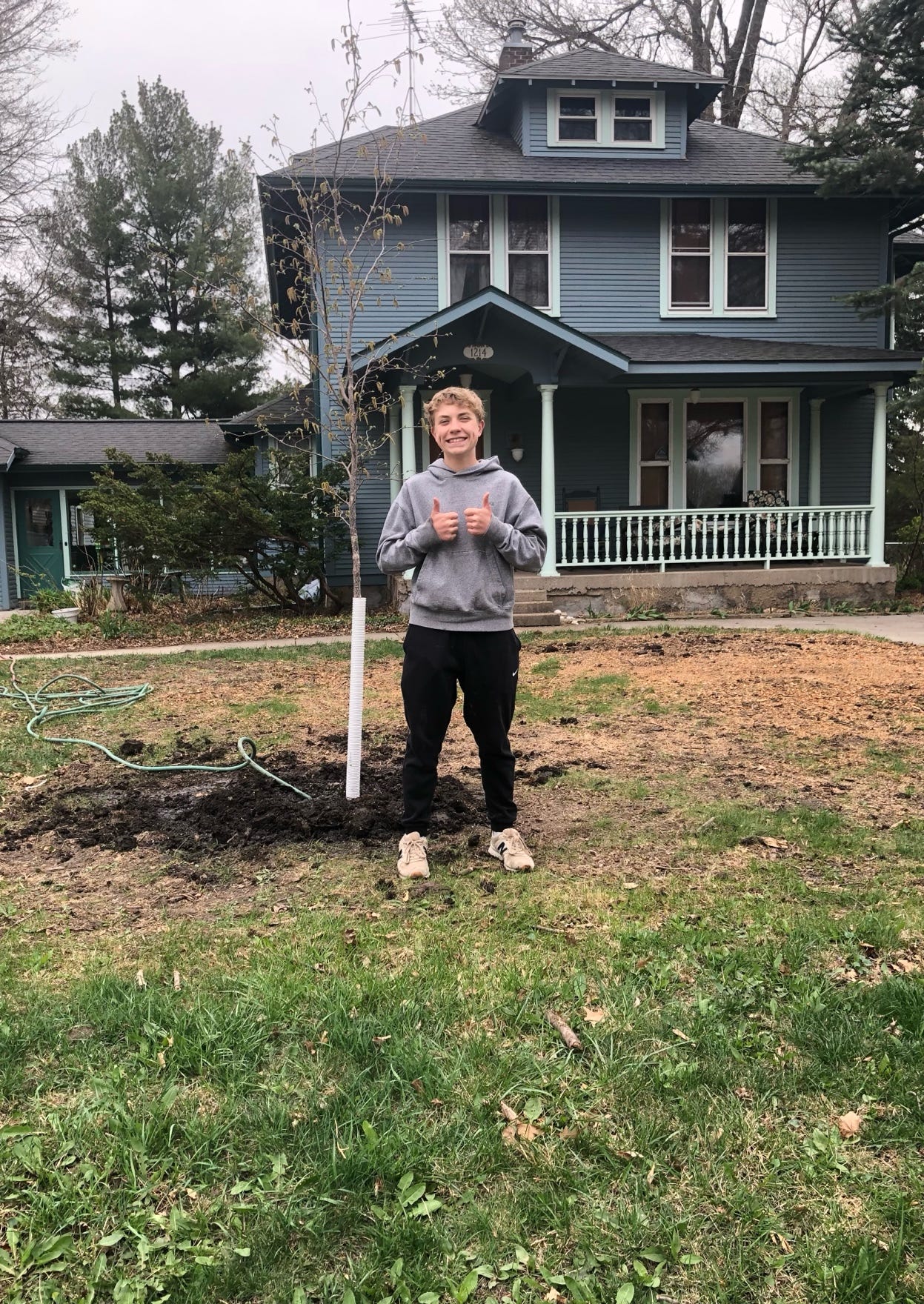
Elise helped me place it in the yard and a grandchild fond of working out planted it.

Here it is with the planter. As you can see, the removal of the hug tree has left us with a bit of a mess. Fortunately, I don’t mind a mess:

A child standing in front of a house

AI-generated content may be incorrect.

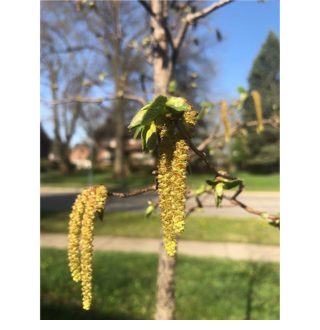
And here are the catkins which are really pollen dissemination devices:

A close up of a tree

AI-generated content may be incorrect.

Another neighbor remarked that it was going to be a long time before the tree gets big. I said, “Then someone else can enjoy it.” And that is the true meaning, the, hope, the power, and the promise of Earth Day.

Bare trees and public spaces

Friends of Big Rock Park here in Pella Iowa held their first event of the season–a walk lead by ecologist Dr. Paul Weihe. We learned to identify and appreciate trees without leaves. Several of the walkers were new to Iowa and wanted to learn what trees are native to our state. 

Iowa’s most common type of timber are oak-hickory forests.

Oaks are slow growing but strong with “ski slope” bark, sometimes taking on different colors. This red oak tree, shown below, with bark shading of white, black, green, and red is older than Pella!

Oaks hang onto their leaves longer than many other deciduous trees, keeping them well into winter. It’s thought that this might serve as a buffer against winter winds and also help the trees warm up when spring comes. I’ve long felt slight resentment for my oak trees when they drop leaves onto the snow which makes them inconvenient for raking. Now, I’ll understand them better. 

One identifying feature of an oak is the starburst pattern within the branch. 

This star pattern translates into waves when oak is used for building. 

Oaks are hardy and even a half dead one will provide plenty of habitat for forest creatures.

The Shagbark Hickory is hard to miss with its bark looking like a league of wild cats attacked a favorite couch. 

This poor shagbark, below, was killed during the growing season and unable to undergo seasonal abscission and shed its leaves.

The distinctive ridged bark of the hackberry:

Large, in charge and near water. It must be an Eastern Cottonwood! These are fast growing with weak branches that drop a lot of wood. They aren’t good yard trees. My mom always claimed she was allergic to their fluff—which is their seeds—and I guess she wasn’t alone. Other people say the same. In the wild, the trees  have plenty of uses to foragers including as arthritis wraps. 

The characteristic burst of thorns is found in a Honey Locust.

Shaggy bark and a leak of sap help identify this as a black cherry. These trees grow small cherries with pits and aren’t generally used by humans, but many wild critters including birds and butterflies love them.

It’s even possible to identify a tree from just a stick. Look for leaf scars and check if they are opposite each other or alternated. A big bud such as shown below means a big flower is wintering in there. If it’s wrapped in a fuzzy coat, it’s a magnolia. 

Public spaces are a treasure and here in Iowa, they are rare gems. Iowa has about 1% of its land owned by the state and federal government which makes our city owned land even more precious. Big Rock Park is 83 acres, about the size of Crapo Park in Burlington. By contrast, a single family owns 400,000 acres here in Iowa and this oil-rich family also owns most of Idaho and Utah. Thank you to the Pella Community Foundation for sponsoring this event, to the Friends of Big Rock Park for their arrangements, and to Dr. Paul Weihe of Central College! 

Follow Dr. Weihi here on WordPress.

Why I killed a tree

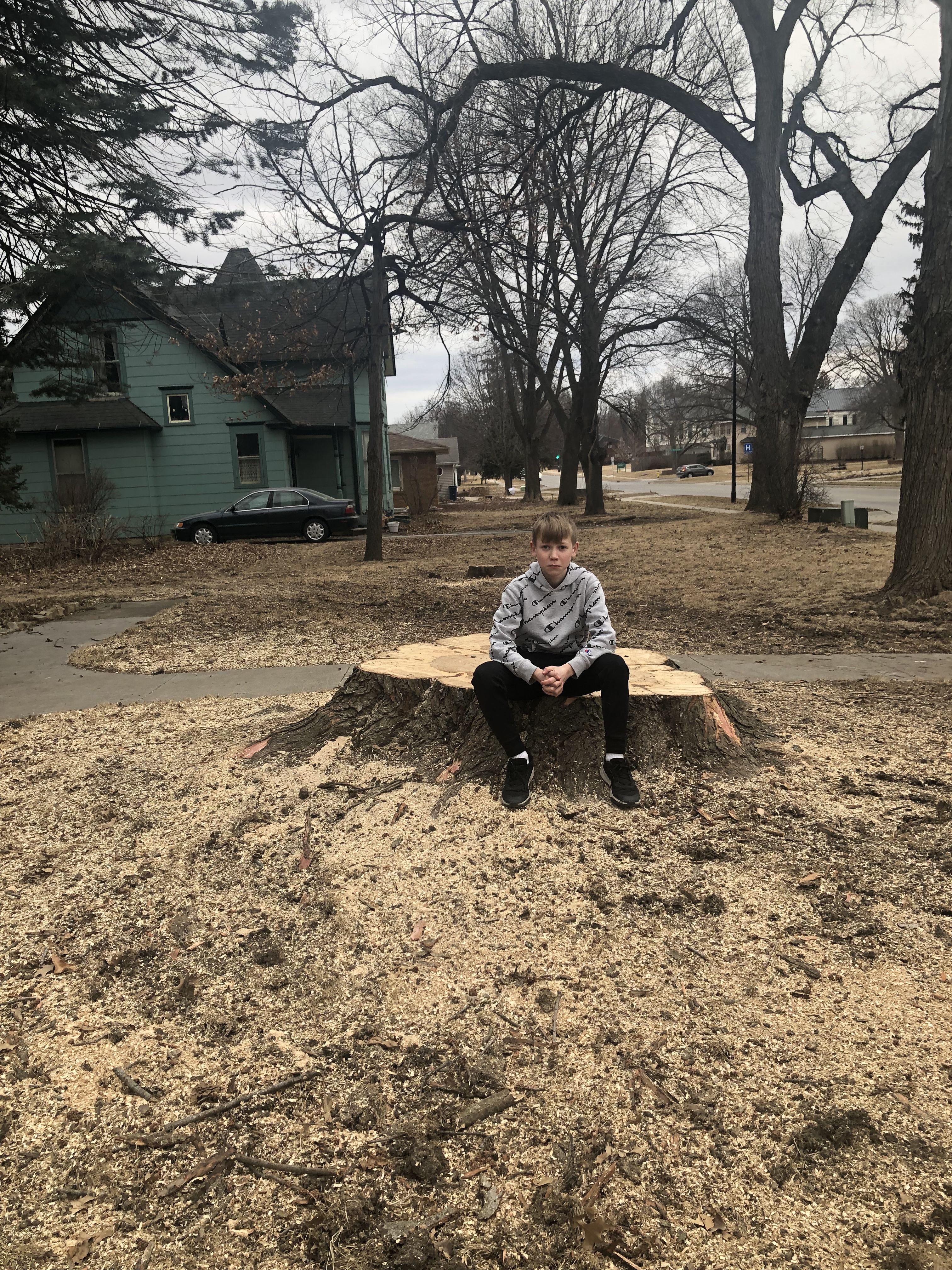
I must explain why we killed the magnificent silver maple tree in our yard. It’s gone, cut down, stump soon to be ground to bits. 

It was planted over a half century ago for quick shade and it grew dangerously large. The branches were soft and the roots of were shallow. We were advised to remove it before it plugged the sewer line. Due to their girth, the roots would be difficult to blast away. Not to mention, our sewer line to the street is PVC so the line being plugged would be a good distance away under the street. It might involve digging up the street!

For as long as I can remember, we had no interest in killing the tree.  But lately, I’d grown edgy about it and other things. Iowa is getting over a 4-year long drought.  Trees seek out sewers during droughts and can even pry open places where pipes meet. Tree roots grow in the winter, especially in mild winters as we’ve had lately. Invasive tree roots seek out sewer lines in the winter and they can cause pipes to break in the winter. I hate to favor a sewer line over a tree but the sewer was not my only concern about the tree.

 We didn’t prune it until it was elderly, not knowing this could give it a hollow spot or two in the trunk eventually.  If someone had pruned it when young, it would have maintained a smaller root volume. It was very close to the house and the driveway. The roots cracked a walkway. We didn’t plant it. My parents did when they owned the house, which we bought from them. I recall watching it grow over the years and thinking it was the equivalent of having a baby elephant. 

Part of the reason for removal was the worry about it falling on our house during bad weather. Even the Iowa legislature is admitting it, bad weather has accelerated, as scientists predicted. But instead of doing anything to prevent worse weather, the Iowa legislature has proposed tax free disaster savings accounts. I don’t need a tax break as much as I need them to take steps to keep us safe. I haven’t felt safe with them lately.

I saw danger not only of it dropping big branches but, we were told by an arborist, it was probably going to split down the middle someday. Why did he say this? It also had a lot of branching, along with knot holes fairly low down which meant, eventually, it was going to weaken. Silver maples are among the trees most likely to fall in a storm.  If it was in the way back of the yard, it would be tempting to let nature take its course, but it wasn’t. It was in the front yard, closer to the house than the street. The house is old but it’s well-built. The house won out. 

The tree had been part of my life for so long, something always there. Because of this, I always took its autumn splendor for granted and don’t seem to have a photo of it.

Here it is in winter, peeking over the house. It’s starting to flower already. The squirrels are going to miss the flowers and seeds, although we have another very large maple in the back yard to keep them busy. 

A pose to show its girth.  

Here it is, throwing shade in the summer. 

A large shade tree can reduce energy consumption by 50%.  The temperature moderation provided by a shade tree can prevent paint from peeling on the house. Trees curb noise. However, a silver maple is the number one tree not to plant near your house, for reasons mentioned above.  Yes, it is the most invasive tree you can plant.

In the neighborhood, several big old trees have been lost to disease or due to sewer line entanglement. One 130-year-old tree was removed because branch fell in a neighbor’s yard during the derecho of 2020.  The neighbor freaked out and so did the homeowner. We also removed a sugar maple that was struck by lightning and slowly dying.

The tree’s branches fell with tremendous thumps and sawdust rained like snow. Despite all my rationalization about why this had to be, it made me sad. The tree was fairly healthy. It posed no immediate threat of falling.

The trunk fell with an earthshaking crash and light streamed into my window.

Ironically, the last branch came down on what would have been my Mom’s 93rd birthday. She planted this tree, after she moved to Iowa more than thirty years before the house got air conditioning in 1999. It might have been free from the bank for opening an account. Her childhood home, a place in the Western Michigan country known as Maple Brook Farm, had a similar tree too close to the house. It’s also gone and in fact, the entire farmhouse was bulldozed and replaced.

I want to plant a climate change resistant tree  or ornamental tree in its place. That side of the yard is where the somewhat new sewer line runs so whatever goes there should have non-invasive roots—a tree with roots that grow straight down. There are plenty such trees including other maple species, spruce trees, pine trees, hickory, and sturdy oak trees which fill this neighborhood. Smaller fruit and ornamental trees fit the bill. Silver maple is not one of them. We frequently pruned it to avoid windthrow, which occurs if branches and leaves are thrown by the wind and take the roots with them. Still, I became afraid of it as it grew taller. If you are reading this and feeling throat tightening panic about your tree, relax. Call a tree specialist for an opinion. Most trees can be trimmed to safety. And if you aren’t sure what type of tree you have, use an ap such as Picture This. A well-kept tree is way more benefit than risk.

Needless to say, I’ve been second guessing myself. I can only say I didn’t want to be a penniless retired teacher with axed Social Security paying the city to dig up the street to remove tree roots from the sewer.  Tree roots can grow even without the tree, so I tell myself that this was the right time. Still, I’m sad about it all. 

Tonight, the winds howl around the house, reminding me that some of my actions are simply preparing for storms to come and let’s be honest, they’re coming. 

The Importance of Being a Tree Hugger

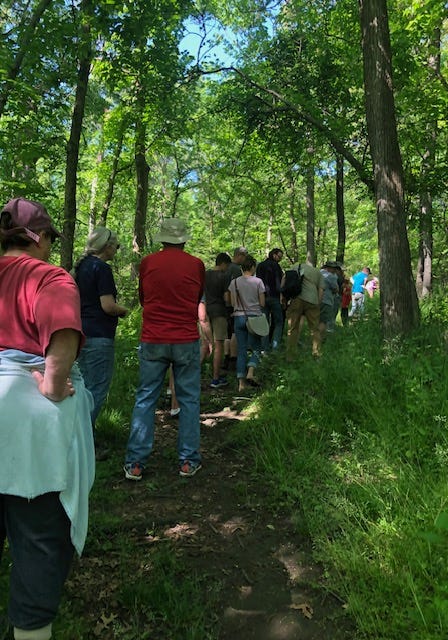
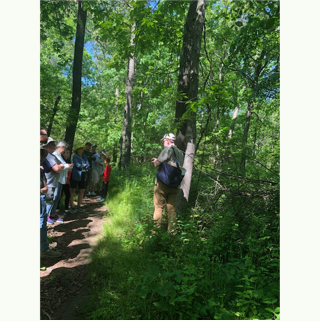
“People want to be connected to the natural world,” says biologist Paul Weihe. Connecting with nature isn’t easy here in Iowa, where just 3% of Iowa is public land and some of this is highway right of ways. Most Iowans don’t own large acreages and depend on public lands for their outdoor recreation. Fortunately, Pella has the 83-acre Big Rock Park owned by the City of Pella! On May 18, Dr. Paul Weihe of Central College gave a multigenerational crowd a new appreciation of living “solar panel apparatuses,” those woody plants that persist through winter and have one or several main trunks –also known as trees.

A group of people standing on a path in the woods

Description automatically generated

When one approaches a tree you want to note its

habitat—where it is

its habit—its size and spreading, some of which is influenced by sunlight

and its anatomy—such as the color of the bark and the width and of the bark plates along with the presence of thorns and fruit.

 Big Rock Park has a variety of habitats—a meadow, a native oak savannah characterized by widely spaced trees, and a prairie like wet meadow. Thus, it’s home to a variety of trees.

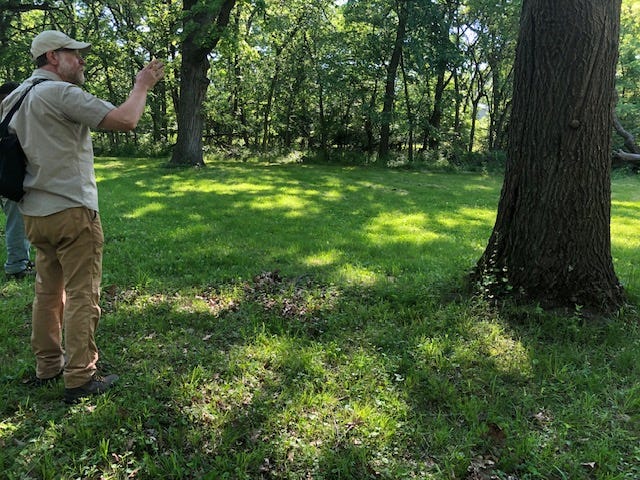
A person standing in a grassy area

Description automatically generated

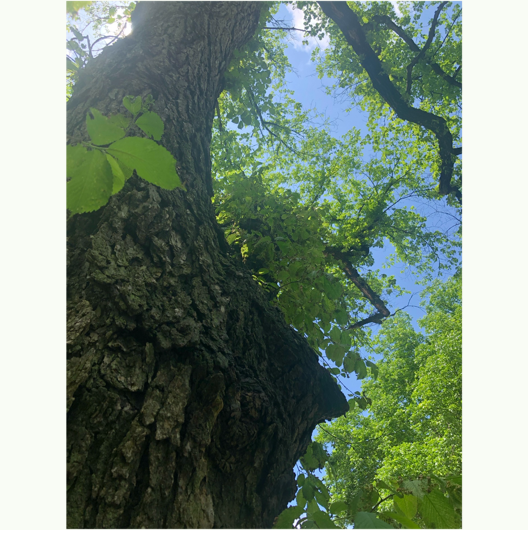
Bark is the dead skin of a tree, which grows out from the trunk anon the tips of branches and roots. Bark is a way to identify trees, even in the winter.Above we see two similar trees. The closer one has vertical stipes or plates of bark with red fissures and bristle top leaves and the other one has white fissures with rounded leaves. They are two oaks of different species—one red and one white. The oak-hickory forest is the most dominant forest ecosystem in Iowa, thanks in part to their fire resistance.

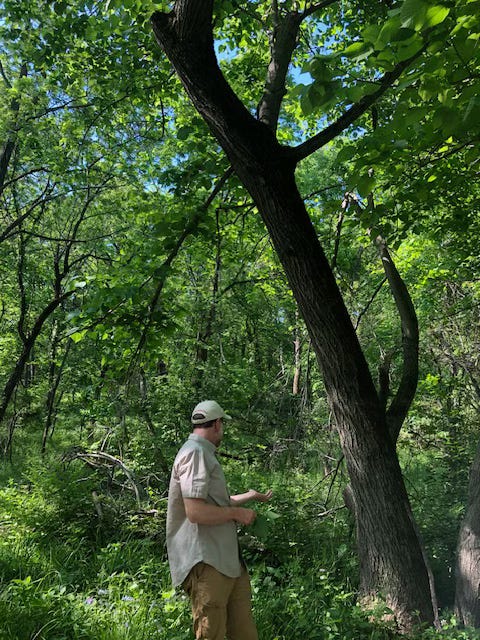
Could anything be prettier than green leaves reaching for a clear, blue sky? This tree (below) is an American Basswood or Linden tree, used for making wooden shoes.

The shagbark hickory (below) has compound leaves and lifting bark plates that are popular homes for bats.

A group of people in the woods

Description automatically generated

What tree has double dentate leaves, very dry bark that yields easily in layers of cream and reddish brown? It’s one of the many native trees that was over-planted as a “street” tree and later fell victim to sweeping plague? Pella’s Main Street was lined with them until the1960s. See the photos and answer below.

A tree with green leaves

Description automatically generated

It’s the American Elm!

The group identified the smooth hickory, hackberry, thorny honey locust, the native black walnut—known for poisoning plants coming near it with juglone toxin, and the wild cherry with “burnt potato chip bark” and gummy resin.

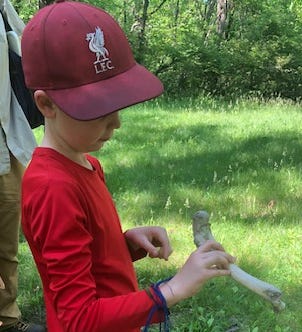
We even found a deer (we think) femur!

A child holding a bone

Description automatically generated

People can identify trees by learning from others, through apps such as iNaturalist, and from keys in books. Dr. Weihe says all are valid, but the books tend to have fewer errors.

Why should we care about trees? Trees cover about a third of the earth, producing oxygen, purifying water, and preventing flooding. And for the religious/spiritual, remember that only God can make a tree.

Observing and journaling about nature increases brainpower and well-being in kids.

Being in nature and even looking at photos of nature is part of healthy aging.

Being around trees reduces stress and hugging a tree releases the feel-good chemical oxytocin.

So, if you haven’t already, take a walk through the trees and don’t be afraid to hug a few.

For more on Big Rock Park, visit here: 

https://www.friendsofbigrockpark.org

Biden sees value in nature

For most of recorded history, with a few exceptions, the idea of environmental balance wasn’t considered. Dominion over nature was part of the Bible and early science.

Nature was seen as punishing—lightning struck evil churches, environmental disasters were punishments from god(s), disease was sin. So was (is)being ugly. Snakes were bad omens or good, depending on your culture. The idea of balance between humans and the environment was unheard of for many societies. It wasn’t as if some vistas weren’t considered beautiful. Most people did not appreciate nature, or downright feared it. Most saw it as irrelevant to their lives.

The idea that nature can be understood is a relatively new one, at least in western culture. 

As the Europeans changed the landscape in countries they over-ran, a few noticed that they were destroying something beautiful and pristine. One such person was George Perkins Marsh, who wrote Man and Nature in 1864. Marsh discussed how the alteration of the landscape could promote climate change and linked desertification to deforestation. He urged citizens to value the environment, manage its resources, and measure progress in terms of the prudent supervision of resources. The US Forest Service was established in 1905 with careful management as a goal. This view of environmentalism is known as Utilitarianism. We preserve nature for our enjoyment and utility for recreation, hunting, and fishing. In the 1930s, the Dust Bowl re-enforced the idea of conservation of resources. God’s punishment became something we brought upon ourselves. Outdoor recreation is big business, generating over $560 billion dollars in 2022.

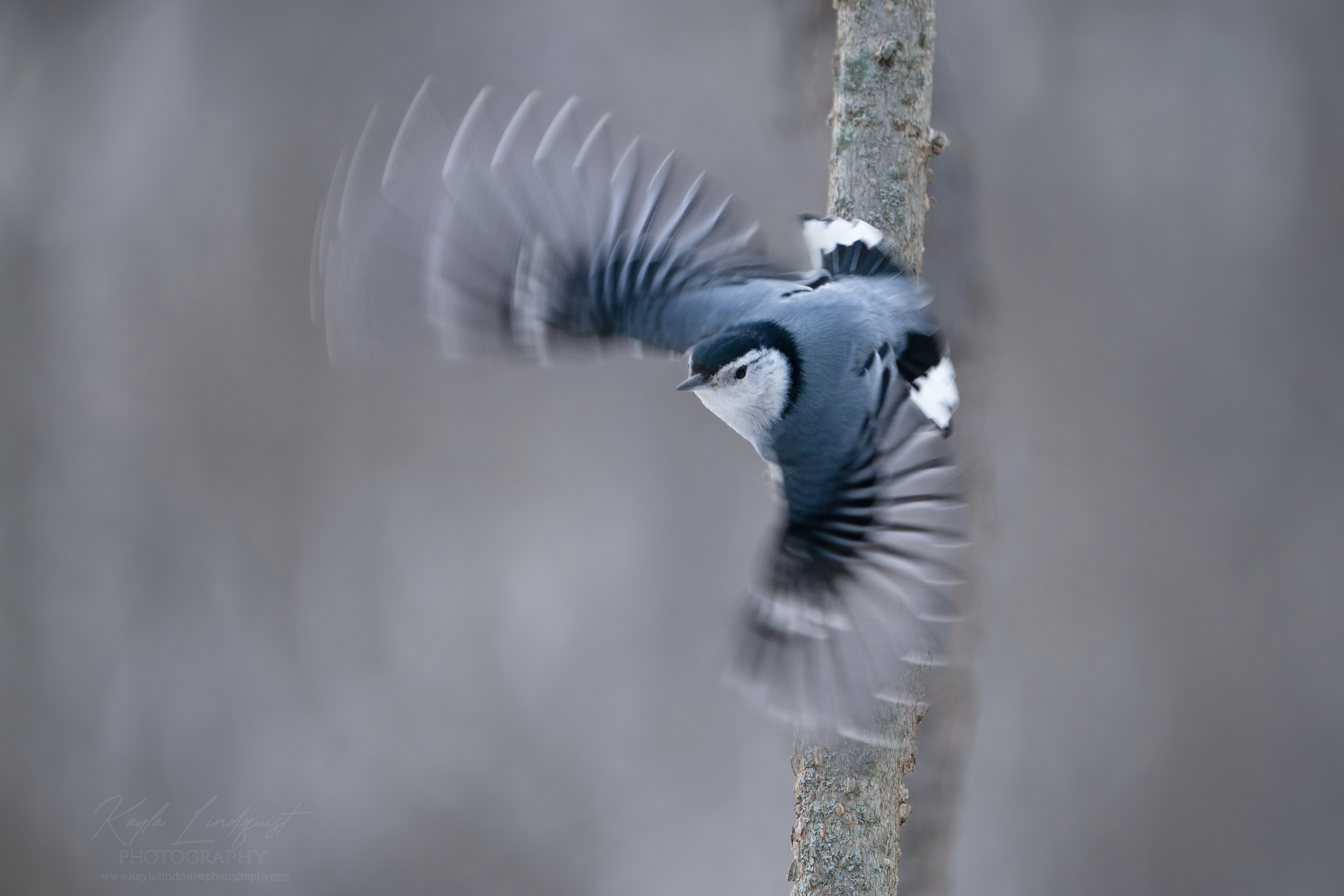
A second type of environmentalism began with John Muir (1838 -1914) and the Sierra Club, founded in 1892. Muir was raised in a harsh religious household and he saw nature as peace and a window to god. This branch of environmentalism saw every species as having intrinsic value. This view is popular today and brings billions to the US economy per year. Bird watching, for example, generates around 40 billion dollars per year in the US. Camping is projected to bring in over 20 billion this year.

A bird flying in the air

Description automatically generated

Nuthatch by Kayla Lindquist

It’s clear that people appreciate nature for its intrinsic value and, like Muir, seek it as a source of peace. Forest bathing, simply meandering in nature, is a popular stress reliever. “Native evergreens are both aromatic and release a high concentration of phytoncides—airborne essential oils that provide a natural immunity boost. The health benefits of this phytoncide “shower” can last for weeks.”  Forest bathing tourism might involve looking at bluebells in England or wandering in a cloud forest in Costa Rica. 

Given this information, the Biden Administration has launched a bold, needed initiative—to count nature’s value in the Gross Domestic Product of a country’s economy. Without considering the value of nature, we get a false picture of  the real economic strength of a country. Read more here.