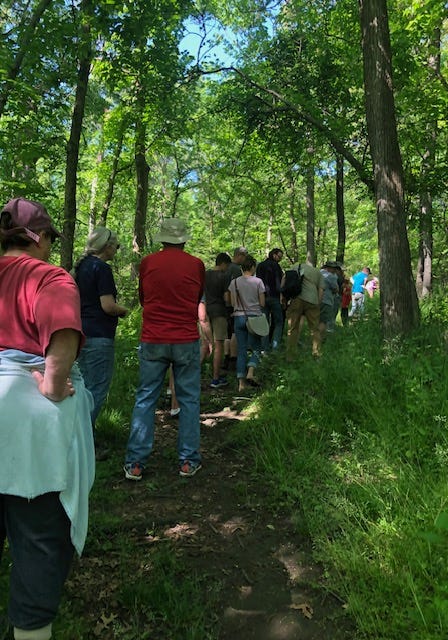
Friends of Big Rock Park here in Pella Iowa held their first event of the season–a walk lead by ecologist Dr. Paul Weihe. We learned to identify and appreciate trees without leaves. Several of the walkers were new to Iowa and wanted to learn what trees are native to our state.
Iowa’s most common type of timber are oak-hickory forests.
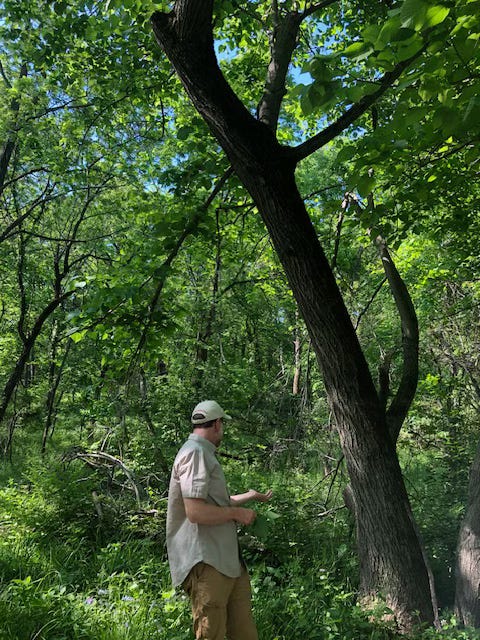
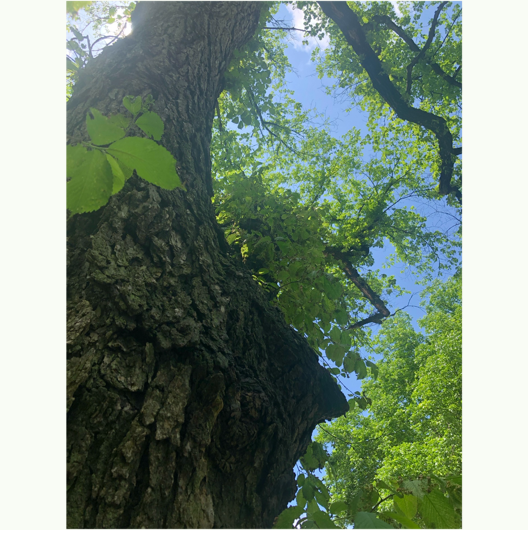
Oaks are slow growing but strong with “ski slope” bark, sometimes taking on different colors.This red oak tree, shown below, with bark shading of white, black, green, and red is older than Pella!
Oaks hang onto their leaves longer than many other deciduous trees, keeping them well into winter. It’s thought that this might serve as a buffer against winter winds and also help the trees warm up when spring comes. I’ve long felt slight resentment for my oak trees when they drop leaves onto the snow which makes them inconvenient for raking. Now, I’ll understand them better.
One identifying feature of an oak is the starburst pattern within the branch.
This star pattern translates into waves when oak is used for building.
Oaks are hardy and even a half dead one will provide plenty of habitat for forest creatures.
The Shagbark Hickory is hard to miss with its bark looking like a league of wild cats attacked a favorite couch.
This poor shagbark, below, was killed during the growing season and unable to undergo seasonal abscission and shed its leaves.
The distinctive ridged bark of the hackberry:
Large, in charge and near water. It must be an Eastern Cottonwood! These are fast growing with weak branches that drop a lot of wood. They aren’t good yard trees. My mom always claimed she was allergic to their fluff—which is their seeds—and I guess she wasn’t alone. Other people say the same. In the wild, the trees have plenty of uses to foragers including as arthritis wraps.
The characteristic burst of thorns is found in a Honey Locust.
Shaggy bark and a leak of sap help identify this as a black cherry. These trees grow small cherries with pits and aren’t generally used by humans, but many wild critters including birds and butterflies love them.
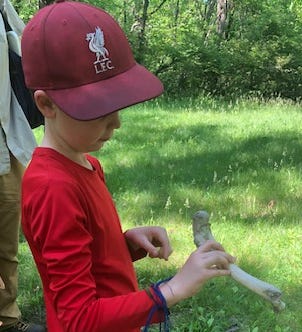
It’s even possible to identify a tree from just a stick. Look for leaf scars and check if they are opposite each other or alternated. A big bud such as shown below means a big flower is wintering in there. If it’s wrapped in a fuzzy coat, it’s a magnolia.
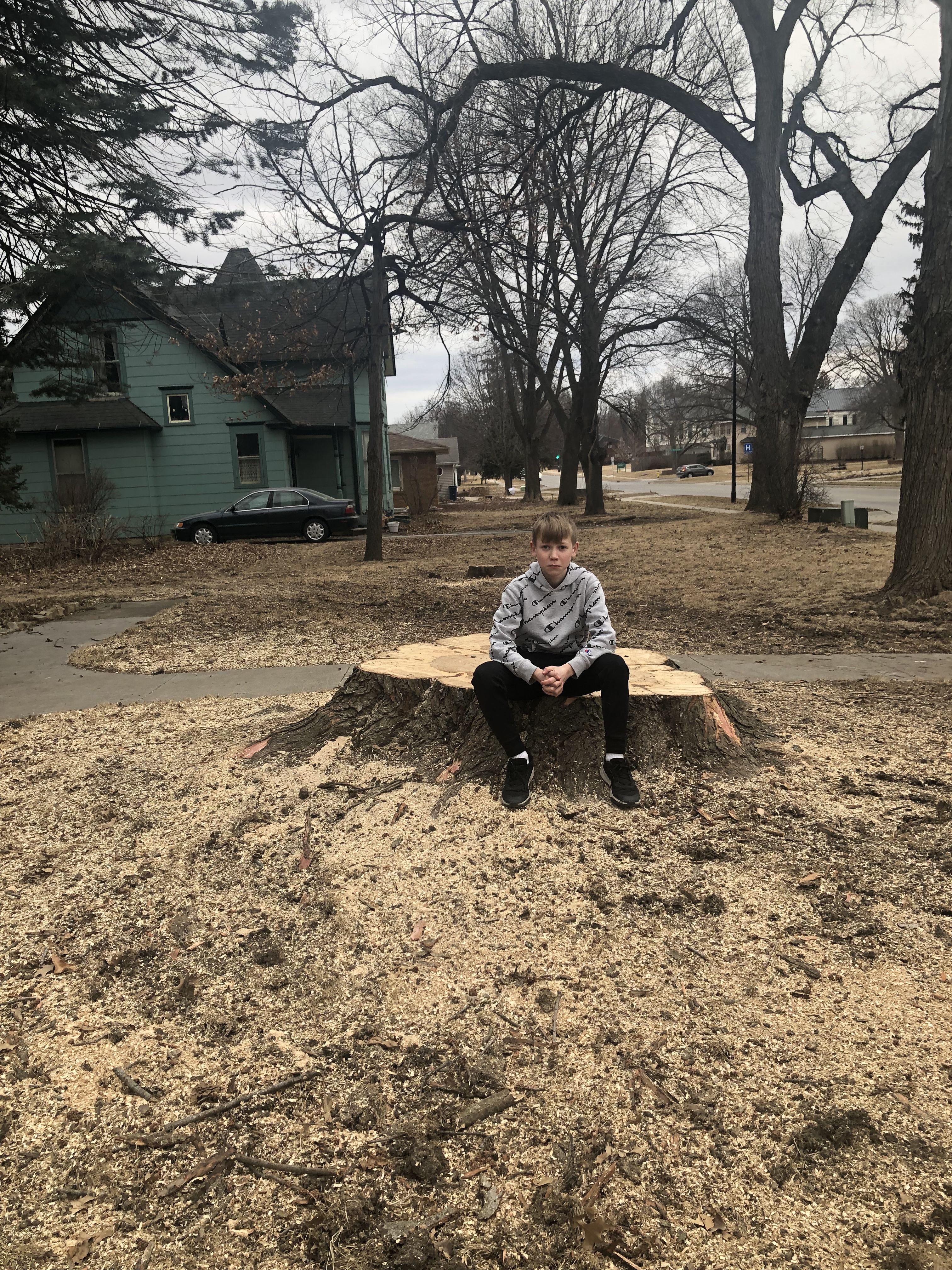
I must explain why we killed the magnificent silver maple tree in our yard. It’s gone, cut down, stump soon to be ground to bits.
It was planted over a half century ago for quick shade and it grew dangerously large. The branches were soft and the roots of were shallow. We were advised to remove it before it plugged the sewer line. Due to their girth, the roots would be difficult to blast away. Not to mention, our sewer line to the street is PVC so the line being plugged would be a good distance away under the street. It might involve digging up the street!
We didn’t prune it until it was elderly, not knowing this could give it a hollow spot or two in the trunk eventually. If someone had pruned it when young, it would have maintained a smaller root volume. It was very close to the house and the driveway. The roots cracked a walkway. We didn’t plant it. My parents did when they owned the house, which we bought from them. I recall watching it grow over the years and thinking it was the equivalent of having a baby elephant.
Part of the reason for removal was the worry about it falling on our house during bad weather. Even the Iowa legislature is admitting it, bad weather has accelerated, as scientists predicted. But instead of doing anything to prevent worse weather, the Iowa legislature has proposed tax free disaster savings accounts. I don’t need a tax break as much as I need them to take steps to keep us safe. I haven’t felt safe with them lately.
I saw danger not only of it dropping big branches but, we were told by an arborist, it was probably going to split down the middle someday. Why did he say this? It also had a lot of branching, along with knot holes fairly low down which meant, eventually, it was going to weaken. Silver maples are among the trees most likely to fall in a storm. If it was in the way back of the yard, it would be tempting to let nature take its course, but it wasn’t. It was in the front yard, closer to the house than the street. The house is old but it’s well-built. The house won out.
The tree had been part of my life for so long, something always there. Because of this, I always took its autumn splendor for granted and don’t seem to have a photo of it.
Here it is in winter, peeking over the house. It’s starting to flower already. The squirrels are going to miss the flowers and seeds, although we have another very large maple in the back yard to keep them busy.
In the neighborhood, several big old trees have been lost to disease or due to sewer line entanglement. One 130-year-old tree was removed because branch fell in a neighbor’s yard during the derecho of 2020. The neighbor freaked out and so did the homeowner. We also removed a sugar maple that was struck by lightning and slowly dying.
The tree’s branches fell with tremendous thumps and sawdust rained like snow. Despite all my rationalization about why this had to be, it made me sad. The tree was fairly healthy. It posed no immediate threat of falling.
The trunk fell with an earthshaking crash and light streamed into my window.
Ironically, the last branch came down on what would have been my Mom’s 93rd birthday. She planted this tree, after she moved to Iowa more than thirty years before the house got air conditioning in 1999. It might have been free from the bank for opening an account. Her childhood home, a place in the Western Michigan country known as Maple Brook Farm, had a similar tree too close to the house. It’s also gone and in fact, the entire farmhouse was bulldozed and replaced.
I want to plant a climate change resistant tree or ornamental tree in its place. That side of the yard is where the somewhat new sewer line runs so whatever goes there should have non-invasive roots—a tree with roots that grow straight down. There are plenty such trees including other maple species, spruce trees, pine trees, hickory, and sturdy oak trees which fill this neighborhood. Smaller fruit and ornamental trees fit the bill. Silver maple is not one of them. We frequently pruned it to avoid windthrow, which occurs if branches and leaves are thrown by the wind and take the roots with them. Still, I became afraid of it as it grew taller. If you are reading this and feeling throat tightening panic about your tree, relax. Call a tree specialist for an opinion. Most trees can be trimmed to safety. And if you aren’t sure what type of tree you have, use an ap such as Picture This. A well-kept tree is way more benefit than risk.
Needless to say, I’ve been second guessing myself. I can only say I didn’t want to be a penniless retired teacher with axed Social Security paying the city to dig up the street to remove tree roots from the sewer. Tree roots can grow even without the tree, so I tell myself that this was the right time. Still, I’m sad about it all.
Tonight, the winds howl around the house, reminding me that some of my actions are simply preparing for storms to come and let’s be honest, they’re coming.
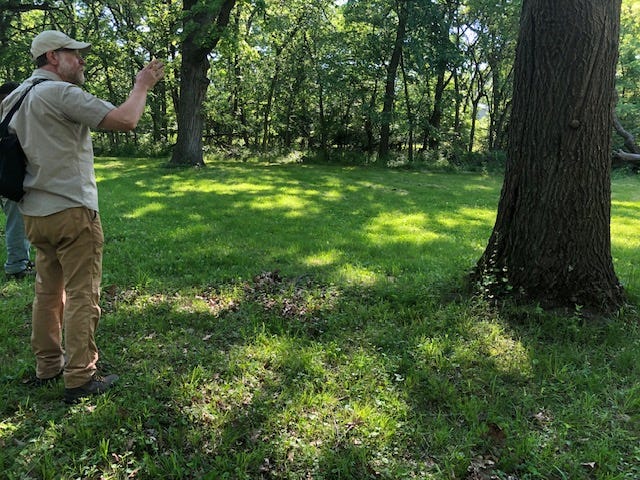
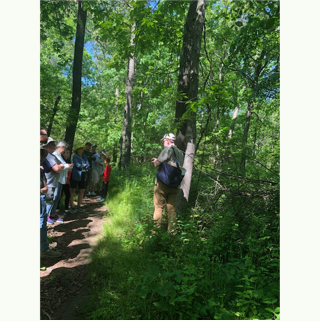
“People want to be connected to the natural world,” says biologist Paul Weihe. Connecting with nature isn’t easy here in Iowa, where just 3% of Iowa is public land and some of this is highway right of ways. Most Iowans don’t own large acreages and depend on public lands for their outdoor recreation. Fortunately, Pella has the 83-acre Big Rock Park owned by the City of Pella! On May 18, Dr. Paul Weihe of Central College gave a multigenerational crowd a new appreciation of living “solar panel apparatuses,” those woody plants that persist through winter and have one or several main trunks –also known as trees.
When one approaches a tree you want to note its
habitat—where it is
its habit—its size and spreading, some of which is influenced by sunlight
and its anatomy—such as the color of the bark and the width and of the bark plates along with the presence of thorns and fruit.
Big Rock Park has a variety of habitats—a meadow, a native oak savannah characterized by widely spaced trees, and a prairie like wet meadow. Thus, it’s home to a variety of trees.
Bark is the dead skin of a tree, which grows out from the trunk anon the tips of branches and roots. Bark is a way to identify trees, even in the winter.Above we see two similar trees. The closer one has vertical stipes or plates of bark with red fissures and bristle top leaves and the other one has white fissures with rounded leaves. They are two oaks of different species—one red and one white. The oak-hickory forest is the most dominant forest ecosystem in Iowa, thanks in part to their fire resistance.
Could anything be prettier than green leaves reaching for a clear, blue sky? This tree (below) is an American Basswood or Linden tree, used for making wooden shoes.
The shagbark hickory (below) has compound leaves and lifting bark plates that are popular homes for bats.
What tree has double dentate leaves, very dry bark that yields easily in layers of cream and reddish brown? It’s one of the many native trees that was over-planted as a “street” tree and later fell victim to sweeping plague? Pella’s Main Street was lined with them until the1960s. See the photos and answer below.
People can identify trees by learning from others, through apps such as iNaturalist, and from keys in books. Dr. Weihe says all are valid, but the books tend to have fewer errors.



 Catherine Haustein