

There’s a lot of alone time writing novels, so when the words finally come together and the venture becomes a book, authors have more enthusiasm about reaching out to others than a crated puppy. This week, I’m excited to share the cover of Snakes in the Class. This cover is one of the first glimmers of my book connecting with someone else, in this case, the cover artist.
Do covers help connect readers with books? The answer is yes. A cover helps identify the genre and the mood of the book. No author or publisher wants to lead a reader astray or trick them into reading something they aren’t going to like. A cover should say “read me” to the right audience.
What’s new for covers these days? According to my cover artist, things such as symbolism and bright, contrasting colors are in.
To help the cover artist create my cover, I filled out a form discussing my content and the main characters. I went over it with my editor and we looked over some sample covers in highly read and reviewed books.
My novel is about a gorgon professor at a college for monsters. It’s not highbrow, but it touches on some serious topics such as responsibility, censorship, and how people with differences are viewed by society.
My editor reminded me that my book was both funny and whimsical. The cover was going to be an original drawing. Here’s the first draft.
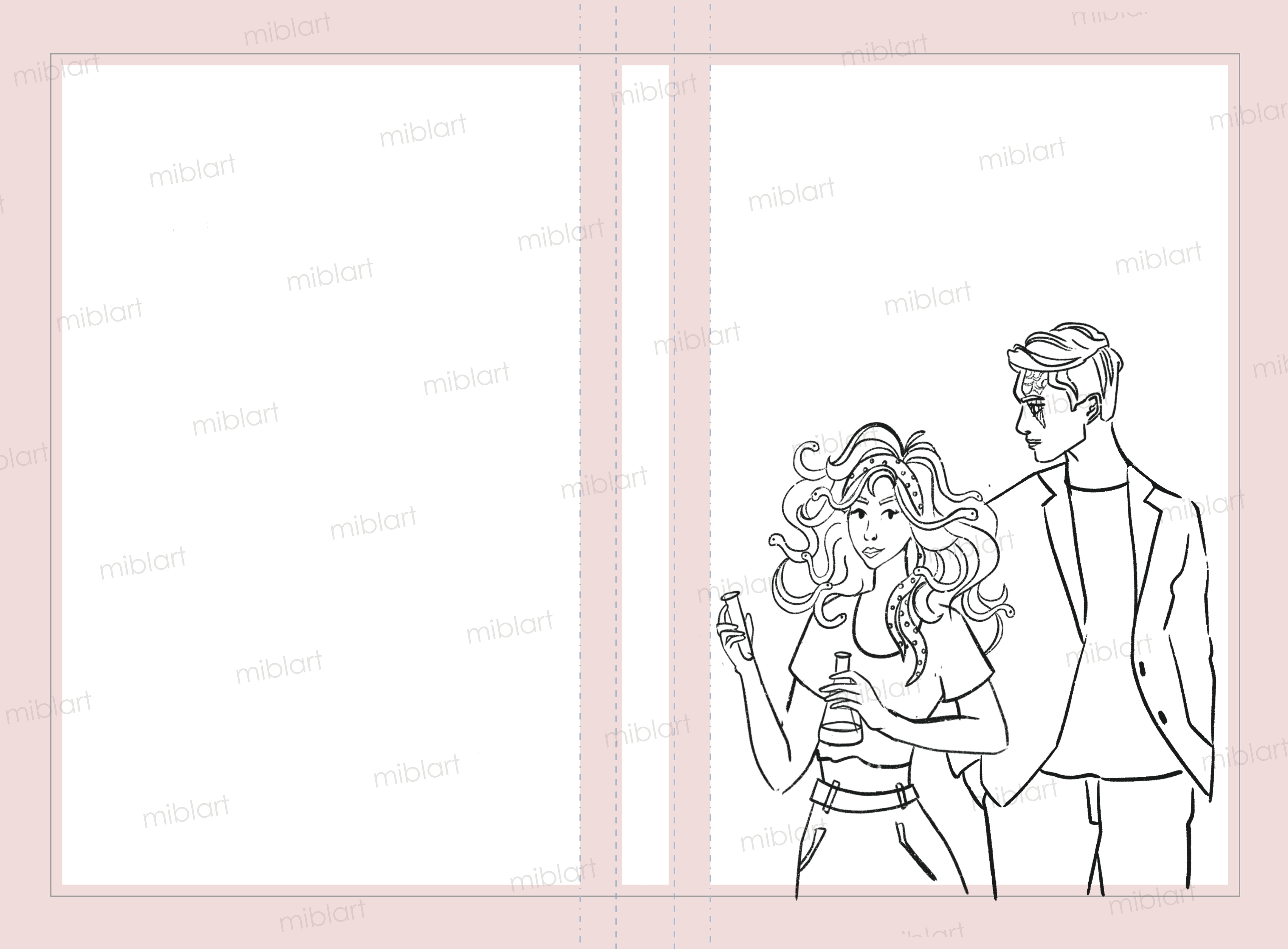
I told the cover artist that the main character, Gormley Grimn, is “a chemistry professor who is a gorgon. Had strawberry blonde hair and her snakes are orange corn snakes.” She’s a chemistry professor because I’ve been one and chemistry is a good problem-solving knowledge base as Gormely finds herself faced with multiple dilemmas. Why corn snakes? In Snakes in the Class, Gormley is reluctant to use her powers , she doesn’t even understand them, so I chose a harmless snake.
The male lead, Ormr Snaakemon, is “an academic dean who is a man on top and a snake on the bottom. From a Pacific Island originally.” My students suggested a snake man.t I wanted someone who didn’t—couldn’t–transform between a man and a snake. I created a snake man stuck in one form, an anti-hero monster surviving in a thankless job. I’ve long been horrified by the nuclear testing on the Pacific Islands. Having a character with parents affected by it was a good way to weave in the misuse of science as a plot point. I also did a fruit fly mutation experiment as a kid which was ever on my mind. Ormr is a mutant snake man, a hybrid more than a scary monster.
The illustrator worked with my editor and publisher to come up with something in the Colorful Illustration category. To quote my illustrator “Colorful book covers with simple vector images are another trend of 2023. Vivid drawings set the right mood and evoke certain emotions essential for the story plot.”
Here’s the final version.

I have a longer post about my cover here.
My novel isn’t out until the end of August, but I’m excited to share the cover, In fact, I had some goodies made to give away as promotions. I’ll be handing them out to bookstores in hopes of getting on their shelves. Do you know a bookstore that would be interested? Would you like a coaster or a sticker? Let me know.
 Catherine Haustein
The cover looks amazing! Love it!
LikeLike