

“People want to be connected to the natural world,” says biologist Paul Weihe. Connecting with nature isn’t easy here in Iowa, where just 3% of Iowa is public land and some of this is highway right of ways. Most Iowans don’t own large acreages and depend on public lands for their outdoor recreation. Fortunately, Pella has the 83-acre Big Rock Park owned by the City of Pella! On May 18, Dr. Paul Weihe of Central College gave a multigenerational crowd a new appreciation of living “solar panel apparatuses,” those woody plants that persist through winter and have one or several main trunks –also known as trees.
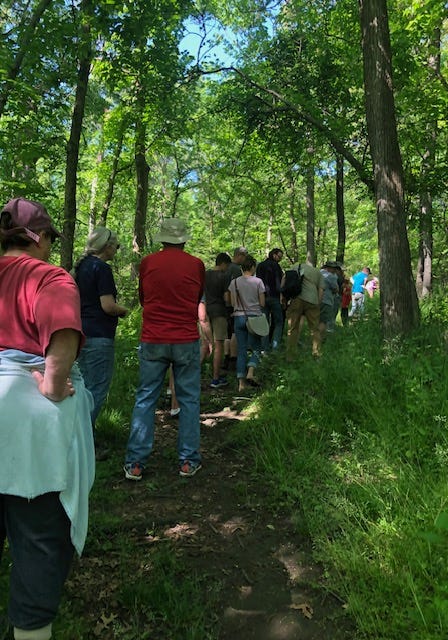
When one approaches a tree you want to note its
habitat—where it is
its habit—its size and spreading, some of which is influenced by sunlight
and its anatomy—such as the color of the bark and the width and of the bark plates along with the presence of thorns and fruit.
Big Rock Park has a variety of habitats—a meadow, a native oak savannah characterized by widely spaced trees, and a prairie like wet meadow. Thus, it’s home to a variety of trees.
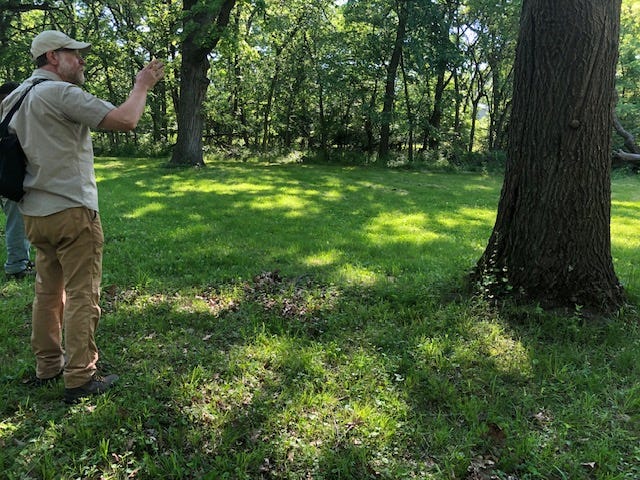
Bark is the dead skin of a tree, which grows out from the trunk anon the tips of branches and roots. Bark is a way to identify trees, even in the winter.Above we see two similar trees. The closer one has vertical stipes or plates of bark with red fissures and bristle top leaves and the other one has white fissures with rounded leaves. They are two oaks of different species—one red and one white. The oak-hickory forest is the most dominant forest ecosystem in Iowa, thanks in part to their fire resistance.
Could anything be prettier than green leaves reaching for a clear, blue sky? This tree (below) is an American Basswood or Linden tree, used for making wooden shoes.
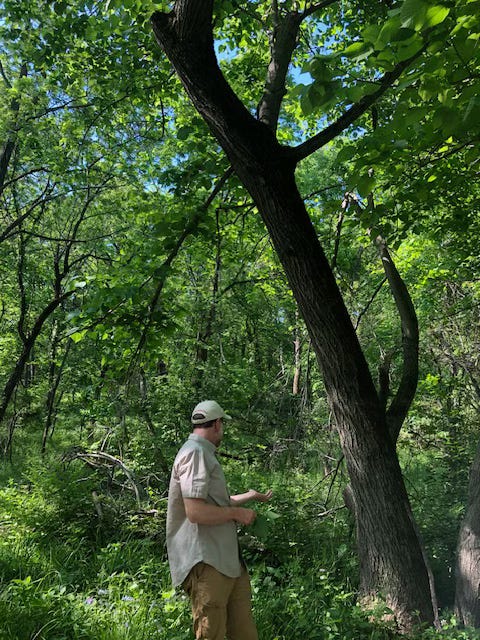
The shagbark hickory (below) has compound leaves and lifting bark plates that are popular homes for bats.
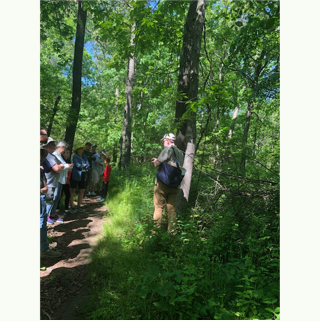
What tree has double dentate leaves, very dry bark that yields easily in layers of cream and reddish brown? It’s one of the many native trees that was over-planted as a “street” tree and later fell victim to sweeping plague? Pella’s Main Street was lined with them until the1960s. See the photos and answer below.
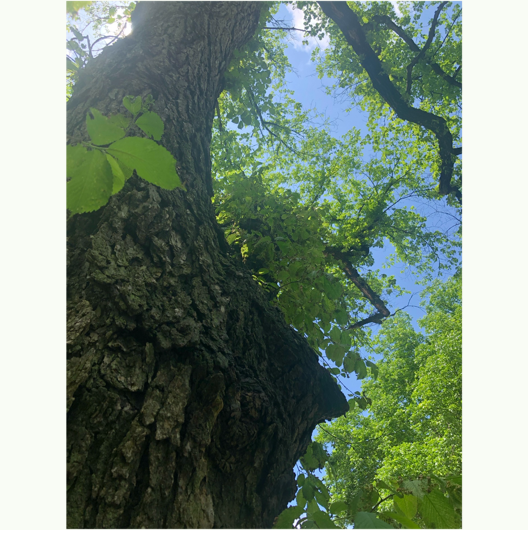
It’s the American Elm!
The group identified the smooth hickory, hackberry, thorny honey locust, the native black walnut—known for poisoning plants coming near it with juglone toxin, and the wild cherry with “burnt potato chip bark” and gummy resin.
We even found a deer (we think) femur!
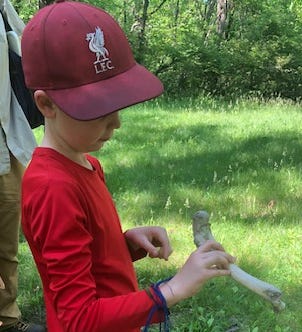
People can identify trees by learning from others, through apps such as iNaturalist, and from keys in books. Dr. Weihe says all are valid, but the books tend to have fewer errors.
Why should we care about trees? Trees cover about a third of the earth, producing oxygen, purifying water, and preventing flooding. And for the religious/spiritual, remember that only God can make a tree.
Observing and journaling about nature increases brainpower and well-being in kids.
Being in nature and even looking at photos of nature is part of healthy aging.
Being around trees reduces stress and hugging a tree releases the feel-good chemical oxytocin.
So, if you haven’t already, take a walk through the trees and don’t be afraid to hug a few.
For more on Big Rock Park, visit here:
 Catherine Haustein
Well, Catherine, you’re talking to one who loves trees. I’m even known to hug them. In the UK overall we have 13% tree coverage whilst here in Northern Ireland (part of UK) we only have 9% coverage. People like me wish the tree coverage was greater.
What you write about is good to hear, helping more people to understand just how important trees are to us & the planet. I hope that walks & talks like Paul Weihe’s will encourage more folk to learn.
I’m currently trying to learn more about the remnants of rainforests in the UK. Yes, rainforests! Temperate rainforest is more endangered than tropical rainforest. Wish me luck. If I can visit a few of the remaining areas here in N.I. I will hopefully write about them.
LikeLiked by 1 person
Oh I’d love to read about them!
LikeLiked by 1 person
thank you, I miss the trees in the north. Here in texas they are only by waterways….
LikeLiked by 1 person
We don’t have nearly enough here in Iowa.
LikeLike