Thoughts on ice

Water is perhaps the most unique and special molecule in the universe. It has one side with a partially positive charge and one side with a partially negative charge. It’s both ionic and covalent. A chemist would call this polar.
As a liquid, water molecules like to hang out together more than one might expect for such a light molecule. It’s just three atoms, two hydrogen and one oxygen. It’s close in weight to methane which is a gas and lighter than chlorine which is a gas. You might say that it has an overpowering attraction to itself which makes it a liquid even though it’s light. Even more importantly to this discussion, this polar molecule can make some neat structures as a solid.

Ice can take 15 forms with thirteen crystalline forms (Ice Ih, Ice Ic, and Ice II-XIV) and three amorphous forms LD, HD and VDH…low density, high density, and very high density. The temperature and pressure help determine which form ice will take. Here on Earth, the ice we get in nature is Ice Ih. The h stands for hexagon. In the figure below you can see the hydrogens (red centered dots) and oxygen (all blue) forming the hexagons.

iceitop
This shows how oxygen(open circle) and hydrogen (with red dot) could arrange to form hexagons. Thanks to Steven Dutch at https://www.uwgb.edu/dutchs/Petrology/Ice%20Structure.HTM
This link shows many ice forms and it is where I got the figures above.
Thanks to the hexagons, the crystalline structure of ice contains more space than liquid water. It’s less dense than water and so it floats.
Amorphous ice has no crystal structure. It’s formed in space at extremely cold temperatures. It can be found in icy moons such as Europa and comets might contain it too.
 All ice luminesces–when hit with ultraviolet light it emits light in the visible region, at 420 nm which is in the violet range. The shimmery bright world of ice and snow isn’t just an illusion. The ice really does emit light.
Besides being shimmery, we all know that ice is slippery. How slippery is it? Most materials have a coefficient of friction of o.3-.6. Human skin has a coefficient of friction of 0.9. Very nice for gripping and other things, isn’t it? Ice has a coefficient of friction that is ten times less than this .02-.05. Very slippery!  Ice near the freezing point is MORE slippery than very cold ice; it’s thought that the extra slip is due to melted water on the surface of the ice. But, this hasn’t been proven. Likewise, car tires slip more on a wet road than a dry one and way more on a wet one. The coefficient of friction for a well-treaded tire is 0.7 on a dry road,  0.4 on a wet one and only 0.1 on ice.
When walking on ice, put your weight on your front leg as penguins do,& wear sticky shoes.  And, don’t forget the sunglasses.

Cement floors and shoes that love them

I’m not sure it’s accurate to say that I love shoes. It’s more that I need shoes. To be a laboratory scientist means closed toed shoes shoes plus cement floors. According to our Fitbits, professors can walk three miles per lab or up to six miles per day while supervising lab classes. I love labs and would rather walk than sit all day. However, I’m ever in search of the elusive comfortable shoe and I join a plethora of health care workers, teachers, beauticians. craftspeople, and sales staff in my quest.

What shoes do hard working cement walkers wear? I asked my Facebook friends: what shoes do you recommend? Here are some of my findings:

img_2527
The science stockroom manager–and a lot of other people–recommended Keens.
img_2577
A CNA said that these Nikes were perfect for her flat feet–so comfortable.
img_2576
A CNA prefers these light weight New Balance that allow her to move easily.
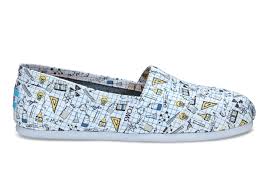
periodic-toms-1
Toms, Sperry, and Birkenstocks–a chemistry research student swears by them. And we all want to get a pair of the chemistry Toms.

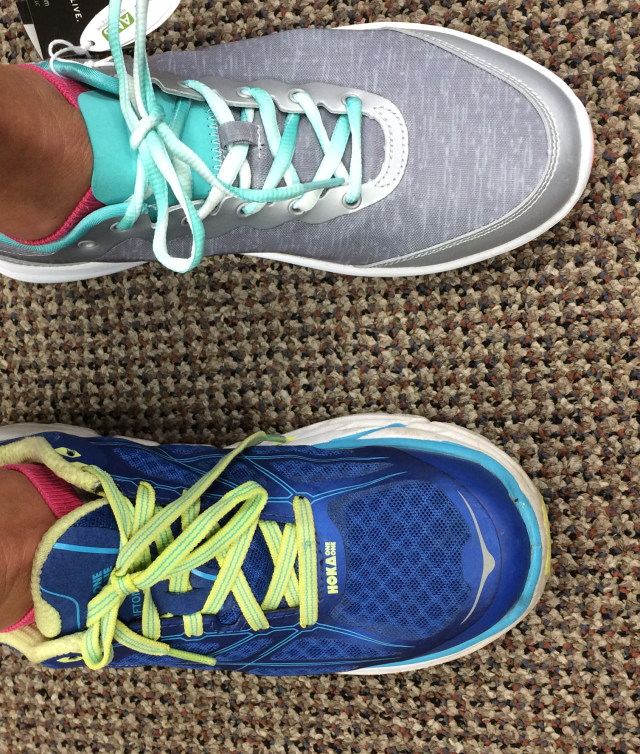
I  went to the local shoe store to compare my Hokas with other shoes.

vionics
Vionics (top) vs my well used Hokas (bottom). I have high arches and don’t need the heel cushion offered by the Vionics. I prefer the Hoka pair but if you have heel pain, the Vionics would be wonderful.


brooks
A nurse mentioned Brooks (top) and they are cute. (Not a match for the Hoka in my opinion.)
img_1616
An auto shop owner prefers Vasque.
img_2566
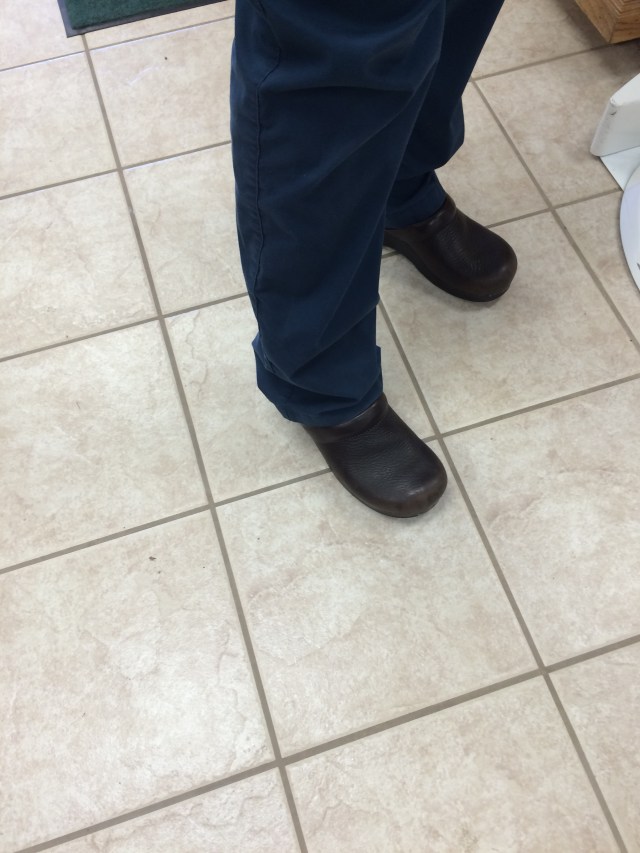
This shoe salesman prefers Danskos.
img_2575
If you’re looking for comfy Oxfords, I recommend Ahnu or Cole Haan.

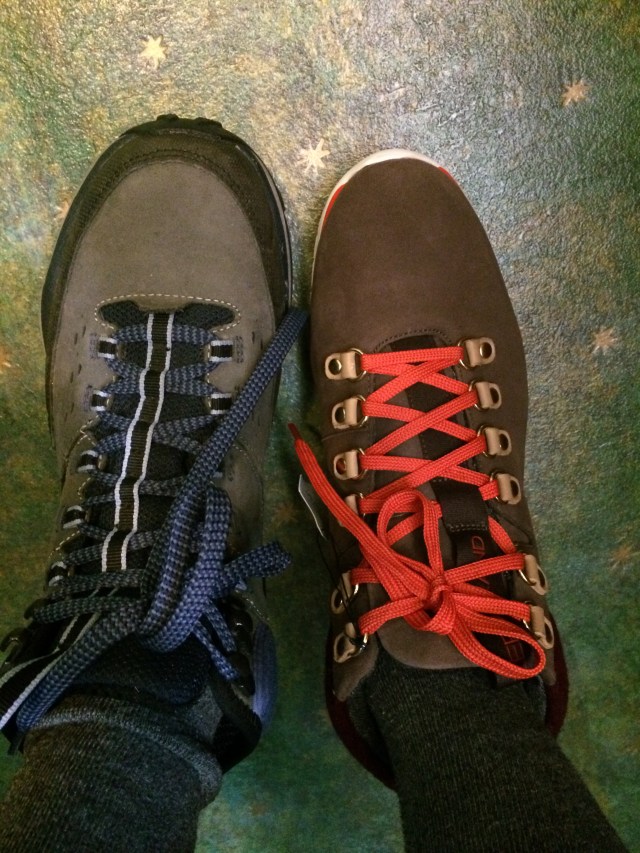
When the going–and weather– gets tough, many cement floor professionals don hiking boots.

img_2580
Hiking boots: Hoka (left) more sturdy and cushiony than the more light and flexible Cole Haan (right). A very small toe box on the shoes on the right so not for me.

Timberland boots were also recommended as “are more than comfy. I constantly walk for 45 or so hours a week and my planters fasciitis isn’t even visible.”

A veteran of trade shows gave this advice: change your shoes at least twice a day and get a foot massage. She explains, “My feet sweat, so not only did I change my shoes I changed my socks too. I gave myself a food massage when I changed shoes (just a couple of minutes starting at the toes and working back). It truly was the only thing that kept me upright for 12-14 hours at the shows.”

Here’s to all who spend their day on cement! Maybe some day my lab floor will be covered with an anti-fatigue mat. Until then, I’ll search for the Holy Grail of shoes–and take that advice to change pairs frequently.

What is love?

I got a request to write a post about love, but when I asked what it was, I didn’t get a good answer.How about this for a theory: love is connection.dogs in love

Mammals begin life connected. Even before birth the connection between mother and child influences our brains, making nerve fibers that will affect our temperament. Some of the way we perceive love and what it means to us, begins before we even take a breath. Motherhood drug use,  exposure to toxic chemicals, or stress will affect our development and our ability to love in the future.

The mother-infant bond sets the stage for the offspring to be able to take and give love and to handle stress. The mother and baby need to look at each other, work together to establish mutual rewards, and generate oxytocin and cortisol (the first to relax us, the second to create vigilance). Believe it or not, the development of a form of ambivalence is a part of the bond. Babies are exhausting. Motherhood is tiring. Our very first experience with love is that it’s too much to maintain intensely. Such is the tragedy of love, but if we are healthy, we can love and do so with some autonomy.

Of course, one can’t talk of love without mentioning erotic love. Kissing boosts the immune system and increases our sense of well-being.  It makes us invincible even though the search for erotic love can bring us to some crazy places of insecurity about our worth and appearance and rightly so, erotic love is stimulated by visuals. Yes, it’s shallow and also wonderful. Even just having a crush releases some feel good chemicals.

Attachment is a phase of love and it is just as chemical as erotic love. As the song goes, “be careful who you love.” There are those who don’t think twice about doing another in emotionally. People who treat others poorly, who fail to attach, have a chemical imbalance. Break ups or “love rejections” are chemically harmful. They might take up to two years to recover from. But it’s better than casting your lot with someone who can’t attach.

Alcohol and love do similar things to the brain: they take away fear, make us feel better about ourselves but also, surprisingly make us more judgmental of people outside our social sphere, creating a special connection with the one you love, be it a person or a bottle.

I personally get a strong sense of connection working beside someone and I’m not alone. This is why a person can love their job or a group they are a part of. It’s no accident that I became a laboratory scientist. Working in lab on an experiment is a delicious form of connection and ever since fictional Victor Frankenstein worked in secret on his creation and subsequently abandoned the hapless creature, the message has been clear: don’t work alone in lab. To be a scientist is to never work alone. It’s true that if you love your job, you don’t have to work.

We love our pets and they can love us. The owner-pet bond is real, healthy, and less dependent on visual cues than erotic love. It’s as true as any love.

The other day I was visiting my dad. My mom, died almost three years ago. He was telling me how much he missed her. I asked him what I could do. He said, “Just listen.” It turns out that feeling listened to is one way that people feel loved.A person will feel loved if they know that you understand what they are going through and that you share the same emotions about it.I was glad and surprised that loving him was so simple as that.I didn’t have to fix anything or make a grand display.  Guess I had a thing or two to learn about love.


The Periodic Table Explained

I post insecurely in front of the periodic table display  at the U of Iowa (featuring actual elements).
I pose insecurely in front of the periodic table display at the U of Iowa (featuring actual elements).

A while back a friend asked: what’s the deal with chemists and the periodic table? In a nutshell, the periodic table displays all of the elements in an order that allows chemists to know something about each one at a glance.

The elements are arranged by increasing atomic number–the number of protons (+ charges)–roughly equivalent to increasing weight. They are in rows according to the shell or as chemists would say, according to the quantum numbers. Quantum numbers are the equivalent to an element’s address and tell a lot about the electrons–negative charge cloud around the atom. Most of the time, reactivity is due to electrons and their placement around the atom. Conveniently, mother nature made it simple, as elements gain mass and electrons, they group themselves. The columns on the periodic table belong to elements growing ever larger but with the same arrangement of elections on the outside. This means, they react in similar fashion.

See that row on the right with the neon sign? Those are the noble gasses which don’t easily react with anything. Conversely, on the far left are things like sodium and potassium that react so easily to give elections that the elemental forms must be stored under an oil to keep them from joining up with oxygen. Why can you chose between chlorine and bromine for your hot tub? You’ll find chlorine above bromine on the table. They act much the same but chlorine is lighter.

Metals are on the left side along with hydrogen, the lightest element, and non-metals such as carbon, oxygen, and nitrogen are on the right. Elements in-between are the semi-metals or semiconductors. Radioactive elements, too big to be stable, have their weight in parenthesis.

This mortarboard, made by a clever Central College graduate, shows the system of symbols used for element names. The Cc abbreviation is for “Central College.” The numbers are for the proton number (the smaller number) and the weight of the element, which includes neutrons, heavy without charge.

Elemental mortarboard at Central College graduation.
img_2620
I like to hand out periodic tables. If someone gives me a tract I will respond by giving them a table. I have even given periodic tables to children associated with the Westboro Baptist Church. I’ll give you one too. Just ask me. 🙂

There you have it. The periodic table will give up lots about the elements without requiring deep thought. The father of the Periodic Table was Mendeleev, a hairy dude who let his lust get the better of him and my guess is that this is why although he made the most useful tool ever imagined way back in 1869, he never got the Nobel Prize. He did it without knowing anything about the parts of the atom–the protons, neutrons, and electrons–basing it all on how each element reacted. That’s what science is all about, predicting, and what helped science slay the beast of fearful superstition that plagued humans throughout history.