Don’t be afraid of WOTUS. A look at a local creek and a federal rule

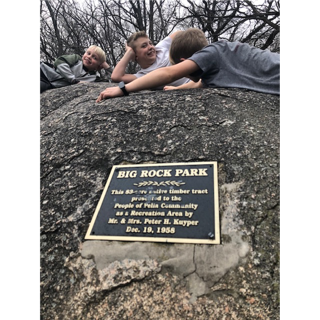
I’ve been an analytical chemist for a long time. For most of my life, I was a professor at Central College. These days, I freelance and right now I’m finishing up a study at Big Rock Park in Pella, Iowa. It has a little creek running through it, totally natural in some places and filled with concrete slabs to prevent erosion in other spots. The creek runs though a west Pella neighborhood. Houses boarder the creek on one side and a farm on the other. The friends of Big Rock Park wanted to know if the water was clean and safe for wading. Kids love to wade there and hike to the rock to climb it and take cheesy photos.
            I started the study not sure what I’d find. One delight was that paper and strip-based color tests, like the ones you use to test an aquarium or swimming pool, have expanded significantly. Paper strip tests were one thing I worked on for my PhD thesis long ago. (Click here for more on my laboratory past.)

For my current project, I made a little laboratory stockroom in a portion of my study and I was all set to go—much like computers getting smaller, so did my lab. Small portable meters such as for dissolved oxygen and dissolved solids became available during the course of the study.  The ease of testing allowed me to engage the public, even kids, with water testing.
The results in the end aren’t surprising. Whatever people put on their land ends up in the water. When salt goes on the roads in the winter, it ends up in the water. When people fertilize their lawns, it ends up in the water. It’s surprising how fast the fertilizer shows up.

One twist to my study which I should have expected but didn’t is that the overwhelmingly most concentrated and persistent pollution was bacteria—particularly E. coli. This bacteria, coming from fecal matter, showed up in early May and persisted through December. Farm run-off has been pin-pointed as a source of this and many other pollutants.

As a water chemist and a chemist in general, I’m in favor of the Waters of the United States or WOTUS Clean Water Rule. As I said before, what goes on the land ends up in our water. We must protect it.Regulated substances include all sorts of chemical and biological hazards including those which “cause death, disease, behavioral abnormalities, cancer, genetic mutations, physiological malfunctions (including malfunctions in reproduction) or physical deformations, in such organisms or their offspring.” Substances which might cause lower oxygen levels in the water, which I did see at Big Rock Park, are regulated and the ruling calls for increased fines for spills as well as more money for “enforcing spill prevention measures, reviewing spill response plans, inspecting spill containment and cleanup equipment.”

WOTUS has met with some puffed up resistance.

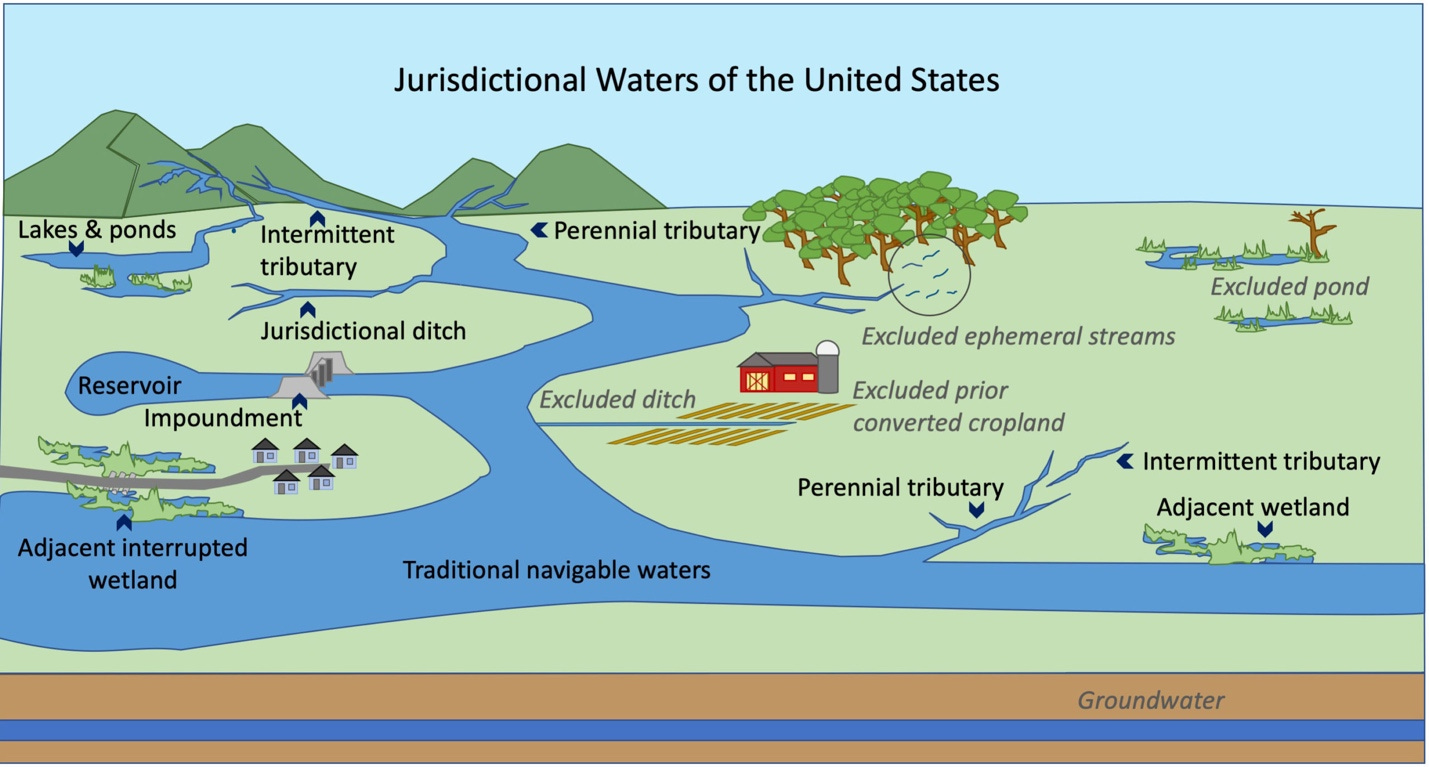
As part of WOTUS, these waters are protected: Navigable waters, Territorial seas, Interstate waters, Impoundments (dam created reservoirs such as Lake Red Rock), and Tributaries

Adjacent wetlands and additional waters are also considered WOTUS if they meet either the “relatively permanent” standard or the “significant nexus” standard, meaning they are likely to affect the other protected types of waters.

Here’s an illustration, also shown below, credit to Sarah A. White of Clemson University.
Diagram

Description automatically generated

These waters are exempt : prior converted cropland, waste treatment systems, ditches, artificially irrigated areas, artificial lakes or ponds, artificial reflecting pools or swimming pools, waterfilled depressions, and swales and erosional features.

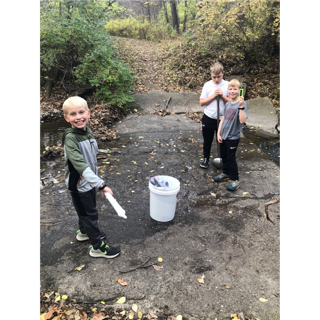
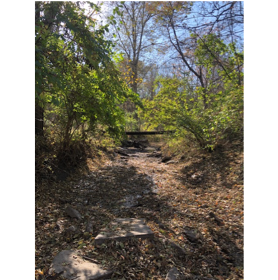
WOTUS covers less than the Obama-era rule but more than the Trump-era rule. It would include the Everglades for example and intermittent streams. Big Rock Park’s creek would fall under this as it dries up at times of drought, as shown in the photo below.
A picture containing tree, outdoor, plant, forest

Description automatically generated

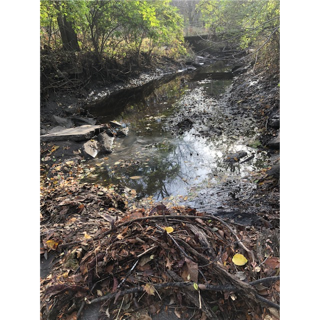
A downpour filled the creek bed and brought all sorts of leaves, sticks, and trash, showing how vulnerable these intermittent creeks are.
A small waterfall in a forest

Description automatically generated with low confidence

The new rule has human health as a focus and looks at both microbial (such as E. coli) as well as chemical pollution. Not only is it projected to lower the cost of clean water, it looks to avert future problems such as pipe corrosion as in Flint, Michigan, where road salt contributed to corrosion. It also supports fisheries.

WOTUS is a good rule which doesn’t go quite far enough in my opinion.

Being mad about WOTUS is more showmanship than anything.  Its controversy is unfounded and made to stoke resentment of rural people, who suffer cancer at a high rate and need to be protected. In the meantime, enjoy our local park. Be sure to use hand sanitizer after touching the water, especially after manure applications on farm fields makes its way into local waters.

Iowa’s high cancer rate–environment or lifestyle?

Iowa Cancer Rate—environment or lifestyle?

Why is Iowa the only state with an increasing cancer rate? Compared to other states, we have more cases of almost every cancer except lung. Other than Kentucky, we are the most cancer-riddled state in the union. I’m not an epidemiologist. I don’t have an answer. But I want to consider our situation. Someone has to.

What have we got that other states don’t have?

Is it the pesticides? There is a connection between cancer and pesticide exposure, known about for years. Pesticides are associated with higher risk of childhood cancer. The nationwide glyphosate herbicide use map is here. Most pesticide usage is in the form of  herbicides. There’s a Strong link between some insecticides and aggressive prostate cancer. But not a link with prostate cancer and herbicides. You can click on this map and see the insecticide usage in Iowa  get higher and higher, until the study was stopped. In case you don’t want to follow the link, the most intense region of use is NW Iowa.

Cancer is associated with animal agriculture wastes and confinement operations; possibly nitrates play a role. Here is a study correlating it. Nitrate consumption, for example in food such as corn dogs has been associated with an increased cancer risk, although exposure on the skin is not.

Where is Iowa cancer increasing the fastest? Along the Mississippi. Over in Illinois, which has a lower cancer rate than Iowa, some river counties also have high cancer rates. Not like here in Iowa, though. What do we have that they don’t?

Where are the CAFOs? You know, those animal feeding operations. Most are in NW Iowa, near Palo Alto County and vicinity. Iowa’s most cancerous county, the one with the highest cancer rate is Palo Alto Countywhich has several lakes and a grotto.  Illinois’s most cancerous county, Pike County, is home to the most CAFOs in the state. 

Where is the most cancer?

Illinois has around 2,000 CAFOs. Iowa, 9,000. North Carolina has around 7,000. Studies of people who live near CAFOs in Iowa and North Carolina showed an increase in lymphohematopoietic cancers (lymphoma, myeloma, and leukemia). This was distinct for people working with the animals. Leukemia rose for those working specifically with cattle. Air toxins were the suspected agents. A study from Duke University linked numerous health problems to living near CAFOs. Here is North Carolina’s cancer profile. Here are their CAFO sites. There’s some overlap but officials there suspect it is due to  coal ash.

Coal ash certainly carries carcinogens such as mercury, cadmium, and arsenic. Until recently, Pella had a coal burning plant and Marion County has a higher cancer rate than neighboring counties, despite having fewer CAFOs. Coal mining is linked to numerous health problems. Here is a map of Iowa’s known coal mines. (Many have been rehabilitated.) It doesn’t match with the highest cancer counties in Iowa but I have to agree with the North Carolina speculation that coal ash a factor in a high cancer rate. But let’s get back to CAFOs.

The American Association for Public Health has called for a ban of CAFOs, citing nitrates seeping into drinking water as a major concern. Iowa is number one in poop production in the US. Thousands of cancer cases in Iowa have been linked to nitrates from animal poop. Iowa has above average toxic air pollution as well.

You can’t talk about Iowa and cancer without thinking about radon, associated with lung cancer, but not thyroid cancer (see maps and data for radon and thyroid cancer here.) Here is the first of a multi-blog story about getting radon out of my basement. Radon is a problem in Iowa but other states such as South Dakota and Nebraska have higher levels. (see map). 

Arsenic is a known carcinogen and Iowa is laden with arsenic. Where is the arsenic? NE Iowa has greatest concentrations. The correlation between arsenic in drinking water and prostate cancer (which is high in Iowa) has been established. But not all states with arsenic in ground water have high cancer rates (California for example). 

Is it obesity? Iowa ranks 11th in the nation for adult obesity. Get this–pesticide exposure is associated with obesity. Yes, insecticides might be making us fat. They might even be giving us brain damage. (This could explain a few things.) The most obese counties are in general along the Mississippi. Cancer rates are rising here.

Iowa isn’t the drunkest state, but it is number two in binge drinking. This could be due to the many colleges here. Alcohol use is linked with cancer, particularly breast cancer. Breast cancer is linked to pesticides, especially pesticide exposure during childhood and prenatally. You’d think all those life-is-sacred people would care more about this. Iowa’s breast cancer rate is higher than average. It is one of Iowa’s top cancers.  If you aren’t sick of maps by now, here’s a map to prove it. Alcohol use combined with pesticide exposure could definitely be a factor in our breast cancer rate.

How about smoking? Iowa is not in the top ten states for smokers but above average. About 10% of smokers get lung cancer and about half of all smokers will get some sort of cancer. It’s a factor in our high cancer rate but not one that defines us over other states.

Age? Yes, our population is older and age is a risk factor for cancer. We rank 16th for percentage of residents over 65. We aren’t distinctively old.

 Radioactive fallout swept over Iowa in the 1950s. This would be a factor, especially for thyroid cancer. It took until 1982 for traces of the fallout to disappear.  This factor Would show up in Idaho more than Iowa. You can use this calculator to determine your elevated risk of thyroid cancer from fallout here.

Lower cancer rates are associated with a high amount of Public lands. Iowa has almost no public lands—only 2.8%. This is just an observation. With so much land privately owned, our environment is beholding to the landowners to protect it and us.

Are we Iowans too lazy to exercise? Iowa Cancer Registry Director Dr. Mary Charlton says our high cancer rate complicated but points to a lifestyle problem. Yet Iowa isn’t one of the top ten most sedentary states.

We also aren’t among the poorest states, but, unlike most, our poverty rate hasn’t decreased in recent years.This is an indication of a state government which doesn’t care to make lives better for the average citizen. And sadly, rural Iowans don’t always get the recommended cancer care.

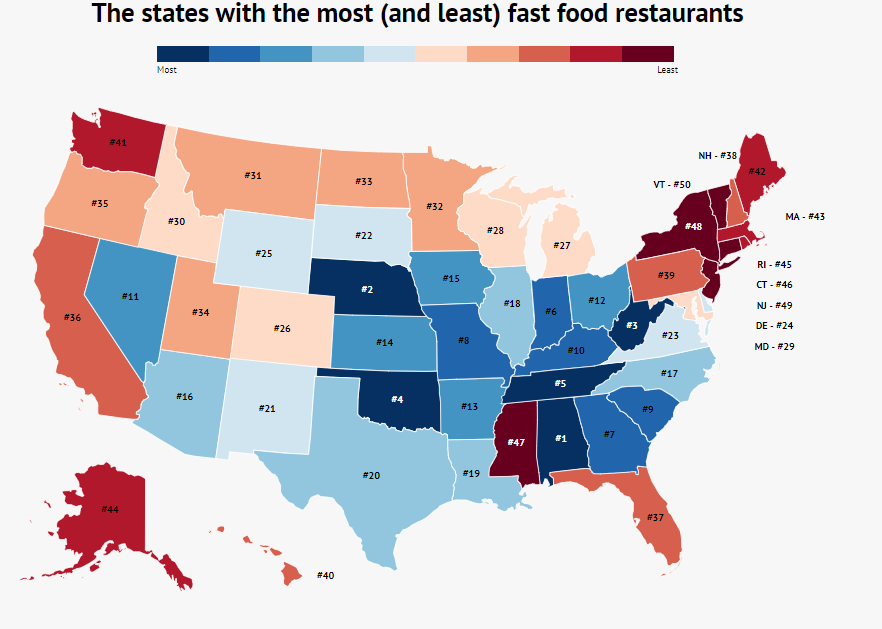
I haven’t discussed diet yet but rest assured, Illinois eats more hotdogs than Iowans. Iowans are in the top of the states for candy consumption, coming in at number eleven. Sugar isn’t linked to cancer though. There have been few and inconclusive studies linking fast food to cancer. Iowa is #15 for fast food consumption. Pella recently was “blessed” with another fast-food restaurant, and you should see the lines at the drive up window, and the nutrient content of the food! 

The bottom line is that on many levels, Iowa doesn’t look like a particularly healthy state. We have nitrates, pesticides, arsenic, fallout, radon, smoking, coal mines, obesity, and too much hog waste.  Sometimes the answer is “all of the above.” I’m going to go a step further and say we’ve been trained not to worry about our health. Studies of the dangers of agricultural chemicals are not taken seriously. Any attempt to keep pollutants out of the air and water is accompanied by screams from elected officials. We quickly gave up on COVID mitigation measures. We even had office holders refuse to wear masks despite their efficacy. As for CAFOs, we’re number one and like ethanol, we’re pretty much stuck with it.

Iowa has a cancer problem and few care. We just don’t care. The story about our cancer rates hasn’t gotten much traction. Has it been in the Register? Are your friends talking about it? Have our politicians stopped bashing WOTUS and rolling it back? No. They are bitching and moaning about not being able to build on wetlands—which could remove toxins–or fighting for their rights to pour toxins into ditches that will eventually drain to the Mississippi.

And yes, our politicians want to censor information about HPV vaccines, which will prevent cancer.

We vote for these clowns and believe them.  Maybe it’s a lifestyle problem after all. 

Okoboji Writers’ Retreat & the world’s largest popcorn ball 2022

I ventured out of my niche here in SE Iowa to partake in the second annual Okoboji Writers’ Retreat on the opposite corner of the state. This area contains glacier carved lakes and the Iowa Lakeside Laboratory, the location of the conference.

I didn’t take nearly enough photos of the beautiful Lakeside Labs.
Here’s what the trip there & back looked like.

I went with my sister, a journalist. We are both freelancers now as we embarked on the four hour drive across mostly rural Iowa.

The retreat was both fun and inspirational. I got ideas about new projects and for better or worse, encouragement to keep using social media. I learned how to make my sex scenes more sensual and met great people, including the owner of this farm and BNB.

Here’s more about the retreat.

And more.

Fortunately, the camera didn’t capture me in the links above, maybe because I was sneaking off to buy beer.

No, I didn’t get a sticker. Oh so uncomfortable!

After getting much information and meeting people who enriched my life, we headed back to Pella and made a few stops along the way.

How often do you have a chance to see the world’s largest popcorn ball in Sac City, Iowa?

It’s right along highway 20 and you can glimpse it from the road. We stopped and parked behind it. The signage was confusing but it looked as if we were in a little park.

A tiny village is tucked away behind the popcorn ball.
I wasn’t sure what this park was about, town’s history maybe, but there was a long list of donors who contributed to the popcorn ball and the shed where it is displayed.
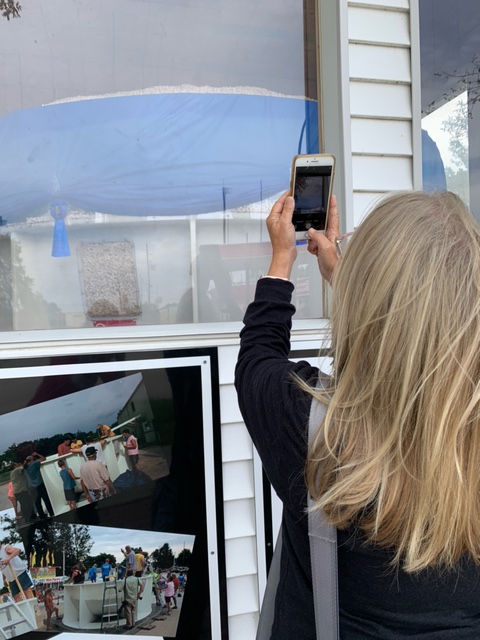
The ball is covered by a blue tarp inside of a roadside stand.

The popcorn ball was made all in one day–June 18, 2016. It weighs 9,370 pounds. This includes 2300 lbs of popcorn. It’s 12 feet in diameter.

We continued on our journey, stopping for mums.

My crooked mumkin–the mum and its pot in an old ceramic jack o’ lantern. Crooked mum, crooked mumkin.

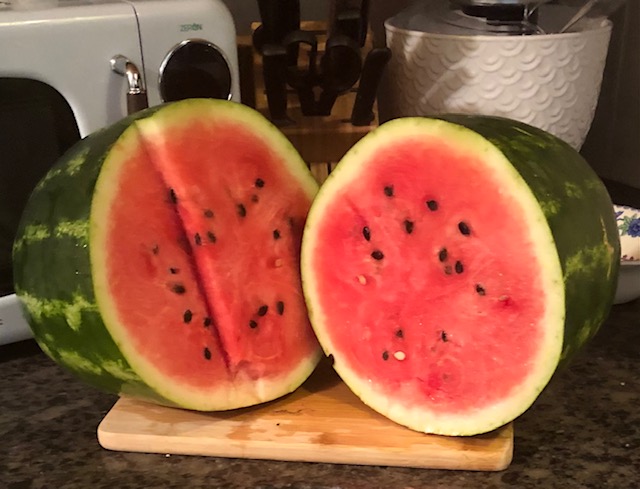
And watermelon.

fresh from the farm

Not willing to let the experience go, I made popcorn balls. It was messy and required vinyl gloves.

Hot and sticky
Tasty, but I’ll leave the world’s record to the pros in Sac City.

In case you were wondering, besides popcorn, a popcorn ball is made from confectioners sugar, corn syrup, marshmallows (optional), butter or margarine, and a small bit of water. I used around 2-3 cups of unpopped corn, weighing maybe half a pound (I’m rounding up to avoid having to use scientific notation or decimals). Think about it before you attempt to outdo Sac City.