I’m not sure it’s accurate to say that I love shoes. It’s more that I need shoes. To be a laboratory scientist means closed toed shoes shoes plus cement floors. According to our Fitbits, professors can walk three miles per lab or up to six miles per day while supervising lab classes. I love labs and would rather walk than sit all day. However, I’m ever in search of the elusive comfortable shoe and I join a plethora of health care workers, teachers, beauticians. craftspeople, and sales staff in my quest.
What shoes do hard working cement walkers wear? I asked my Facebook friends: what shoes do you recommend? Here are some of my findings:
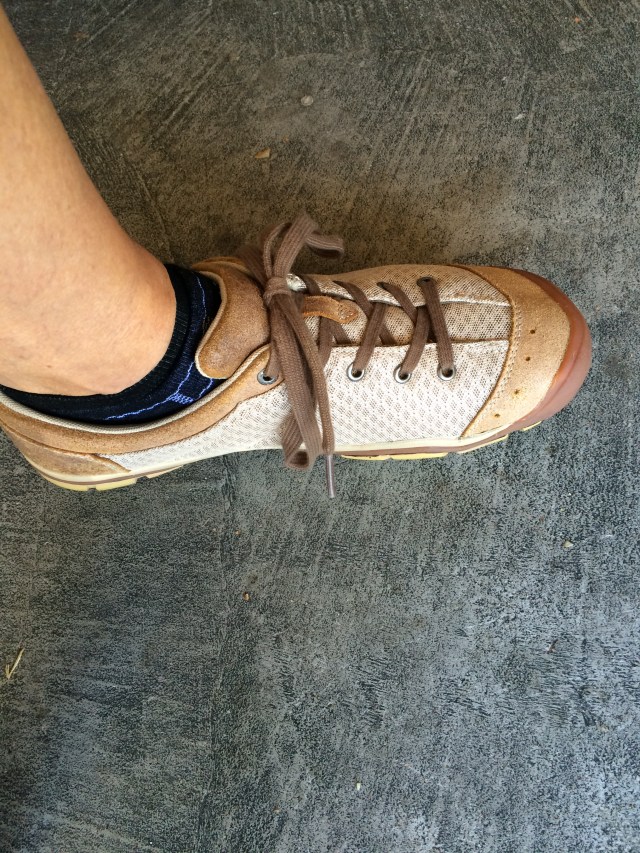
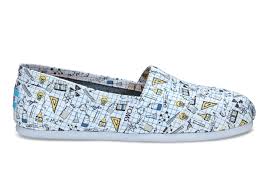
The science stockroom manager–and a lot of other people–recommended Keens.A CNA said that these Nikes were perfect for her flat feet–so comfortable.A CNA prefers these light weight New Balance that allow her to move easily.Toms, Sperry, and Birkenstocks–a chemistry research student swears by them. And we all want to get a pair of the chemistry Toms.
I went to the local shoe store to compare my Hokas with other shoes.
Vionics (top) vs my well used Hokas (bottom). I have high arches and don’t need the heel cushion offered by the Vionics. I prefer the Hoka pair but if you have heel pain, the Vionics would be wonderful.
A nurse mentioned Brooks (top) and they are cute. (Not a match for the Hoka in my opinion.)An auto shop owner prefers Vasque.This shoe salesman prefers Danskos.If you’re looking for comfy Oxfords, I recommend Ahnu or Cole Haan.
When the going–and weather– gets tough, many cement floor professionals don hiking boots.
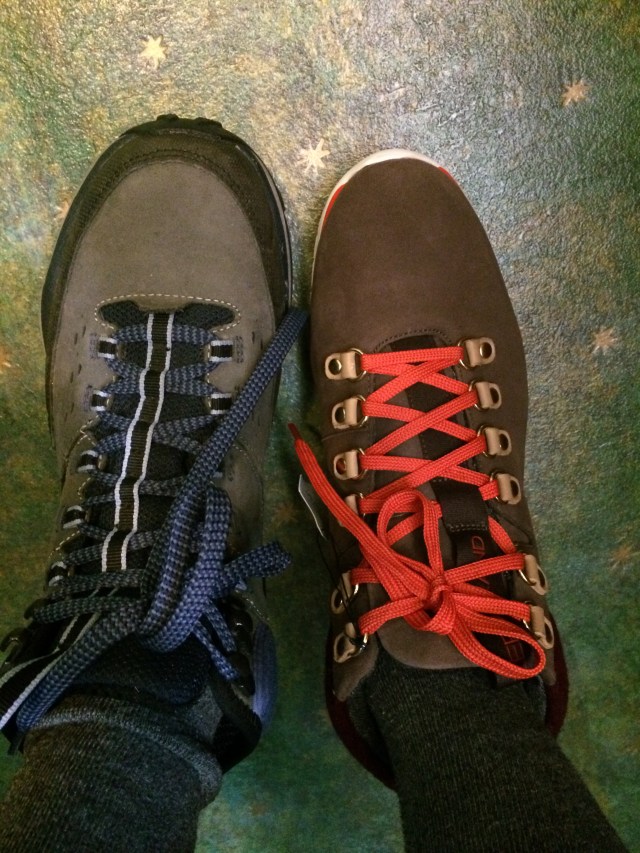
Hiking boots: Hoka (left) more sturdy and cushiony than the more light and flexible Cole Haan (right). A very small toe box on the shoes on the right so not for me.
Timberland boots were also recommended as “are more than comfy. I constantly walk for 45 or so hours a week and my planters fasciitis isn’t even visible.”
A veteran of trade shows gave this advice: change your shoes at least twice a day and get a foot massage. She explains, “My feet sweat, so not only did I change my shoes I changed my socks too. I gave myself a food massage when I changed shoes (just a couple of minutes starting at the toes and working back). It truly was the only thing that kept me upright for 12-14 hours at the shows.”
Here’s to all who spend their day on cement! Maybe some day my lab floor will be covered with an anti-fatigue mat. Until then, I’ll search for the Holy Grail of shoes–and take that advice to change pairs frequently.
I’m busy making final edits to Mixed In. Here’s an interview with me on my publisher’s web site. Yes, I do love mixing things–chemicals, food on my plate, and even genres.
The marriage rate has fallen in China as young women opt for self sufficiency. The oldest person in the world credits her early divorce and refusal to remarry as part of the secret to her 116 years. It makes a person wonder, if not for social rules, would women get married at all? Please take a moment to answer this poll and/or add your insights.
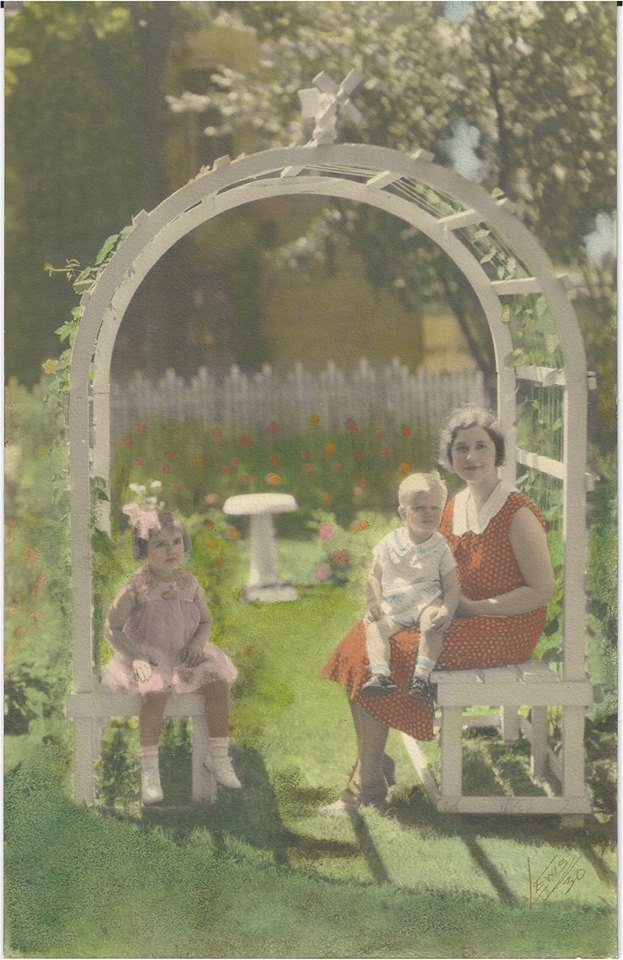
Gladys Fedelia Kendrick Hinga and children around 1930 in Holland, Michigan
My grandma Gladys was a well-educated woman and lovely hostess.I have to give credit to her for instilling me with an appreciation of new scientific advances. She wove such horror tales of life without technology and antibiotics and the difficultly of being a wife and mother during those times. See that cute little girl? That’s my Aunt Connie who was born before antibiotics. She’d get ear infections and puss would drip from her ear! No wonder I rushed to board the lifeboat that was scientific progress.
Grandma was a wonderful cook. But when pre-packaged foods came about she had no qualms about using them — freeing up time to go dancing or take her grandchildren on educational outings. I still remember when she took me to a museum and I saw a whole display of shrunken heads.
Here’s her meatloaf recipe. Easy, tasty, and loaded with sodium chloride!
3 lbs ground beef
2/3 cup oatmeal
1 1/4 cup V-8
3 eggs
1 pkg Lipton onion soup mix
2 tablespoons mustard
1/4 tsp pepper
3 tsp salt
Worcester sauce
Bake at 350 for 1 1/2 hours.
***
Salt is both good and bad. It can help retain fluids in the body but too much will cause kidneys and arteries to overwork and thus create hypertension and damage to kidneys and arteries. In fact, my grandmother suffered from artery damage later in life. Biologist Dr. Ellen Dupree explains it this way “Salt is essential for normal functioning of our cells. Too much or too little salt affects water balance in our cells, affects our blood pressure, the ability of our nervous system to function properly and can affect kidney function. Salt levels are so important that we have multiple hormones designed to maintain proper salt concentrations in blood (and around cells).”
I can’t sleep when I’ve eaten too much salt and I’m not the only one. Endocrine Abstracts published a study that found that salty foods will keep people awake and give them restless sleep. In graduate school I used to eat a hot dog the morning of an exam to wake me up after a night of cramming–especially for organic chemistry, oh what a killer.That was in the 80s when people said things like “I’ll sleep when I’m dead.” Would I pull an all nighter today? Na.
Here is a recipe from my mom. Mom inspired me to not aspire to be a house wife. She couldn’t hide how bored she was. Although she was loving and nurturing, I found myself weaving tales of school that went well beyond what actually happened because I felt the need to entertain her. I was finally busted when I told an elaborate story about having speech therapy. Not only did I not need speech therapy, I claimed that the therapist gave me a Payday Candy bar.
Mom made this cake for my dad’s birthday. I’m not sure why it’s called a Russian Tea Loaf although I once had a Russian tell me that if you have blue eyes, you are part Russian. In the 1950s-80s, the U.S. and Russia were locked in a Cold War which made Russia glamorous. My family lived in Washington D.C. during the Bay of Pigs incident and learned early in life to duck and cover. I practiced running home from school to die with my mom in ten minutes or less. I even had a sleeping bag at school in case the Big One was launched and not detected in time and the school was used as a bomb shelter. If you see older citizens of the U.S. with no savings and their health shot through from bad living don’t judge. They were taught from an early age that they were going to die young. Now we have school lock down drills and terrorist threats so only those who grew up in the 90s escaped that sense of doom and dread that is part of our culture.
As with most mid-century cooking, this uses a pre-made item, the angel food cake, an American invention. It also contains an unspecified package size. Sorry about that. There wasn’t the vast array of choice back then. Cut the cake with a serrated knife.
Russian Tea Loaf
Buy an angel food cake.
Custard filling:
5 eggs–remove yolks and set aside
3/4 cup sugar
1 1/2 cups half and half
1 envelope unflavored gelatin
1/4 cup cold water
1 pt whipping cream
1 tsp vanilla
Beat yolks until light and add sugar. Heat cream in double boiler. Add egg yolks mixture and cook until thick.While custard is hot, add gelatin which has been dissolved in cold water. Let cool and add stiffly beaten whipping cream and vanilla. Cut cake in 3 layers and put custard between layers and over entire cake.
The other day my son asked me for the recipe of something I’d made for the family. I was embarrassed to admit that it was 1950s cooking–meat seasoned with a can of mushroom soup. Nearly as bad as 80s food–think chicken nuggets– 50s food freed the housewife from much of the tedium of cooking. She now had time to think thoughts such as “if I had been born a man, what would I be?” This is the heart of the feminine mystique. (My mother would have been a veterinarian.)
My novel Mixed In looks at the past to form a dystopia. I absorbed a restlessness from my mother that was characteristic of women of her era. But this blog is not about malaise. It’s about “50s” cooking. I hope to publish here on my blog a series of favorite unhealthy family recipes that probably all of us in the U.S. have enjoyed. Most require prepackaged food and a hand mixer.
Let’s start out with Granny’s cheesecake. This recipe is based on Jell-O. Almost lost to history, Jell-O became popular around 1902. I once lived just 30 minutes from the Jell-O museum and sadly never visited.
Jello gives this cheesecake an unexpected lightness. My Granny always had one ready when we were coming to visit. Here is the recipe in her own words.
Granny Grace’s Cheesecake
1 cup of sugar
1/2 package large cream cheese
1 tsp vanilla
1 pkg lemon Jell-O and 1 cup water cooled together
1 13 oz can evaporated milk
1 graham cracker crust in a 9 x 13 pan
Set Jell-O. Put bowl, beaters, and evaporated milk in the refrigerator. Mix cream cheese, sugar, and vanilla with a fork very well.
In a large bowl beat evaporated milk at high speed until volume doubts. Add cooled Jell-O. Pour in cream cheese mixture and fold with a spatula. Pour into crust. Sprinkle extra crust mixture on top.
Crust
12 graham crackers
1/3 cup sugar
1/4 cup melted butter
There you have it. A uniquely 20th century food.
Do you have a favorite 50s recipe to share? Send it to me at hausteinc@gmail.com
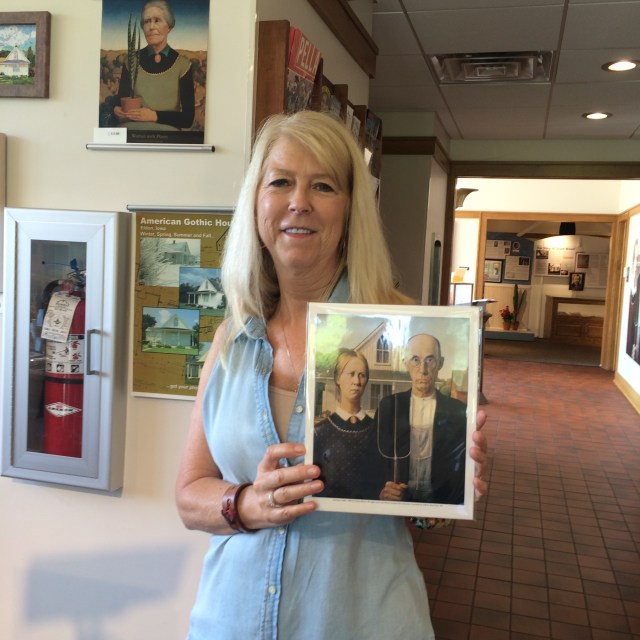
An hour and three minutes from my driveway lies the second most famous house in America–the American Gothic House in Eldon, Iowa. This house, along with painter Grant Wood’s sister Nan and his dentist, is in one of the most recognized and parodied paintings in art history. And it makes for a super cute day trip. My sister and I went today.
The house was built in 1881 by Catherine and Charles Dibble. It was owned by Gideon and Mary Hart Jones when Wood painted it in 1930. The large gothic windows on the otherwise simple structure enchanted him. The original owners wanted to add something beautiful to their new home and thus, the windows. Mrs. Jones watched the artist sketch her home on the back of an envelope and she rushed to take down the lace curtains, wash them, and tidy the place up. Wood never came back to the site and he added his own details to the curtain in the painting.The painting catalyzed his career, marked by a love for his home state and its people. Wood envisioned an arts colony in Iowa and saw this painting as a form of tenderness for the people here. He loved the farm fields–the rows of crops were like designs on a dress or apron. He pulled together the sprawling landscape of Iowa into a neat box with shadows on chickens and farmer tans on the people. He fretted over the loss of the simple culture. He loved the snug homes and plentiful fields. And he promised his sister and dentist that no one would recognize them. How wrong he was. Nan later admitted to loving the fame despite Iowa farm women being critical of her sour expression in the painting. (And she pointed out that no one made a fuss about the looks of the man.)
Nan Wood Graham–herself an artist– enjoyed her role as the model in American Gothic.
In 1970, Carl Smith donated the home to the State Historical Society of Iowa. In 2007, a visitor’s center opened.
Information about the house and Grant Wood plus iconic costumes are at the center. Admission is free. Donations welcome.
Here It is again
American Gothic House showing the summer kitchen on the left.
Here’s the dark side of it.
Back of the American Gothic House. Look! Another gothic window! What a view!An adorable museum and of course a gift shop.What does it take to put together such a charming place? Administrator Holly Berg has two masters degrees–one in museum studies and one in geo science. Her second job is being a college professor.Downtown Eldon is quiet. Bring your own pie and sandwiches–the cafe is closed.
I just signed a contract with City Owl Press for my dystopian novel Mixed In. Here are some fun facts about Mixed In:
It’s set in the near future in the city-state of Cochtonville. I’ve written about Cochtonville before in my story Grave to Cradle (also in The Female Complaint.) To be honest, when I picture Cochtonville, I picture Cedar Rapids gone wrong.
The protagonist is chemist Catrina Pandora Van Dingle, who comes to Cochtonville to work for Cochton Enterprises. Like I am, she is a jack-of -all trades analytical chemist. She comes to Cochtonville to study beans found in the pocket of Thomas Jefferson’s hand me down trousers.
Her love interest is Ulysses S. Butz, owner of The Union Station bar. He does much more than sell drinks at that bar.
She has a friendly lab mate, the hapless synthetic chemist Jester Rana.
I always like to have at least one older female character. In Mixed In, it’s Wilma. Wilma has parties but she doesn’t sell Tupperware.
I looked to the past and the 1930s-40s-and 50s to describe the mood of this place. So you’ll find some prohibition and the modern day equivalent of a Vice Squad. Quite a lot is banned in Cochtonville including any art that doesn’t relate to agriculture.
I began writing this while teaching my Science Fiction and Empire course and let the news my students were talking about in that class and in my Short Story Writing course influence the plot.
This novel doesn’t have religion in it, and by request, is a tiny bit less sweet than Natural Attraction.
My thanks to Sarah E. Gold for proof-reading the initial draft for me and to Susanna Sturgis and Kay Van Wyk for beta reading. Amy Sue Nathan provided feedback on the first fifty pages.
Thanks also to bar owners Steve Bray (Green Gable Inn in Cedar Rapids) and Diane Chaplin (Chaplin’s in Arnolds Park).
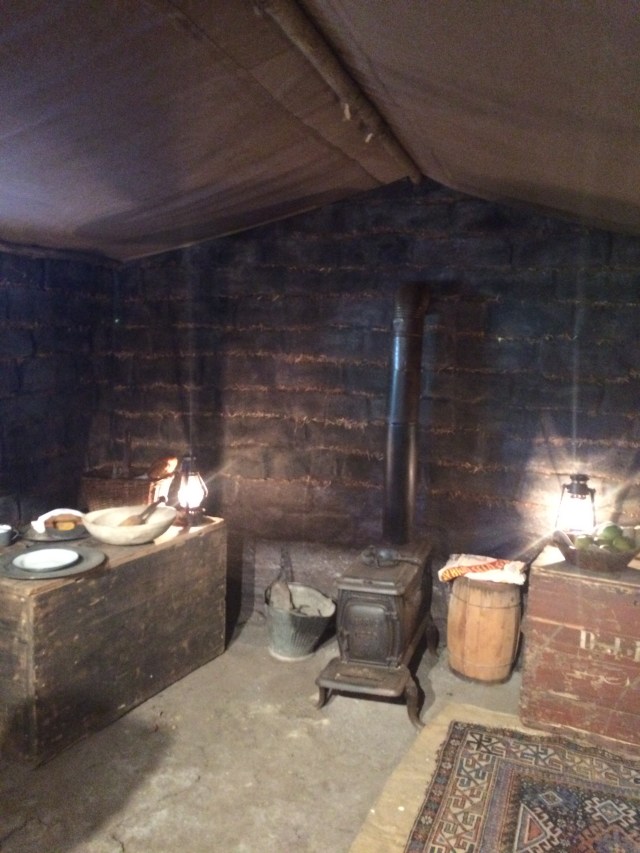
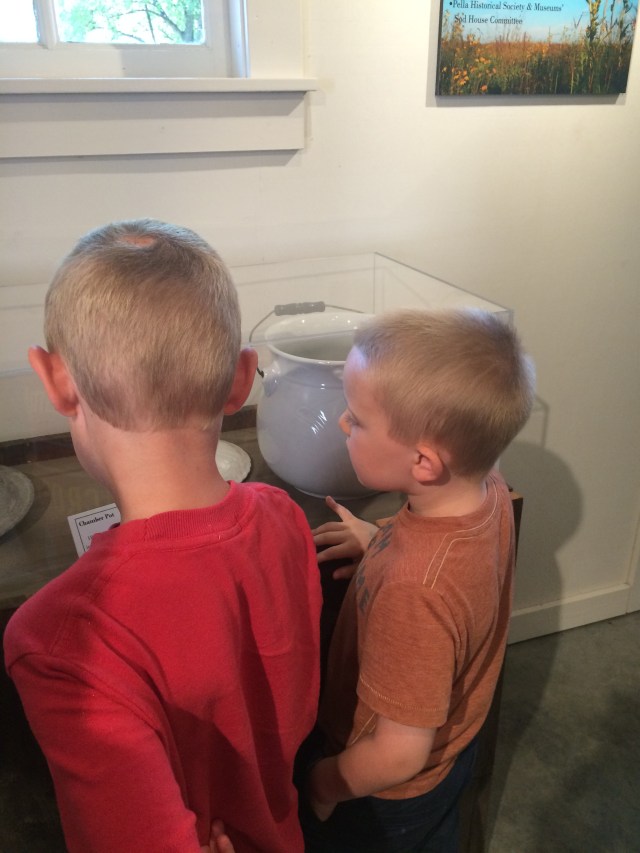
A cozy sod house interiorA chamber pot. The children were slightly horrified.Not much to look at from the outside. I found the inside to be sweet smelling like grass. Early Pella settlers lived in houses like this in 1847. It took about a week to build a sod house. This sod house can be viewed at the Pella Historical Village.
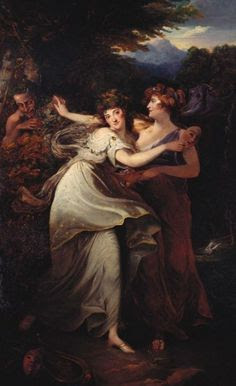
Dora (front) as the comic muse while a creep looks on
My blog post about Dora Jordan is up on Sheroes and it’s my birthday. What could be more magical? But how did I, who tends to write about science, become a fan of this famous comic actress? I met her through Michael Faraday, England’s greatest chemist. I had planned to write a short story with him in it–having previously written one with Isaac Newton— and in preparation read his biography. The man was born poor, worked incredibly hard, invented the electric motor, discovered electromagnetic inductance and several elements, and still, I learned from his biography, as he grew older he had finances to worry about because of his lowly birth status. Several people championed his receiving a pension from the government because of his scientific contributions. The King at the time was William IV and one of Faraday’s champions was Lady Mary Fox, identified in his biography as the illegitimate daughter of the King with actress Dora Jordan. This intrigued me. I read Faraday’s correspondence and there Mary was, writing to him and receiving his reply. There was a story here and a Faraday contemporary. I researched Mary’s mother, the actress. Thus I met the hard working Mrs. Jordan–quite a bit more lively than Faraday and someone who also could have used a royal pension for her service.
She was nearly written out of history. Imagine Amy Schumer, Carol Burnett, or Lucy just disappearing. That unsolved mystery along with my family’s involvement in a Shakespeare Festival means it was like catnip for me to uncover more about her. Not to mention that the whole story points out the capriciousness of social status.
I was entranced by her industriousness, her strong female roles, and ability to work while bearing numerous children–ten born to the prince who unexpectedly became king. There were condoms back them but…
She lived before photography and was a genius with costumes and make-up. Thus, it’s hard to know exactly what she looked like. She had a beautiful singing voice and played several instruments but, alas, before recordings. Known to be a quick study with a jolly laugh, she was much admired. Even Jane Austen was a fan. And she elevated comedy to rival tragedy, which was considered the more “literary.”
Her mysterious death in which she seemed to fade into the cosmos has fascinated people for two centuries, along with the odd dealings with the statue of her commissioned by the repentant King and meant to be put in the Hall of Queens. But the statue notion was really not that odd if you know what scientists did in that day. When Mary Somerville was denied entrance into the Royal Academy of Sciences because she was a woman, her supporters had a bust of her placed inside as a protest. Putting a statue in a spot where a woman wasn’t allowed was a statement and the sculptor Chantrey made the Somerville bust and sculpture of Dora. Like most things associated with William IV, things didn’t go as he planned and the statue was hidden away from public sight for 130 years until being reinstated by the current Queen Elizabeth.
I have an extensive Pinterst Board up for her…with a few of my own theories and opinions tossed in. This one belongs to someone else but contains a fair number of cartoons, first slamming her for taking up with the prince, then slamming him for leaving her and the children as he chased wealthy young women. The excuse for the later was that he needed an heir but in all honesty, there were plenty of other princes (he was the third son) and in fact, one of them fathered Queen Victoria. Since William and Dora had a son who might have been a splendid King, Victoria et al had a vested interest in getting rid of Dora’s memory and in getting rid of women’s rights all together.(However, she was fair to her illegitimate cousins. Some historians say it was because the royal family owed Dora.)
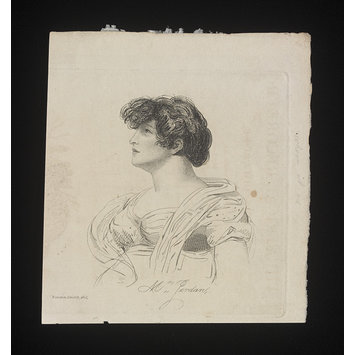
Silhoette of DoraThe famous statue of Dora and two of her children showing comedy mask and pan pipes at her feet. Motherhood does tower over career, doesn’t it? Even the statue almost fell out of history but God Bless the Queen (Elizabeth) for putting it in Buckingham palace 135 years later than it was scheduled. Photo from http://www.douglasjennings.co.uk/images/mrs-jordan-02.jpg
There’s something “researchy” to digging up things about a woman who was once nearly wiped from history. I can’t believe that I even found and bought a theater handbook of hers. For someone that the palace tried to censor, there is a lot of memorabilia about her. And as I have mentioned before, like her I have struggled for my family and known the sting of betrayal despite my generosity and hard work. All I can say is, women have more options now.
I’ve never bought the story of her death and took the liberty to re-write history and fictionalize her story in a novel.
As for Michael Faraday, he got his pension and later Queen Victoria offered to knight him and give him a house. He declined the knighthood but took the house. One can’t help speculating that Lady Mary knew all about the troubles that come to commoners when there is no social safety net and how much they are at the mercy of the whims and of the powerful no matter how much they work or donate to the Kingdom.

















 Catherine Haustein
