I just signed a contract with City Owl Press for my dystopian novel Mixed In. Here are some fun facts about Mixed In:
It’s set in the near future in the city-state of Cochtonville. I’ve written about Cochtonville before in my story Grave to Cradle (also in The Female Complaint.) To be honest, when I picture Cochtonville, I picture Cedar Rapids gone wrong.
The protagonist is chemist Catrina Pandora Van Dingle, who comes to Cochtonville to work for Cochton Enterprises. Like I am, she is a jack-of -all trades analytical chemist. She comes to Cochtonville to study beans found in the pocket of Thomas Jefferson’s hand me down trousers.
Her love interest is Ulysses S. Butz, owner of The Union Station bar. He does much more than sell drinks at that bar.
She has a friendly lab mate, the hapless synthetic chemist Jester Rana.
I always like to have at least one older female character. In Mixed In, it’s Wilma. Wilma has parties but she doesn’t sell Tupperware.
I looked to the past and the 1930s-40s-and 50s to describe the mood of this place. So you’ll find some prohibition and the modern day equivalent of a Vice Squad. Quite a lot is banned in Cochtonville including any art that doesn’t relate to agriculture.
I began writing this while teaching my Science Fiction and Empire course and let the news my students were talking about in that class and in my Short Story Writing course influence the plot.
This novel doesn’t have religion in it, and by request, is a tiny bit less sweet than Natural Attraction.
My thanks to Sarah E. Gold for proof-reading the initial draft for me and to Susanna Sturgis and Kay Van Wyk for beta reading. Amy Sue Nathan provided feedback on the first fifty pages.
Thanks also to bar owners Steve Bray (Green Gable Inn in Cedar Rapids) and Diane Chaplin (Chaplin’s in Arnolds Park).
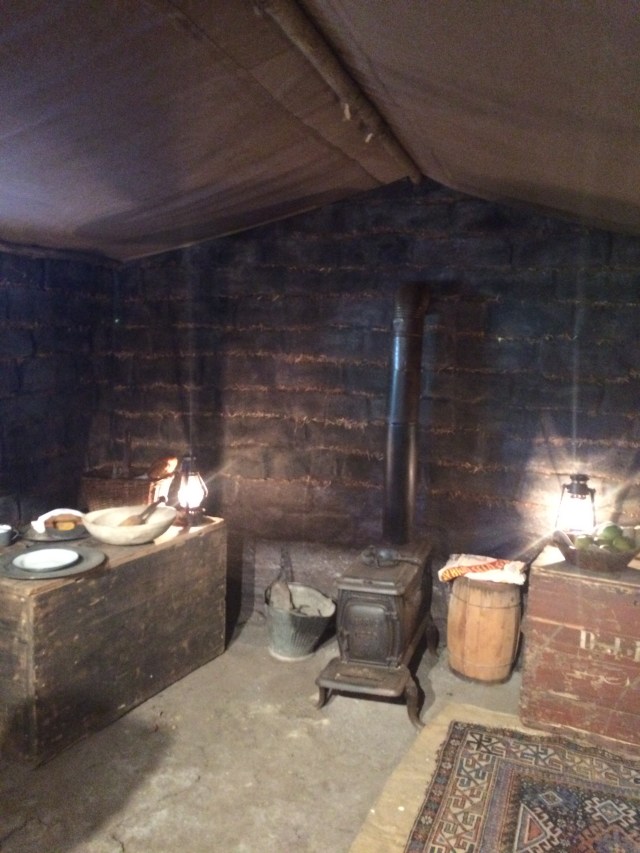
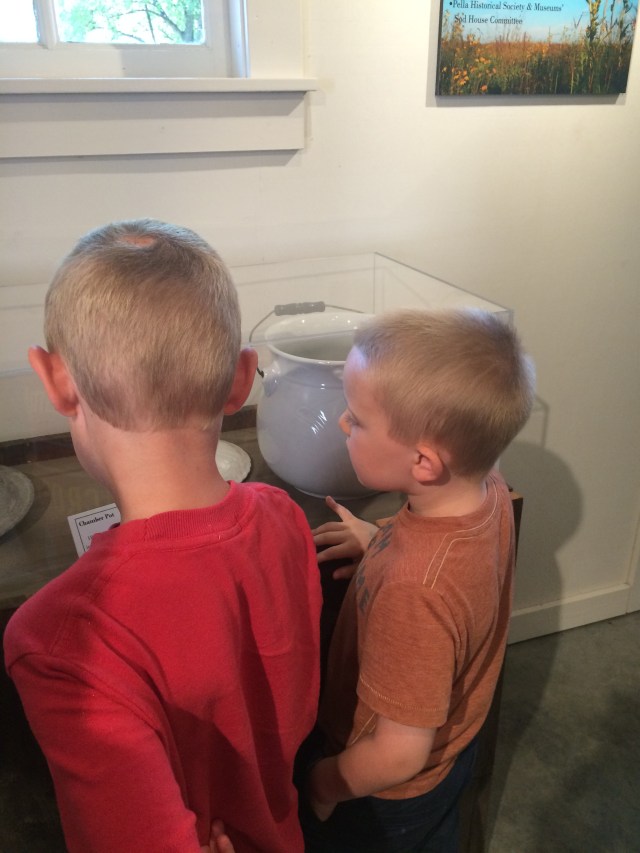
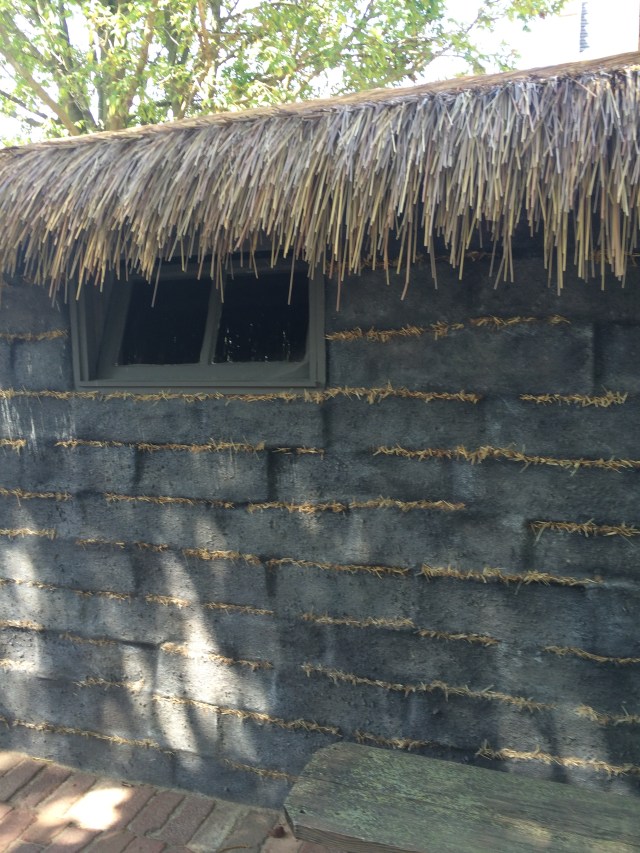
A cozy sod house interiorA chamber pot. The children were slightly horrified.Not much to look at from the outside. I found the inside to be sweet smelling like grass. Early Pella settlers lived in houses like this in 1847. It took about a week to build a sod house. This sod house can be viewed at the Pella Historical Village.
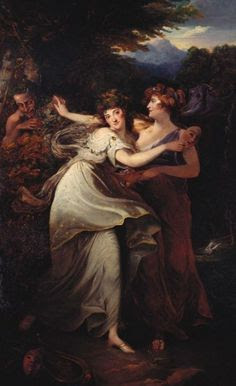
Dora (front) as the comic muse while a creep looks on
My blog post about Dora Jordan is up on Sheroes and it’s my birthday. What could be more magical? But how did I, who tends to write about science, become a fan of this famous comic actress? I met her through Michael Faraday, England’s greatest chemist. I had planned to write a short story with him in it–having previously written one with Isaac Newton— and in preparation read his biography. The man was born poor, worked incredibly hard, invented the electric motor, discovered electromagnetic inductance and several elements, and still, I learned from his biography, as he grew older he had finances to worry about because of his lowly birth status. Several people championed his receiving a pension from the government because of his scientific contributions. The King at the time was William IV and one of Faraday’s champions was Lady Mary Fox, identified in his biography as the illegitimate daughter of the King with actress Dora Jordan. This intrigued me. I read Faraday’s correspondence and there Mary was, writing to him and receiving his reply. There was a story here and a Faraday contemporary. I researched Mary’s mother, the actress. Thus I met the hard working Mrs. Jordan–quite a bit more lively than Faraday and someone who also could have used a royal pension for her service.
She was nearly written out of history. Imagine Amy Schumer, Carol Burnett, or Lucy just disappearing. That unsolved mystery along with my family’s involvement in a Shakespeare Festival means it was like catnip for me to uncover more about her. Not to mention that the whole story points out the capriciousness of social status.
I was entranced by her industriousness, her strong female roles, and ability to work while bearing numerous children–ten born to the prince who unexpectedly became king. There were condoms back them but…
She lived before photography and was a genius with costumes and make-up. Thus, it’s hard to know exactly what she looked like. She had a beautiful singing voice and played several instruments but, alas, before recordings. Known to be a quick study with a jolly laugh, she was much admired. Even Jane Austen was a fan. And she elevated comedy to rival tragedy, which was considered the more “literary.”
Her mysterious death in which she seemed to fade into the cosmos has fascinated people for two centuries, along with the odd dealings with the statue of her commissioned by the repentant King and meant to be put in the Hall of Queens. But the statue notion was really not that odd if you know what scientists did in that day. When Mary Somerville was denied entrance into the Royal Academy of Sciences because she was a woman, her supporters had a bust of her placed inside as a protest. Putting a statue in a spot where a woman wasn’t allowed was a statement and the sculptor Chantrey made the Somerville bust and sculpture of Dora. Like most things associated with William IV, things didn’t go as he planned and the statue was hidden away from public sight for 130 years until being reinstated by the current Queen Elizabeth.
I have an extensive Pinterst Board up for her…with a few of my own theories and opinions tossed in. This one belongs to someone else but contains a fair number of cartoons, first slamming her for taking up with the prince, then slamming him for leaving her and the children as he chased wealthy young women. The excuse for the later was that he needed an heir but in all honesty, there were plenty of other princes (he was the third son) and in fact, one of them fathered Queen Victoria. Since William and Dora had a son who might have been a splendid King, Victoria et al had a vested interest in getting rid of Dora’s memory and in getting rid of women’s rights all together.(However, she was fair to her illegitimate cousins. Some historians say it was because the royal family owed Dora.)
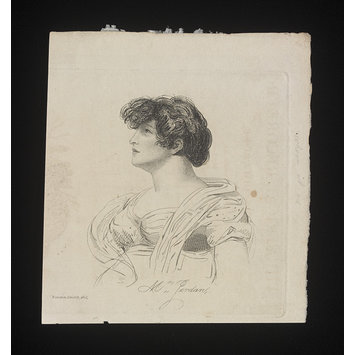
Silhoette of DoraThe famous statue of Dora and two of her children showing comedy mask and pan pipes at her feet. Motherhood does tower over career, doesn’t it? Even the statue almost fell out of history but God Bless the Queen (Elizabeth) for putting it in Buckingham palace 135 years later than it was scheduled. Photo from http://www.douglasjennings.co.uk/images/mrs-jordan-02.jpg
There’s something “researchy” to digging up things about a woman who was once nearly wiped from history. I can’t believe that I even found and bought a theater handbook of hers. For someone that the palace tried to censor, there is a lot of memorabilia about her. And as I have mentioned before, like her I have struggled for my family and known the sting of betrayal despite my generosity and hard work. All I can say is, women have more options now.
I’ve never bought the story of her death and took the liberty to re-write history and fictionalize her story in a novel.
As for Michael Faraday, he got his pension and later Queen Victoria offered to knight him and give him a house. He declined the knighthood but took the house. One can’t help speculating that Lady Mary knew all about the troubles that come to commoners when there is no social safety net and how much they are at the mercy of the whims and of the powerful no matter how much they work or donate to the Kingdom.
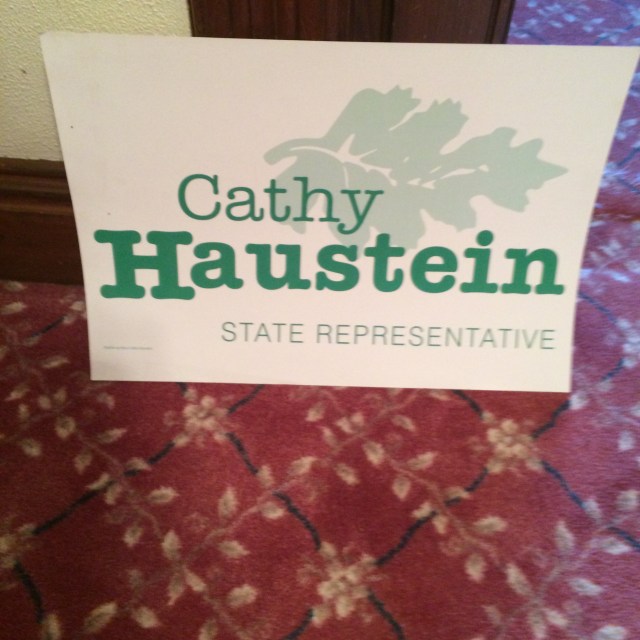
People steal and deface signs so a window sign was the go to.
A while ago I ran for public office. I ran because I was a member of League of Women Voters. We hosted candidate forums. There were two elected officials who came, reluctantly in my opinion, and used the time, not to listen, but to toss out a variety of scare tactics and to be walking, talking advertisements for their special interest donors. One man was a manufacturer who had something to do with plastics and any type of regulation was his enemy. He would ask rhetorical questions about why this or that needed to be regulated and being a chemist, I would answer him with some science. Then I figured it out–he didn’t want an answer.
The other guy struck me as terribly lazy with a million excuses as to why he couldn’t accomplish anything for our district. I got mad. I thought “this an affront to democracy.” They represent us. So I filed the proper papers at the State House and with a lot of help from friends and my husband, my treasurer, I ran against “Sleepy.” I didn’t win, but I learned a lot.
I began by knocking on doors. I would tell people I was running for state representative and almost everyone would say “what’s that?” and “who is it now?” My big issue was water quality.
I had fund raisers. One fund raiser site was toilet papered the night before the event. I ran advertisements. A friend was a sign guy and he made some signs with an oak leaf and my name on them. Another friend had a printing company and made handouts–cowboy cards they are called. My campaign manager was the high school government teacher. Pretty soon, my opponent knocked doors for the first time in his life. He ran advertisements. He had signs. He sent out mailers. I was against God and family apparently. That kind of thing really works in my district. Probably a dead dog could have run on that platform and won. A friend of my parents even ran a radio ad against me.
You learn a lot about politics doing such a thing. You have to disclose who gave you money and you can look up who donates to your opponents. Several people donated to both candidates. When you run ads you have to say who paid for them—have a disclosure statement. One newspaper left off my disclosure statement and I got in mild trouble from the state. The next election, I wasn’t running but another person ran against Sleepy and the same newspaper left off her disclosure statement. I then wrote the election board and said I suspected that this was on purpose and it never happened again.
I got anonymous hate mail. I turned it in to the Post Office. My local party chair told the party chair of the other party (we all know each other here) and said that if it happened again, there would be a federal investigation. (True.) It never happened again,
The local chair of the opposite party called me up and chewed me out for walking down the sidewalk with some cowboy cards in hand, saying it wasn’t allowed. I called the county auditor and as I recall, he called her and said it was allowed. See the pattern here–you run for office for democracy’s sake and people harass you–not about issues or differences of opinion but on stupid “gotcha” stuff.
I saw that people do not show up to candidate forums. (I have even witnessed that the person who did not show up to the forum won the election.) I decided that one thing that would help politics is publicly funded elections.
Here is another thing I learned about politics. If you win, there are perks such as milage to visit your constituents and you get great, and I mean great, health insurance.
I found that I was bad at remembering names. This is not a good trait for a politician.
I took of photo of my opponent’s license plate because you know what, he had plates from the neighboring county. Not even from the place he represented. No matter. I lost. He won. A third party candidate jumped into the race. It was exciting. I spent $4 per vote. The winner spent $16 per vote.The man had to work for his seat for probably the first time ever. This made it kind of worth it to me. I wish I could write a novel about the experience but I can’t think of a single thing earth shaking or inspirational revelation about the process. I did it because I wanted to see a lazy man have to work for once in his life. That I did.
A while ago I was asked what it was like for a teacher to transition into summer.
First thing I did was get my house in a lesser state of randomness. It’s now just chaotic. I am not a tidy housekeeper which would no doubt shame my grandmothers. I am one of those people who can’t find things if they are put away. There are no Nobel Prizes for housekeeping. My lab on the other hand, is clean, as an analytical lab should be. Priorities.
I usually do some sort of laboratory research in the summer. During the school year, a student researcher might work 3-6 hours per week. In other words, at the best of times, each week accomplishes a little less than a day’s worth of discovery and insight. This year, I didn’t plan to do research and in fact, I miss it. As Isaac Newton said, it’s like picking up pebbles on a beach to learn the secrets of nature and they are indeed, right there waiting for discovery. Summer is a great time to make strides in research. I’m sad I didn’t come up with a project but one is on the horizon for the fall that I’m excited about.
This year, I decided to concentrate on reading and writing fiction.I became the teacher of Short Story Writing quite suddenly after my fiction writing mentor, Arthur Johnson, decided to retire. The course has been fun to teach but I’d like to give it a tiny bit more grooming. I’ll be looking for short stories to use as examples of classics and how to do it right. Some of my favorites to use are “The Yellow Wall Paper“, “The Tell-Tale Heart,”(always a favorite of the class),”St. Lucy’s Home for Girls raised by Wolves, ” How I Contemplated, ” “Incendiary Girls,” “Edison, New Jersey, ” (often my students do not understand people trapped in a situation), “Hell Heaven,” and “The Pukey.” What’s one thing you notice about them? There is no problem solved by a gun and no “it was just a dream.” They might just be saying something about the human condition. Maybe there is a beautiful word or figure of speech. I’m going to add something by Constance Fenimore Woolson. Any more suggestions? What’s your favorite story?
I’ll be going to a writing conference, the Iowa Summer Writing Festival in Iowa City. I need a pilgrimage to Iowa City every now and then to give a penance to my younger self for making a poor choice when I moved away from there and started a new job while pregnant. Talk about stressful. One thing I can say about my life is that no one ever rescued me from my bad choices. This summer, I’ll be working with Sands Hall on my third novel.
That is what I’ll be concentrating on during the month of June. In July, I’ll spend time with family, go to some music festivals, and start working on a lab manual for Instrumental Analysis which I’ll teach in the spring. I am very happy with my “Cleaner, Greener” lab manual and now have the itch to write another.
In other words, teachers use the summer to re-gain balance and to plan for the future. It’s a wing spreading time, but come fall, I’ll be happy to see everyone again.
School’s out here in Pella and summer unofficially begins. In Iowa, we will watch our corn grow from the tiny shoots pictured above to up to 12 feet. Imagine every one of those tiny plants as 12 feet tall. It’s supposed to be “knee high by the 4th of July” but is often much taller than that.
Iowa grows about 2.3-2.4 billion bushels of corn per year. (A bushel is 56 pounds.) It’s not sweetcorn. Much is field corn and used for ethanol production, sweeteners, and most of all, animal feed. Ninety-five percent of animal feed is made of corn. Citric acid, used as a food preservative, food additive, beer additive, component of soaps and detergents, and to make artificial lemonade, can also be made from corn. Iowa produces the most corn of any state in the U.S. and about 10-20% of the corn produced is exported.
Like other grasses, corn contains p-coumaric acid which can act as a mild antibiotic and reduce the chance of stomach cancer.
About eighty-eight percent of corn is genetically modified. (2012 statistic)
Herbicide use on field corn has increased as weeds have become resistant.
It’s everywhere in my agricultural dystopia of Cochtonia, too. It grows quickly and some even glows in the dark.
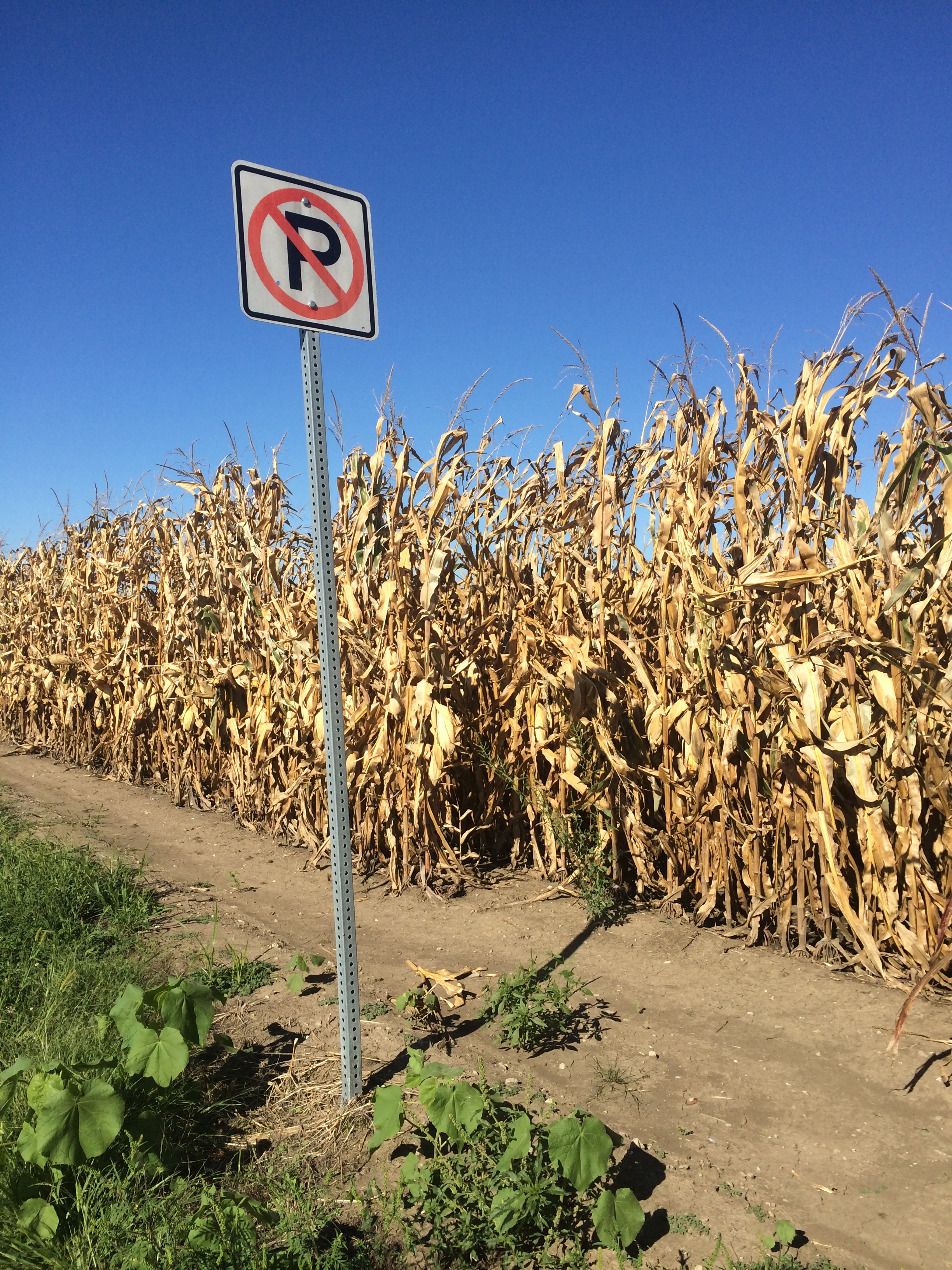
What are my deep, dark feeling about corn? Well, it’s green and that is good. But I’m not from Iowa originally and I have always found it sort of scarier than hell. Yes, it’s true. There is so much of it and it is absolutely everywhere. It even makes it more humid here in Iowa. Honestly, do we need so much of it? It’s a thing you can’t escape. Yes, it is pretty when it sways in the wind and even kind of pretty when it’s dried for harvest. (see below). But if ever there was a zombie plant, it would be, yes, it would be corn.One minute it’s so small and cute and the next minute it’s huge and being sprayed with crop dusters. It’s everywhere. It’s in everything. If I eat high fructose corn syrup I get insanely hungry. Zombie. Believe me. You can’t escape the corn. ***
I got a request to write a post about love, but when I asked what it was, I didn’t get a good answer.How about this for a theory: love is connection.
Mammals begin life connected. Even before birth the connection between mother and child influences our brains, making nerve fibers that will affect our temperament. Some of the way we perceive love and what it means to us, begins before we even take a breath. Motherhood drug use, exposure to toxic chemicals, or stress will affect our development and our ability to love in the future.
The mother-infant bond sets the stage for the offspring to be able to take and give love and to handle stress. The mother and baby need to look at each other, work together to establish mutual rewards, and generate oxytocin and cortisol (the first to relax us, the second to create vigilance). Believe it or not, the development of a form of ambivalence is a part of the bond. Babies are exhausting. Motherhood is tiring. Our very first experience with love is that it’s too much to maintain intensely. Such is the tragedy of love, but if we are healthy, we can love and do so with some autonomy.
Of course, one can’t talk of love without mentioning erotic love. Kissing boosts the immune system and increases our sense of well-being. It makes us invincible even though the search for erotic love can bring us to some crazy places of insecurity about our worth and appearance and rightly so, erotic love is stimulated by visuals. Yes, it’s shallow and also wonderful. Even just having a crush releases some feel good chemicals.
Attachment is a phase of love and it is just as chemical as erotic love. As the song goes, “be careful who you love.” There are those who don’t think twice about doing another in emotionally. People who treat others poorly, who fail to attach, have a chemical imbalance. Break ups or “love rejections” are chemically harmful. They might take up to two years to recover from. But it’s better than casting your lot with someone who can’t attach.
Alcohol and love do similar things to the brain: they take away fear, make us feel better about ourselves but also, surprisingly make us more judgmental of people outside our social sphere, creating a special connection with the one you love, be it a person or a bottle.
I personally get a strong sense of connection working beside someone and I’m not alone. This is why a person can love their job or a group they are a part of. It’s no accident that I became a laboratory scientist. Working in lab on an experiment is a delicious form of connection and ever since fictional Victor Frankenstein worked in secret on his creation and subsequently abandoned the hapless creature, the message has been clear: don’t work alone in lab. To be a scientist is to never work alone. It’s true that if you love your job, you don’t have to work.
We love our pets and they can love us. The owner-pet bond is real, healthy, and less dependent on visual cues than erotic love. It’s as true as any love.
The other day I was visiting my dad. My mom, died almost three years ago. He was telling me how much he missed her. I asked him what I could do. He said, “Just listen.” It turns out that feeling listened to is one way that people feel loved.A person will feel loved if they know that you understand what they are going through and that you share the same emotions about it.I was glad and surprised that loving him was so simple as that.I didn’t have to fix anything or make a grand display. Guess I had a thing or two to learn about love.
I pose insecurely in front of the periodic table display at the U of Iowa (featuring actual elements).
A while back a friend asked: what’s the deal with chemists and the periodic table? In a nutshell, the periodic table displays all of the elements in an order that allows chemists to know something about each one at a glance.
The elements are arranged by increasing atomic number–the number of protons (+ charges)–roughly equivalent to increasing weight. They are in rows according to the shell or as chemists would say, according to the quantum numbers. Quantum numbers are the equivalent to an element’s address and tell a lot about the electrons–negative charge cloud around the atom. Most of the time, reactivity is due to electrons and their placement around the atom. Conveniently, mother nature made it simple, as elements gain mass and electrons, they group themselves. The columns on the periodic table belong to elements growing ever larger but with the same arrangement of elections on the outside. This means, they react in similar fashion.
See that row on the right with the neon sign? Those are the noble gasses which don’t easily react with anything. Conversely, on the far left are things like sodium and potassium that react so easily to give elections that the elemental forms must be stored under an oil to keep them from joining up with oxygen. Why can you chose between chlorine and bromine for your hot tub? You’ll find chlorine above bromine on the table. They act much the same but chlorine is lighter.
Metals are on the left side along with hydrogen, the lightest element, and non-metals such as carbon, oxygen, and nitrogen are on the right. Elements in-between are the semi-metals or semiconductors. Radioactive elements, too big to be stable, have their weight in parenthesis.
This mortarboard, made by a clever Central College graduate, shows the system of symbols used for element names. The Cc abbreviation is for “Central College.” The numbers are for the proton number (the smaller number) and the weight of the element, which includes neutrons, heavy without charge.
Elemental mortarboard at Central College graduation.
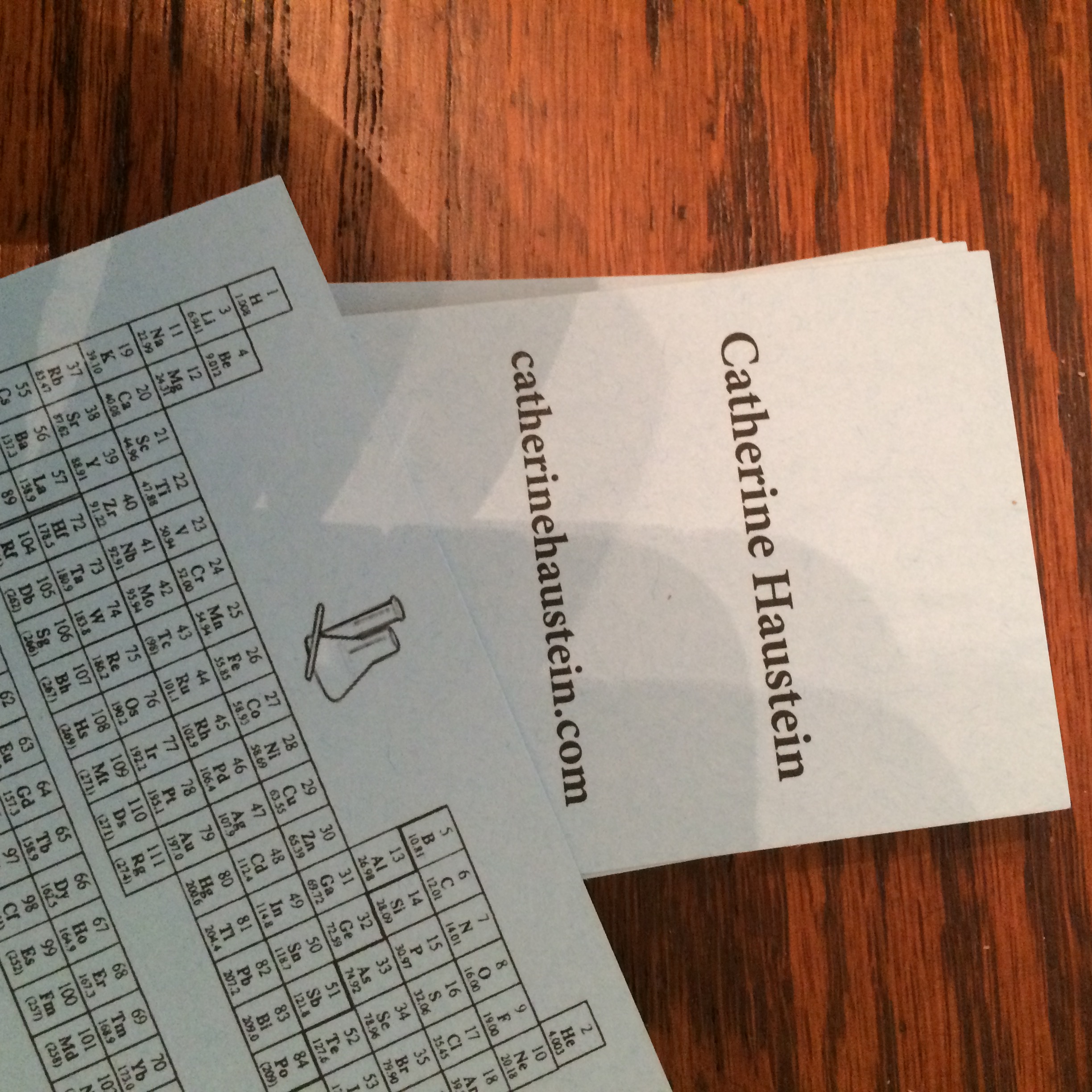
I like to hand out periodic tables. If someone gives me a tract I will respond by giving them a table. I have even given periodic tables to children associated with the Westboro Baptist Church. I’ll give you one too. Just ask me. 🙂
There you have it. The periodic table will give up lots about the elements without requiring deep thought. The father of the Periodic Table was Mendeleev, a hairy dude who let his lust get the better of him and my guess is that this is why although he made the most useful tool ever imagined way back in 1869, he never got the Nobel Prize. He did it without knowing anything about the parts of the atom–the protons, neutrons, and electrons–basing it all on how each element reacted. That’s what science is all about, predicting, and what helped science slay the beast of fearful superstition that plagued humans throughout history.
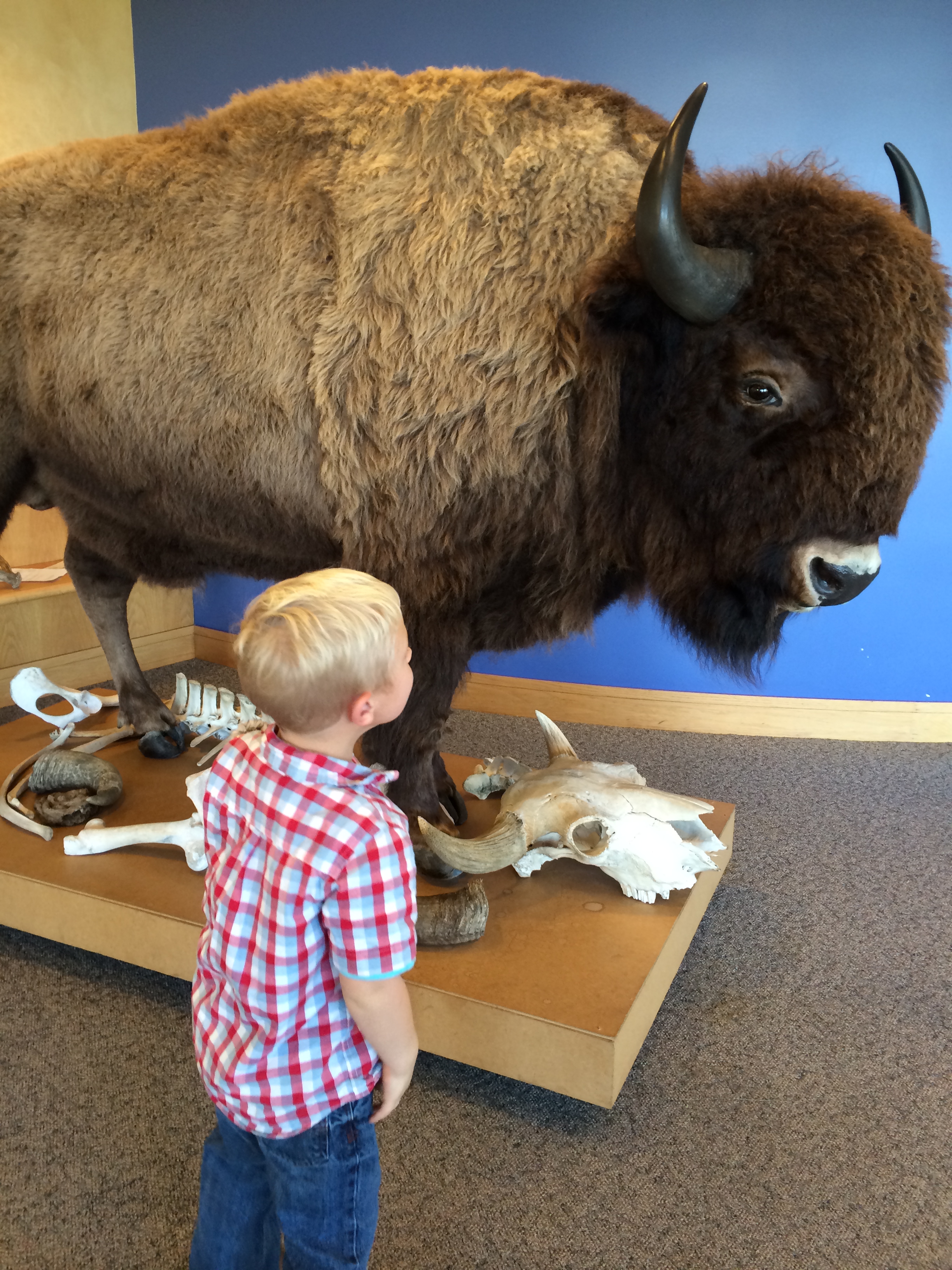
In Natural Attraction, Clementine, posing as naturalist Calvin, travels west and wonders where the bison are. Eventually she finds some, and Buffalo Bill as well. The sad fact was that even in 1871, the bison had been hunted into near oblivion, in part to discourage Native Americans, and to provide entertainment for tourists. The good news is that we now have a Bison Legacy law that protects North America’s largest land mammal.
The Neal Smith Wildlife Refuge is about a half hour from my house. It’s a wonderful day trip where you can view herds of buffalo and elk, walk trails, and visit the information center. We can’t undo the past but we can learn from it and take steps to appreciate the depth and breath of life on Earth.
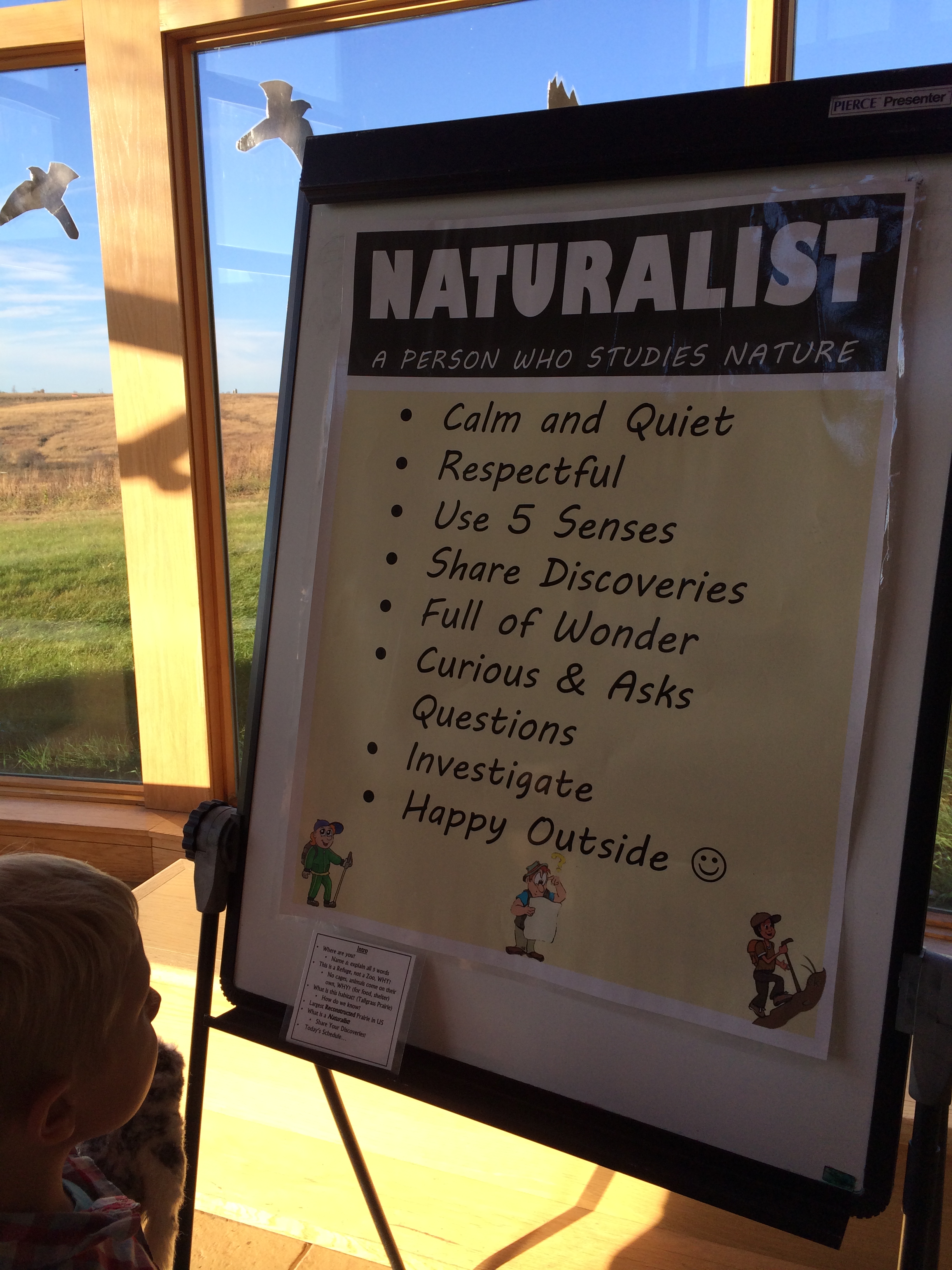
Display at the Neal Smith Wildlife Refuge in Prairie City, Iowa
Do you have what it takes to be a naturalist?
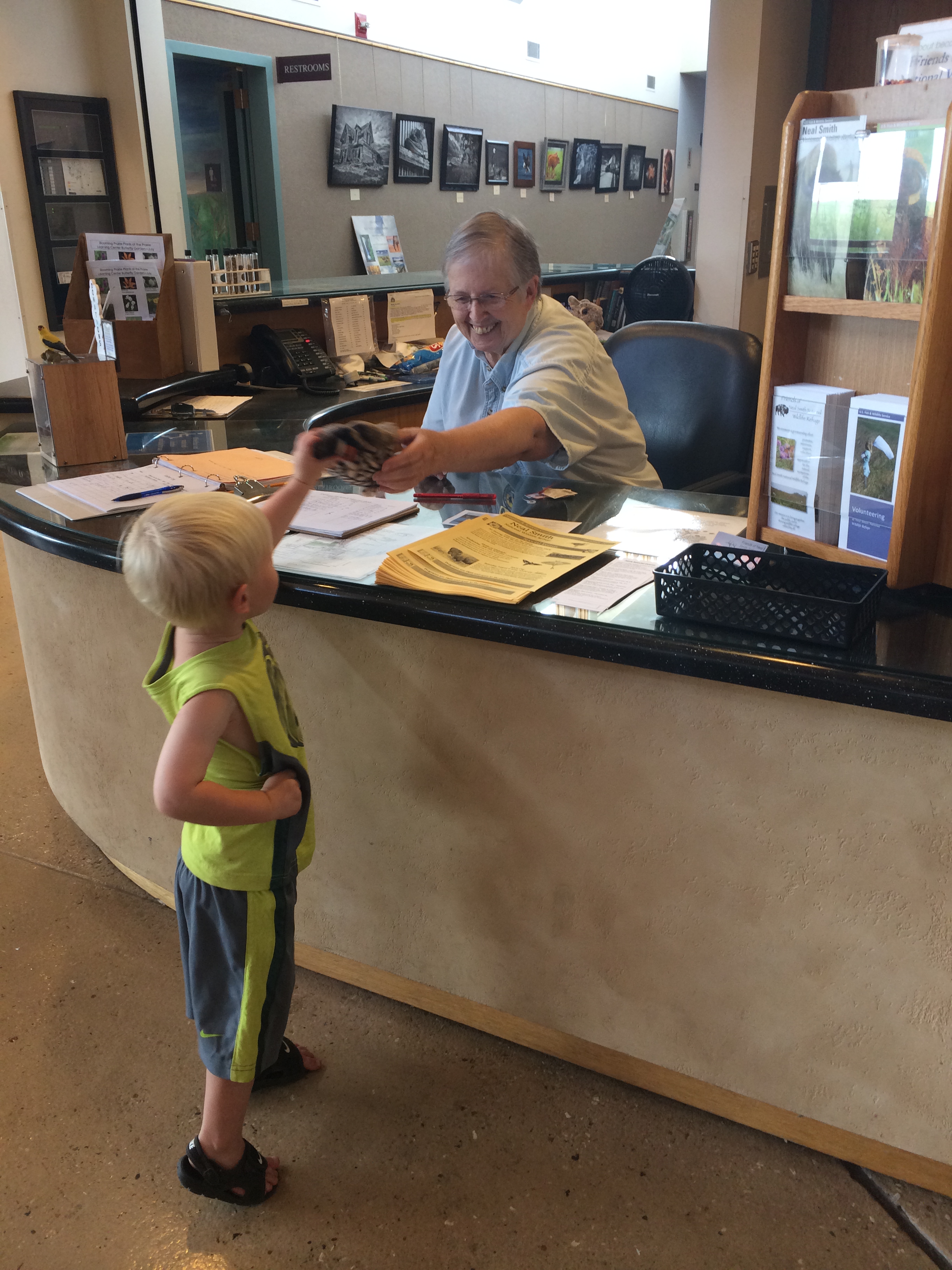
A friendly volunteer shares a moment with a young visitor.
In Natural Attraction, Clementine must face crowds of experienced scientific men and make her case for discovering a new species by giving a talk and demonstration. Over a century later, presenting research via a poster is common and even at times, controversial. As with science fair displays, a formal poster session is a great way to accommodate numerous presenters in a short period of time.
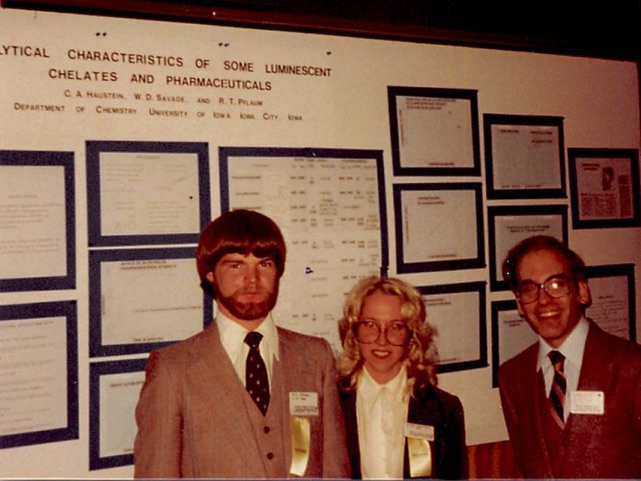
Here’s a poster of mine from the 80s. The first thing scientists of today will notice is how big and beautiful it is. Yeah, the 80s were big all over. No computer generated posters. A real live secretary printed this off and since it isn’t crooked, probably glued it to the poster paper for me. Some of this research is what a man tried to steal (see previous post.)
A poster session 80s style.
These days, posters, glasses, and hair are much smaller.
This week my research students wrapped up another successful semester. Yes, there are moments during research when you wonder a’what ever were we thinking?” with a project. The great thing about research is, you aren’t alone. That whole solitary scientist in lab alone is a myth. We work in groups. Why did Dr. Frankenstein run into trouble? He didn’t have a lab group!
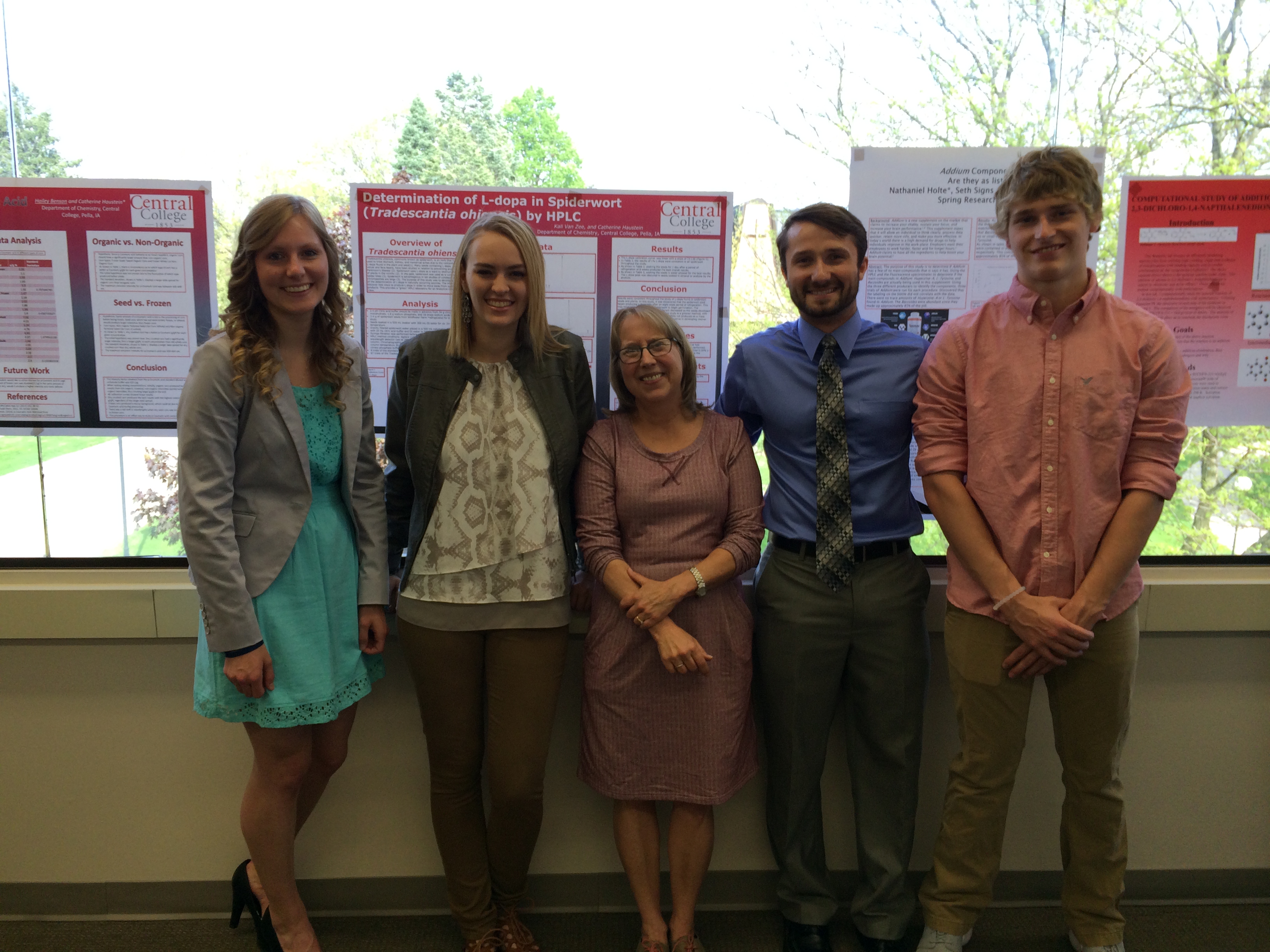
Here’s my research group and their posters, made via Power Point and a big printer. A little blue tape and they’re up with ease.
Although analytical chemists are known to improve their technique with age, students this semester remarked on more than one occasion that time isn’t always on your side–the brain shrinks with age. (Were they sending me a subtle message? I was teaching an extra class.) But we did it , and we won’t talk about our struggles. Our posters went up, they look beautiful, and now comes some of the sadness of being a teacher, the end of the year good-byes.





 ***
***