

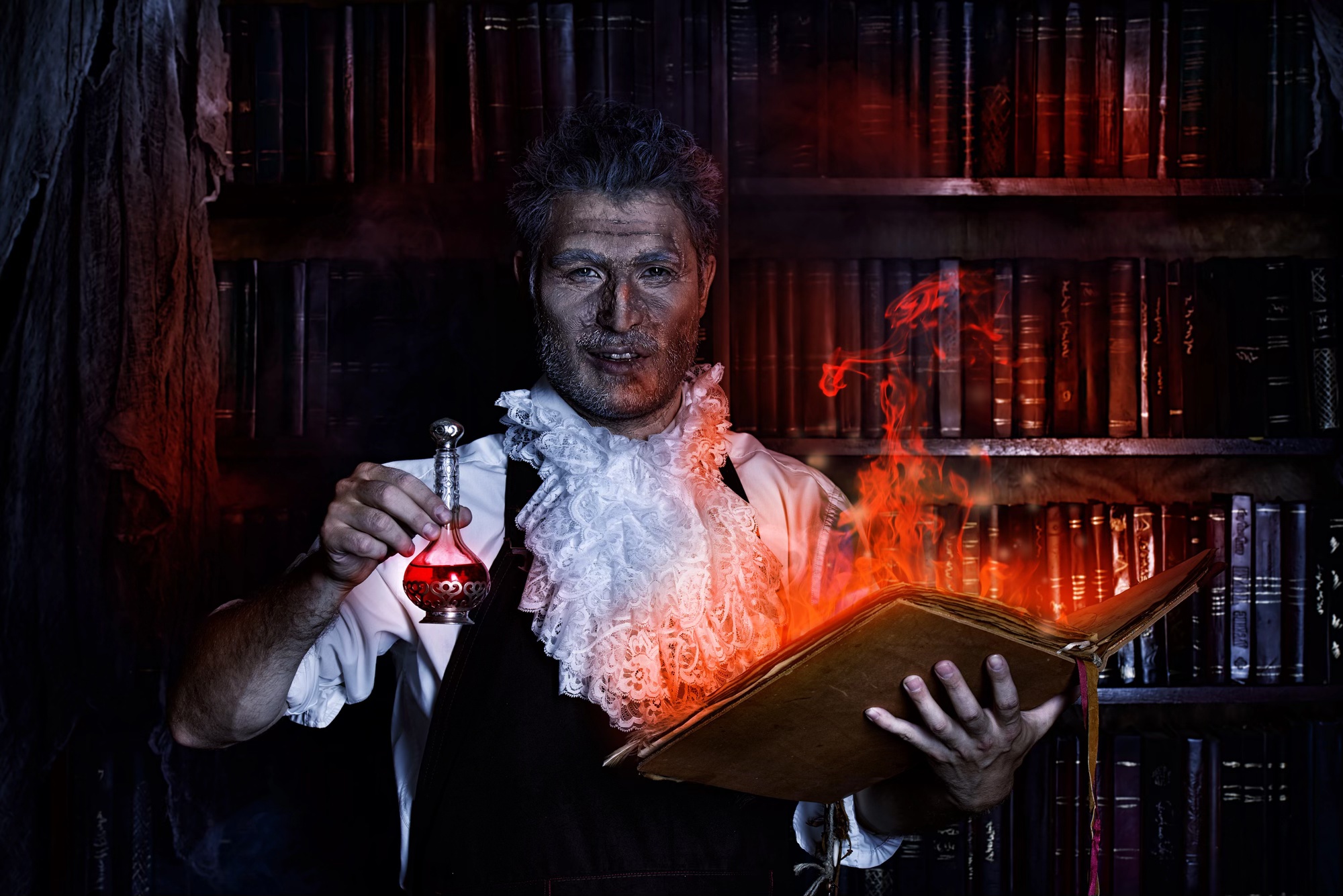
One of my favorite monsters is Frankenstein’s monster, the guy created by the scientist Victor Frankenstein from assembled body parts and brought to life by a spark of lightning. The careless scientist was hoping to bring his dear mother back to life. You can’t blame a guy for trying. But he violated a rule of science–he worked alone. The hapless creature he made was created in secret. Only alchemists work in secret. Although alchemists came up with some still used techniques such as distillation, their results aren’t reliable, reproducible, or even understandable. Some of their ingredients included “thoughts and prayers.” They’ve failed “peer review.” They weren’t necessarily mad scientists, just bad scientists.
The rules of new science are:
Never work alone in lab.
Keep a carefully detailed lab notebook.
Share your results with others so they can be verified and reproduced.
Thus, to work in secret is to bring about all sorts of trouble. In 1818 when the novel Frankenstein was published, scientists in Mary Shelley’s native England and in other countries close to them culturally were just beginning to move away from alchemy. Understanding electricity was the new hot topic. Batteries made from two metals and an electrolyte were a breakthrough in Italy. In the US, Benjamin Franklin established that lightning was a huge static charge and that it was attracted to tall pointy objects. No more would people see a lightning strike as being the hand of an angry God. It was Mother Nature.
Inspired by electric eels and frog legs jumping between the poles of a battery, humans hoped that electricity could “reanimate” dead things. Shocking executed people to see if they would revive was tried unsuccessfully.

As for Frankenstein’s creature, he turned out to be intelligent and sensitive, but without parental guidance. He resorted to menacing his creator once he had been firmly rejected and had no companion to turn to. Like all great writing, Frankenstein says something about the human condition. The novel makes a statement on nature and nurture and the cruelty of judging and rejecting someone based on their appearance.
Yet here we are, facing the same kind of science that made the creature and made him lose his mind.
Project 2025, the sweeping right-wing blueprint for a new kind of U.S. presidency, is here. It will sabotage science-based policies that address climate change, the environment, abortion, health care access, technology and education...and even cancer research. The government funds 40% of basic science, science done to advance knowledge and improve health, and the research is shared with the public and other scientists. In fact Obama made sure all of us can access federally funded research. Now, scientific research is on the chopping block.
If Congress agrees to the cuts and to the foolish idea of replacing government scientists with many years of experience with political loyalists, expect to see bad science. Scientific growth requires autonomy of thought. (This isn’t the same as technological growth.) No doubt other countries will take the lead in basic science research and could share information with our scientists if they are allowed. Corporations will do their research and patent it but it won’t be basic science and it won’t be public.
As an indicator of things to come, a panel of non-expert politicians recently declared that COVID came from a lab, something most scientists don’t see evidence for, and that Trump did a great job handling it. (A prestigious science journal published results saying the US delayed acting on the Covid -19 virus, setting the vaccine development back. Are you one of those people who think the virus came from a lab? Scientists don’t agree with that.)
This is the kind of “king pleasing” science done before science was real. It’s more like alchemy.Alchemists and kings frequently crossed paths in history because kings really wanted to turn less valuable metals into gold. This can be simulated by plating reactions such as this one and is probably how alchemists appeased his highness. Of course, not everyone was convinced and for a good reason. I’ve even written a futuristic novel on this theme.
You could say that science in the hands of politicians and loyalists is akin to an unsupervised child. It could become a monster or maybe just make a mess. We’ll see.

 Catherine Haustein