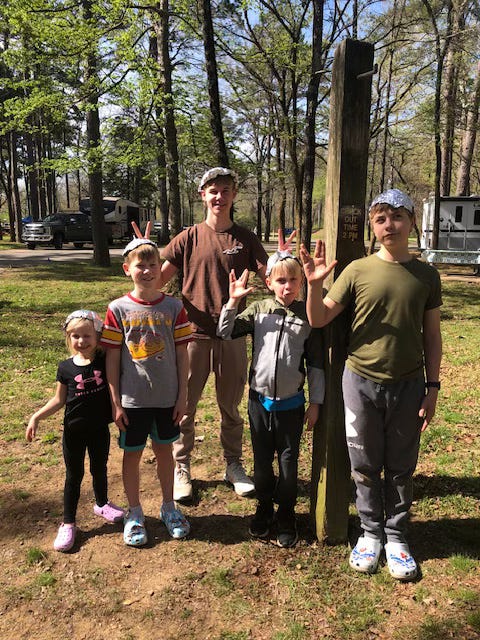
I’m really lucky that my kids took me to Missouri and into the center of the path of the total solar eclipse. I sometimes get the hint that they aren’t sure I’ve had enough adventures yet, having been a lowly professor who was dedicated to my job. Until this time. I was sure that eclipse viewing close to totality was good enough. I was wrong.
We went camping at the Sam A Baker State Park. It’s not close to any major city and the crush of people they expected didn’t show up in force, although the campgrounds were full. We camped and although I’d prefer a luxury hotel, it was worth it. The park was pretty and well kept. The spring ephemerals were in bloom.
We attended a lecture about the eclipse given by a retired astronomy professor. We learned that one special thing about this eclipse is that the moon was very close to the Earth (perigee) and the sun far away (apogee). This made it possible for the moon to totally cover the sun. (An annular eclipse doesn’t meet this requirement). I also had no idea that the moon has a titled elliptical orbit, as does the earth, which is why an eclipse occurs in so many varied places. This also explains why they are more likely to occur when the Earth is titled towards the sun, which means they are rare in winter. Here’s a map of upcoming eclipses. He stressed that we needed to wear eclipse glasses to prevent us from going blind, but at totality, we could take them off.
He also told us to look for Baily’s Beads and talked a little about solar ejections (coronal mass ejections.) The later has the potential to disrupt telecommunications and navigation devices. This is called a Carrington Event –one melted telegraph lines and sparked railroad tracks during the US Civil War. The world is anticipating another one, with a scary scenario. Using their best predictive powers, scientists are working to predict the next super storm.
We had no cell service and hadn’t gotten a weather update in days. Starlink traveled overhead but we couldn’t get a connection, only a reminder not to subject ourselves to the whims of billionaires. People asked the wise professor the inevitable. “What’s the weather going to be like?” He echoed what a man selling firewood had predicted. “It’s going to be perfectly clear.”
Sometimes, it’s hard to muster a sense of awe, but with cool breeze and eerie shadows, the eclipse caught us in its snare.
Moon-shadow basking.
We weren’t prepared for the weird and surreal moment of totality. Without a sunset, darkness fell as if a switch was thrown. We dropped our glasses, under the spell of the darkened sun with its dazzling corona. Had I been alone, I might have cried. Stars came out. Crows cawed. A frog chirped. Humans yelled at the raw moment of cosmic wonder. Within 4 minutes, the sun peeked out and the light came back in a rush.
(photo on location by Paul Van Zante)
We headed for home, avoiding St. Louis and its traffic. Back roads put us behind an hour, not bad considering all-nighters experienced by some.
During the long car ride, I sat there thankful for the experience. I was grateful to the professor and his insights. It made me proud to have been a professor. Without understanding of an eclipse, it would have been a frightening experience. It’s good to be reminded that we really are at the mercy of the universe. Science has helped make nature appear less capricious, but every bit as magnificent.
As I was traveling on highways a couple weeks ago through North Carolina, Tennessee, Kentucky and Indiana, I saw signs, particularly in Indiana, where politicians were really pushing fear and bragging about how strong they were and how they were going to make sure you weren’t going to be a crime victim. Crime is not a laughing matter, but the crime rate has plunged and people over estimate how common it is. (A notable exception is domestic violence. )
The political billboards were showing how tough on crime each politician was. The irony was, it was rainy, the traffic was terrible, and trucks in particular were just driving like crap. Unlike the crime rate, the motor vehicle accident rate is on the rise.
On a dark desert highway…
Trucks were in a hurry and they were doing bad jobs of merging. I saw one pull in front of a little Honda and almost take it out. At a merge, two trucks didn’t want to give each other room and almost crashed. Another truck wove all over the road, the driver looking at a screen in her hand.
To my horror, I saw a truck driver getting out of a truck at a gas station. He was wearing slides with thick soles. My chemist danger signs flashed. Flip flops and sandals have caused over a million accidents. Not only do they fall off and get stuck under pedals, they double driver reaction time. Add thick soles and you get even slower at pushing the brake pedal. Imagine this in a truck.
Welcome to Indiana!
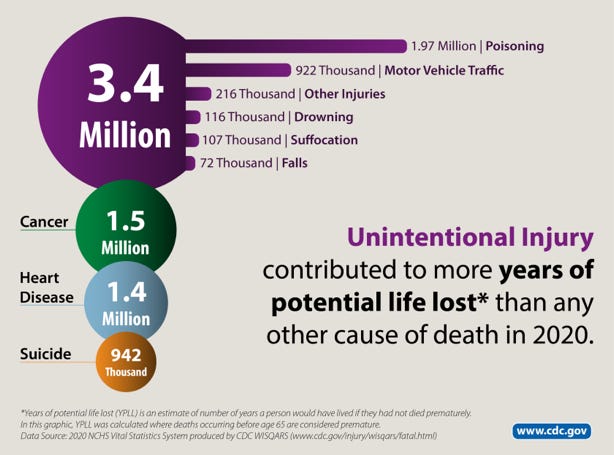
That was just on a small stretch of Indiana highway. I started thinking. Really, what should be we be worrying about? Should be we be worrying about getting mugged and robbed? I mean, sure, we should be, but what is more of a danger to us—other peoples’ bad driving or a stranger’s criminal intents? What’s most likely to kill us?
The political billboards were meant to make people afraid of death by homicide. It isn’t a top cause of death overall, especially not compared to heart problems, cancer, poisoning, or motor vehicle accidents. I suppose one thing that makes people afraid of it is that you can choose to get in a car but you can’t choose not to be mugged. But politicians are notoriously guilty of ramping up the fear. Interestingly enough, people who are more educated are less likely to commit homicide. (Domestic violence is also less common for educated women and educated couples.) Educated people are less likely in general to commit crimes. What do you want to bet that some of those tough on crime politicians complain about student loan forgiveness? If they really cared about reducing crime, they’d make college free. They’d pour money into public education.
Meanwhile, drive safely. Watch out for the other guy.
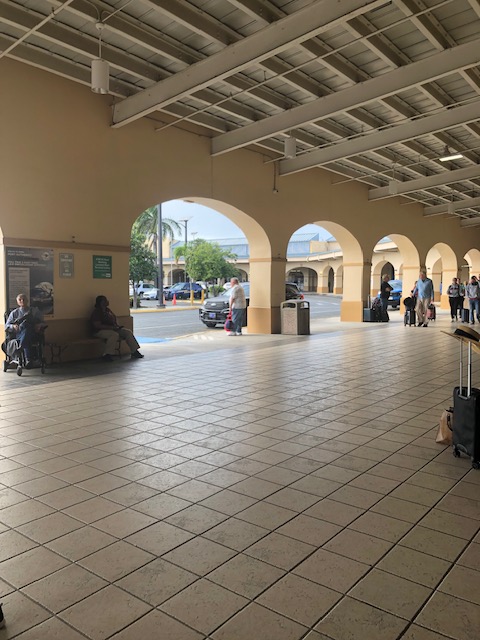
Last week, I had the delightful pleasure of visiting St. Croix in the US Virgin Islands, one of the US Territories.
Just east of Puerto Rico, the US bought these islands from Denmark in 1917.
Above: Flying in
The US Virgin Islands is a US territory. US citizens don’t need a passport. They don’t go through customs. Dollars are the currency. The only weird thing about it is that cars are driven on the left side of the road. And, the people can’t vote. They have a representative to Congress but she can’t vote either.
It’s been described as a sleepy place to go for snorkeling, diving, and beach life. We visited the town Frederiksted, off the beaten path. How “sleepy” is it? Well, what could be more peaceful than a beautiful ocean view with a chicken?
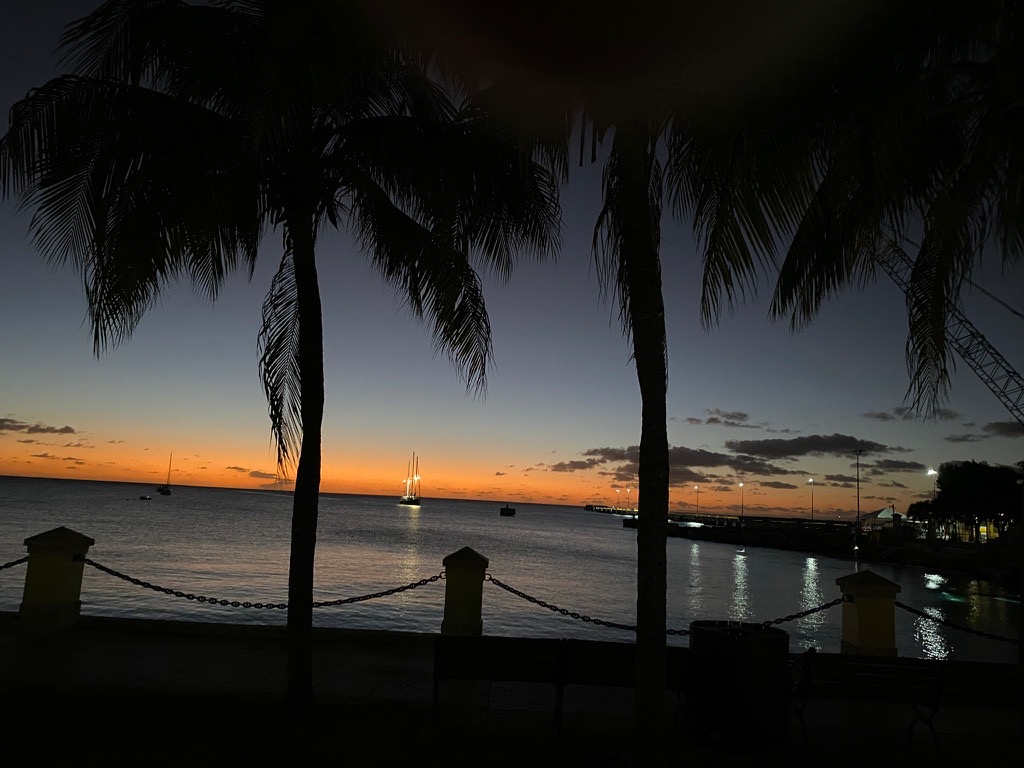
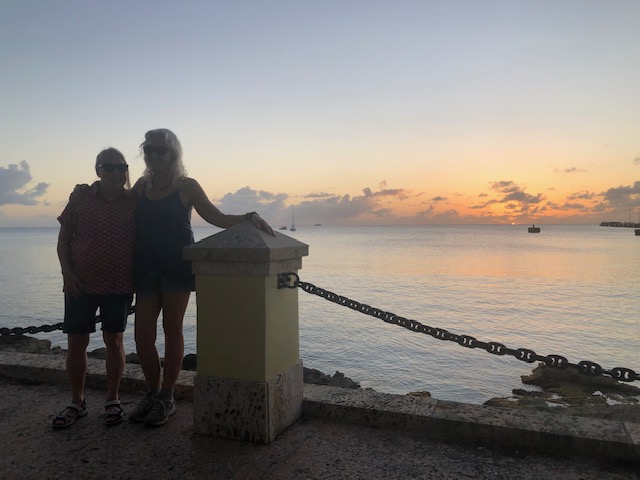
Besides being mellow, this town had great sunsets. It’s a little over 1000 miles from the equator, which makes it immune to seasonal daylight fluctuations. Sunset was always about 6:30 pm. The temperature was in the 80s during the day and in the 70s at night, with a soft, balmy trade wind.
*
And best of all—great friends live here!
Beaches were sandy or rocky depending on the location. Some were great for beach combing, although you aren’t supposed to take your findings off the islands.
The coral reef ecosystem meant abundant animal and plant life. Here (above) is a brain coral skeleton on the beach. Brain coral make up the foundation of coral reefs and can live up to 900 years!
One of the first thing we did was go snorkeling. I was pretty bad at it—something to improve for sure—but I did see peaceful turtles, beautiful fish, and colorful corals as I thrashed around and adjusted my snorkel.
During turtle nesting season, streetlights are red to keep the females happy and the hatchlings from being fooled into crawling towards the road.
We enjoyed great Caribbean food, local beer (excellent), and even a shot of rum at this place shown below.
*
We weren’t able to see the entire island during our too short trip but we managed to visit a former sugar plantation and its not so nice dungeon. The only bright side to this is a successful slave rebellion and emancipation in 1848.
As mentioned before, the citizens can’t vote and have little representation, but they are US residents. Hurricanes in 2017 damaged several buildings and funds to repair them are just coming in now.
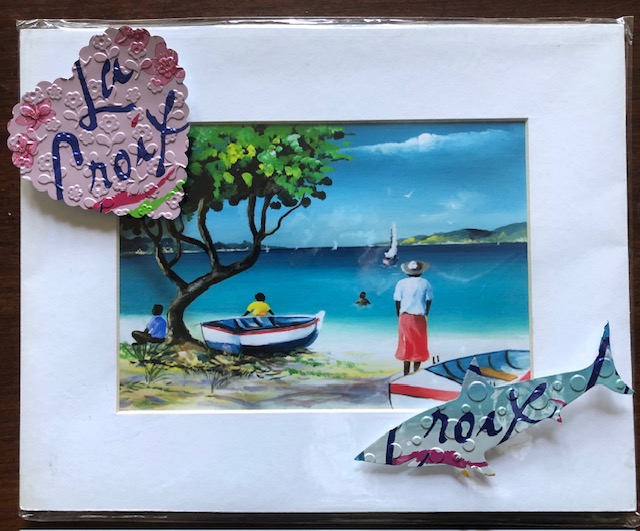
I wasn’t on the “shopping” side of the island (Christiansted) but I did manage to grab a few souvenirs. I’ll have to return!
Nature was seen as punishing—lightning struck evil churches, environmental disasters were punishments from god(s), disease was sin. So was (is)being ugly. Snakes were bad omens or good, depending on your culture. The idea of balance between humans and the environment was unheard of for many societies. It wasn’t as if some vistas weren’t considered beautiful. Most people did not appreciate nature, or downright feared it. Most saw it as irrelevant to their lives.
The idea that nature can be understood is a relatively new one, at least in western culture.
As the Europeans changed the landscape in countries they over-ran, a few noticed that they were destroying something beautiful and pristine. One such person was George Perkins Marsh, who wrote Man and Nature in 1864. Marsh discussed how the alteration of the landscape could promote climate change and linked desertification to deforestation. He urged citizens to value the environment, manage its resources, and measure progress in terms of the prudent supervision of resources. The US Forest Service was established in 1905 with careful management as a goal. This view of environmentalism is known as Utilitarianism. We preserve nature for our enjoyment and utility for recreation, hunting, and fishing. In the 1930s, the Dust Bowl re-enforced the idea of conservation of resources. God’s punishment became something we brought upon ourselves. Outdoor recreation is big business, generating over $560 billion dollars in 2022.
A Twist on the Everyday is a reader-supported publication. To receive new posts and support my work, consider becoming a free or paid subscriber.
They also seem to have an axe to grind against the public schools. This story begins with elected one Steve Holt, who came to Iowa from South Carolina and owns a Tropical Snow. No doubt this makes him an expert on Iowa schools because he accused public schools of harboring employees who abuse children and teach the hatred of America. Ironically, his wife is a public school teacher who prompted students to walk out in protest—of her! She didn’t mean to offend but from what I can gather, isn’t seeking out any DEI courses to help her understand the students’ point of view. I took an (on-line) DEI course and learned some things about myself that needed to be adjusted. Why be ignorant, even if it’s unintentional? This backstory might help explain the outburst which follows later. The Iowa Governor backs Holt up on his dim view of the schools. You can read the entire story here.
A journalist sent what she intended to be an uplifting message about the local schools to Mr. Holt and copied her representatives.
Here’s what she had to say:
to steven.holt, barb.kniffmcculla, ken.rozenboom
Good morning!
As I watched the news last night and this morning, I was moved to share a couple of experiences with you, Mr. Holt, regarding the way our young people today feel about their country and their patriotism. I have two stories.
Story #1 involved the return of a Pella soldier from his basic training in Alabama just before Christmas. He has a great relationship with his sister, a third grader at Madison Elementary in Pella. She was expecting his return on the weekend, but under the guise of celebrating her half birthday with her classmates, she received a very special gift … her brother all wrapped up in a big birthday box. Here’s the rest of the story. One of the students asked if they could ask Levi some questions. “Of course,” said the teacher. Hands shot into the air, and Levi patiently answered each and every question they asked. Students were excited about his adventure. He was very positive about his training. I heard nothing but positive thoughts coming from all in the room regarding our country, our military, and his young man’s service. It certainly illustrated a love for our country and what those serving us are doing.
Story #2 happened just last week. As a part-time reporter for the Marion County Express, I was invited to Jefferson Intermediate in the Pella Community School District and Pella Christian Grade School to cover the presentations of the local American Legion post honoring the fifth graders – over 200 of them – who had written essays about the United States flag. Every single one of those students received a folder containing a certificate recognizing their participation, and, along with that, a miniature flag. Several American Legion members were present for this occasion and enthusiastically shook hands with each and every student as they were presented their awards. Respect was shown at both schools for those gentlemen, and the students exploded with cheers of appreciation as the three essay winners were announced. They waved their flags proudly as the gatherings concluded. Patriotism and appreciation for those who have served was evident.
These two examples are just the tip of the iceberg. Please be careful about making judgments about today’s schools and today’s youth. There’s all kinds of good taking place. And, if you’d like to catch the winners reading their work, they’ll be presenting them at the next Legion meeting on March 25 at 7:30 p.m. at the Legion Hall in Pella. The meeting is open to the public.
Holt sent a brief note of thanks. She didn’t hear from McCulla. Her Senator, Ken Rozenboom, wasn’t exactly thrilled with her glowing letter. Here is his response:
Thanks for the message. I agree that so much good is going on in our schools. But you’re obviously trying to drive a point home. I wish we could always deal with schools who are doing the right thing. But please consider the school issues that have been dumped on us since I was first elected to the Senate 12 years ago:
Boys in girl’s bathrooms and locker rooms
Boys competing against girls in athletic events
Gender transition surgery for teens
Pure pornography in our school classrooms and libraries, including graphic illustrations of pedophilia
Teaching first graders that the gender listed on their birth certificate was just a guess
Schools refusing to open as Covid slowly came under control
Masking and mandatory vaccinations of children with off-label, experimental drugs
Teaching kids that they were racist just because of the color of their skin
I didn’t create those controversies. Some schools and some teachers did. Are you suggesting that we are supposed to ignore those issues? Please don’t confuse action on those problems with “judgments about today’s schools and today’s youth”.
Respectfully,
Ken
I’d like to address a few things from his list. A few I’ve already covered.
Schools refusing to open as Covid slowly came under control
He wrote his letter to a woman whose sister, a teacher, died from COVID before the vaccine became available. Iowa Republicans even banned mask mandates. I was a teacher myself and it was terrifying. And teachers died. People died.
Below: the governor and her mask advisory team of not scientists.
Pure pornography in our school classrooms and libraries, including graphic illustrations of pedophilia
Who knows what he is talking about?! He has barely been in a public school except to show his face campaigning. The aforementioned “cool loser” has never attended a public school. I wish he’d given some peer reviewed citations for his bullet points. Without evidence, I’m left with the impression that the porn accusations can’t be verified.
The journalist sent specific examples. Senator Ken replied with unverified rumors and repeated blame. In other words, he was disrespectful of the letter writer, our schools, and of knowledge itself. Without documented evidence, we can’t say who created these controversies. Clearly, there are enough people in Iowa who have had trauma and are moved to vote for authoritarians who blame and stoke fear about the public schools and the libraries, evidence or not.
I hate to break the news to those who think in binary terms but there are not two sexes. Scientists used to think this but now we know more.
The idea that sex chromosomes consist of a big one, X, and a smaller one, Y, goes back to 1905. The pioneering work was done by Nettie Stevens, who by the way shares my birthday. She discovered that in many species, the tiny chromosome conferred maleness. She studied meal worms to reach her conclusion. Her idea was briefly stolen by a man.
We’ve all learned this in school: XX means a female, XY means a male. But after nearly 120 years, it’s time to update, because human life is more complicated. Being male or female comes as a result of some biological tug of war, often helped along by chromosomes but not always. Sometimes hormones come into play and anatomy is not always forthcoming.
One to two out of every 100 people will not fit the purely XX female or XY male genetic patterns. The blanket term for this is intersexual. What’s their story? The answer has many twists.
Some people carry the genes of an absorbed twin, and that twin might have been a different sex.
Some have gonads which are different than their chromosomes due to disruptions during sexual development in utero.
Others have genes that give them gonads different than their chromosomes, so an XX person might have male sex organs or an XY person will develop breasts and female sex organs. This is rare, it occurs in one out of 4,500 people.
Men can have XYY chromosomes, a condition called Jacobs Syndrome. Some may be abnormally tall and have learning and speech challenges which can cause them to be bullied.
Biologists say sex is hard to identify because it could be based on anatomy, or chromosomes, or hormones. I haven’t even discussed hormones! It’s a topic best left to endocrinologists. Making laws about sexual identity, especially when done by the less informed is reckless and possibly malevolent.
When I was a schoolgirl in Rockville Maryland, someone, a group of teachers I think, asked the students to decide if they wanted a new national anthem. I like new things and was enticed by the idea. We sang all sorts of patriotic songs as part of our research on the proposal. This was a DC suburb, and many kids were from military families. In the end, most of us decided that we could do better as a nation than the Star-Spangled Banner (SSB). It wasn’t fun to sing and since we’d all been irradiated by the above ground nuclear testing, the bombs bursting in air was a pointed reminder of the health effects of bombs.
Yes, a flag is a symbol and people tend to think symbolically, but to my child’s mind, it was a limited symbol. I really gravitated towards the “wilder” songs with references to the beauty of the national landscape such as God Bless America or the collective love of country as in This Land is Your Land. The idea of a new national anthem never got much traction but let it be known, I have never enjoyed singing the Star-Spangled Banner.
Corporate profits are up, way up, but have you noticed how just about everything you buy breaks right away? I’m not talking about minor purchases like that Mainstay humidifier I just put in the garbage. I’m talking about big things we rely on. For example, have your glasses been shucking out faster than usual?
The first time, my wire rims sprang apart while I was on vacation. Thank you to the man in Detroit who fixed them for free. I moved on the plastic frames, but it wasn’t long until I thought I was losing my eyesight. Everything was blurry. I couldn’t even read. I’d been wearing glasses for most of my life. I was used to them. Initially, I had no idea it wasn’t my eyes. It was my glasses. They were crisscrossed with tiny scratches, even though I’d bought scratch coating.
The second time, two years later, I was driving 100 miles. I had a hard time focusing on the road. I thought I was getting a brain tumor or something. I’d gotten the extra coating of scratch prevention and anti-reflection coating. But the glare and reflection were terrible. I could even drive a little bit better if I put my glasses on my head. When I got to my destination, I looked at my glasses. There were scratched along the center like my previous pair. There was also some kind of weird cloud forming at the top as if sweat dripped down on them over the hot summer. I took them to the eye doctor as soon as I got back from my trip. Ironically, someone else was there with the very same problem. The clerk told us both how we should be cleaning our glasses.
The glasses clerk confessed that those coatings that you put on your glasses to protect them are only guaranteed for a year and then they start breaking down. It wasn’t my error that had caused the scratch coating and the anti-reflective coating to create some kind of a weird maze resembling corn borers through a row crop.
Glasses aren’t my only problem. I have a new refrigerator, a Bosch, a medium-expensive brand, and already the handle has gotten a crack. It looks like some kind of plastic fatigue.
But the Bosch company says it’s cosmetic and not covered by the yearlong warranty, so I can’t get it replaced for free. Should I have just bought a really cheap refrigerator? This one was not at the bottom of the line or anything and although it has many aspects I like, it’s still breaking.
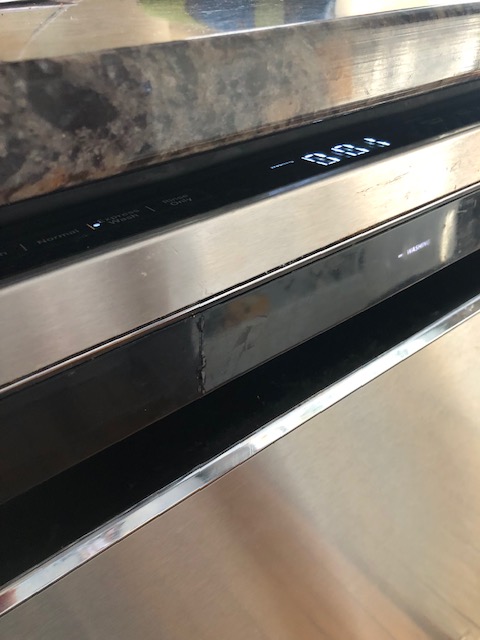
Let me show you the front panel of my dishwasher.
A piece of plastic broke off. This dishwasher is a KitchenAid, so not the cheapest brand. It’s 3 1/2 years old. That’s all. According to the place that sold me the dishwasher, to replace the plastic would cost $300 plus labor. I think that seems high for a slab of plastic. I contacted KitchenAid and the help-line people were nice but even after talking to them, I can’t figure out what the part number for it is. For now, let’s hope the super glue we used holds. And curses to the plastic manufacturer. Maybe it was outsourced like the door plug on the Boeing.
On a happy note, my Kohler kitchen faucet started corroding after ten years. It had a lifetime warranty.
My plumber got to work and helped me arrange a replacement faucet. I couldn’t get the exact same one but I did get a new faucet, arriving earlier than promised.
In recent years, the US Consumer Protection Bureau has been weakened. (We don’t have to even guess who did this. We know, don’t we?) Things are made cheaply now. One way to fight back is to learn to fix your own stuff. My vacuum cleaner, a Dyson, is pretty easy to fix. A hose attachment got a hole in it and the replacement was $5. I even got some help installing it.
The Iowa caucuses will take place this Monday, January 15. A caucus is a party meeting and both the Democrats and the Republicans will meet separately to discuss who should run for president and what their party goals and beliefs should be.
In case you haven’t followed the Republican caucuses here, candidates have been crisscrossing the state trying to prove which one is the biggest, toughest bully. Ever since Joni Ernest won a Senate seat with an ad about castrating pigs and shooting Obamacare, Iowa has been racing towards the bottom of the valley of incivility. We have an attorney general who never tried a case, so understandably needs an extra million dollars to run her office. But she wanted to give Biden the Bird and this mean message won over the hearts of Iowans.
In a local election, the library was disparaged to the extent that some highly sheltered people became afraid to go there. The worry? They were lead to believe porn was sitting out in the childrens’ section. When a library crack-down referendum lost in a local election, the head of the group pushing for the oversight called those who didn’t support her views porn loving Marxists for government spending. And on matters of book censorship, my own state senator implied I was a pervert when I pointed out that for books, context was important.
Our governor ignored the urging of medical professionals on several issues numerous times, yet took the advice of Moms for Liberty, even posing with them. It really doesn’t matter if people in these groups have kinky sex or shoplift. There’s money to be made from endorsements after all.
What happened to Iowa? I’d credit money pouring into misinformation. Take a look at the local county website. It’s filled with conspiracy theories and misinformation. Their antics have been reported, yet people still vote for them. It’s no secret that money has fueled their opinions and packed the Supreme Court. Iowans are no match for the conservative media sites popping up, many of which inflame stories and harass people they disagree with. Studies have shown that conservative people are more susceptible to misinformation, more likely to repeat it, and that conservative news sites spread more misinformation.
The Democrats are having a caucus but not voting for the presidential candidate. The vote will be done through a mail in ballot. According to the Marion County Democrats:
On November 1, 2023, the window opened for Iowa Democrats to request their Presidential Preference Cards for the 2024 Iowa Caucuses. The IDP Disability Caucus was instrumental in this process. This is a major change in our Caucus; however, it’s definitely more inclusive and something that many will appreciate this year with the extreme weather that we’re experiencing. It enables participation by those who are sick, don’t drive at night, work evening shifts, stuck at home due to nasty weather, babysitting or elderly sitting and the list can go on and on.
If you’ve not requested your Presidential Preference Card, please note that February 19th is the last day to make your request. The on-line process is the easiest and quickest way to ensure your request is received in a timely manner. The online submission form meets accessibility needs and does provide an option for Spanish translation. If there are questions regarding the online process, they’ve created a helpline to call (515-216-3893) and if necessary, leave a message and they’ll call you back as soon as possible.
Another option to request a Presidential Preference Card, is to print & complete the attached IDP Request Form.pdf and mail it to the address on the form.
The bold is my addition. I always liked the caucus and the discussion with neighbors. However, I find the “discuss now, vote later” approach more appealing than I thought I might. It’s true that it’s more inclusive. Additionally, COVID is on the rise again, and although Iowan’s don’t like to admit having it, wastewater don’t lie and our level right now is “very high.” Not everyone can afford to be exposed.
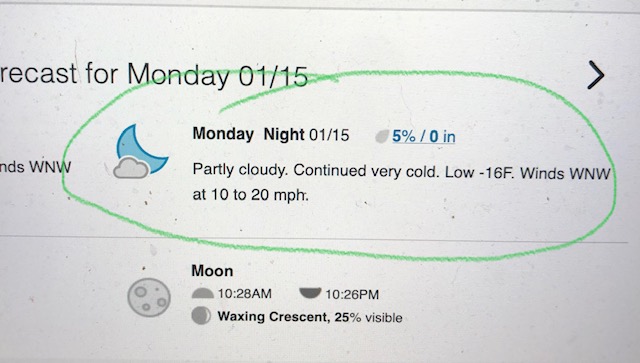
If that’s not enough to show that an in-person vote isn’t inclusive, get a look at the weather forecast!
It’s not just cold.
It’s windy!
It’s too bad the weather won’t allow more people to attend because one useful thing that will happen is to discuss the party platform.
In an under the radar announcement, the EPA has decided to rebuild the endocrine disruptor screening program. I’m pretty happy about this. It’s an example of the kind of protection I expect from the government.
Endocrine systems, aka hormone systems, are found in all mammals, birds, fish, and many other animals. Hormones are chemical messengers and they regulate many biological processes.
Many modern synthetic chemicals can act as hormones or interfere with their workings. Chemists have blessed us with over 85,000 synthetic chemicals. About 1000 of these are thought to be endocrine disruptors. These chemicals range in use from plasticizers to explosives. The EPA is the agency charged with testing and regulating these chemicals. Testing requirements began in 1998. The idea was to make sure people and animals weren’t being exposed to disruptors. It stalled out and then stopped altogether in 2015. The program is one of those that doesn’t get funded, depending who is in charge of the government. In particular, the EPA staff received little to no support and direction from the Trump Administration.
Why would the average person care at all about endocrine disruption?
Here are a few reasons:
Endocrine disruptors, or EDs, can harm the thyroid. These chemicals can exhaust the thyroid, resulting in conditions such as obesity, heart problems, and insulin resistance. In fact, this harm can begin when a person is a small fetus– your mother’s exposure might give you obesity and fertility problems.
Endocrine disruptors harm testicles, decreasing sperm function and testicular health. Being exposed to disruptors before birth can cause a short testicle to anus distance which is often associated with male infertility. They can also create hypospadias, in which the opening to the penis isn’t at the tip.
Other problems which can result are cancer, including childhood, thyroid, breast, and prostate cancers along with decreased immune function, including a lowered response to vaccines.
The newly announced study focuses on endocrine disruptors found in pesticides. Since the year 2000, data from across the globe has been collected on people living in and near agricultural areas and those employed in agriculture and gardening. These populations experience high rates of birth defects, especially genital defects, along with higher rates of hormone dependent cancers, and poor semen quality. Most prior studies have been epidemiological, meaning they look at overall health of populations.
Although people living and working on and near farms bear a lot of pesticide exposure, people can get exposure from foods and manufacturing sites as well. The chemicals can get into air and water and travel long distances. Besides humans, wild animals are affected by endocrine disruptors. And epidemiological studies take years to complete which is why the new study is needed. (Information comes from this source.)
The new study will systematically look at the pesticide chemicals themselves and screen them for endocrine disrupting properties.
Thirty pesticides will get added scrutiny in this project. The EPA has 403 pesticides to review in total and of this, 86 have enough data to be shown as not concerning. Additionally, 161 look to be safe from endocrine disrupting properties. This study will by no means forbid pesticide usage—it aims to do what the companies did not and test for safety of chemicals widely distributed in our environment.
The screening tests mix cells with the possible endocrine disruptors and look for reactions between them. Often times, the chemicals being tested will fluoresce or change color when they interact. This new study will help look at pesticides and their by-products in an efficient way. Getting politicians to care enough to protect us will be a whole different challenge. Thankfully, the Biden administration has begun the process.
In order to keep us safe from synthetic chemicals, we need studies of their safety and most often the government, must do these studies. A color changing or fluorescence screening is an efficient way to look for Eds.