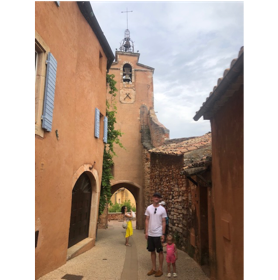
The family recently took a trip to France. We spent most of the time in Provence in the Luberon region, nesting in a villa in the quaint town of Roussillon.
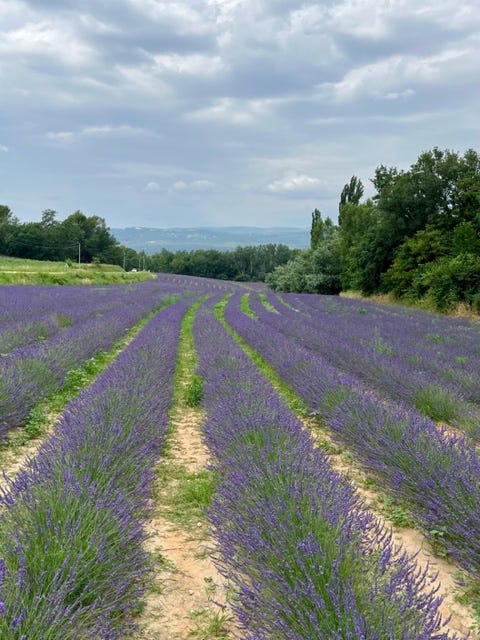
One thing you notice in France is how good it smells! The agriculture here includes melons, herbs, olives, wine, and lavender.
My son took the photos of the lavender fields.
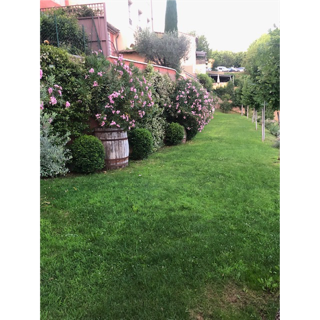
Everywhere you go are flowers and olive trees.
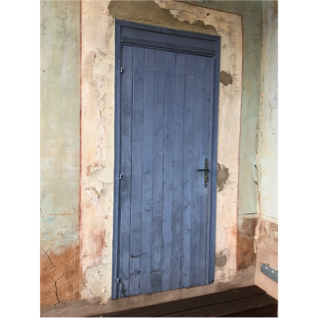
The ochre tinted buildings have colorful doors and shutters.
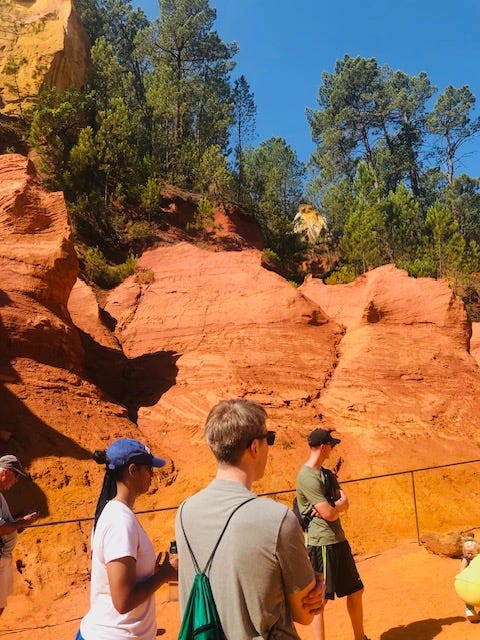
Roussillon is known for its ochre. You can even tour a mine—not at all rigorous.
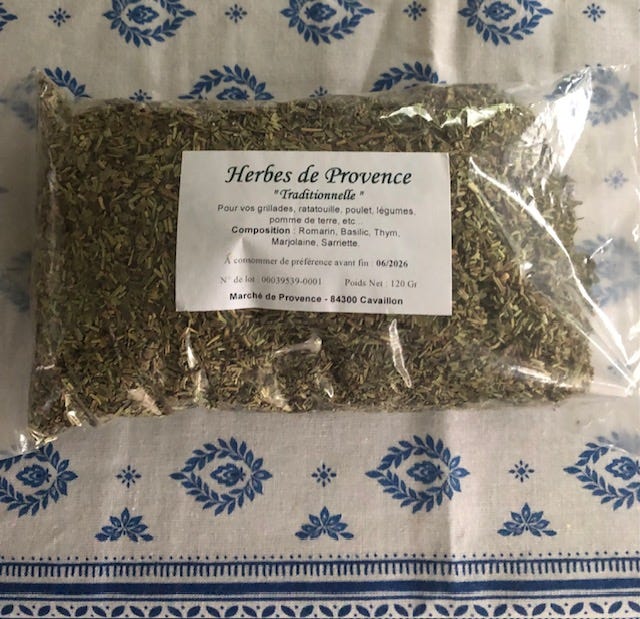
The iron rich soil along with limestone and plenty of silica stimulates the growth of many different plants including orchids, chestnuts, pines, heather, and the herbs found in Herbs de Provence.
It’s also got plenty of cute shops and art stores.
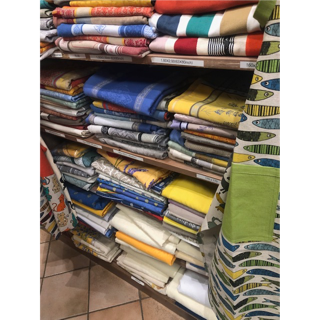
No photos allowed at the art stores but the region is also known for fabrics.
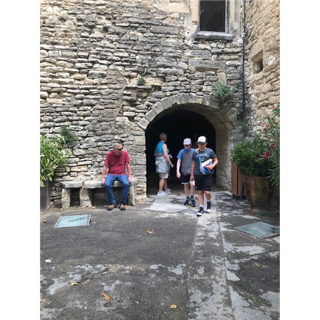
Nearby, the beautiful town of Gordes is made of sedimentary rocks and perched on a mountain.
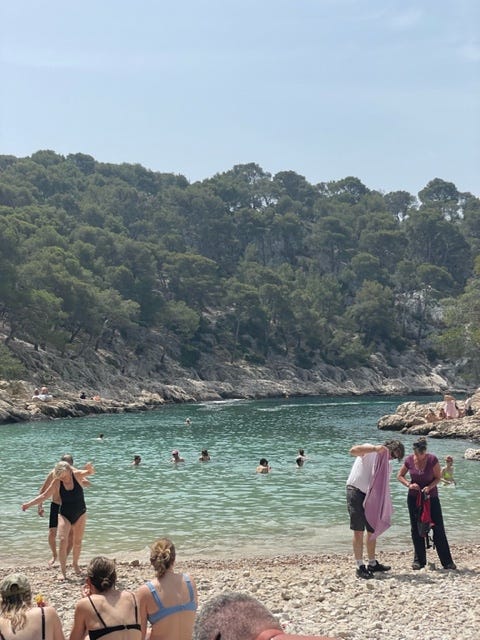
One day, we took a trip to Calenques of Cassis. Click on this link and see the cliff we walked along to get to a beach. No thanks Google maps, for not warning us of the steepness. We lived. No one fell off. I’m not sure how. Somehow this route to Port Pin was not as easy as it’s rumored to be.
This was our reward when we reached our destination. Fortunately, we found a safer path back to our car.
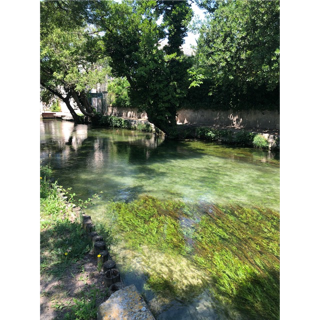
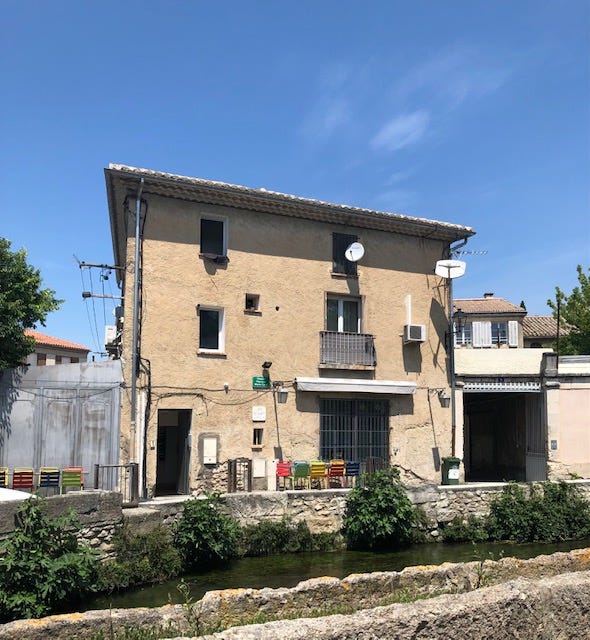
L’Isle-sur-la-Sorgue is a pretty town filled with canals and a lively market. Getting there involved a lot of twists and turns. Some of us (not me, I was a tagalong) rented cars and navigated the massif. Somehow, this area is advertised as good for cycling. I’m not sure about the bicyclists but we in our cars only screamed a few times as we squeezed through the narrow roads, far less than when we drove in Italy.
I wished I had my water testing equipment. I could show the people of Iowa what water can be—so clear and filled with fish.
This says Pierre and Marie Curie Chemin. I thought “chemin” meant lab but really, it’s a street. When in France, try to bring someone along who speaks French. The locals aren’t dying to practice their English, although I found the French merchants very good at upselling.
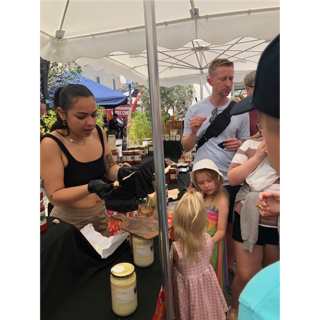
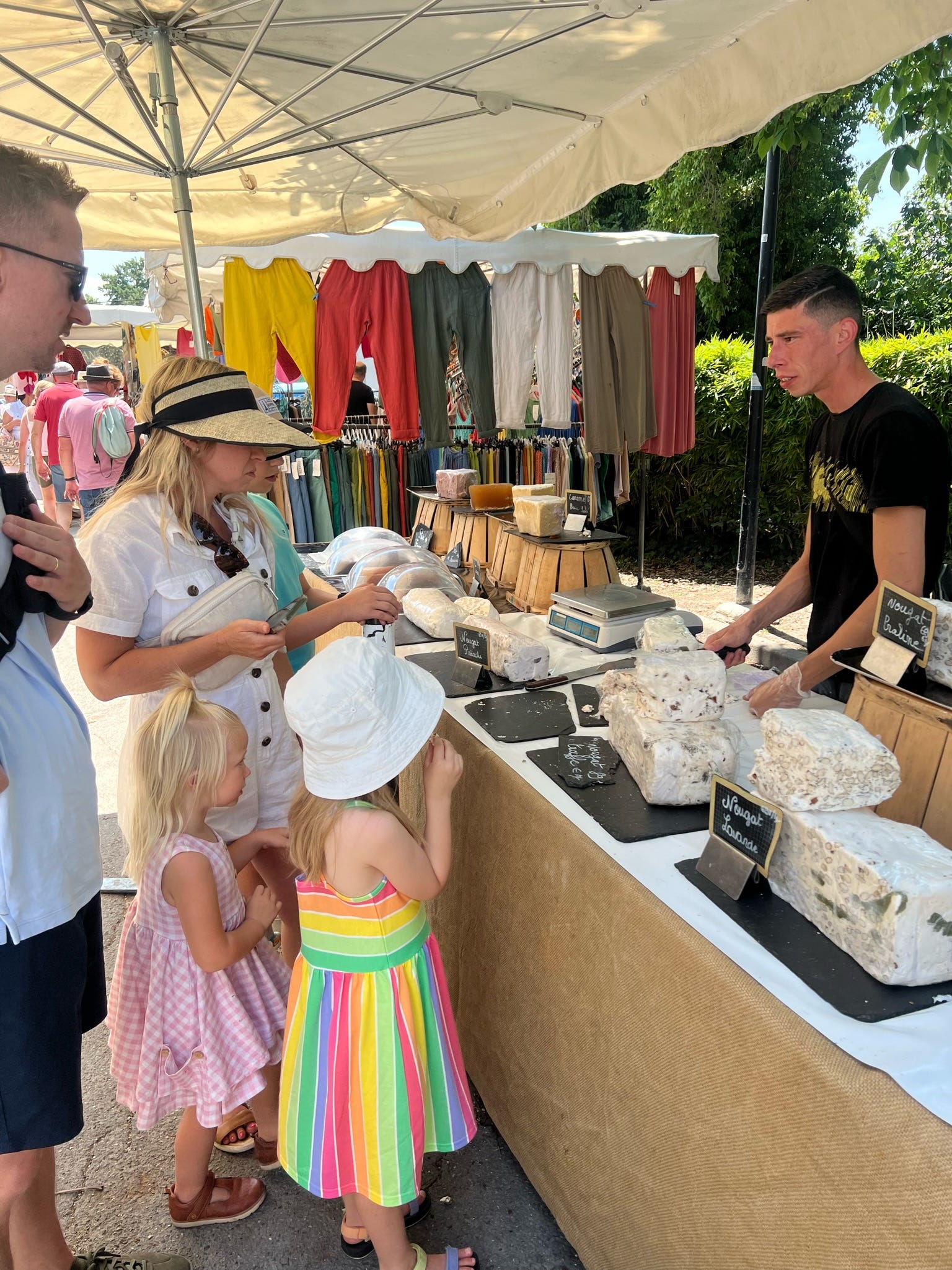
The merchants are very liberal with samples.
Nougat is made from sugar, honey, and nuts.
Before you know it, you’ll have sampled your way into many euros worth of nougat.
Southern France also has plenty of castles for exploring many built for by the Cathars as they tried, ultimately in vain, to keep religious Crusaders from exterminating them. One of their many beliefs was equality between men and women—very unpopular with the pope! Lesson here—watch out for those religious authoritarians! They’re mean.
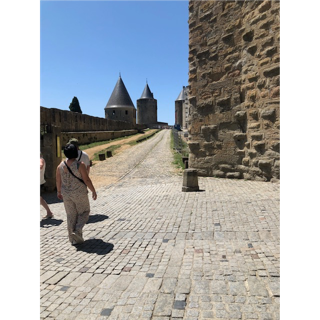
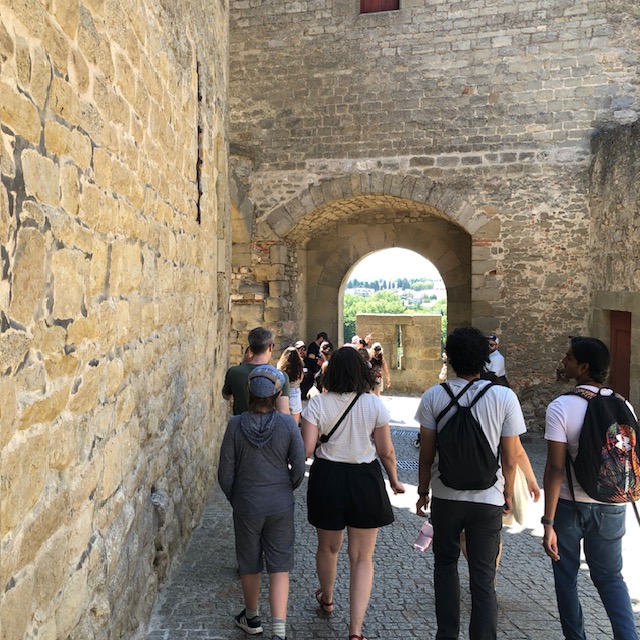
Here are some photos from Carcassonne, some of which is now a lively marketplace.
Now I’m back to the land of corn and soybeans. I wish we had some lavender fields or at least better smells. Flowers are where it’s at. Barnswallow Flowers, I’m talking about you!
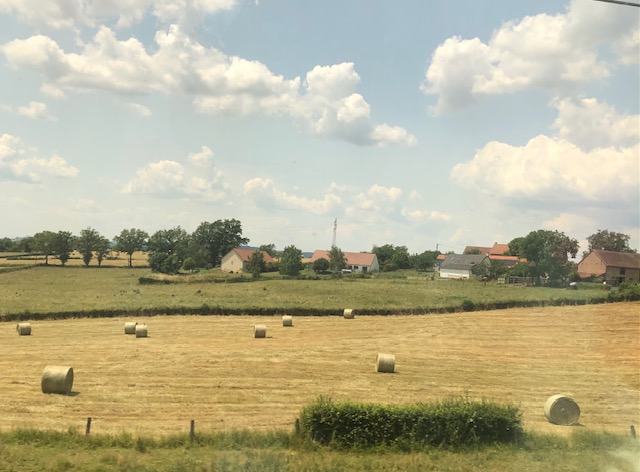
Not long ago, I was in France and took a picturesque train ride from Avignon to Paris. You know what I saw? Farms. Farms producing grains, lush melons, olives, flowers, orchards, and vineyards along with fields of dairy and beef cattle. The scene was idyllic.
Above: passing by a farm in Southern France
France is food independent, producing the most sugar beets of any country in the world. They also grow grapes for wine (of course), and corn for cattle and goats and other animals. A map of the farming areas here. They’re pretty proud of it, too, as evidenced by this cereal “Made and cultivated here in France.”
As an Iowan, I was always told to shut up any criticism of our monoculture farming. “We feed the world” is an oft repeated mantra. Clearly, Iowa doesn’t feed France. They have their own farms and vineyards. The fresh produce in the markets isn’t from Iowa. I got to wondering, does Iowa feed anybody? The answer is it can’t be relied upon for a healthy diet.
In other words, Iowa doesn’t feed the world. On a state by state basis, Iowa ranks tenth in the amount of land converted to farmland. What are we doing with all that land? What are we producing? Corn is by far the most abundant commodity followed by hogs.
A whopping 57%-41% of Iowa corn goes to making ethanol to put in gasoline. As for ethanol, I try to avoid it. I have a hybrid car and rarely have to fill the tank. Under these conditions, ethanol can be corroding.
Iowa feeds the world meat and processed corn products and ethanol. If you look up the top ten farm products in Iowa, you’ll not see a fruit or vegetable. This isn’t a healthy diet. For fruits and vegetables, we need to turn to another state–California is the nation’s top agricultural state.
France looked delightfully pastoral, a lot like Iowa in the old days, before ethanol took over with added windmills for energy production. I’m not saying what we have now is worse, although the visual appeal of today’s monoculture is lacking. Ethanol’s driving force is to rely less on other countries for oil by replacing it and its feedstocks with bio-based materials. It made sense but with more fuel, all we did was use more.
What’s wrong is the refusal to consider the downsides and to plan for the future. It seems like asking for trouble to make so much “food” into fuel. Can we explore other energy options here and return in part to cultivating more food? Other countries have been working on it. We should, too. There’s nothing wrong with being proud of your place. But let’s be honest. Iowa doesn’t feed the world. To say we do is a lie. it’s arrogant. I can’t be proud of that.
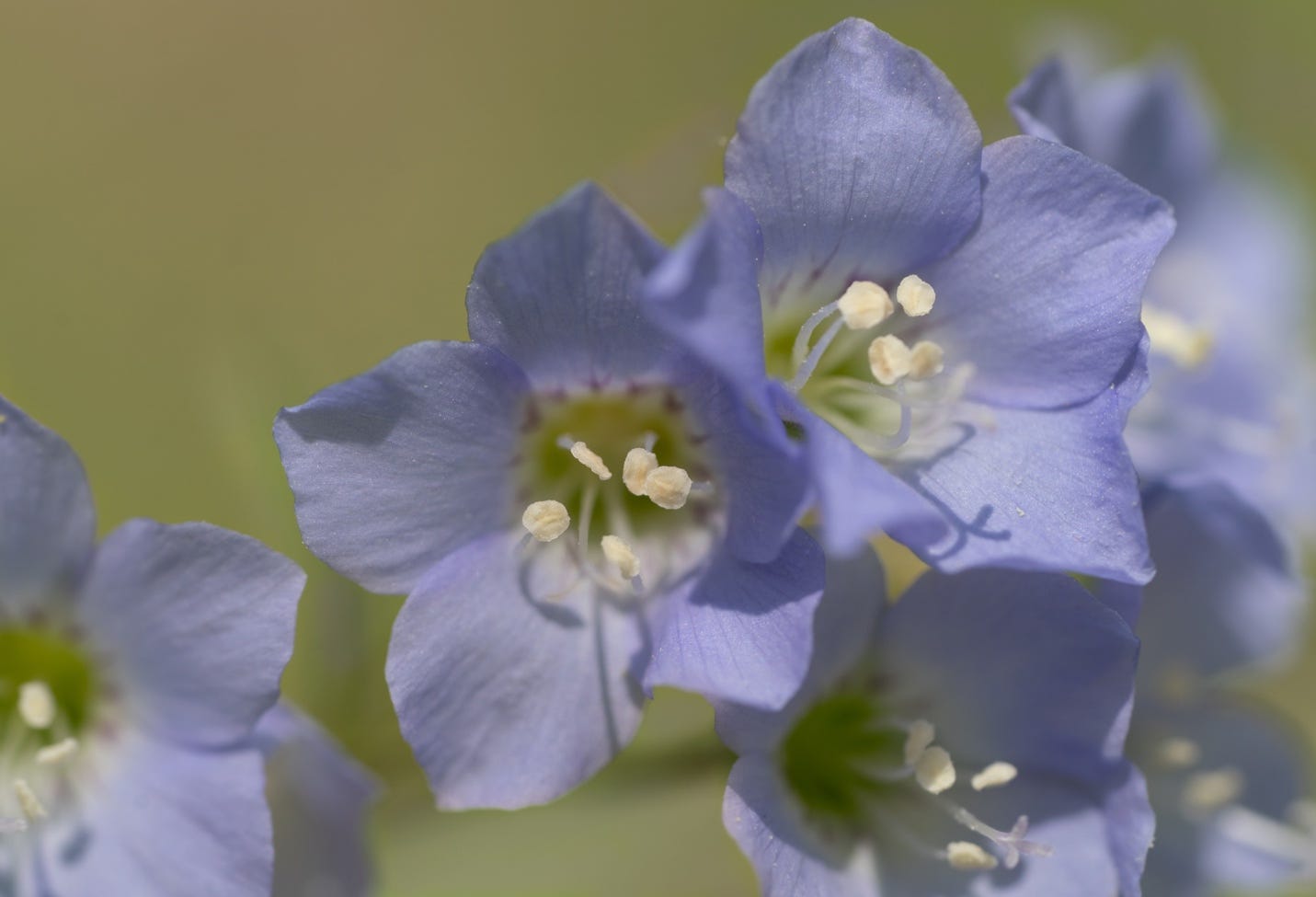
If you want to understand how living populations work together, a walk through Big Rock Park to view the spring ephemerals will do it. Kristen Siewert and Tom Rosberg each lead a foray into the Big Rock Park bur oak savanna this spring to help nature lovers do just that.
Pictured above: Jacob’s ladder by Kayla Lindquist.
Although the trips were only a few weeks apart, the flowering plants weren’t the same because they were, well, ephemeral. Ephemeral plants have a brief blooming season, popping up sequentially and providing pollinators’ first food. They almost take turns flowering and as Tom Rosberg explained, this means they don’t compete with each other for pollinators. When the trees leaf out and the forest light dims, they stop flowering.
Spring ephemerals are an important source of food for bees and butterflies. The red admiral butterfly winters here in Iowa, making these first flowers of spring necessary for their survival. A popular ephemeral with them is the Spring Beauty.
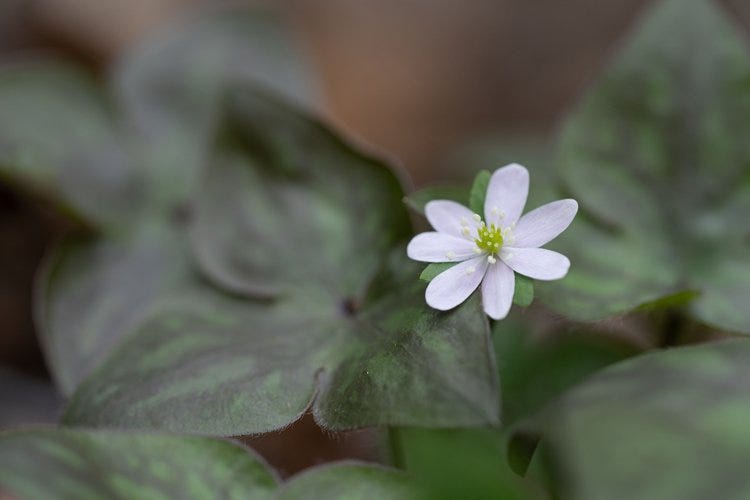
Spring beauty and Dutchman’s britches, shown above, are plants which rely on ants to disperse their seeds. They produce seeds containing elaiosomes which are oil-rich packets of nutrient which act as smorgasbords for ant. The ants carry the seeds, discard them, and feed their larva the elaiosomes. You can read more about this here.
Spring beauty can be white or pink and variations in-between, including white with pink stripes. Pink seems to be the favorite for pollinators and those with pink pollen are especially prized by miner bees. Deer and rabbits prefer the pink flowers as well.
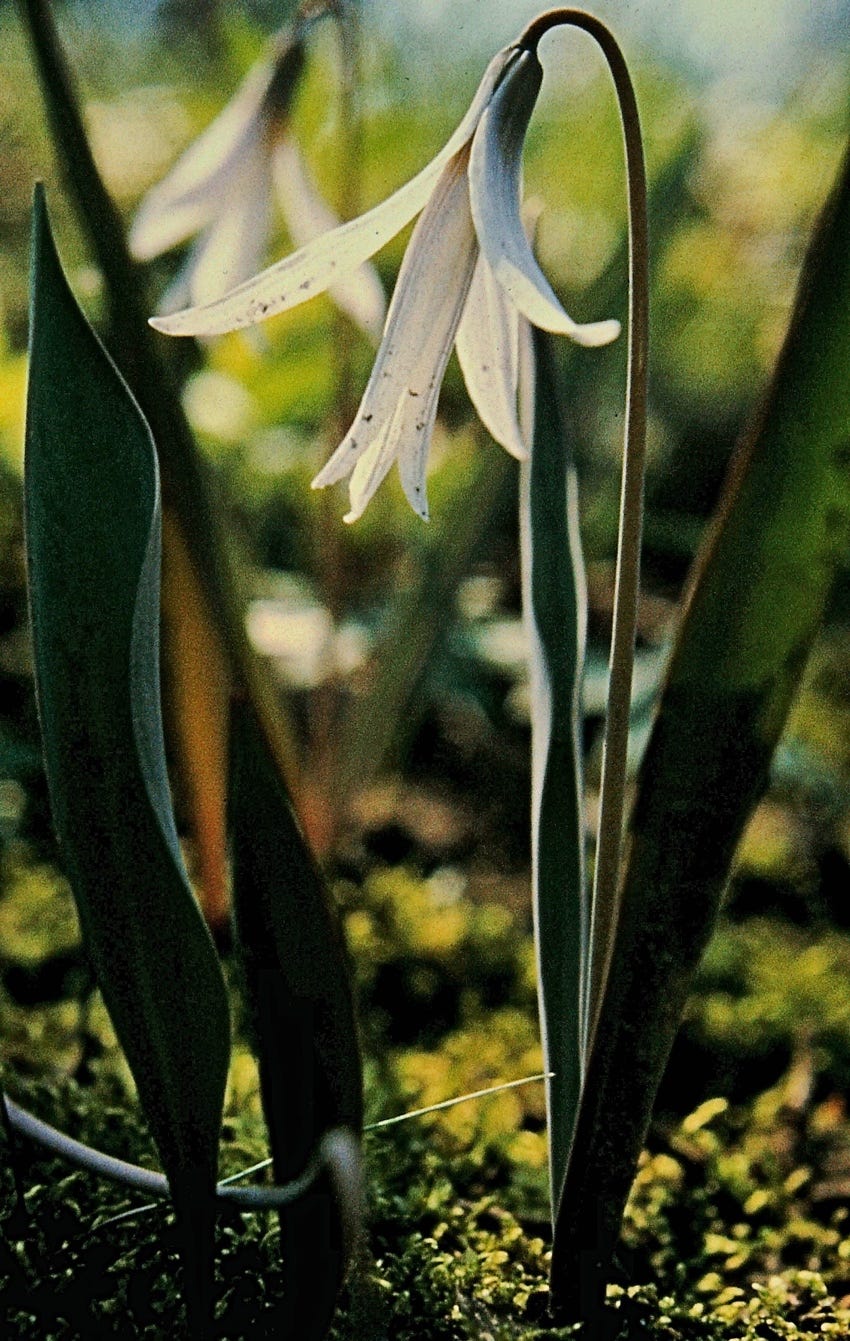
Some of the earliest spring ephemerals are the trout lilies. Trout lilies are so name because of their leaves resemble trout swimming in a stream. They are listed as being“special concern” and threatened species.
If we had an official flower of Big Rock Park, it might very well be the prairie trout lily also called the white fawn trout lily or Prairie Fawn Lily. Not only does Big Rock Park have a large population, the flower looks like a Dutch bonnet from Volendam, making them a perfect icon for the town of Pella. A very similar species with more mottled leaves, the white trout lily, can be found near the white fawn lily in the more open meadow area of the park.
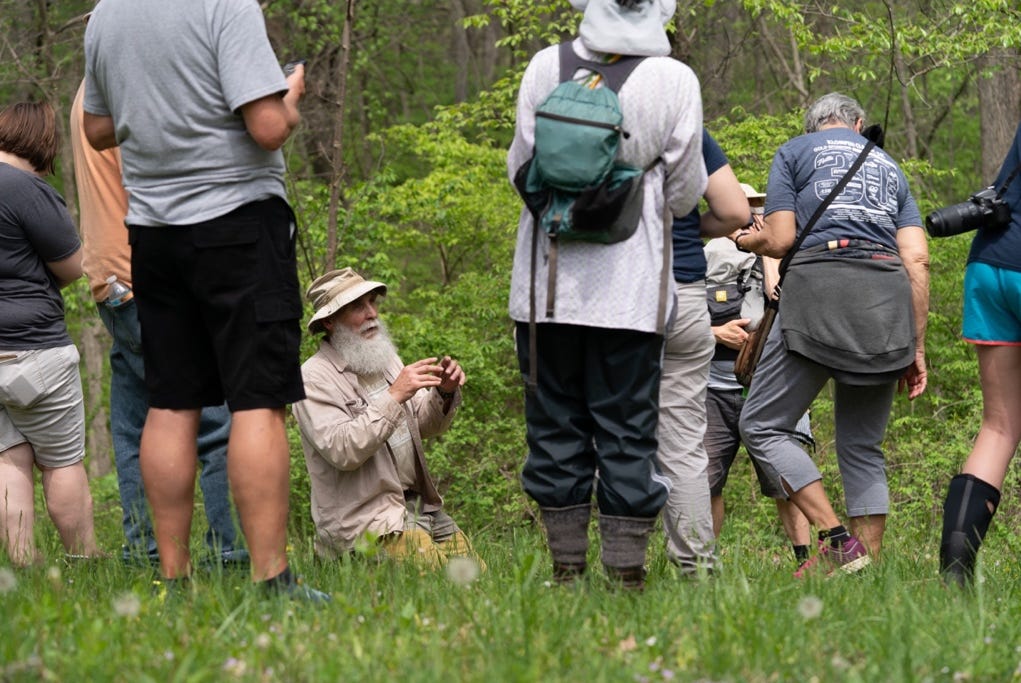
Below: Dr. Rosburg discusses the intricacies of the Prairie Fawn Lily. Photo by Kayla Lindquist.
Below: Prairie Fawn Lily (photo by Steve Johnson) Big Rock Park has the biggest population of this plant in Iowa! They are now in hibernation and will reemerge next April.
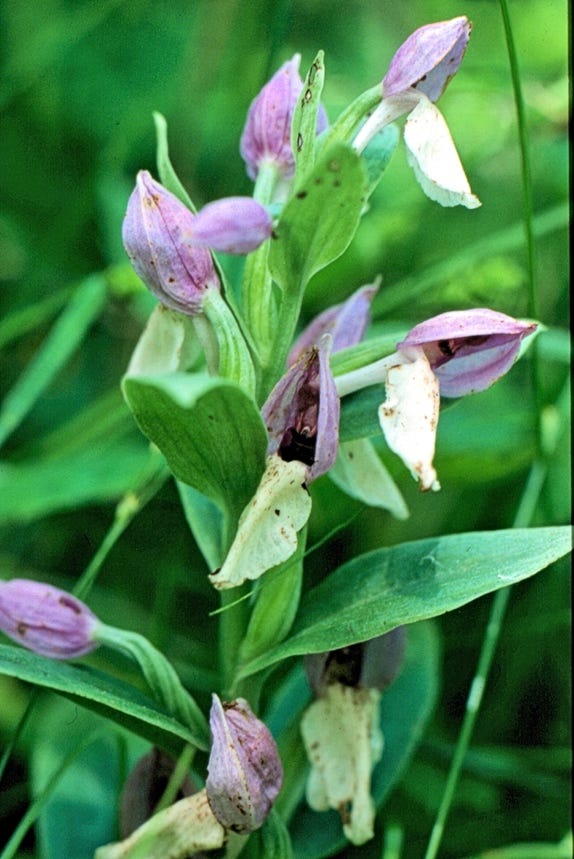
For those lucky enough to find it, the showy orchis is one of several native wild orchids in the park. It resides in the southern part of the park but is hard to find. At one time, it was trampled by paintballers! Invasive honeysuckle has spread into its territory, helped along by digging for new sewer lines at the parameter of the park. Hopefully the park can someday be declared a natural wildlife area and the ephemeral orchid will thrive again.
Photo by Steve Johnson
Above: Kristen Siewert and Kayla Lindquist enjoying the fine art of “forest bathing” and standing on the rock.
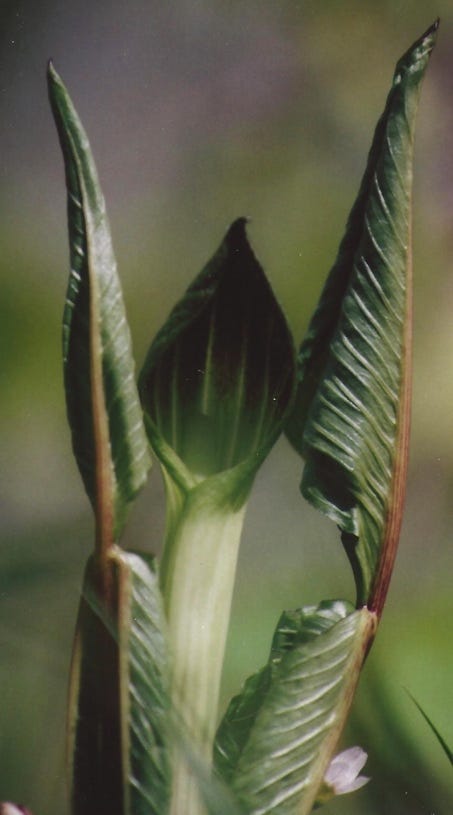
Although technically not ephemeral, Jack(or Jill) -in -the-pulpit pops up and flourishes from March to June in Big Rock Park. These plants have male and female flowers (the females have two leaves and some biologists say they are greener, photos here). In general, better nourished and more mature plants become females. The flowers can also be bisexual. The plant’s sex can change from year to year.
Two jack-in -the -pulpit showing maroon spadix. Dark colors guard plants from too much light and can warm the interior of the flower.
A young Jack or Jill emerging. Photo by Steve Johnson.
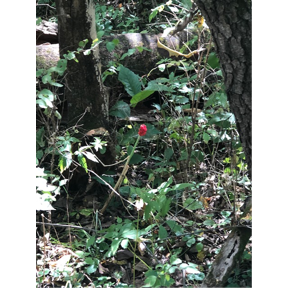
One biologist pointed out that maroon flowers often attract flies and don’t smell good. This is true for the jack-in -the -pulpit. They emit a smell that resembles fungus. When fungus eating gnats come to get a meal, they fall into the pulpit. Male flowers coat them with pollen and have an opening for the flies to escape. The females trap the (hopefully) pollinated flies, which have no escape but they bring the pollen. Some studies have found that the flowers emit a smell that resembles a female fungus gnat, luring male gnats into the plant. The female plants will go on to form a stalk of red berries which can be found throughout the park in the fall. Be careful! Every part of this plant is poisonous. Click here for photos.
Photos of the Jack and Jills- in-the–pulpit taken by Steve Johnson. Photo of berries taken by Cathy Haustein
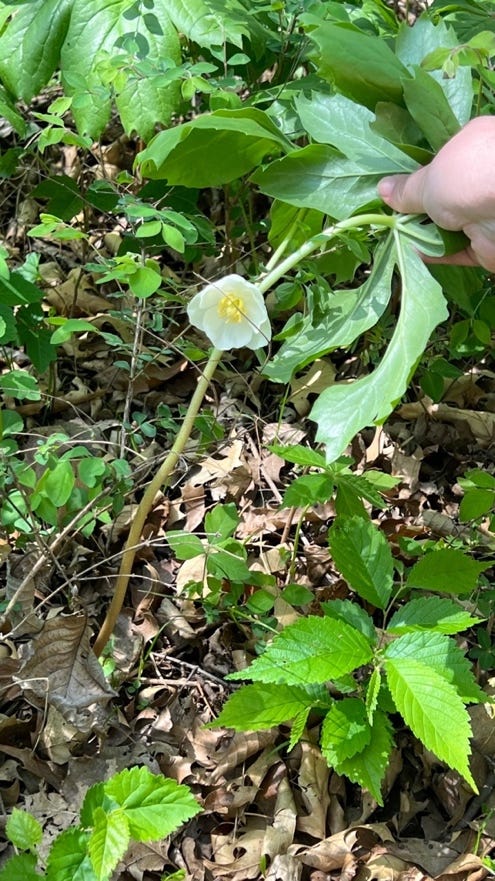
Mayapple is another common spring flowering plant at Big Rock Park, prevalent in the north west side of the park. Mayapples are big and green and nearly dwarf their one white flower.
Photo above by Sheril Graham.
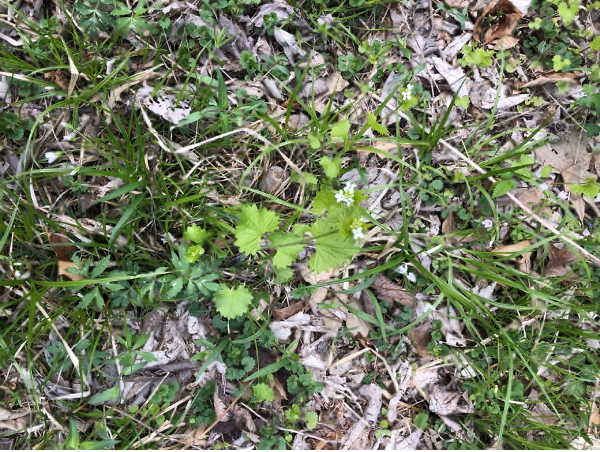
Garlic mustard is an invasive species in the park. Bees love it and it’s edible but it puts out chemicals that kill other plants, including trees, disrupting their symbiotic fungi. We didn’t feel at all guilty pulling it up but to really get rid of it, the plant should be put in a plastic bag, sealed up, and dumped in the trash. If you walk through some of it, brush off the bottom of your shoes or you’ll bring it home.
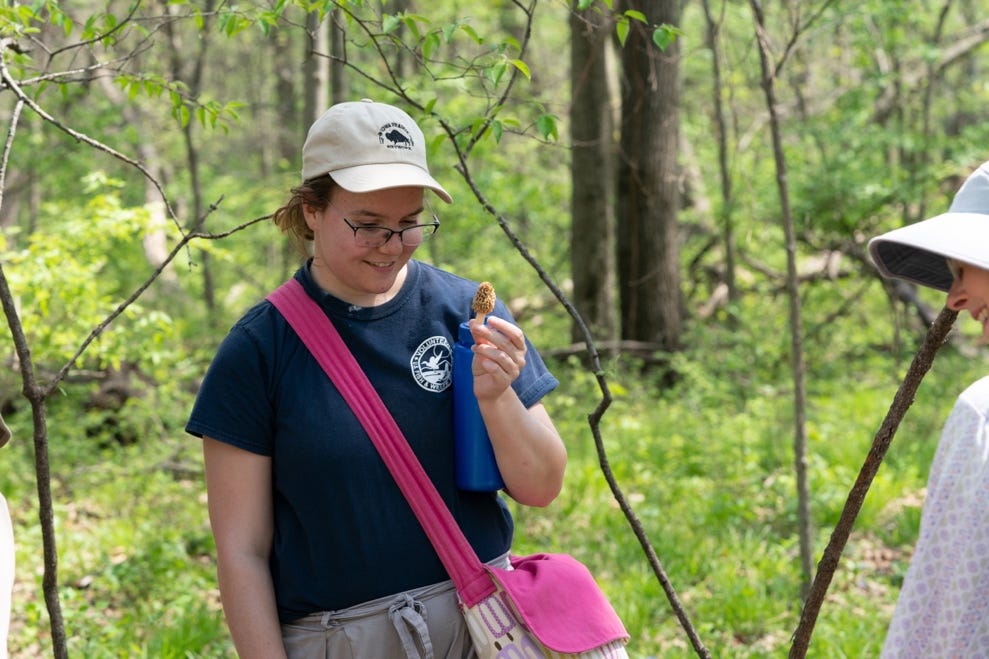
This article has mentioned fungi several times and fungi are prevalent at the park, including the sought-after morel mushroom.
As we transition into summer, most of these spring finds have settled down beneath the surface or have traded blossoms for berries. They’ll be back next spring to nourish our souls along with the pollinators!
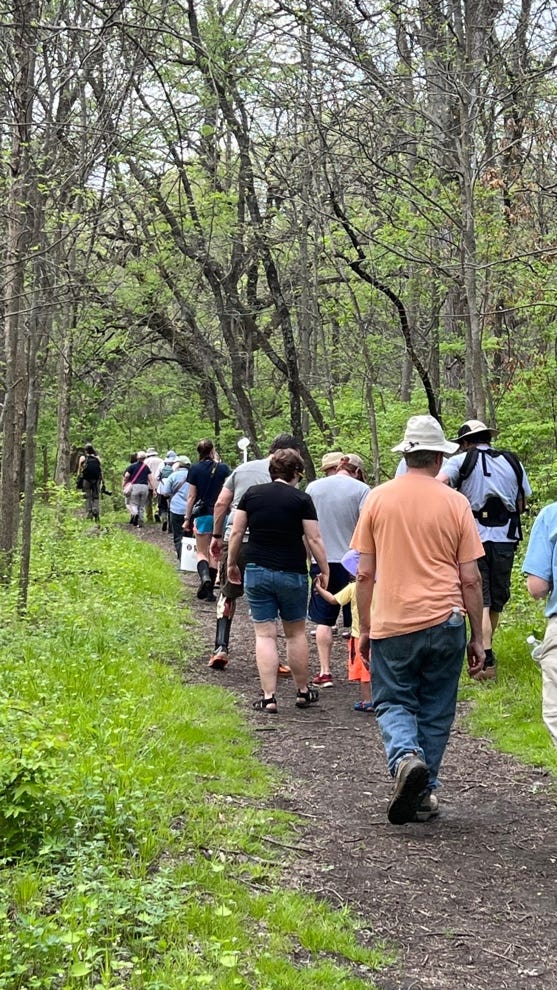
Above: a large group follows Dr. Tom Rosburg on May 7. Photo by Sheril Graham
Thank you to Marion County Community Foundation and Pella Community Foundation for sponsoring the nature walks.
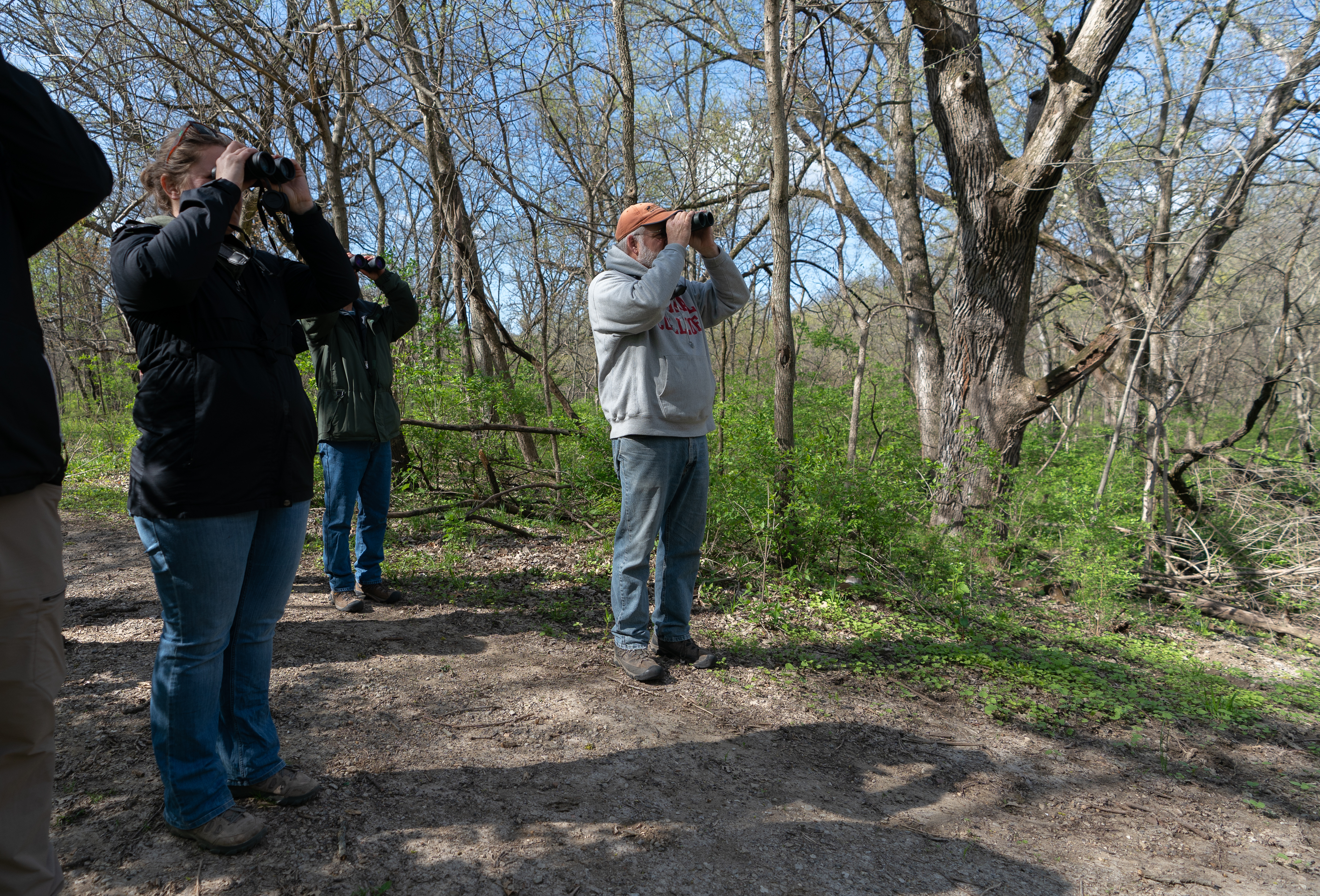
On April 29, a band of nature lovers met with Dr. Russ Benedict to learn about the birds of Big Rock Park. The Central College naturalist began with a lesson on how to use binoculars and then led us on a mile walk around the woodsy exterior of the park while he talked about avian migration patterns and all things bird. Some birds such as robins are generalists and will live anywhere. Others such as the tufted titmouse, are very picky about their habitats and will only nest in diverse oak forests as found at Big Rock Park. Spring migration is a race against time and weather to establish territory.
Below: Binoculars Up! Focus binoculars, spot the bird, quickly raise the binoculars. Photo by -Kayla Lindquist www.kaylalindquistphotography.com
One prevalent bird was the Yellow-rumped warbler or butter butt—one of the few birds that can eat waxy fruit such as bayberries and will even eat candles! This helps them survive brutal winters.
It was a beautiful and sometimes noisy walk. Carolina wrens popped up and scolded while hairy woodpeckers worked on making their holes in soft wood. A woodpecker will make a new hole every year!
In terms of migration, the over 400 species of Iowa birds fit into one of these categories:
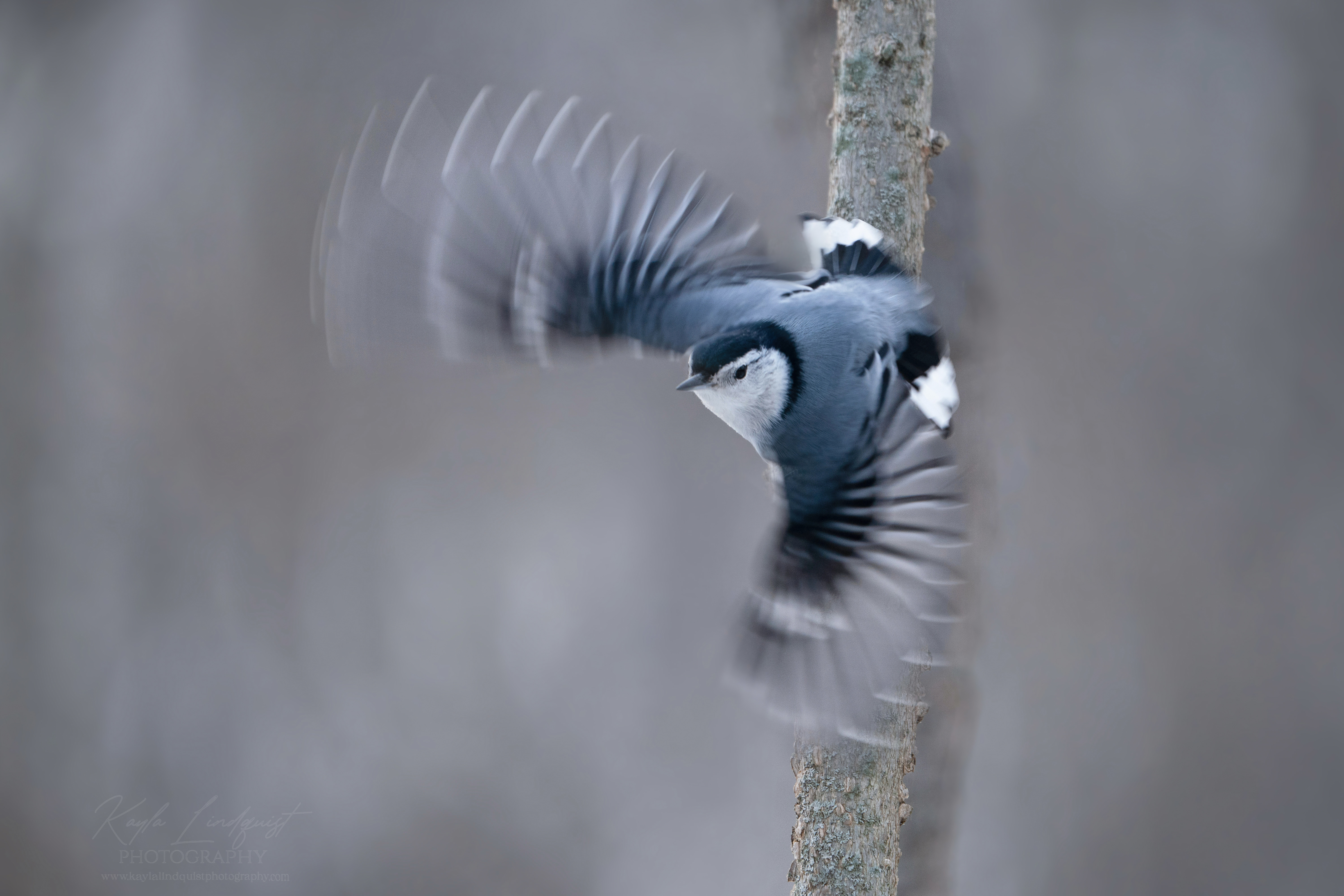
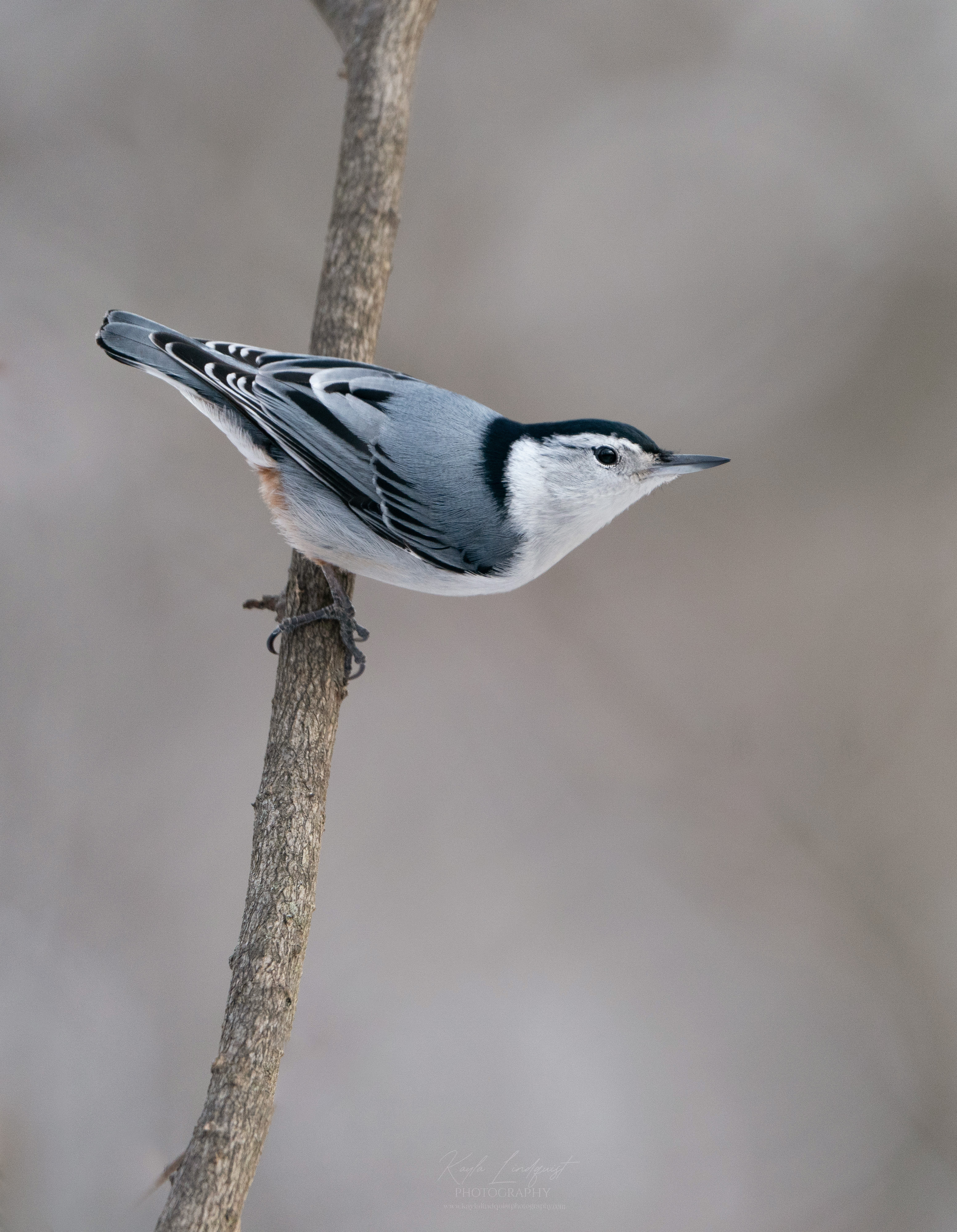
Permanent residents such as cardinals, blue jays, owls, crows, and nuthatches. Chickadees not only are permanent residents, they rarely move more than three miles from their place of birth. Another fun fact about chickadees is their call. The more “dees” you hear, the more alarmed they are about their situation.
Nuthatches, as shown below, usually don’t migrate and prefer to live near mature trees as found at Big Rock Park. These photos were taken by Central College student Kayla Lindquist. Be sure to take a look at her other photos at www.kaylalindquistphotography.com
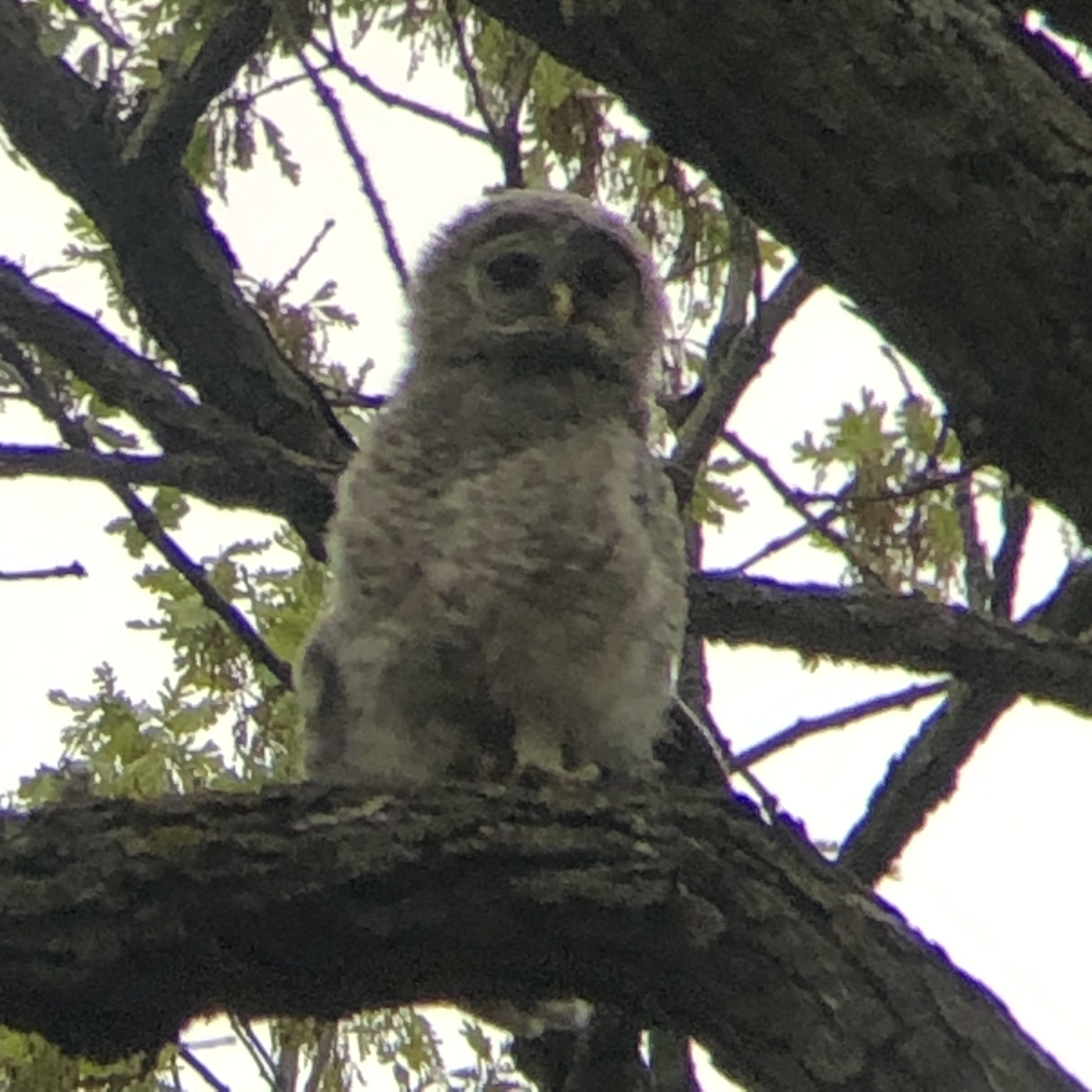
Barred owls rarely move from their roost. They can be seen in Big Rock Park year around.
(photo by Sheril Graham)
Regular Breeding residents who migrate here for the spring and summer as seen with many song birds including warblers and thrushes (such as robins), hummingbirds, bluebirds, and catbirds. These birds usually fly at night and stop to eat and rest in daylight. Turkey vultures migrate into Iowa in the spring since they can’t eat frozen roadkill. Turkey vulture watchers say the big birds are arriving earlier and earlier due to climate change.
Snow birds who winter here and fly north to breed such as eagles, juncos, gold finches, and tree sparrows.
Passage birds who fly through on their way to someplace else including many water birds and grackles.
When birds migrate, the males usually take flight first. They want to establish a territory. In the first wave of migrators, you’ll find the seed eaters, followed by insectivores, and lastly, caterpillar eaters. Usually, daylight patterns (photoperiods) prompt birds to migrate. In the spring, some might try their luck and migrate earlier or farther north than usual. This poor male Summer tanager came here too early and starved.
Females pick males based on territory, but courtship plays a role, too. Birds will have specific behaviors such as twittering their wings and singing to attract a mate. The most appreciated males croon for a long period of time. In birds such as blue jays, catbirds, and mocking birds, the most virile are those who sing up to five minutes without repeating a pattern.
Bird populations are declining in the US and across the globe. Grassland birds such as meadow larks are suffering the biggest loss while water birds are faring the best. Here in Iowa, loss of habitat and CRP fields due to ethanol are big contributors to the decline along with fewer insects.
Ways to save birds include putting up nest boxes which was highly successful with bluebirds. Turning off lights and putting up curtains to keep birds from hitting windows and buying shade grown coffee are a few more ways to help birds. Keeping wild places like Big Rock Park is one of the best ways to help keep bird populations alive. (Click the link for more ideas.)
Birdwatching is inexpensive and hip. A helpful resource for newbies and experienced birders is the All About Birds site. Big Rock Park offers an easy walk. Come fall, the migratory birds will leave the park at a much more leisurely pace than they arrived. If you want to hear the chorus and watch their spring frenzy, now’s the time.
I had a delightful chat with the Book Nook and Vick Mickunas about my book series and the upcoming Snakes in the Class.
If you are at all curious about what I see as Iowa’s future or are looking forward to my monster academia, or if you are just plain bored and want an entertaining podcast to listen to
A few years ago, I wrote a blog about biologist Frances Hammerstrom (1907-1998). One thing that struck me when I read her biography was that when she and her husband arrived in Wisconsin to study prairie chickens, the local people shyly asked how they could be married and only have a couple of kids. Many Midwesterners of 100 years ago had no idea birth control was possible. Thanks to the Comstock Act, even talking about birth control, much less using it, had been illegal until 1915.
Birth control and sexuality taught in schools didn’t begin until the AIDS epidemic in the 80s. It became part educating about sexually transmitted infections. Before that time people maybe read pamphlets or possibly a comic book in which sex or disease was discussed. Confusion reigned. A roommate of mine told me that all her parents mentioned to her about sex was that her mom gave her a douche bag and told her she was going to need it after she was married. I recall being confused when someone gave me the finger and said it was what happens before babies are born. I thought a doctor had to somehow open a woman to release the infant. And let’s not forget the numerous tales, told by men, of those who got blue balls and were made gay because women who were lesbians wouldn’t have sex with them. Sexual coercion wasn’t discussed back then in case you were wondering.
It goes without saying until the 80s a lot of people were in the dark about sex and birth control. I went to school in the 70s and we all had stories about relatives or friends from high school or people we knew who were pregnant and didn’t even know it. One particular case involved someone who went to the hospital with pains nine months after prom and gave birth to a baby. Fortunately for her she thought it was somewhat humorous that her parents never told her anything about sex and she ended up with this surprise kid.
Possibly people are familiar with the book or movie Carrie in which the main character gets her period and thinks that she is dying of this horrible disease because their parents didn’t tell her anything. Yep. There were people like that in school. It was the job of the PE teacher to tell them about feminine hygiene. Fortunately, around the mid-century point, science decided that sex was worth studying and people began talking about it as an educational compoent.
I was lucky. My mom wasn’t excited to talk to me about sex but she did give me the book Everything You Want to Know about Sex but Were Afraid to Ask. As someone who had a stream of kids two years apart, she was more than happy to advocate learning about birth control.
Studies of and information about sexuality exploded since the days of Hammerstrom. Sex education in schools has numerous advantages over the “self-taught” method including delaying sexual encounters, decreasing sexual risk taking, and improving academic performance. We’ve now reached the point in the US where most pregnancies are intended. We still fare worse than Canada and Europe for unintended pregnancies.
We need to ask ourselves, why is prudery suddenly rearing its ugly head politically? I’m not going to argue when people should have sex or who they need to have it with, but I do wonder why we have sudden interest in not talking about it.
Here’s the thing about sex in a book: a good book will include emotional content as well as consequences. You can’t get that from a YouTube video or from peers which is probably where kids will go if information isn’t available in school. In fact, most teens have watched porn, some of which isn’t too wholesome. Just in terms of how long it takes to read a book vs watch porn, I’m going to say that a book with sexual passages is more healthy, although I have my concerns about rape as entertainment.
For most of my life, I’ve been an Iowan and a caucus goer. When I was younger, I went to whatever party caucus seemed most interesting. I drifted toward the Democrats because they are more scientifically correct and just plain nicer. When Republicans discussed a candidate who could win despite serious personal flaws, I walked out of the caucus and didn’t come back. They were right though. He won.
I’ve run the Democratic caucus for Ward Two Pella more times than I can recall. Some of this is because I was the default precinct chair. I did it once and no one cared to replace me. Voila. A task for life, or so it seemed. I’ve had coffee with Jill Biden, enjoyed a meeting of education experts with Barack and Michelle, asked an insulting question to Pete Buttigieg. I hope he forgives me.
My car got stuck in half frozen mud at a Kamala Harris event after which I signed up to caucus for her—a day before she withdrew. I rocked out to Muse at a Bernie rally. Being three quarters Dutch, I was interviewed by television and newspapers in the Netherlands. Like most Iowa Democrats, I took the whole process seriously. Maybe too seriously. Seeing Iowa slip towards authoritarianism, I wrote an entire Iowa-ag based dystopian novel series. Not surprisingly, some of it has already come true.
As political money poured in, Iowa became alarmingly polarized politically. Sometimes, the Democrats had no candidates running at all in Marion County. Since nobody else would, I ran for office and John Edwards showed up and stumped for me. One of my parents’ close friends made a radio ad against me. After all, he was Christian Reformed, like Betsy DeVos. This had to be a low point for me—realizing even a friend would turn on two of the kindest people in the world.
Political ads became meaner and gun laden. Political aggression became more common in my hometown. Local Republicans discussed shooting Democrats, after which, assault rifle hunting was permitted. Recently, Trump supporters had a parade complete with a low-flying helicopter. They gathered at a church and someone nearby with a Biden sign got a rock thrown at her window, cracking the glass.
By the time the last fateful caucus rolled around, I, a precinct captain, was paranoid as heck. So yes, I admit, I didn’t use the app. I hadn’t been trained on it and the e-mails about it seemed like phishing schemes. In my opinion, the caucus process went smoothly. The reporting stumbled, in part due to jammed phone lines—thanks, Republicans. For better or worse, the Democratic caucuses in Iowa are first no more. Meanwhile, a trail of people more interested in winning than practicing democracy are coming here to eat corn dogs, but half as many corn dogs will be consumed.
Now here we are banning books, ignoring science, and torching public schools. We’ve fallen into the abyss, an example of how not to do things. We might even allow loaded guns in cars. The Democrats are smart to get out. Give others a chance!
Did the caucuses wreck my state? This place was once a heaven. Now, our poet laureates can’t even sing about it. I can’t blame the caucuses for some of the decisions we’ve made here. The last election wasn’t even closely predicted by the polls in some cases, so not everyone is happy about the state of the state.
The easy solution, for those who don’t like extremists, is to move to ranked choice voting. Quite a while ago, I worked at a college where we had elections to committees. Some sort of malaise swept the place. I’ve forgotten what. People fell into two camps. Opinions were divided. I’ve forgotten what divided us but I clearly recall what brought people together. The math department advocated for a change in voting strategy. We switched to Approval Voting, in which voters could select multiple candidates of whom they approved. The rancor and polarization dropped and the results were more palpable.
Ranked choice voting is another sensible alternative approach. If Alaska can do it, so can other states. The question is: are we sensible?
Below: I pose with Jan Postma of de Telegraaf. It was fun meeting him. Believe it or not, we both have ancestors from the same area of the Netherlands.
It’s Sunday in my small town. It used to be said that the only traffic jam we had was when people went to church on Sunday mornings. But there’s no traffic jam. There’s barely a car on the road.
Religious affiliation in the U.S. is declining. Churches are left scrambling–what to do with their building? What to do with their remaining people? In a desperate attempt to find new, younger, church members, our state legislature passed a bill to give public school money to parents so they could pay private schools, many with religious affiliations. These people, of course, are Republicans, which gives a big signal as to why some people don’t want to go to church anymore. You might not be a Republican, but you’ll have to deal with them, and here in Iowa, they’ve done enough damage. They are so mad about groups of people who might not be Republicans that they are doing things like underpaying nurses at the U of Iowa hospitals. Some want to ban books and get upset about gender. They might litter their yards with signs connecting Trump with Faith. Here in Pella, many displayed both Trump and the religious private school affiliation. I’m from a religious family but politics sullied religion and Trump made the hypocrisy all too clear.
I went to a church which had a big church fight twenty plus years ago. Why were some people mad? I’m not sure but most turned out to be conservative. One reason cited was the minister saying the church should be more welcoming to gay people. Another item people had a fault with was praying for peace. The angry in the congregation took their money and left. What did this say? Even God couldn’t escape the long fingers of the well-moneyed.
The issue of gay rights is sometimes a turning point. One person I spoke with had friends who came out as gay. They expected the church to come around and lovingly embrace these members. Instead, the church got more conservative. The pastor even compared gay marriage to beastiality in a sermon. It came off as cruel. The person didn’t want to stay silent, couldn’t do it. They left the church and the denomination, moving to a “social justice” church. (According to Pew, affluence and secularism contribute to accepting homosexuality even though gay people aren’t necessarily affluent. It is more a sign of security.)
One person became disenchanted with spiritual dancers in church –seeing them as young girls in nightgowns writhing around sexually in a church which wouldn’t allow gays to perform in any capacity.
Like schools, churches had to adapt to covid. This is when many pastors found out how much misinformation their parishioners absorbed on a constant basis. One pastor had an uphill battle in his request for people to wear masks. The no-masks won. One outspokenly anti-mask octogenarian ended up with covid, spent months in the hospital, and was out in time to attend the minister’s good-bye party–without a mask. Feeling that churches are “too germy” is another reason people avoid going there.
“Churches don’t show love and culturally, the mean aspects of Christianity are taking over. Secular people are nicer,” is one thing I was told when I asked.
Pollution and I have a long-standing grudge match. Pollution is a form of chemical assault. Anyone and everyone should be angry about pollution. So what if it helps the economy? You know what else helps the economy? Innovation.
Many studies have connected sickness and hospitalization for respiratory problems with air pollution. For example, COVID and other viral respiratory diseases are harder to fight when the air around those affected contains particulates and chemical pollutants. Particulates are a pervasive form of air pollution here in Iowa. The most hazardous of particles are the very fine ones known as PM2.5. These tiny particles can clog your lungs and accumulate. You can never cough them out. Once your lungs are coated with them, you either need a lung transplant, or you will die. They come from combustion. Gas and diesel engines, home heating, power plants, fires, and cigarettes all contribute to these damaging particles. Chemical reactions such as those associated with farming and industry are other contributors.
Coarse particles known as PM10 will cause respiratory illness. They come from such things as grinding and crushing rocks along with dust from unpaved roads. Course particles can aggravate existing conditions, cause shortness of breath that could result in a hospital visit, create susceptibility to respiratory infections like pneumonia and bronchitis, and cause excess strain on heart muscles.
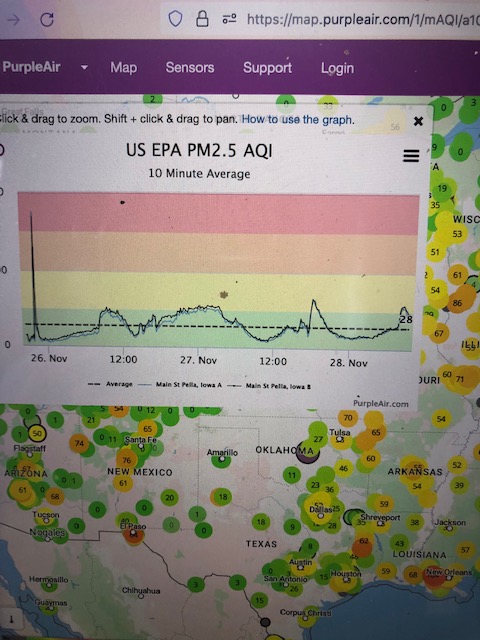
Recently, I got an air particle monitor as a gift. It uses a laser to count the small PM 2.5 particles. I connected it to a sensor network and you can follow the Monitor here.
Here’s what it looks like when displayed:
You can see that currently, Pella’s air pollution isn’t too bad. It was pleasantly low during Thanksgiving week-end. You can see a spike on the left -hand side of the top graph when someone smoked a cigarette near the monitor. Smoking puts out a small, dangerous cloud of particulates—enough to register as hazardous. There are ebbs during quiet times and after the rain shower, followed by rises corresponding to traffic, when neighbors were using leaf blowers, and when smoke from a wood stove or bon fire drifted on the breeze. The thing about pollution, especially air pollution, is that it doesn’t stay put. No doubt you remember from chemistry class that gases have a lot of kinetic energy. They move.
For now, we are in an air pollution lull. It’s early in the week and industries haven’t gotten into full swing. The fields are dormant after harvest. What can we expect in the future? No doubt air pollution will rise this spring.
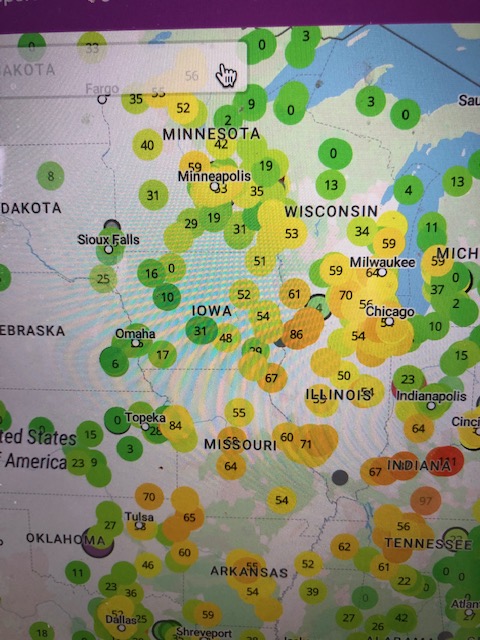
Fertilizer itself is a pollutant, resulting in significant air pollution and particulate emission. Because of its demand for fertilizer, corn is one of the dirtiest, most polluting of crops. Fertilizer manufacturing is in itself polluting.(Note the higher air pollution levels near the Mississippi which is the site of numerous fertilizer plants.) You might be grumbling about the coming winter but for today, go out and enjoy the air.
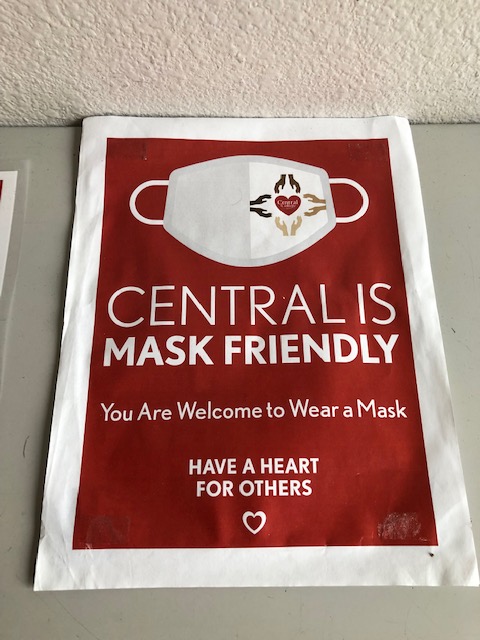
As a scientist, it took me a while to grasp why Iowa’s governor stood fast against mask wearing during a respiratory pandemic. Not only did she and her cohorts not support mask mandates, they banned them and made those who wore them pariahs. The net result was more covid deaths, but even worse than this, the college where I worked supported her. We briefly had a mask mandate, following a student petition, but for the most part, this is what we signaled.
The message was: you can wear a mask if you want, you poor, weak thing instead of stressing the science: masks work to slow the spread of covid by at least 40%. In a place where people sit close and windows won’t open, this would have gone a long way to keeping covid out of the classroom.
It took a while for me to process it was one more academic microaggression—Second Class Citizen status in a place of higher education. There was no need to protect the professors. If you wanted to protect yourself it was up to you to be the outsider. It was also expected that if we got covid, we had to carry on someway somehow.
The response of my college and my state to covid gave me a moral crisis. It’s been widely documented that the Trump administration played down covid and withheld supplies to blue states because he wanted to punish the governors. My son was doing his emergency room residency in Detroit when the pandemic nit. The struggles he had to get supplies and the deaths he saw, especially among public workers and CNA aids, were real. Our family had grown to love Detroit and to read about their helplessness in the face of the Trump administration gave me a deep loathing. Fortunately, assisted by the auto industry and the governor, it fought back. To see my supposedly educated employer somewhat shrugging off the dangers of covid hit me hard. Students even said some coaches told them not to get the vaccine! Ironically, I never got covid in the classroom.
The bottom line is, I retired from a job thought I’d take to the grave with me or at least work at until age 70. As an educator from a family of public school teachers, college administrators, and librarians, being a professor was a familiar fit for me. The stimulation of new ideas, research, and writing was a dream come true.
This isn’t to say there weren’t snakes in the garden, such as the visit from the governor devoid of passion. As a chemistry professor, I became aware of the desire of legislators to both praise, harness, and censor scientists. It quickly became apparent that the powers that rule in Iowa didn’t want our opinions on climate change, pollution, or saving the wetlands. If we couldn’t produce some engineers, preferably conservative in outlook, what good were we?
I was only accused falsely by a student once, thankfully. It had to do with the Vagina Monologues, which my school no longer performs. This was around the time purity culture was rampant. Students even fell victim to the No Dating Movement, a form of benevolent sexism. The student was most certainly pushed to be angry with me by outside forces.
There were a few uncomfortable moments with the staff –unimpressed with the egghead professors–as well. When the science building, of which I was once dubbed the czarina, underwent renovation, I made my request to keep the humidity down in one room. It contained equipment which measured infrared (heat) absorption of molecules. In simple terms, substances can be held together by a plus-minus attraction as found in salt. They can be held together in a restless sea of their outer electronic charge as with metals. Or as with everything from water to oil, they can hold together by sharing their outer coating of electrons in clearly understood patterns. This equipment measured the later. But since the detectors were looking for shared electrons, the optics had to be made of substances in which electrons were not shared in order to make them transparent to what was being measured. Some of this was salt crystals. Predictably, my pleas were ignored, the salt in the instrument took on water, and the equipment needed costly repairs.
My past includes a long list of things I tried to shrug off. Poor ventilation in my office—enough to give OSHA concern. My lab roof leaked. A student had terrible allergies whenever he walked into the room. Years later, a plastic bucket filled with collected rainwater that had been hidden in the ceiling burst with a shower of gunk and mold. I became so afraid the fume hoods would break down, as they were known to do, that I came up with a whole book of labs that didn’t need them. Here’s the thing—I was often chastised for bringing up these valid concerns as if I was a naughty, out of control pest instead of an employee worried about health and safety.
I’ve been given emerita status and can return any time to use the new equipment the college bought after I left. The people who ignored my demands for lab and office quality control have long since retired. Although I’d intended to, I don’t go back. I’m not sure why.
Across the nation, teachers suffer from poor salaries and lack of time for professional development. Want to know a lack of time example? I was grading papers beside her bedside when my mom died! It seemed perfectly normal to both of us.
Meanwhile, our governor has the luxury to pardon turkeys remotely to help stop the spread of disease. Turkeys are more important than teachers and students, who by the way, are spreading flu and RSV, but never mind, mask mandates are banned.
I’m writing this to bear witness. What we had in the way of education—supported and encouraged educators passionate about their subject matter and their students—is eroding faster than an Iowa field. Here in Iowa, few care to do anything about erosion. It’s too darn bad. We had a good thing.