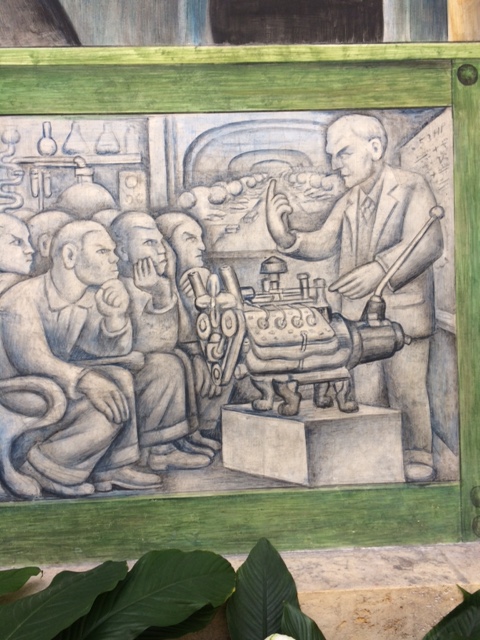
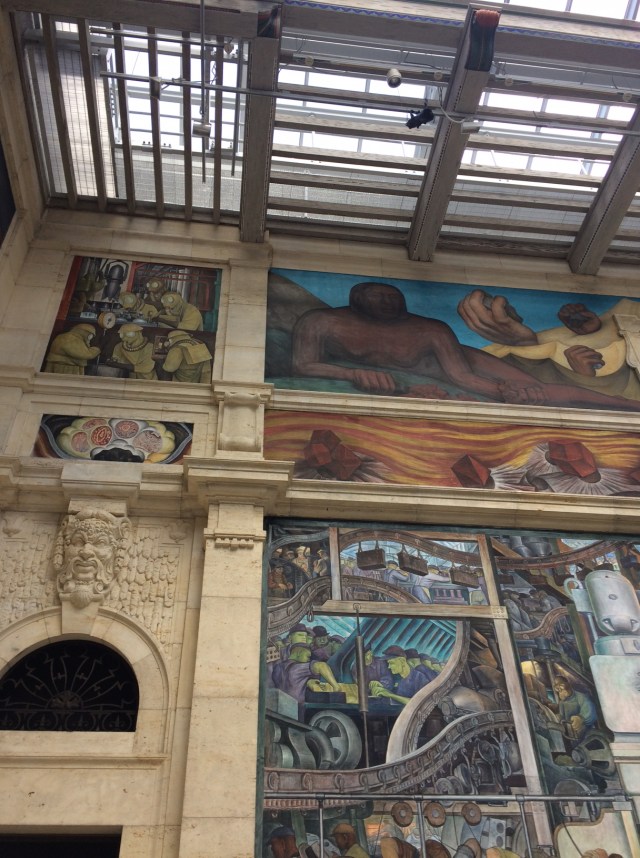
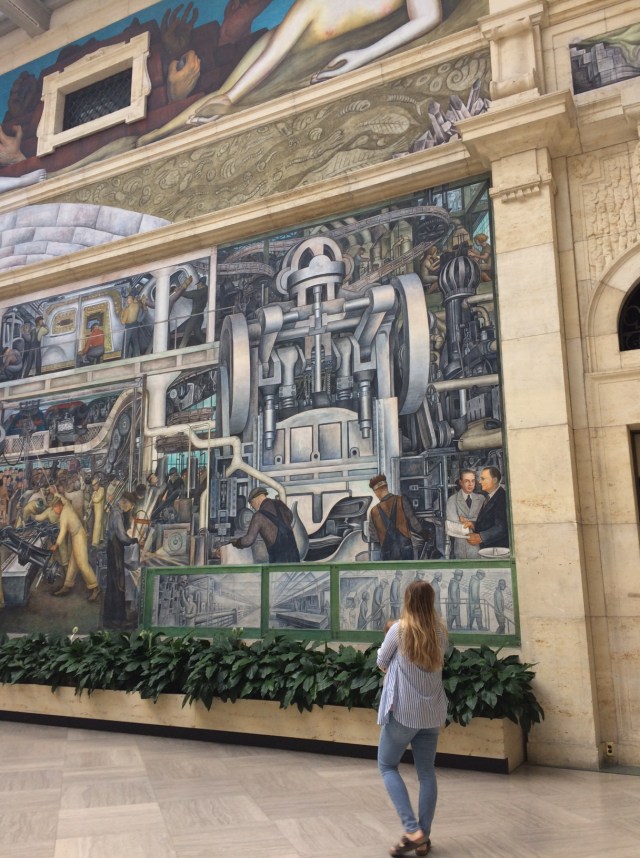
Detroit has too much art for a short visit but I did what I could to take in the visual arts on my trip there. Entranced with the street murals, I headed to the Detroit Institute of Arts to see Diego Rivera’s 1932 masterpiece.
Rivera painted people of all races working together–something that didn’t happen in 1932Characters from cartoons of the 1930s look onwhile boss man tells workers how to do their jobs.Up in the corner, scientists make vaccines while the diversity of Detroit is celebrated in the top center mural.Here it is to scale.
From start to finish, the mural took just nine months to complete. Rivera had assistants but he alone painted all of the people.
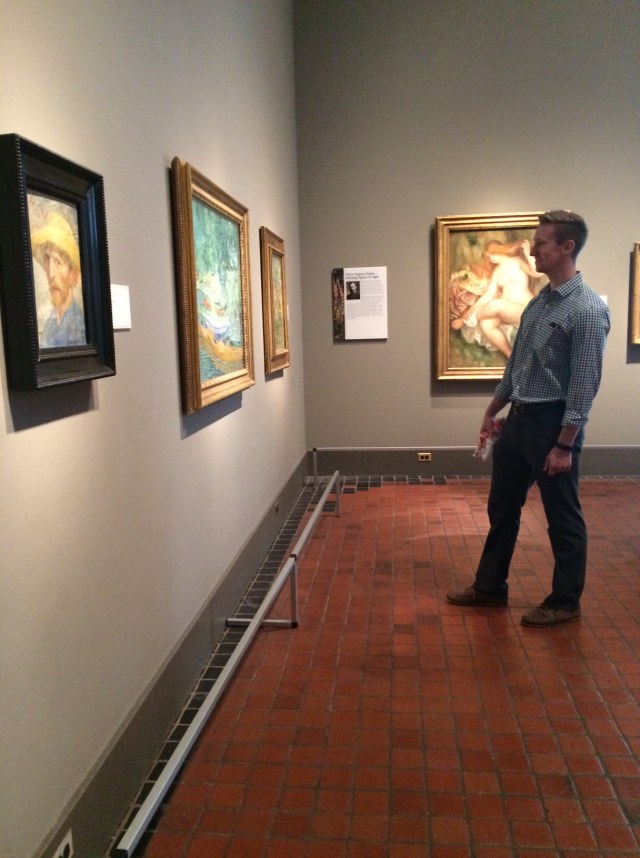
There was a lot more to see at the DIA.
Get up close and personal with the classics.
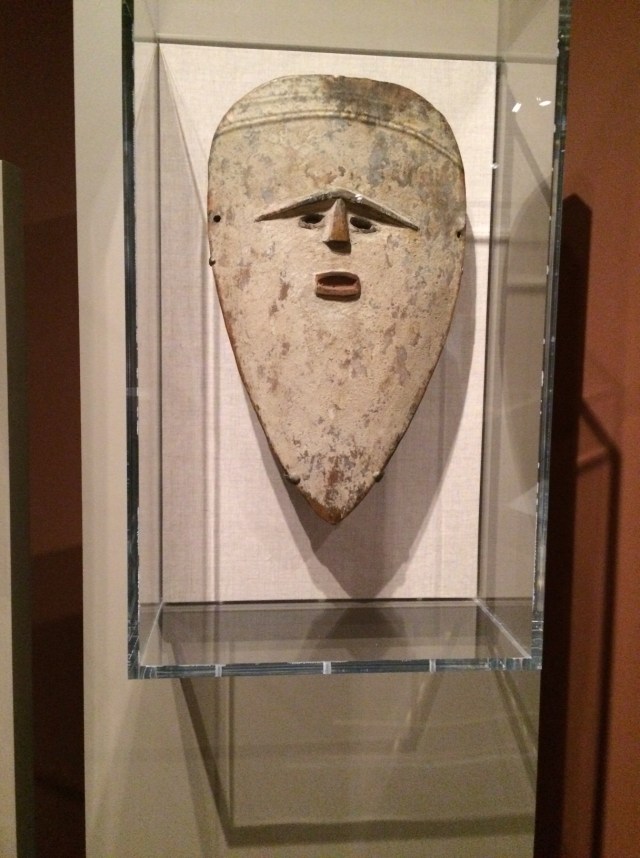
Or maybe you’re interested in traditional African masks This is a death mask, indicated by the color white–associated with death.
I’m getting ready to celebrate my house’s 100th birthday. Here’s what a table setting looked like back then.
Or do you prefer your art more modern?
In contrast, and not too far away from the DIA is the Heidelberg Project, a city block made into street art. Part of the artistic value is the controversy. Is it beautiful? Ugly? Trashy? Transcending? What is it saying about consumerism? Why is it filled with clocks?
The Heidelberg Project is on Heidelberg Street in Detroit.
The artist, Tyree Guyton, said that he’s attempting to create a new reality in his neighborhood AND get people to visit a place that they would be scared to visit otherwise.
If you are curious about Detroit and want to see its art but are scared, here is a crime risk assessment. With the exception of the Heidelberg Project, most tourist areas are in low crime spots. Crime is dropping in Detroit…it’s fallen to the 5th most dangerous city in the US. Use caution. And keep your eyes open–especially for art.
Workers struggle while bosses and the public (including Dick Tracy) look on.)
Rivera painted people of all races working together–something that didn’t happen in 1932
Characters from cartoons of the 1930s look on
While boss man tells workers how to do their jobs…
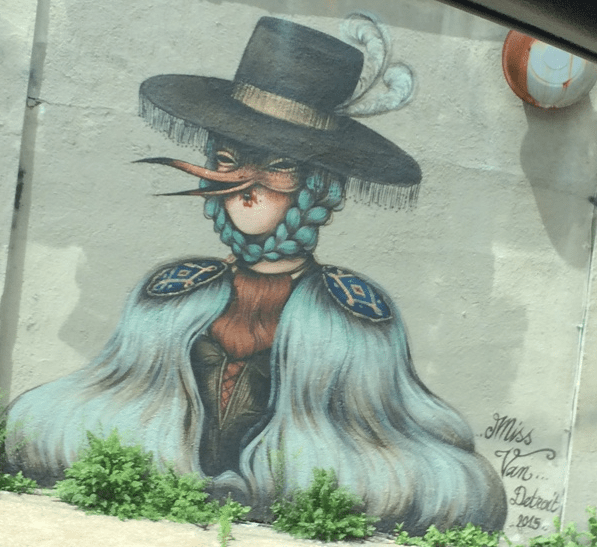
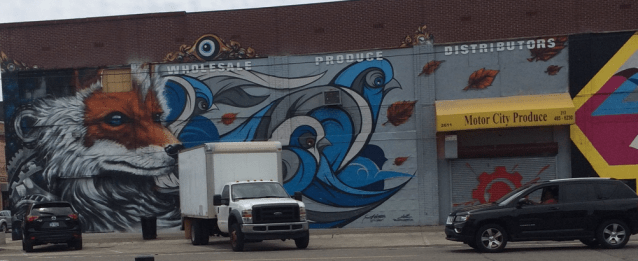
You can also spend a day outside staring at the art–everything from the bizarre to the political and even art from famous artists and street artists. Here’s a guide to more street art. Detroit is the #2 city to visit this year according to the Lonely Planet but in street art, it’s Number 1.
In my next novel, I’ve got characters who are angry. I did some research about anger to help me understand them better. I’ve learned a lot about it, especially from this reference, and I thought I’d share some of it.
Anger is learned behavior. Hostile and angry people are that way because they saw it play out somewhere. They learned that people bully, belittle, and argue with each other and that this gains respect. The hostile environment can be at home but school and the workplace are also places where people learn that anger works.
The true emotions behind anger are frustration, hurt, disappointment, and threat/fear.
Angry people want others to feel the way that they do. If they are hurt, they want others to hurt, if they are ashamed, they want others to be ashamed.
The average adult will be angry once a day.
People who use emotion rather than logic to guide their reasoning tend to be more angry. Emotional reasoning can lead people to misunderstand social cues.
Stress causes low frustration levels and can make the stressed out person see threats that don’t exist or have unreasonable expectations.
Labeling and derogatory perceptions of other groups of people —people rating–causes anger. If we look at the recent mass killers in the US most are misogynists and supremacists.
Physical pain, drugs, and alcohol can exacerbate anger and frustration. Even a spate of minor irritations can build up and cause anger.
Anger is not always bad. It can be motivating if used as a positive catalyst for change.
Physically, anger causes a release of both glucose and stress hormones. It creates strain on the heart and pancreas. Eventually it will affect the brain, creating a hyperactive amygdala (the seat of fear in the brain) and dampening reaction in the prefrontal cortex (the part of the brain that controls reasoning and social behavior.)
Anger can be dealt with easily by most individuals. The amygdala quickly returns to normal. Crying can help bring the brain back to normal.
Ironically, people who are taught to suppress emotions such as sorrow are more likely to became angry or depressed (the passive form of anger.) Boys who have been shamed for showing pain or sorrow often find that anger is the only socially acceptable emotion they have.
Type A people are often rewarded for their drive and determination. They can give others the impression that they are best able to respond to threats. They are more likely to be angry and focus on the weaknesses of others and in turn, make themselves sick.Angry people are more likely to have colds, skin problems, and arthritis. Being Type A is hard on the immune system. The stress of anger causes other problems such as weight gain, ulcers and acid reflux.
Since anger produces cortisol, angry people suffer from hormone imbalances and the result can be thyroid problems and decreased bone density.
Angry people are poor communicators and even worse listeners. They are often impatient and in a hurry.
One reason I enjoy writing science fiction is because it is at its best, social satire. It’s both serious and campy, insightful and strange. It is by nature, multidisciplinary, wrought with nuance and language subtleties that make it unpalatable for some readers and catnip for others.
Author David Ketterer says “Science fiction (in the inclusive sense) combines satire with the kind of visionary (or prophetic) imagination exemplified by Dante’s Divine Comedy or Milton’s Paradise Lost. ..”
If you look at the history of science fiction, you can see prime examples of social satire. Ray Bradbury, who wrote during the era of segregation said that much of his work is about oppression and racism. The word robot derives from the Czech word for slave so often in science fiction, you can assume that a robot represents an individual who has low social status and is oppressed, like Wall E. The term was first coined in a play, R.U.R. In this campy melodrama, the robots finally accomplish a rebellion against their tormentors.
Likewise, an encounter with an alien or “other” may be a subtle comment about racism, classism, or sexism, often accompanied by an anti-colonialism sentiment. One of my favorite classical examples is First Men in the Moon by H.G. Wells in which a scientist and a businessman have competing ideas about studying the moon vs conquering it.
James Gunn argues that science fiction has its own set of protocols set apart from literary fiction. Like science itself, it is a genre in which characters encounter the unknown, solve problems, and create understandable universes. He describes it as “the literature of the human species encountering change.”
Margaret Atwood calls Science Fiction “Social Commentary about Now. ” She doesn’t write a novel without a modern detail hidden in the story line. An older woman, she warns what life was like, and could be like, if women aren’t allowed to control their own bodies, as happened in the past.
Since science fiction is mainly about today’s society, a person doesn’t need to be a scientist to write science fiction. Some scientists avoid it because they dislike the anxiety about science that is often found on the pages. However, the science must be plausible and based on scientific information or the story won’t have authority. To paraphrase the late author and biochemist Isaac Asimov, science fiction needs to make brains respectable.
One way that an author can gain credibility is to accurately name chemical substances. For example, vibranium, found in Wakanda, carries the Latin noun ending -ium which became common for elements in the Victorian era when many elements were discovered and named. Despite a lot of well-known memes, keep in mind that scientists are most often drawn to science because they want to help people To create fresh, realistic characters, here are some traits that scientists feel help define them.
Through its discoveries and ways of looking at the world, science creates change that society adapts to. This is why we have science in science fiction–to create strange new change.The most important parts of science fiction are people and change, and in the best cases, satire based on today.
There is no Beauty without Strangeness (Detroit mural)
I’m excited that Mixed In has been nominated for a Rone Award in the category of Science Fiction and Time Travel. The first stage of this award is reader voting followed by judging. I’d love to be judged but to get there, I need some votes. If you are so motivated, please vote for me by following this link.
If you haven’t yet registered, you’ll need to do so. Then you’ll get information and reviews about small and independently published books from Ind’ Tale Magazine. I’ve found publishing with a small press to be satisfying–although not lucrative. If you want the big bucks, get an agent and hold out for a big publishing house. If you want to be happy, small press might be for you. I enjoy my interactions with small press editors. They are nice, helpful, and keep current with publishing rends. Why don’t I self publish? I can’t go it alone. I need editors and proof readers to help me. Before I even submit a novel for consideration, I hire a beta reader and then a proof-reader/copy editor. In my case, the more comments I get the better.
Mixed In is a milieu novel with an agricultural theme. It’s a little naughty. If that’s for you, please lend me your vote and sign up for the Ind’Tale newsletter.
Spring is here at last in the Northern Hemisphere and no doubt you’ve had the chance to enjoy the early morning bird songs. The Dawn Chorus, as it is called, usually begins about 40 minutes before sunrise.
Why do birds sing in the early morning? There are several theories. One is that the songs carry better in the early morning and birds sing to advertise that they made it through the night and are therefore good mates and formidable foes. Early rising birds have better relationships with their mates than sleepy birds of the same species so maybe there is some truth to this.
Another idea is that it is too dark to look for food so singing is a great way to pass the time. Birds with bigger eyes and those who perch higher up in trees tend to sing first.
Gaining popularity is the theory that birds sing when other things are quiet. In places where there are noisy morning insects, birds sing before the insects start making noise. It’s thought that urban birds like to sing before the city gets noisy. Daylight plays a role in telling birds when to sing. It stimulates testosterone in the birds and brings on mating season.
It was first thought that birds sang haphazardly but in the 1940s, conservationist Aldo Leopold noticed that there was a pattern to their singing with a distinct order of birds joining the chorus, prompted by the amount of daylight. What birds are you most likely to hear in the morning? Starting things off in Iowa is the robin, the traditional early bird who gets the worm. Cardinals follow soon after. In the Pella area, field sparrows, indigo buntings, eastern wood pewees, black-capped chickadees, tufted titmice, and house wrens are common members of the dawn chorus. In Leopold’s audio recording, the Wisconsin birds appear in this order: American Robin (first heard at 1 seconds) 2. Field Sparrow (28s) 3. Indigo Bunting (70s) 4. Eastern Wood-Pewee (100s) 5. Song Sparrow (130s) 6. Gray Catbird (150s) 7. Eastern Bluebird (170s) 8. Great Crested Flycatcher (181s) 9. Northern Cardinal (200s) 10. Wood Thrush (207s) 11. Mourning Dove (214s) 12. Ring-necked Pheasant (223s) 13. Eastern Meadowlark (230s) 14. Brown Thrasher (251s) 15. Warbling Vireo (270s) 16. House Wren (280s) 17. Blue Jay (290s)
There are two categories of singing birds. Oscine or true Song Birds must learn to sing from other males. It can take up to a year for a bird to come into his voice. Here is an example of a male sparrow learning to sing. This type of bird usually is monogamous and has to work hard to attract and keep a mate. They perch on high branches to advertise and have regional dialects. In some cases, such as the cardinal, both males and females sing. Suboscine birds are more common in South America but include flycatchers here in North America. These birds instinctively know how to sing.
I forgot to set my alarm last night and am grateful for the loud robin who woke me up this morning. Birdsong is both relaxing and mentally stimulating. It’s the right mix of repetitiveness and jazz. It doesn’t get annoyingly stuck in your mind nor is it chaotic noise. It’s even being used to treat depression and anxiety. It’s a wild love song and who can argue with the joy of that? I’m opening my windows and letting it pour in.
When teaching science fiction, I, and many others, use the MICE quotient to help my students focus on the type of story they are creating. Once an author knows what type of story they have, it’s easier to craft it into something that their readers will enjoy and appreciate. All stories are a blend of all of these categories. The question is, what letter dominates.
The MICE quotient was popularized by Orson Scott Card. Briefly, MICE is an acronym for these common categories of science fiction:
Milieu. The milieu novel focuses on a place and community. Most often, society itself is the antagonist. A stranger comes to town and is transformed by being in this milieu. The Wizard of Oz and Gulliver’s Travels are classic examples. The tale begins when the stranger comes to the place and ends when she leaves. Mixed In is clearly such a novel. Without the dreary world of Cochtonville, none of the events would have taken place. All good science fiction has more than aliens and robots. It has metaphorical implications. That is, it says something about society and this is clearly evident in any milieu novel. The metaphorical implication of Mixed In is that the Midwest could become Cochtonville. In fact, it’s inched closer to the dystopia since the novel was written. Sometimes I worry I am living in my own Milieu.
Idea. The idea story is based on a question and ends when it is answered, as in a mystery novel. It begins when the mystery is introduced and ends when it is solved. Wolves and Deer: A Tale Based on Fact is an idea novel, beginning when Grace Clare learns of the death of Dora Jordan and ending close to when the mystery is solved.
Character novels are often the stuff of both high literature and romance. They start with a character with a clear problem and desire and end when the character is transformed for better or worse or accepts her fate for better or worse. An example of a character novel is The Color Purple or in the case of science fiction, Frankenstein. Natural Attraction is a character driven novel moved forward by Clementine’s desire to be taken seriously as a scientist.
Event stories are based on an interruption to a normal way of life and follow what happens as characters try to bring life back in order. A classic example is The Lord of the Rings series which begin when Bilbo discovers the ring and ends when order is restored. Most science fiction and fantasy stories are event based and my next novel will be such a novel. Then I will have a quartet of books each representing one letter of the MICE quotient.
Do you have a favorite letter in the MICE quotient? Every novel I write has a huge dose of place and time in it so perhaps I lean towards the M.
I’m excited to say that Mixed In is in contention for a Rone Award for Science Fiction. If you’re looking for a Milieu novel with a touch of romance, a dash of absurdity, and a pinch of naughtiness, check out Mixed In.
The challenge to writing a novel set in the past is that the past disappears. In London of 1832, the setting for Wolves and Deer: A Take Based on Fact, today’s familiar landmarks were not yet in place including the Houses of Parliament and Big Ben. There were no steel framed buildings. Making steel required hand stirring until 1856 and the British were slow to incorporate the material into their structures even after the Bessemer Process was developed (in England ironically). Buildings were wood frame and flammable and flames took Dora’s Drury Lane Theater in 1809. It was rebuilt shortly before her death and can be found in Covent Garden (see below)
I can’t say that I learned much more about Dora Jordan during my recent visit to London although I enjoyed visiting such a vibrant and cohesive city.
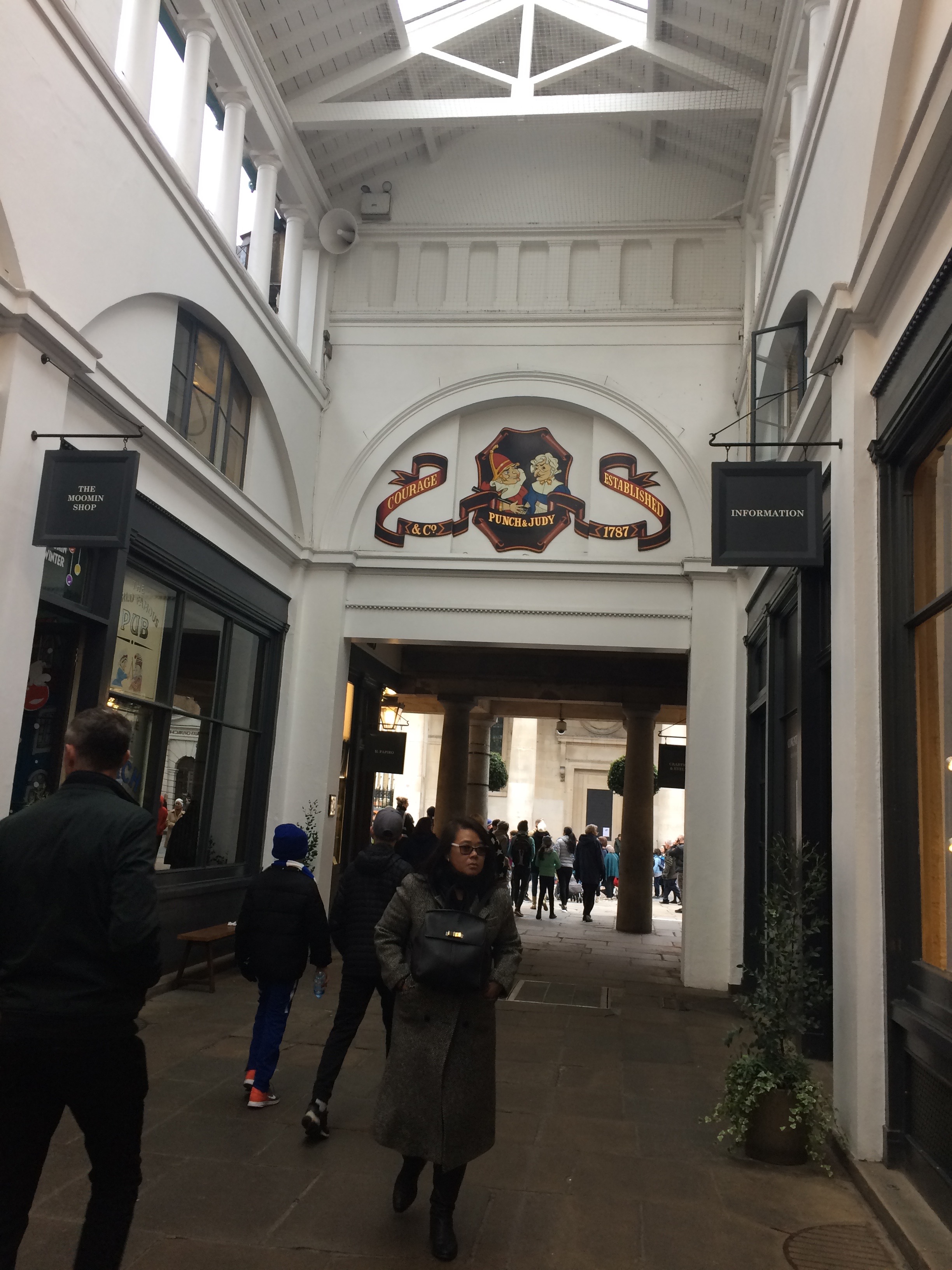
Covent Gardens
A bust market place and theater district
Walking around London, I imagined the places Dora Jordan and my protagonist in Wolves and Deer: A Tale Based on fact, Grace Clare, had been.
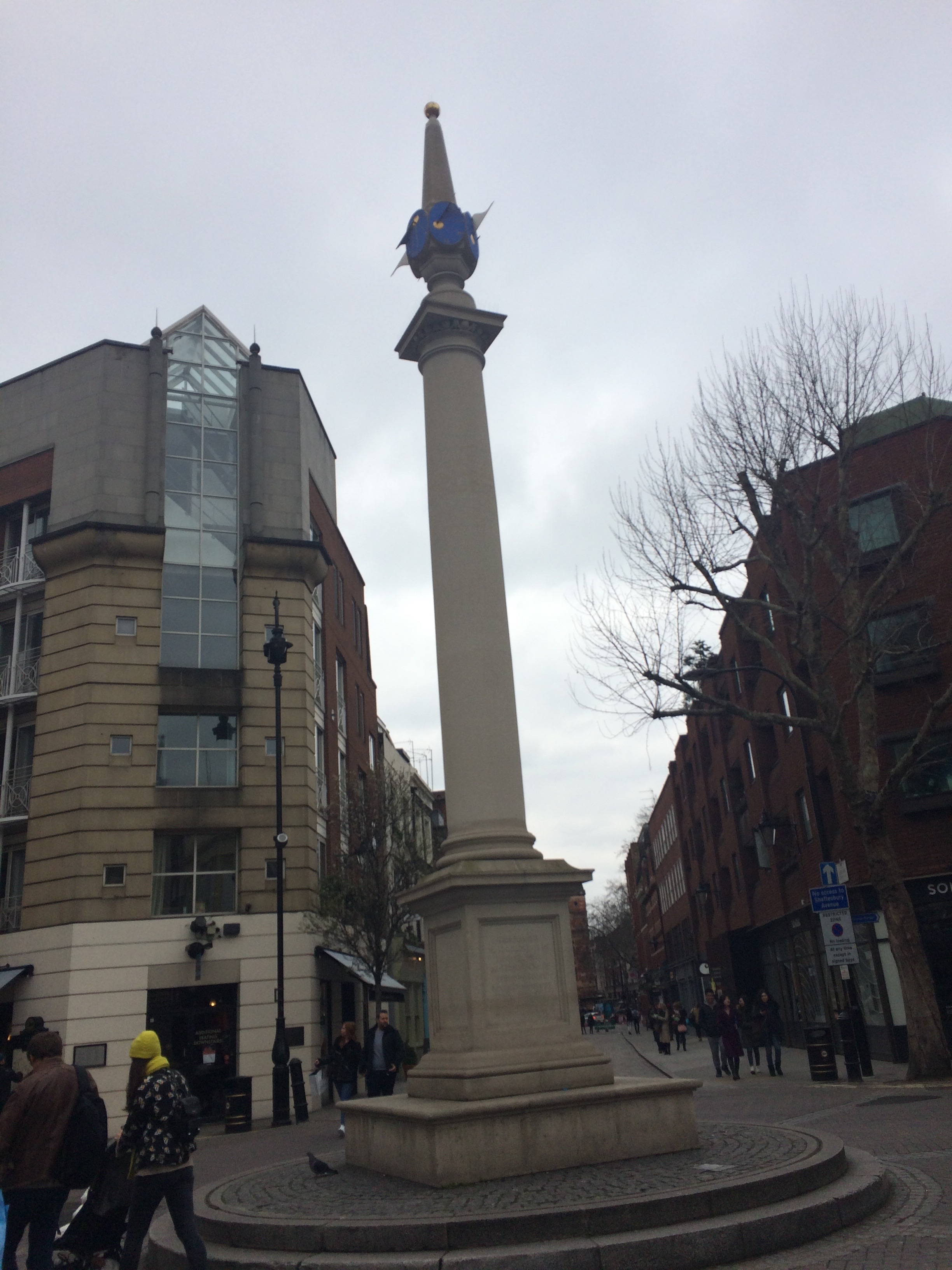
Seven Dials in Covent Garden has been vandalized and rebuilt at least once.
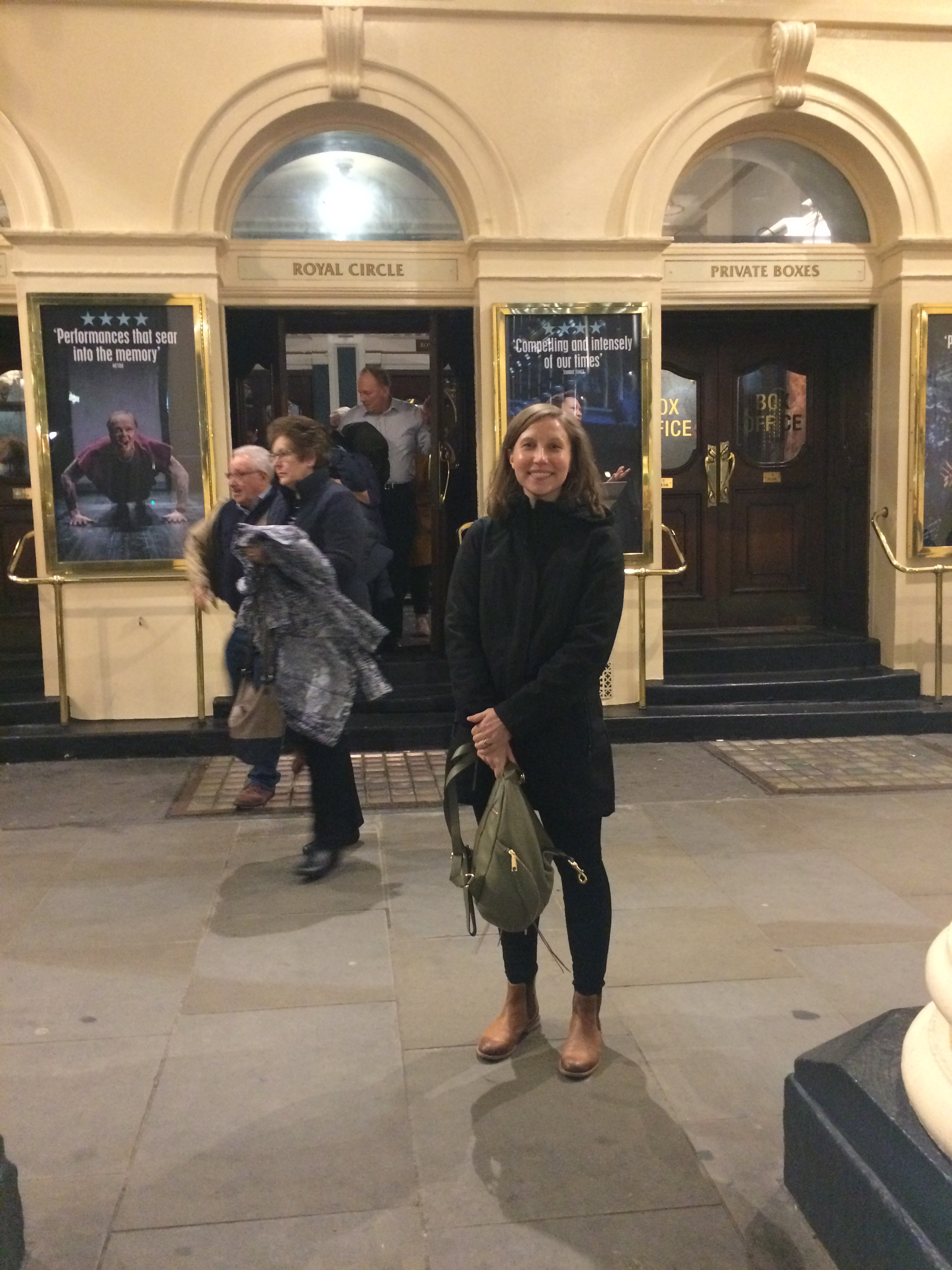
Theater Royal Haymarket was standing during Dora’s day and she played here.
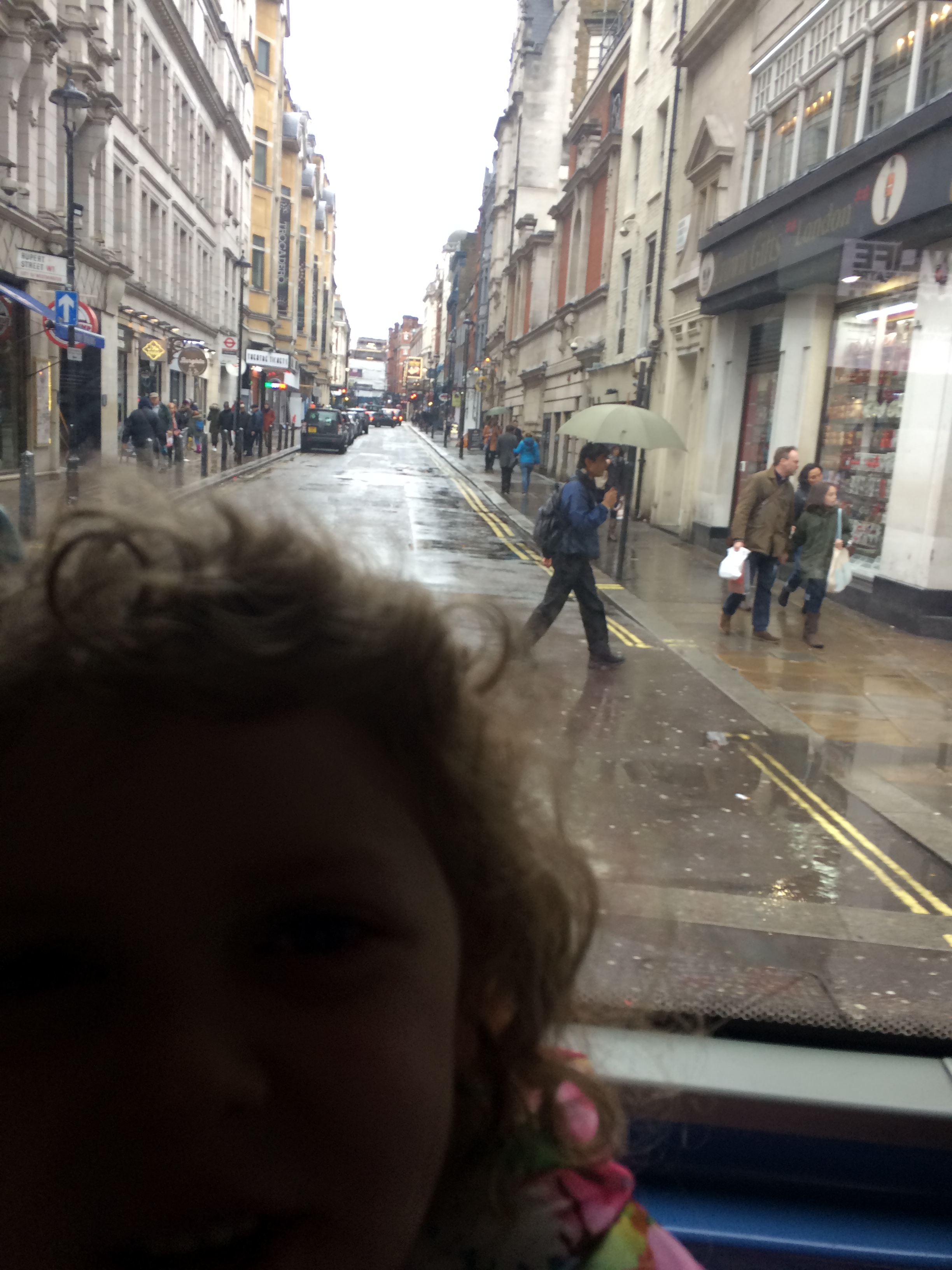
A street such as this one and a child’s “photobombing” head would have been a familiar sight to Dora.
What did I learn about William IV during my trip? I came to understand how little he got from being King. Most notably, as King, he had a marble statue of Dora commissioned and it’s now in Buckingham palace. Where’s is his statue? There isn’t one. He is remembered for the Fourth Plinth, a pillar in Trafalgar Square with no permanent statue because, the story goes, he left no money for one. The only trace of William I saw was this plinth with its temporary sculpture during a bus tour and the tour guide was quick to mention his lack of funds. Didn’t get a photo but this was there.
He comes up lacking at the Tower of London as well. Among the Crown Jewels and regalia only the Queen consort’s ring 1831 ( no names attached) was displayed. This was a gift to Queen Adelaide, the one woman who was unfortunate enough to marry him when he was at an advanced age, had ten other children, and was acting erratically. Together, the pair wasn’t able to produce an heir. Victoria was their niece. William ruled for seven years. He’s is known for his support of slavery which was abolished during his reign and opposition to reform (before reform, parliament members were representing districts with no people in them) which was accepted during his reign. He became King through a series of unfortunate events, left the mother of his numerous children in a bind, and produced no heirs. Additionally, he carefully saved Dora’s letters to him, yet had his own correspondence burned. His legacy is an empty base for a statue and that’s about it.
Wolves and Deer is the story of Grace Clare seeking answers about the death of Dora Jordan.What really happened? Who is to blame? Should she seek vengeance? And most importantly, how much power should our rulers have over us?
London is for children. People there are friendly and accommodating to kids.
Here are the places we visited:
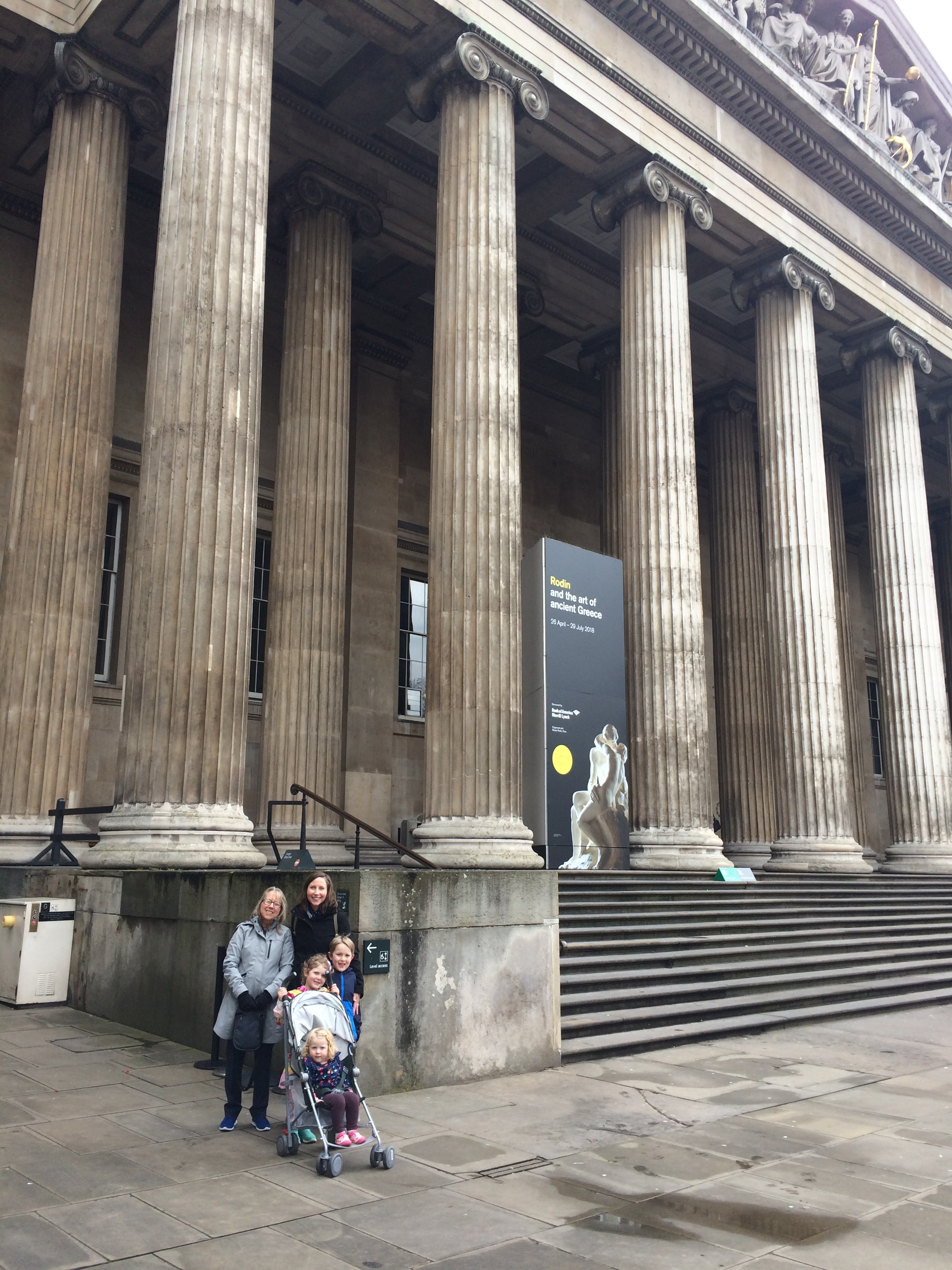
The BritishMuseum houses collections of artifacts, some of which were collected and donated and others were looted from fallen empires by the British Empire. This was one of the favorite stops for the older kids.The baby rode happily in the stroller during the visit and there was a special line for parents and kids that kept the wait to get in short.
A treasure trove of artifacts from many civilizations awaits.
Our own stuff and things we stole from other empires on display.
If you are looking for a stop to get toys, consider Harrods and Hamleys. Harrods is a little tricky because you need to walk by breakable exhibits to get to the toys but it’s right by the food court so you can add a stop and get braffles if you need something. However, be aware that your kids will want things that they can get in the US such as Legos, Beanie Boos, Barbies, and Sylvanian families. The selection at Hamley’s is extensive. Leave room in your suitcase.
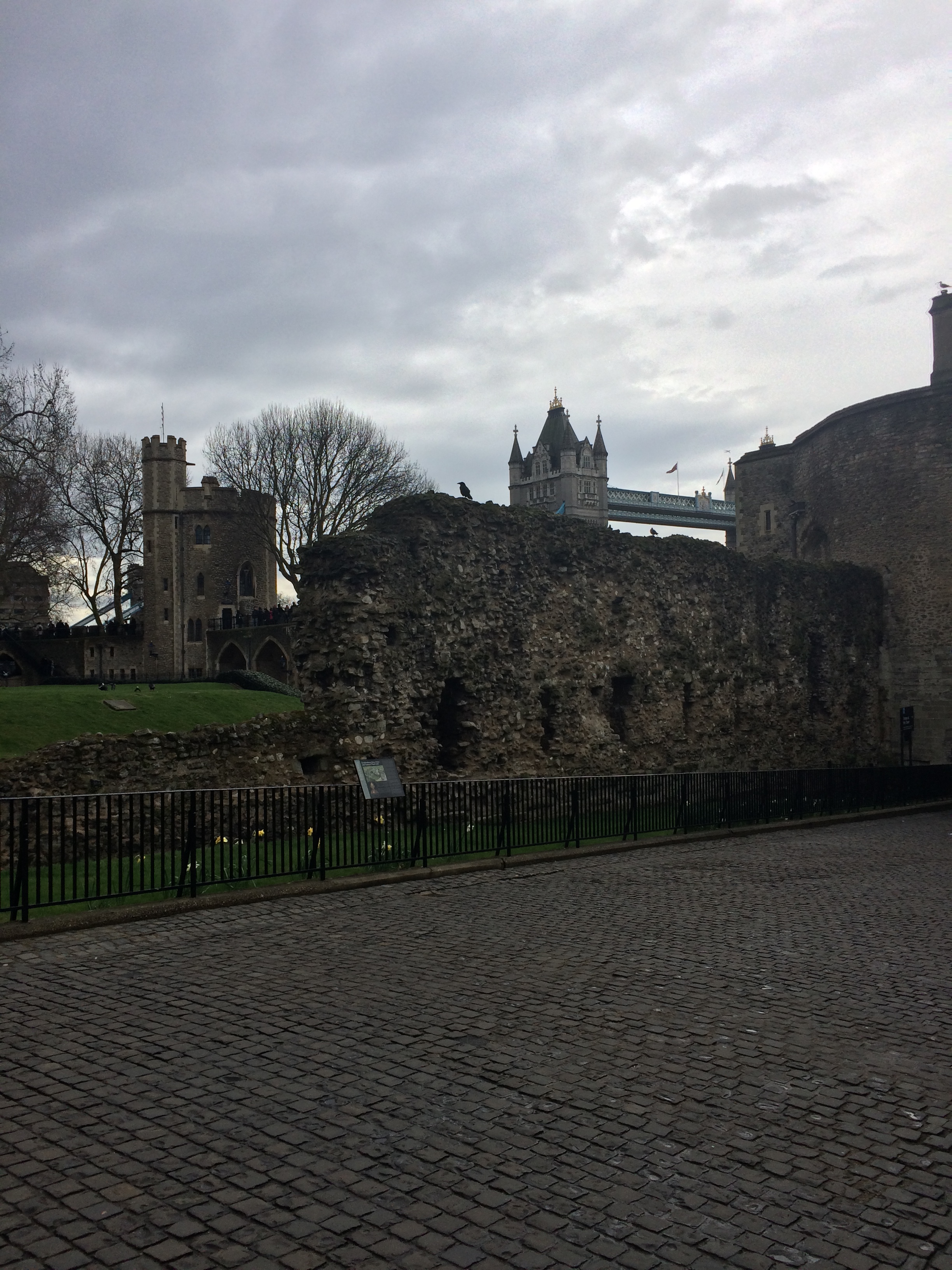
The Tower of London comes complete with characters dressed in Period Costumes.
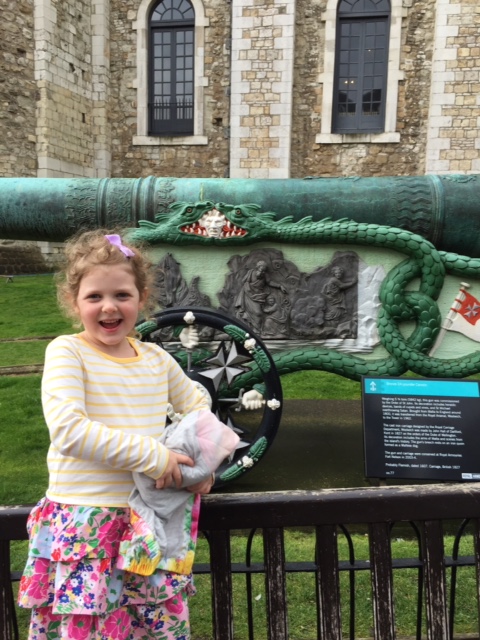
The kids found the cannon display interesting.
However, the kids were most impressed with the Crown Jewels exhibit. They ran about while Dad stood patiently in line until we could get a glimpse of but not photograph the Royal regalia.
Ravens protect the Tower.
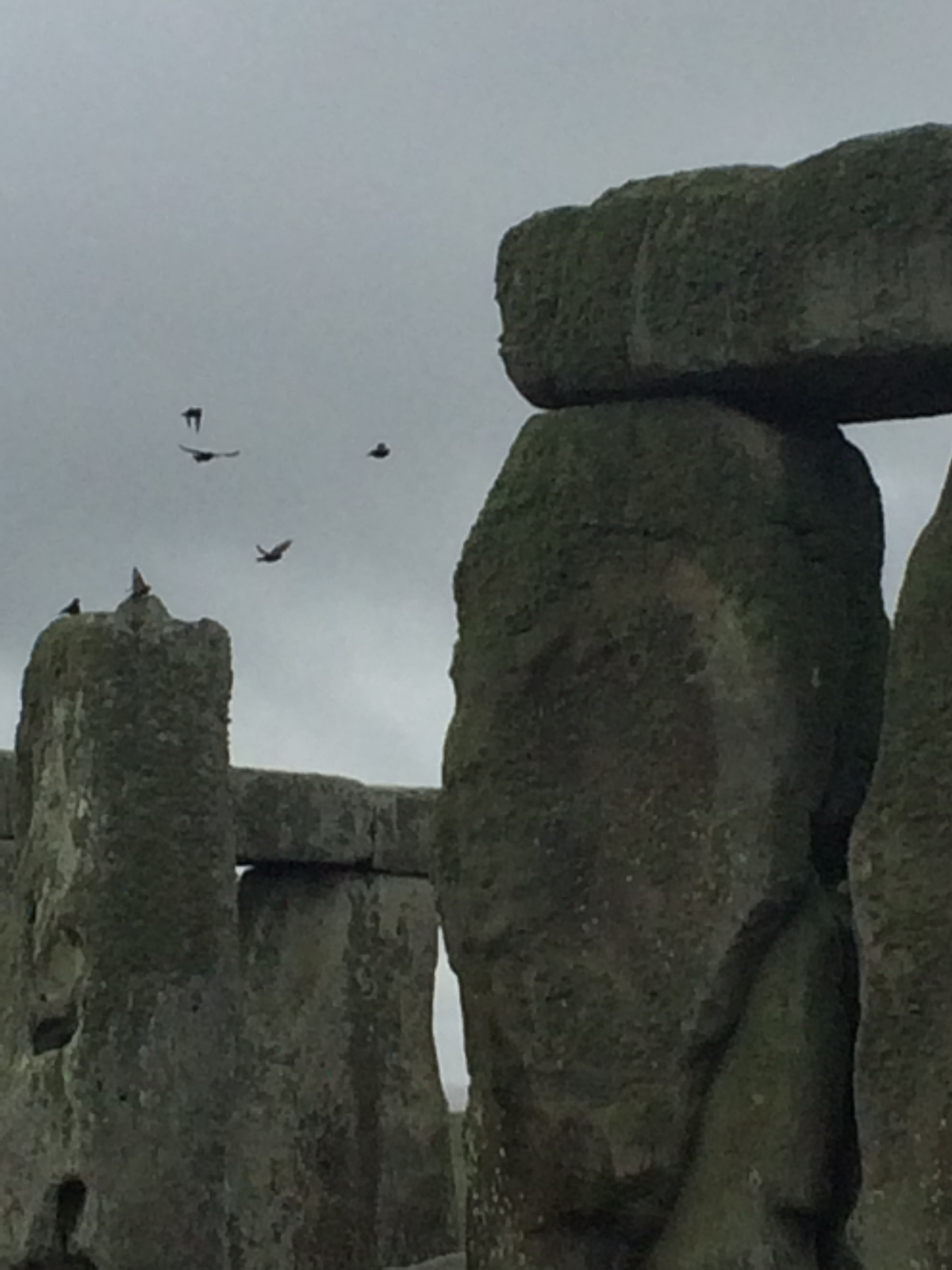
Stonehenge
Going to Stonehenge doesn’t only allow you to see a mystical ancient ruin, it gets you out into the countryside of England. Our guide explained to us that it’s not the only stone circle in England but is an easy drive from London and near other attractions so it’s the one that the British government has elevated into a tourist attraction. The two hour car ride passed easily, thanks in part to iPads and Gameboys, The kids loved running free once we got there (it takes an additional short bus ride from the parking area.) It’s cold and windy out on that plain and our guide brought extra hats, scarves, and mittens. If you need, there are souvenir hats and sweatshirts etc available in the gift store. There is also a small museum with other artifacts. Is it worth it to ride all the way out there to see this one thing? Yes, of course!
Then be sure to go on and visit somewhere else–Bath or Salisbury are popular destinations. We chose Salisbury and it wasn’t at all crowded, perhaps because of the season or the recent poisoning incident.
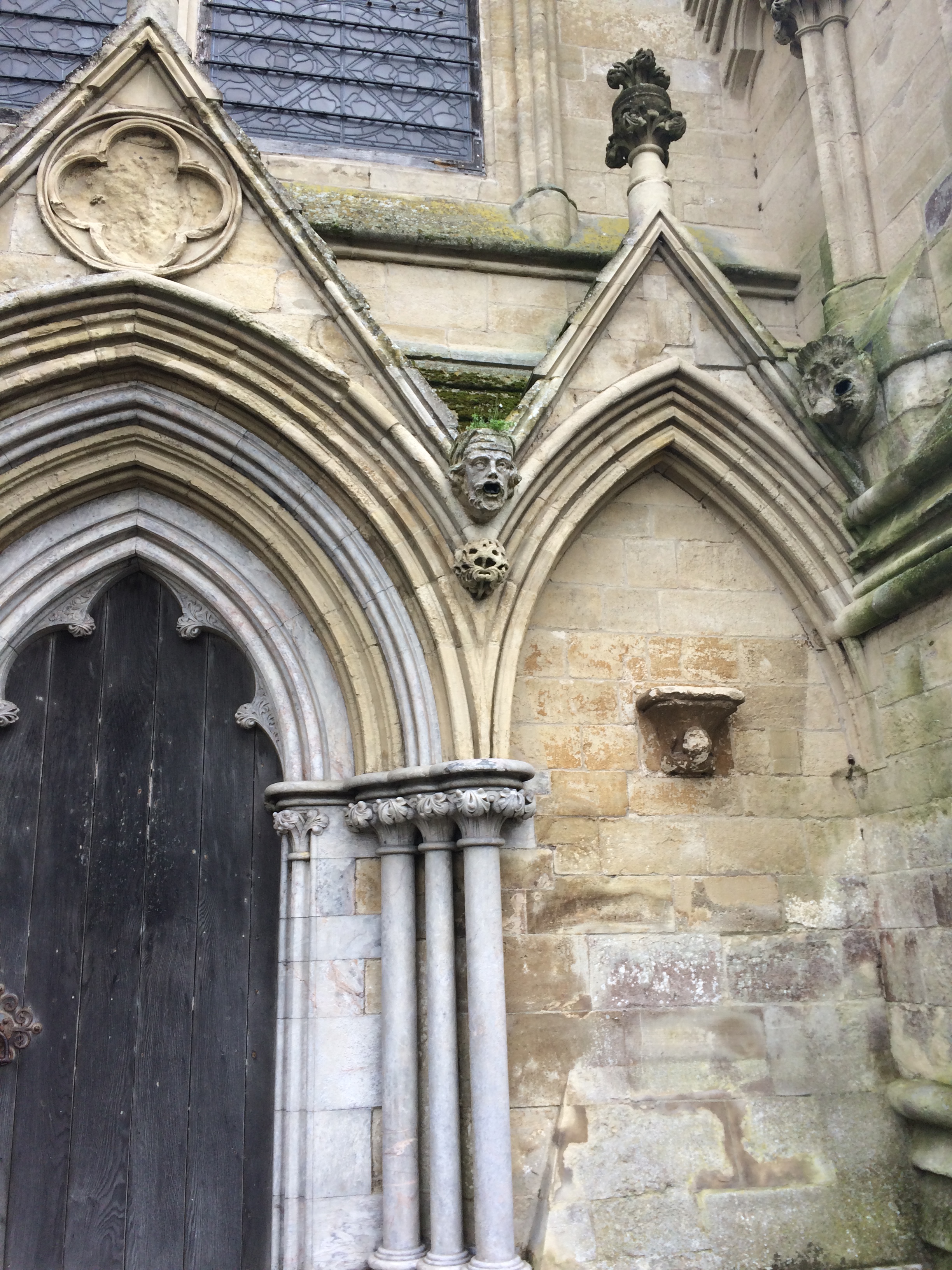
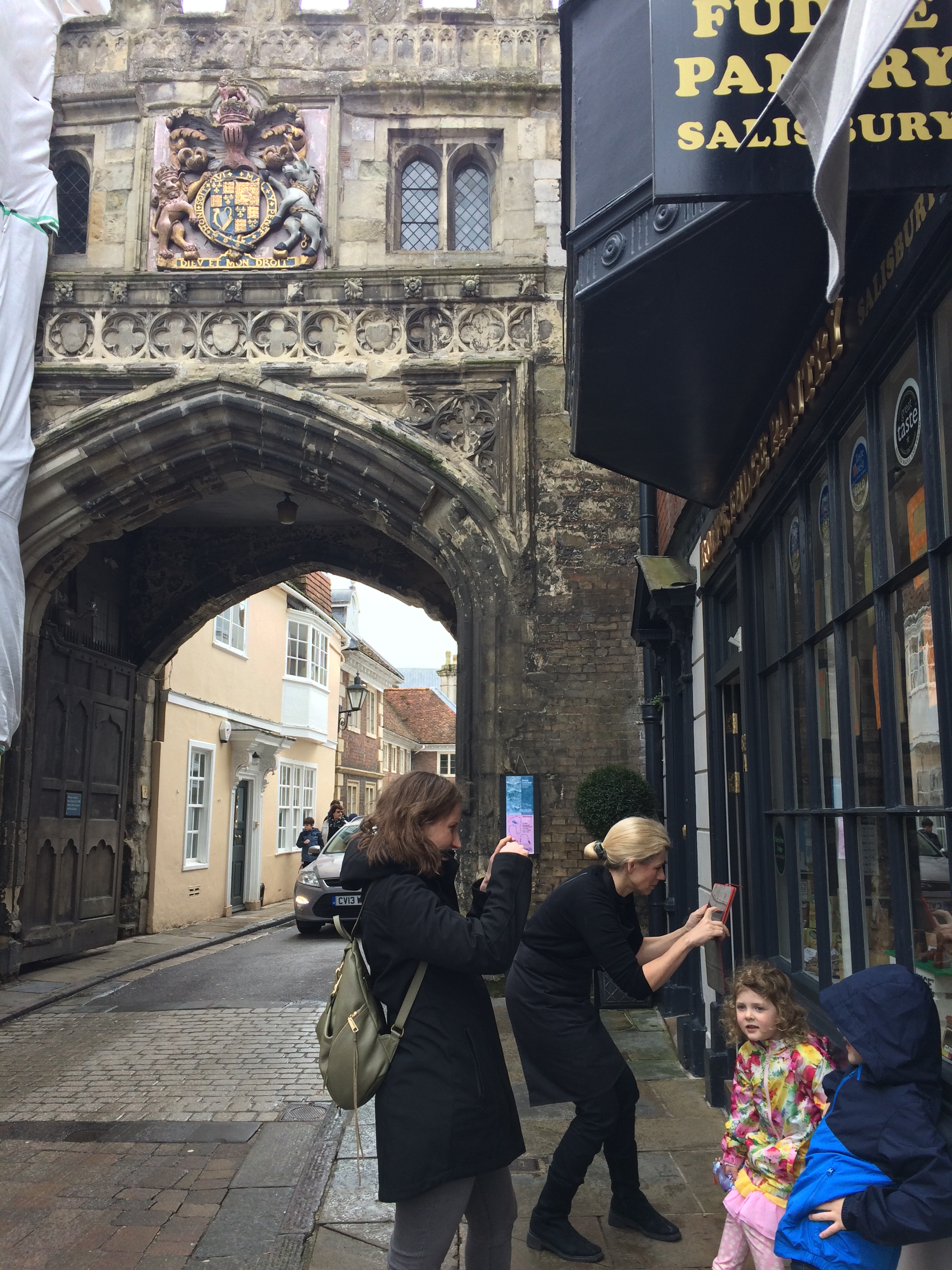
Salisbury is the site of a cathedral, moved there from Sarum in 1220. The most intact copy of the Magna Carta resides there, although you can’t photograph it. (You can buy a copy at the gift store.)
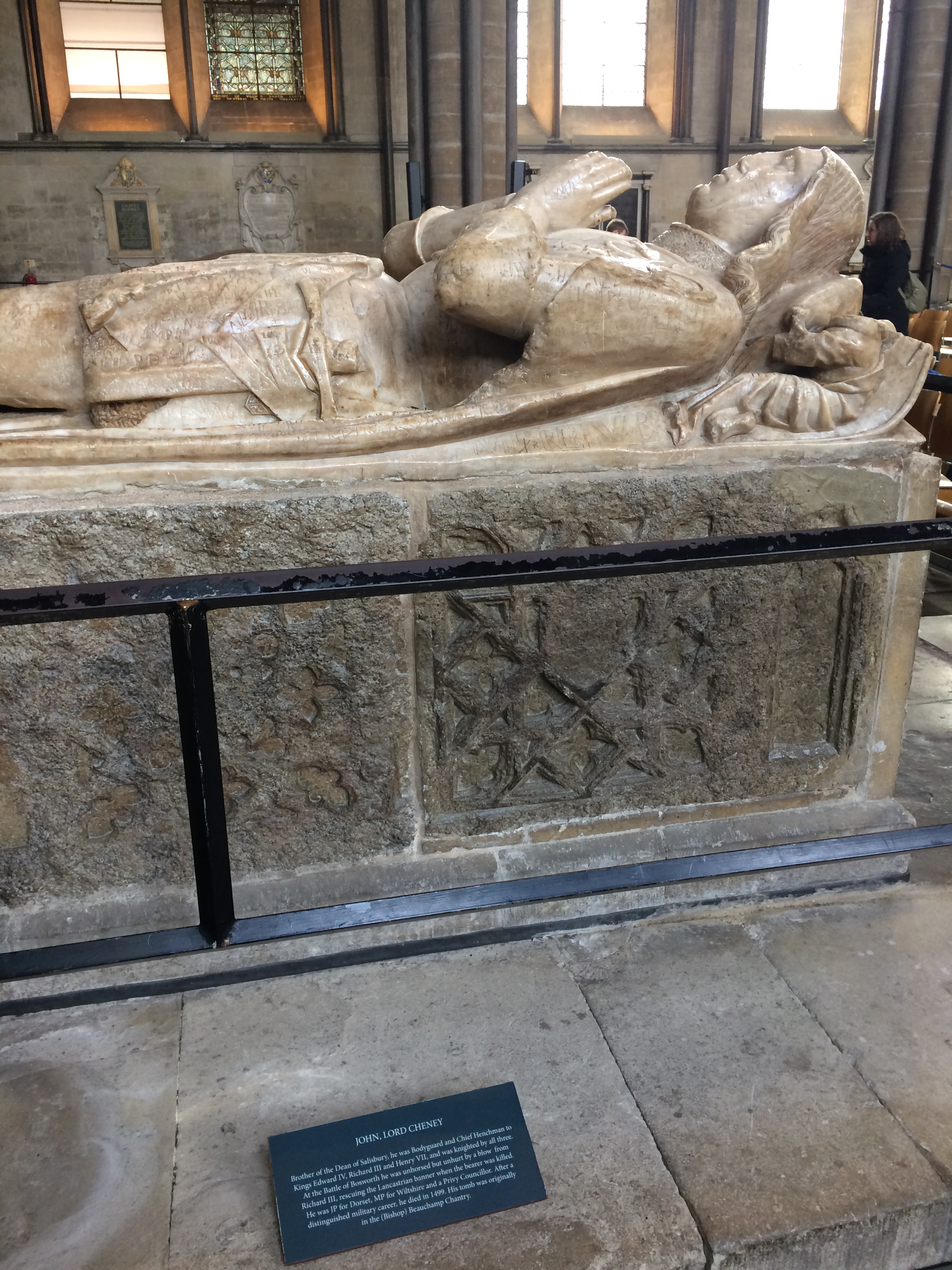
Who says being a henchman is a lowly job? This one got a fine tomb!
Such a pretty Medieval town. What are people taking a photo of?
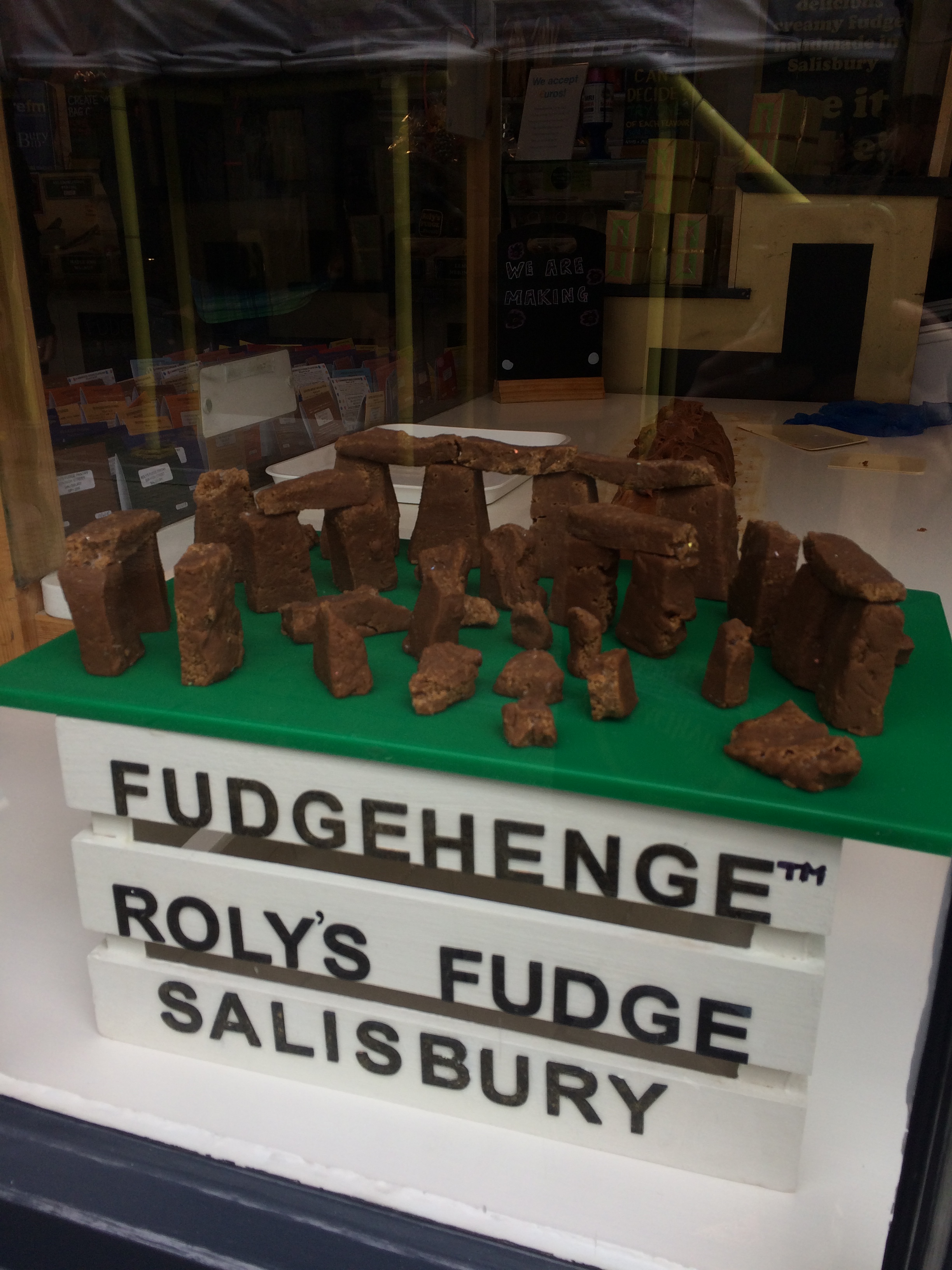
It’s Fudgehenge!
It was a short hop from Salisbury to Old Sarum in Wiltshire. William the Conqueror built a castle there in 1070 and my kids claim his ancestry so off to see the old homestead. It had a few precarious spots but the children loved running about.
A note on kids and gift shops: What is a tourist attraction without a tourist trap? I’d budget about 5 pounds per kid per tourist stop.
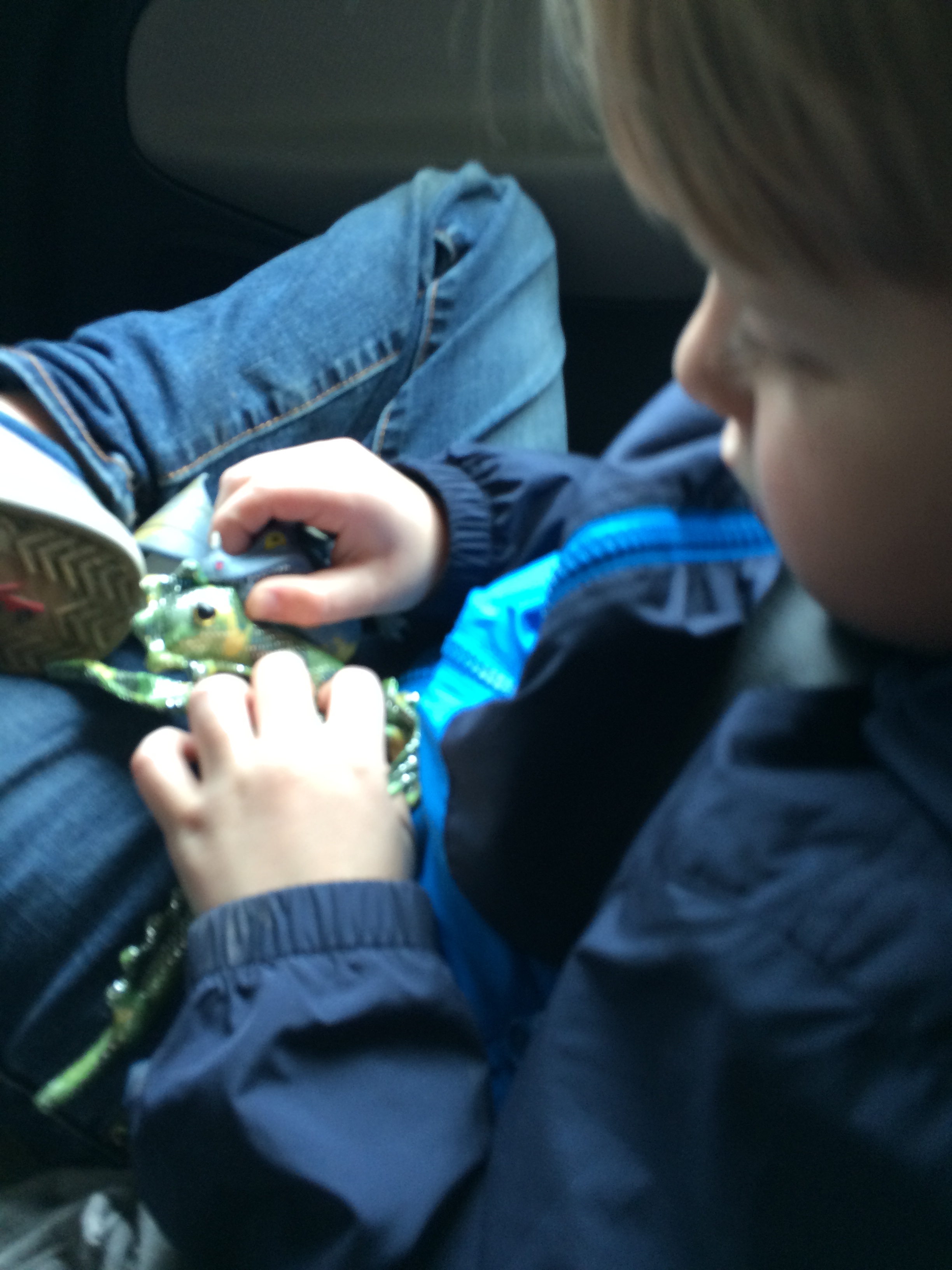
Not one dragon but two–that’s what happens when your granny comes along.
When in London, be sure to take in:
A theater production. There are shows for kids and shows for adults. My daughter and I went to a show together and left the kids behind with Dad, giving her a break from motherhood for just one night.
Theater Royal Haymarket.
Piccadilly Circus in the Theater District
There is nothing like live theater and coming out onto Piccadilly with so many happy people was amazing. The tube was packed so we walked back to our hotel on the crowded main streets. A night to remember!
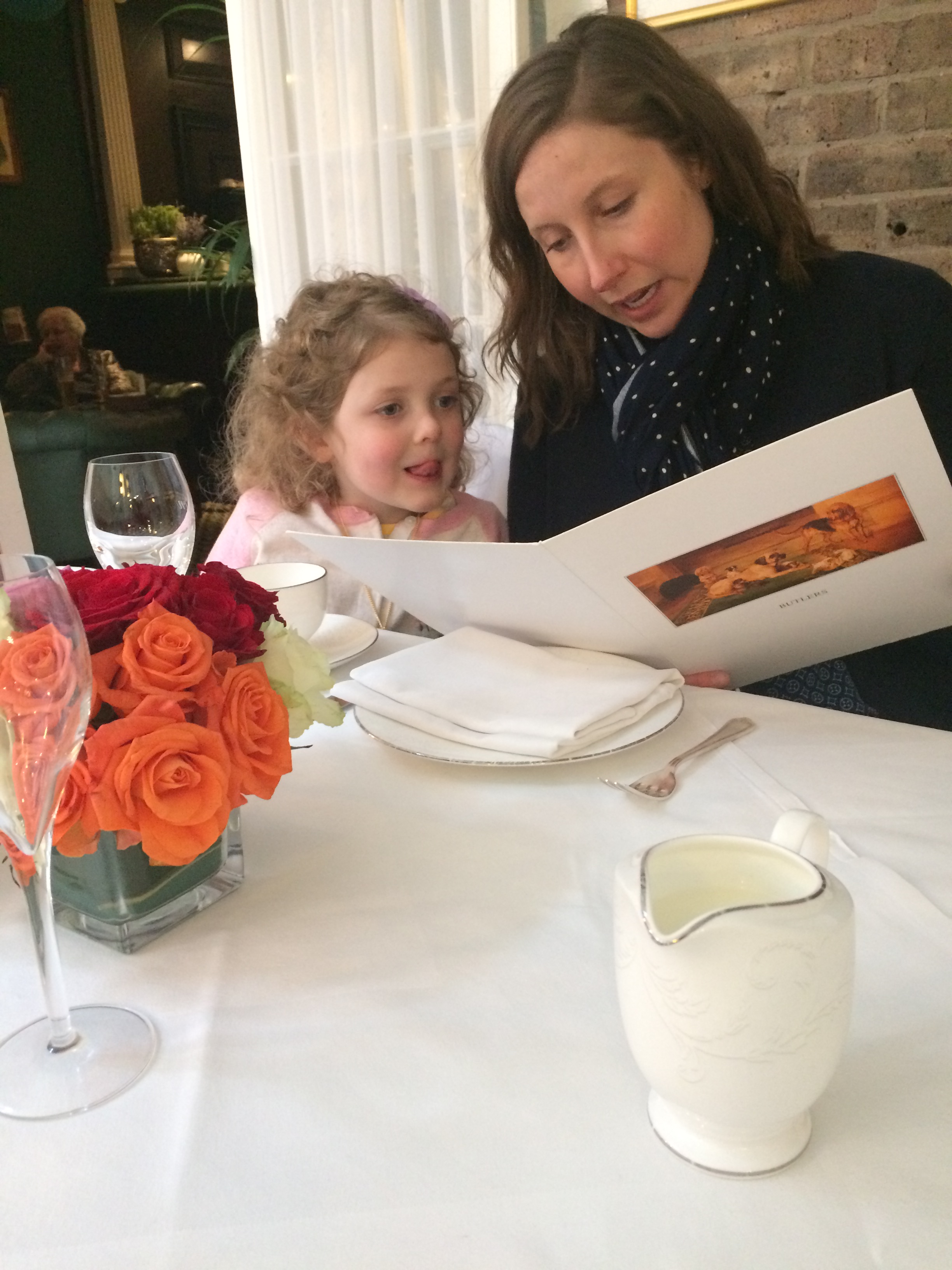
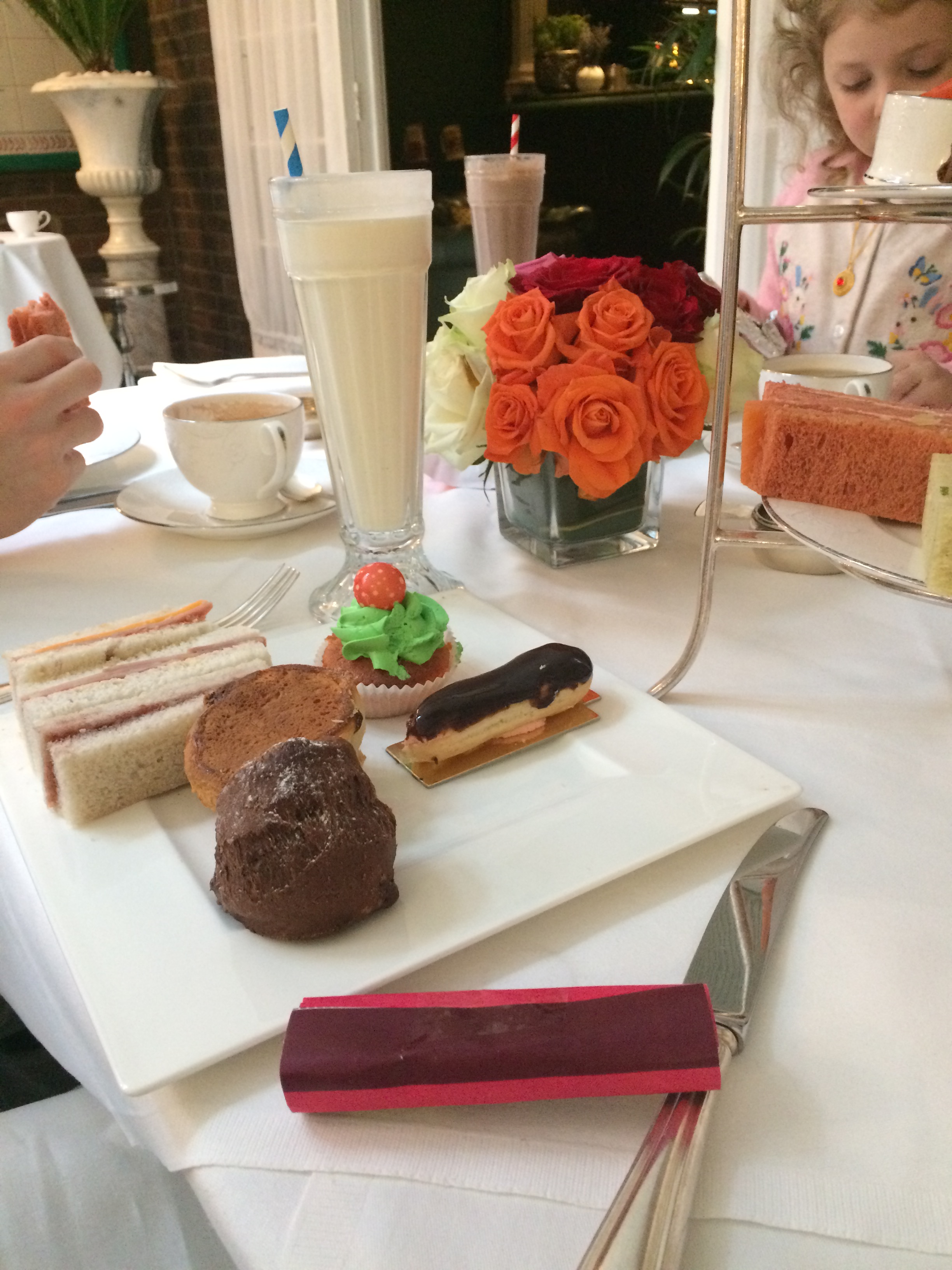
A Chocolate Factory themed tea service for kids. And good tea and sandwiches for the parents.
The baby ate the candy off her cupcake before I could take a photo of it.
I admit:
My son in law carried the stroller and the child up and down stairs without complaining. This helped us get places faster because there aren’t enough lifts anywhere.
2. My daughter’s study abroad experience in London with Central College gave her an ease in London that made the trip go off without a hitch.
3. They’ve taken the children to Dublin and Barcelona so they have this whole traveling with kids down. London was a record for tearless travel days.
4. I did not miss the United States news or culture at all.There are stricter media rules in the UK so less propaganda and the biggest murder incident was an old man killing a burglar with a screwdriver. He got in trouble for it, too.
London was teeming with fun and culture. We didn’t get to see it all so we’ll have to go back, don’t you think?
Recently I went to London with my daughter and her family including three children under eight. My daughter studied in London as a college student and was eager to take the kids to one of her favorite cities. They also took me, nearly a stay at home, along. I was worried I’d be bumbling and in the way. No need to have fretted. It was a perfect trip, Here’s my advice on what to bring if you are a novice traveler to London.
For sure take: a longer raincoat with a hood. Most people there wear ones that are not rubbery looking.
I wore water resistant comfortable shoes. There are lots of escalators and narrowish stairs so don’t get anything too clunky.
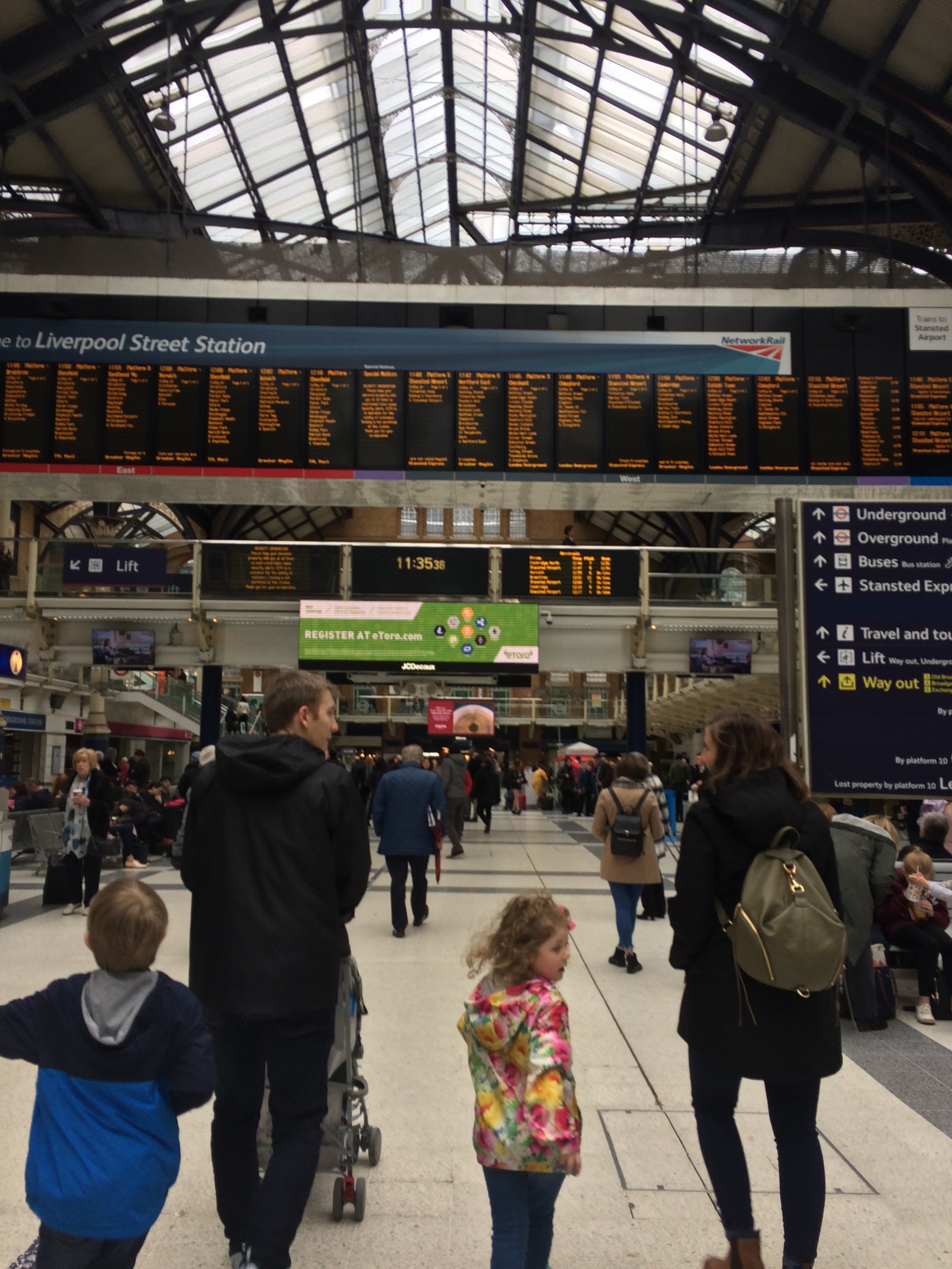
The tube is well-marked, color-coded, and easy to navigate.
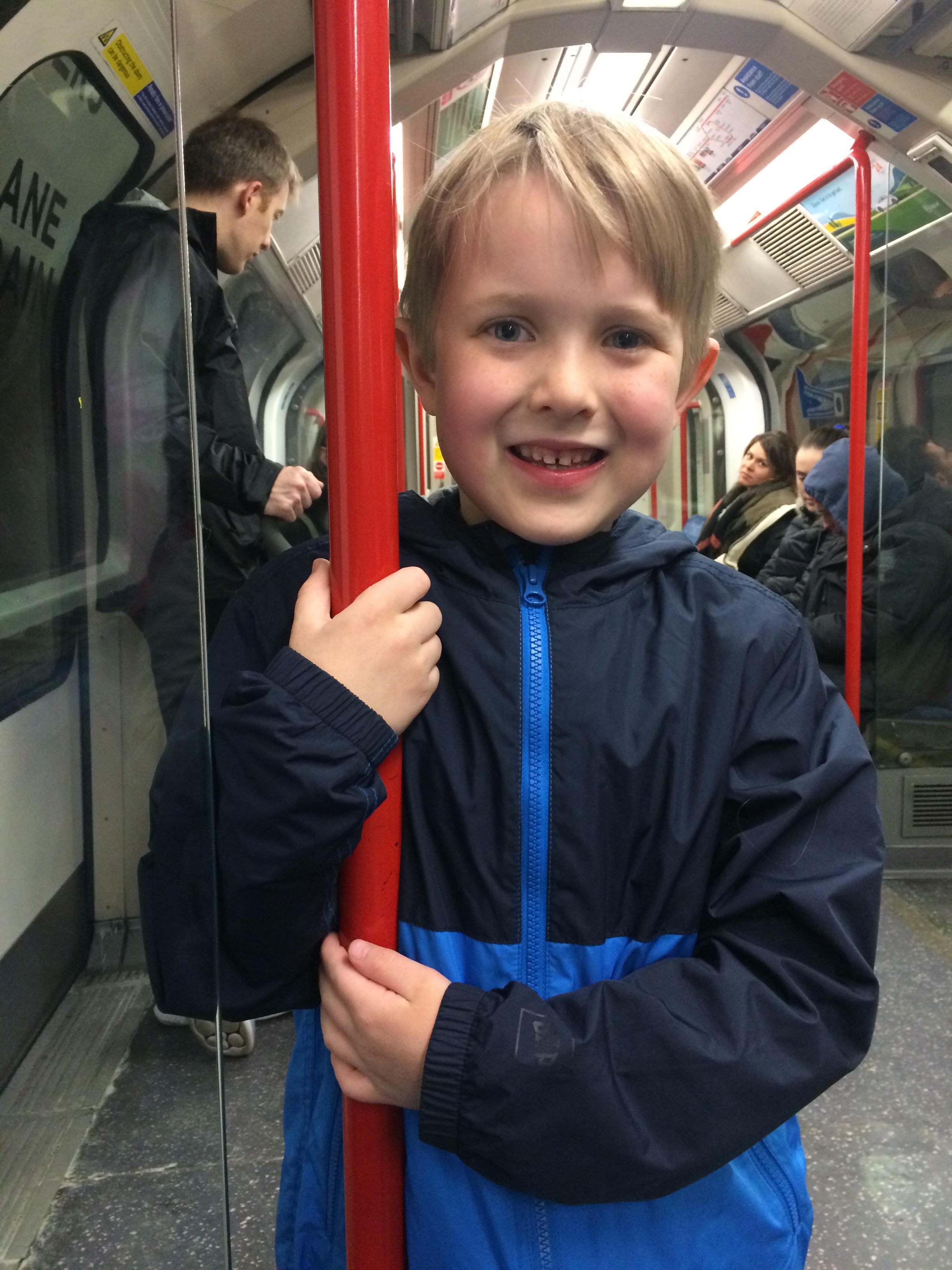
Riding the Tube like an experienced traveler.
Although hotels have universal plugs it might be just one per room so consider carrying a travel adaptor.
A credit card with no foreign transaction fee. Your Costco associated card will do this. Be sure to call the company and give them your travel dates. And if the merchant asks for dollars or pounds, say pounds.
Skip: an umbrella. Annoying tourists with umbrellas almost poking your eyes out will convince you that you might as well just walk in the rain like the Londoners do. If you find yourself wanting one, almost any tourist and sidewalk shop sells them.
Worry less about: your hair. It rains a lot there. Your hair isn’t going to look great unless you spend too much time with it. People walking around looking glamorous appeared to be tourists in London to shop. In fact, one native Londoner told us that intelligence and personality are more important than attractiveness to the British. However, London is a diverse city so look how you like. Speaking of glamour, they do have some fabulous department stores but we were on a holiday with kids so if we even glanced at a nice purse the baby would break free–so no shopping this trip even though we stayed just off Oxford Street. On the plus side, returning through customs is easy when all you have is that catapult pencil sharpener the kids insisted that you buy for grandpa.
I probably wouldn’t: drive.
Avoid jet lag: To accomplish this I followed advice of several of my London loving friends–cut back on caffeine the week before, eat more carbs than protein, wear compression socks. (Sockwell was my favorite brand.) I spent the long flight there watching movies, eating, resting my eyes, taking kids to the toilet. In essence, I pulled an all-nighter, something I hadn’t done since I took organic chemistry in graduate school. I wasn’t looking forward to it but when someone on the plane opened the window and I was treated to a brilliant sunrise over the UK, my heart jumped for joy. I was wide awake and eager to start the day.
The flight on the way back was an hour longer due to strong headwinds. Then I had a four hour layover! I walked around the airport and had a vitamin drink, popcorn, and nuts for dinner. My second flight was delayed due to an issue with a tire. I slept briefly on the 2 hour flight back, dreaming of the devils from The Book of Mormon.
What I loved about London:
Neighborhoods are so cute and there is something about the light in London that makes flowers vibrant. It’s fully worth a wandering about.
Here is a residence in Camden, an adorable area of London.
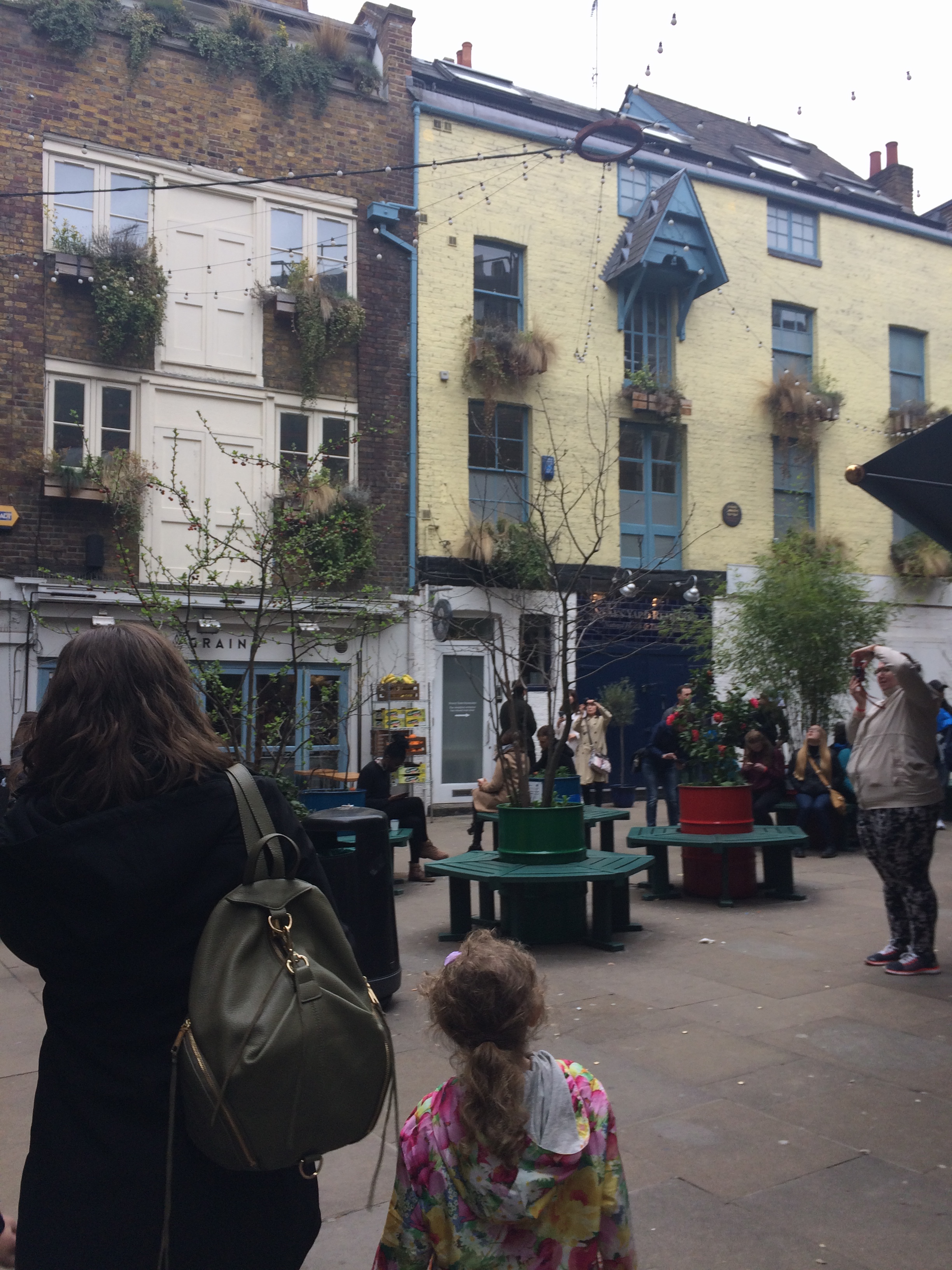
Here’s a look at Soho:
Neal’s Yard in Soho
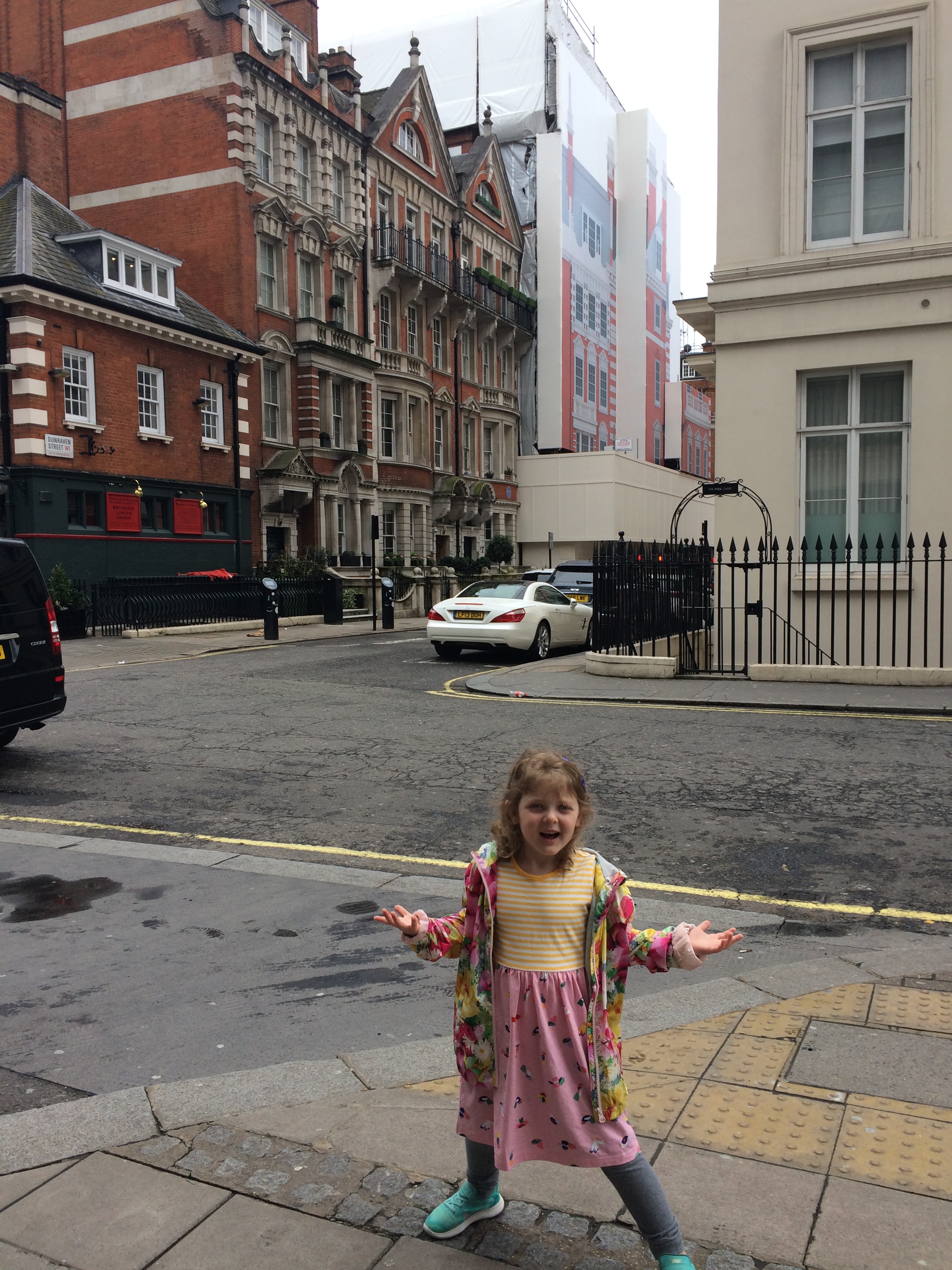
We stayed in Mayfair. Here’s a shot of a side street.
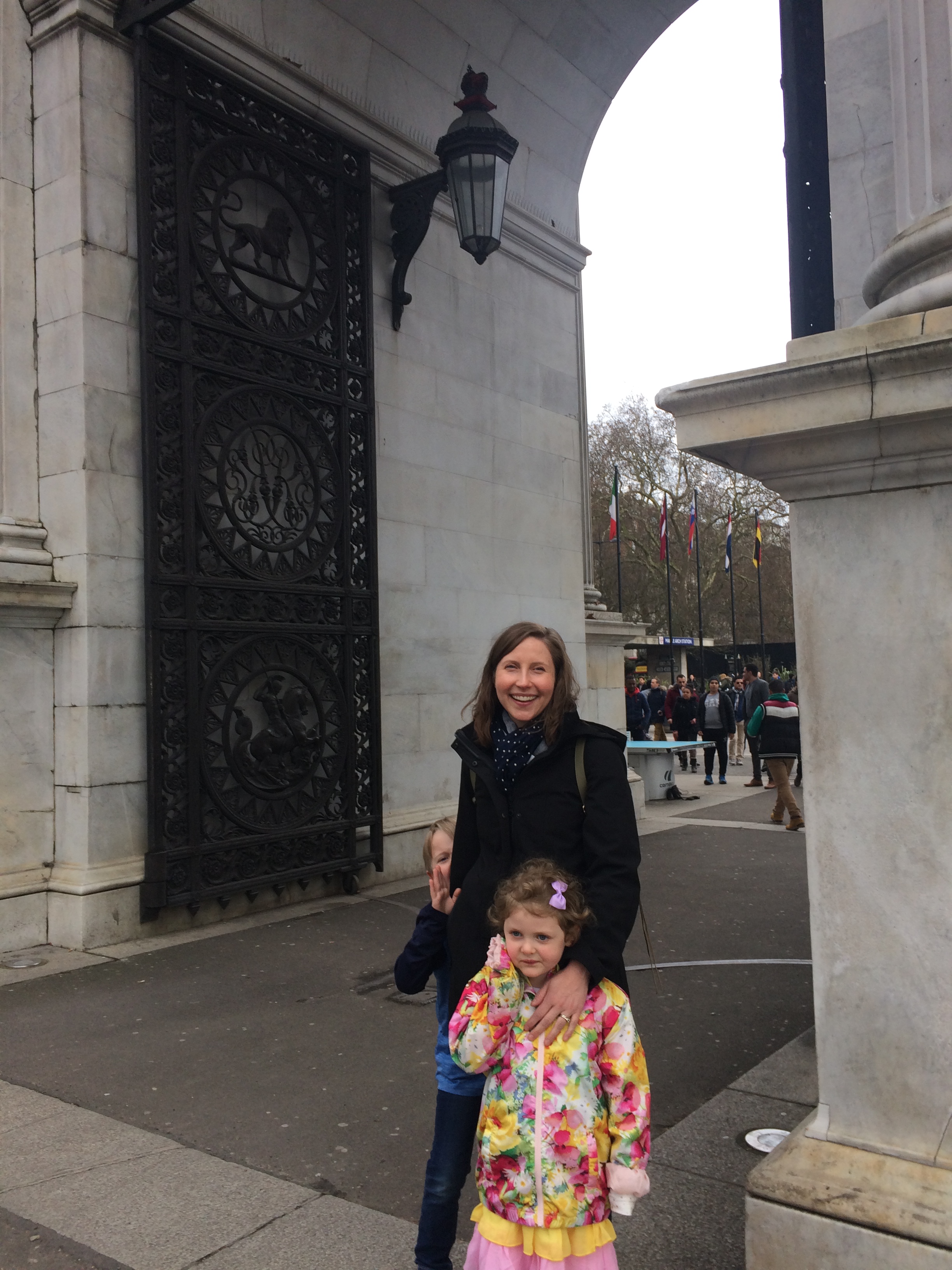
We stayed near Marble Arch at the edge of Hyde Park.
Like several landmarks in London, Marble Arch was moved from its original spot.
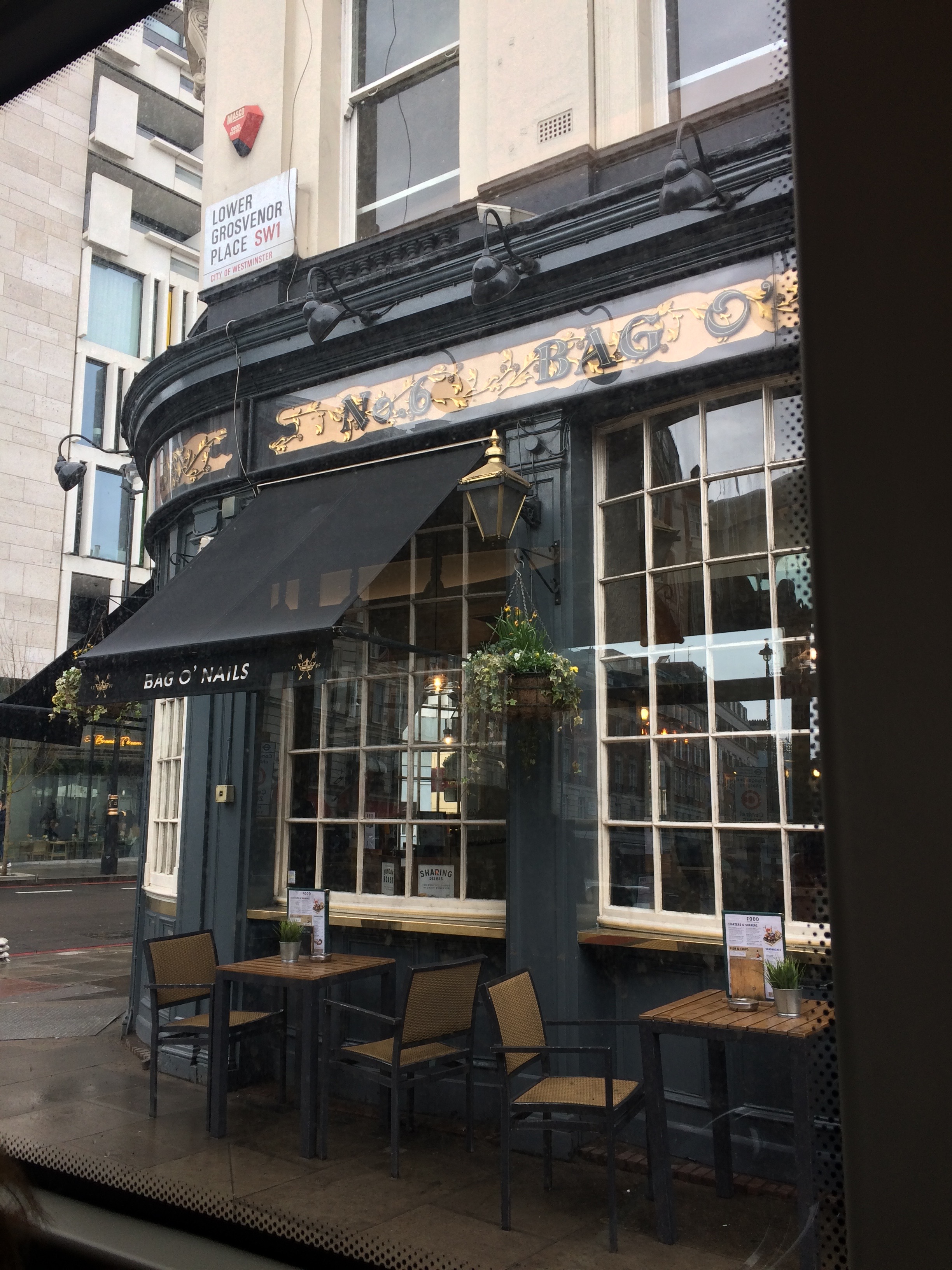
Hyde park is a fully used green space. I enjoyed looking out my hotel window at people walking and jogging through the park while the double decker busses and cabs went by. The city was pulsing with people and unlike here, you rarely heard a siren.
My next post will be about what we did with the kids.













 In my next novel, I’ve got characters who are angry. I did some research about anger to help me understand them better. I’ve learned a lot about it, especially from

 Spring is here at last in the Northern Hemisphere and no doubt you’ve had the chance to enjoy the early morning bird songs. The Dawn Chorus, as it is called, usually begins about 40 minutes before sunrise.











 Catherine Haustein