Birth control, gold crosses, and women’s rights under Hitler

Historically there have been many times that birth control was banned by governments. Hitler banned all forms of birth control– although his soldiers could have condoms wrapped in plain brown wrappers to “keep them healthy.” After all, syphilis was called the “Jewish Disease.”

Adolf disliked confident women, finding them unfeminine. Working women and women who were childless were scorned under his regime. He saw children as being akin to warriors for his cause and saw motherhood as the only calling a woman should have. It was even illegal to talk about birth control. He put forth laws to encourage marriage and his government paid cash bonuses for children born between 1933 and 1936. In addition, a mother got a medal upon the birth of her fourth and sixth child. A woman was awarded a gold cross for bearing her eighth child. Medals were awarded yearly on his mother’s birthday. On Dec. 16 the crosses were handed out. They were worn around the neck on a ribbon.

mother8
Would you have 8 kids for this? What every mother needs–an ugly cross to bear…I mean wear.

Abortions were considered crimes against “the body and the state” and were banned–the penalty was death!  But if the woman wasn’t white, doctors did not enforce this ban. Later, non-Aryans were encouraged to have abortions while they were strictly illegal for others. Although feminists put up resistance–and were jailed or sent to concentration camps– most German women agreed with Hitler and saw him as a savior. They were thrilled to be a part of something greater than themselves. However, his policies didn’t have much impact on population growth.

Countries that fought against him benefited from the labor of their un-oppressed women.  In England condoms were so common that they were used as waterproof covering on military microphones. As history proved, it doesn’t pay to oppress your women or ban your condoms.This could be why feminism stands strong in Germany today but as always, faces challenges from the ultra-right.

Sadly, here in the US, Texas is working hard to be the next oppressive regime.

Birth control banned in the United States!

cool-must-see-black-white-historic-moments-children-saleThe idea that birth control is lewd and promotes bad behavior has a long history in the United States. Bans or partial bans were a part of our history from the 1870s to the 1960s and there is one figurehead presumed to be responsible for it all.
Morality crusader Anthony Comstock was at first assumed to be a buffoon or eccentric who was overly concerned with the morality of other people. He was from rural Connecticut but began his career in New York City because, of course, cities must be regulated and punished for they are filled with debauchery and filth. Unfortunately, while most city people laughed at this absurd notion and his antics which included chasing prostitutes with umbrellas, he was taken seriously by the country folk and by a few rich men including wealthy ultra-conservatives such as Samuel Colgate and J. Pierpont Morgan. Colgate was a prude and Morgan wanted to see banking deregulated. They decided that America needed a purity movement and politicians–who would also give them the legislation they wanted– to go with it. They hired Comstock to lead the purity movement which would help get their guys elected. It worked.

Backed by a corrupt Congress, Comstock was able to push through the Comstock Act which was the law of the land from 1873-1915. This legislation prevented the mailing, selling, teaching about, producing, or discussing any form of contraception. Comstock himself hated condoms and condom sellers in particular. He said that they had to be hunted down like rats. Fortunately, the underfunding of police and government forces allowed for home businesses creating condoms to pop up and condoms became black market items.

Noting their oppression, women took it upon themselves to give each other educational lectures about birth control and some of these educators were highly popular and experts at eluding arrest. As a nurse, Margaret Sanger became alarmed by the number of poor women dying from illegal abortions. She wrote pamphlets about birth control and became a hero to most married women of her day. It was well understood that too many children inadequately spaced risks the health of both the mother and the child. Also, children of older, well-educated mothers have better survival rates and are healthier. Sanger became the first woman to openly run an illegal birth control clinic.

Sanger was from a large family and blamed lack of birth control for her mother’s death. She had greater fervor than Comstock did. Her work eventually overturned his laws and she helped develop and promote birth control pills. She even coined the term “birth control.” She lived to be 89–fifty years longer than her poor mother. Most of her success came in the last decades of her life. Never underestimate the power of a passionate little old lady! Sanger followed her own advice and had just two healthy sons who interestingly enough became football players and one had a career a coach. Comstock had no children–his detractors claimed he was a eunuch–but stood as an inspiration to ultra-conservatives for decades after this death. Here’s another interesting tidbit about Comstock, he praised women for trying their hardest to look good for men–their lords–but was against corsets because they might interfere with pregnancies and reduce milk supplies. Ladies, it’s all about the babies!

Today there is more data than ever that delaying and limiting childbirth produces children who are stronger, smarter, and even taller. If you are or plan to be happy with the number of children you have and look forward to an active and productive retirement, you can thank Sanger. And be on the look-out for modern day Comstocks! They reside primarily in the Republican Party and, thanks to them, the Supreme Court says there’snothing to stop the Comstock Law from being enforced again!

A Quick and Questionable Post About Wearing Gloves

img_3119
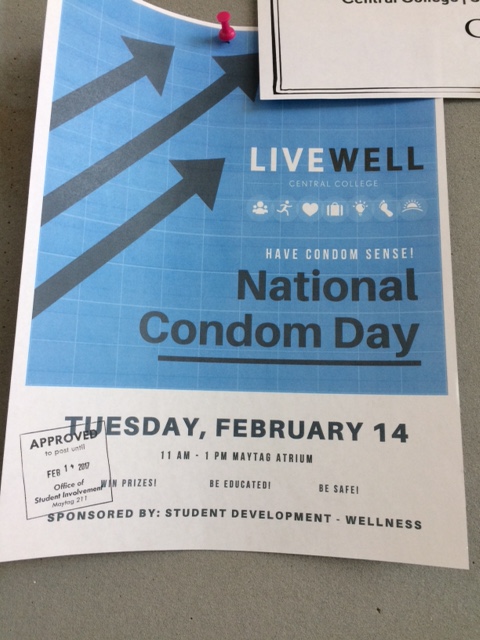
No longer considered taboo, condoms even have their own day of celebration.

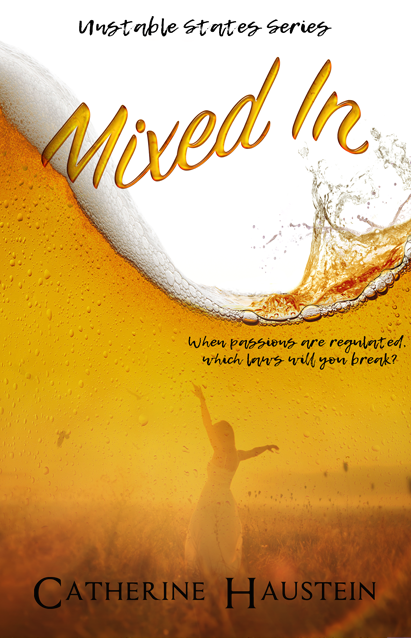
If you’ve read the back of Mixed In you know that the plot involves condoms. This is nothing new. Literature about condoms goes way back. In 1655 “seed catchers” made from linen cloth tied on with ribbons  were celebrated in L’Escole de Filles (The Philosophy of Girls) which was both a novel and a play. In this popular work, the suggested use of a condom was to spare the woman. This was a revolutionary idea because they were only used as a disease protection device for men. The hero in the condemned but popular tale wore a condom. Thus, the association of heroes wearing condoms and scoundrels not wearing them was forged.

As the popularity of condoms spread throughout the 17th century, so did euphemisms for them. During Shakespeare’s time naughty slang words began with “qu” which was pronounced “k.” For example, a male’s private part was a “quipped” and a woman’s a “quaint.” Shakespeare used the word “quondam” much as one might used “condom.” He later used the word “glove “in this way and “glove” became the English term for condom for many years after. Let it be noted that gentlemen wore gloves out of respect for ladies.

This wasn’t the end of quondams as a topic for literature and conversation. In 1709 the Second Duke of Argyll waved one about in Parliament and blamed them for allowing gentlewomen  and women of quality–this means women who were financially independent– to be “debauched.”He wanted them to be outlawed. Fortunately, he was an unpopular fellow so his rant simply helped spread the word about quondams. In this same year, a poem about them called “Almonds for Parrots” became popular followed by “Ode to a Condom” which praised them for preventing big bellies, bubos (syphilis), and squabbling brats.

During the 18th century, women were the primary condom sellers and producers. Mrs. Phillips was a popular condom merchant in London with a shop near the Strand in the early 1700s. She made her wares from sheep caecum and brimstone (sulfur) vapors.  After 1843, rubber condoms became the norm.

As you can see, condoms have long been used, admired, and written about fondly.

I’d like to credit this book for the information used in this post with additional support from this one. And if you’d like to support/read a modern sci-fi about condoms, here’s a  link.

What do those color coded diamonds on trucks and buildings mean?


msds-icon
The hazards diamond, also known as the hazards icon.

download


Have you ever seen this posted on a building on a building or a truck and wondered what it was? This colorful symbol is known as the hazards diamond and is a quick way to identify the dangers of chemicals that lurk behind it. It was developed for firefighters but is used extensively by anyone working with chemical reagents.

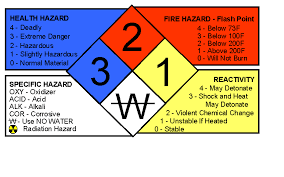
Each color represents a type of hazard: blue for health, red for fire, yellow for reactivity, and white for anything else you need to know to be able to approach and use this chemical safely. Numbers inside each diamond range from 0 (no risk) to 4 (extreme risk).

Here is each risk shown more specifically,

images

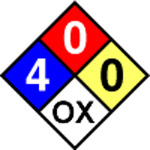
For example, you might see this near a swimming pool.

getdocument
Chlorine gas is a deadly health hazard and will oxidize (bleach) powerfully. But it won’t catch on fire or detonate.


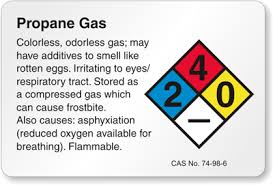
And this near propane tanks since propane can be harmful to health if used incorrectly and–as we all know– it can catch on fire easily.

unknown-1


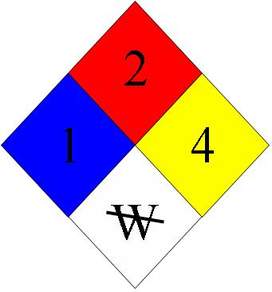
It’s fun to play guess the chemical. At least, it is for me. What do you think this is?is


Now you know what those diamonds mean and remember, they are a chemist’s best friend.


How long did it take to write and publish Mixed In?

I spent a good part of January going over edits for my soon to be published dystopian novel, Mixed In. This novel has been proof-read professionally, edited twice, and still I did find some mistakes. This is completely normal. Now, it moves forward to its publication date-March 7th.

I thought it would be fun to take a look at the timeline and process I’ve gone through thus far.

May  2015 My previous novel, Natural Attraction was published. I began marketing efforts–blog tours, radio interviews, readings. I also read indie fiction and the news to get an idea of what was being published and what was happening in the world. I wanted my next novel to be more contemporary with a simpler plot.

My short story writing class at Central College discussed world and national events with concern. My analytical chemistry class gave presentations about new devices. One was a laser bubble device & a cell-phone spectrometer developed by one of my former professors-Alex Scheeline. This helped set the stage for Mixed In. It would be a dystopia.It would be set in the very near future. The protagonist would be a chemist. She’d help develop a device. Since I study chemicals in plants, the novel would also be about plants. And agriculture. It would be set in the midwest.

Late fall 2015 I further formulated and collected ideas for my second novel. I asked Facebook friends and posted blog quizzes about how much sex they’d like to see in a novel, what types of science they were interested in, and what might make a dystopia. The verdict was to have it be slightly naughty. Huffington Post provided some inspiration about women becoming in touch with their inner passion.I decided to make the dystopia close to home–something based in the world of agriculture. This would be a combination of A Handmaid’s Tale, Idiocracy, and chemistry.

January 2016 I earnestly began Mixed In, set in the authoritarian business focused city-state of Cochtonville. Cochtonville was also the setting for my short story “Grave to Cradle.” Grave to Cradle was first published by Slink Chunk Press, then added to an anthology published by Shade Mountain Press.  The working title for the novel was “No Regrets.”

March, 2015 Writing when I got up in the morning and before bed, I now had 50K words. For many authors, the abandonment point comes around 40K words. I was happy that I broke through. My goal was 73,000 words. (The final book is 76,00o words.)

October,2015 I finished the first draft. As you can imagine, it was filled with errors, inconsistencies, bad sentences, worse punctuation, and the worst proof-reading. I hated myself for even trying to write it. Yet I revised. Revision is the key to writing. For most of us, the first draft is terrible and embarrassing.

April 2016. I sent the revised novel to a professional editor for comments on plot, character, and continuity. I sent the first fifty pages to another reader for comment.(I pay people for this)

I got the comments back from the two hired editors. Both agreed that other than the first chapter, there were three boring chapters that needed to be cut or reworked before the book got interesting. I revised the manuscript, making Chapter Two more active and cutting Chapters Three and Four.

May 2016. I sent the manuscript out to be proof-read and copy edited. (I am an atrocious proof-reader. I hire people to help me.) During this time I looked over the City Owl editors’ wish lists. On Heather’s list was a dystopia that didn’t have to do with zombies or vampires. My dystopia had no vampires or zombies. But I wasn’t going to make the “open reading period” deadline because the manuscript was being proofed. I wrote Heather and asked her if I could submit after the deadline. She said yes. I sent the manuscript to her at the end of May. I began another novel to pass the time.

July 22, 2016 Acceptance!

July 31, 2016 Signed contract!

August 2016 First round of edits by City Owl editors.

Late September 2016 I discussed cover concepts with an editor and a cover artist.

We perfected the tag line and the pitch–thanks Facebook friends.

Later in the month, I began discussion with the editor and artist about the cover specifics. I wanted the cover to feature a splash of beer/dirty water.

November 2016 More edits.

December 2016 Cover approved. I love the splash.

January 2016 Second round of edits.

Received a copy of the sales sheet.

Official Cover reveal (January 24, 2017)

January 21-25. Final read.

As you can see, it has been a year since the first few pages were written. My head is spinning as the project moves ahead. It was meant to be a comic dystopia. Suddenly, I see parallels with current events…kind of like when you are pregnant and then it seems like pregnant women are everywhere.

Looking ahead: Pre-order date is March 5. Publication date March 7, 2017


Thoughts on ice

Water is perhaps the most unique and special molecule in the universe. It has one side with a partially positive charge and one side with a partially negative charge. It’s both ionic and covalent. A chemist would call this polar.
As a liquid, water molecules like to hang out together more than one might expect for such a light molecule. It’s just three atoms, two hydrogen and one oxygen. It’s close in weight to methane which is a gas and lighter than chlorine which is a gas. You might say that it has an overpowering attraction to itself which makes it a liquid even though it’s light. Even more importantly to this discussion, this polar molecule can make some neat structures as a solid.

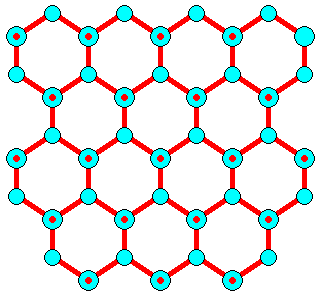
Ice can take 15 forms with thirteen crystalline forms (Ice Ih, Ice Ic, and Ice II-XIV) and three amorphous forms LD, HD and VDH…low density, high density, and very high density. The temperature and pressure help determine which form ice will take. Here on Earth, the ice we get in nature is Ice Ih. The h stands for hexagon. In the figure below you can see the hydrogens (red centered dots) and oxygen (all blue) forming the hexagons.

iceitop
This shows how oxygen(open circle) and hydrogen (with red dot) could arrange to form hexagons. Thanks to Steven Dutch at https://www.uwgb.edu/dutchs/Petrology/Ice%20Structure.HTM

This link shows many ice forms and it is where I got the figures above.
Thanks to the hexagons, the crystalline structure of ice contains more space than liquid water. It’s less dense than water and so it floats.
Amorphous ice has no crystal structure. It’s formed in space at extremely cold temperatures. It can be found in icy moons such as Europa and comets might contain it too.
 All ice luminesces–when hit with ultraviolet light it emits light in the visible region, at 420 nm which is in the violet range. The shimmery bright world of ice and snow isn’t just an illusion. The ice really does emit light.
Besides being shimmery, we all know that ice is slippery. How slippery is it? Most materials have a coefficient of friction of o.3-.6. Human skin has a coefficient of friction of 0.9. Very nice for gripping and other things, isn’t it? Ice has a coefficient of friction that is ten times less than this .02-.05. Very slippery!  Ice near the freezing point is MORE slippery than very cold ice; it’s thought that the extra slip is due to melted water on the surface of the ice. But, this hasn’t been proven. Likewise, car tires slip more on a wet road than a dry one and way more on a wet one. The coefficient of friction for a well-treaded tire is 0.7 on a dry road,  0.4 on a wet one and only 0.1 on ice.
When walking on ice, put your weight on your front leg as penguins do,& wear sticky shoes.  And, don’t forget the sunglasses.

Urine trouble: some fun facts about pee.

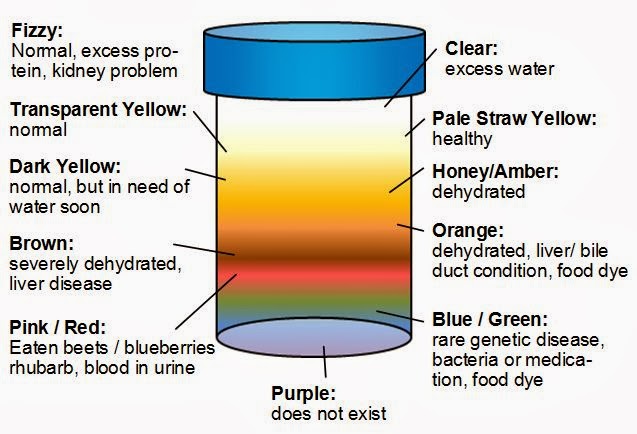
  1. 3_urine-color-meaning-chart
    From https://iytmed.com/urine-color-meaning/

    Before chemical tests, doctors used the taste of urine to detect diabetes. Sweet urine meant the person was diabetic.

  2. People incorrectly used  a urine test involving pee and nails in corked jars  determine if someone was a witch. If the cork popped out of the bottle they were guilty of witchcraft.
  3. A genetic enzyme disorder called alkaptonuria makes urine turn black in air.
  4. Blue or green urine can be caused by the substance methylene blue, used to treat methemoglobinemia or bladder spasms and irritation or by Viagra.
  5. Porphyria can change the color of urine to purple or possibly blue. It’s thought that  King George III suffered from this.
  6. Dark urine is a sign of dehydration.
  7. Orange urine may be sign that you have eaten blackberries or rhubarb.
  8. Red urine may be due to beets but it’s usually blood!
  9. Dark purple urine is often seen in kidney failure and with people who have frequent use of catheters.
  10. For a full list of urine colors and their causes, visit http://www.urinecolors.com/ or here.
  11. No matter how big or small, most mammals take 21 seconds to pee.
  12. Can you smell asparagus pee? It’s genetic.
  13. In the past, urine was used to tan animal hides and poor people sold their urine, unless they were too poor to have a pot to piss in.
  14. The element phosphorus was first isolated from urine in 1669.
  15. There’s a musical called Urinetown.
  16. Urine may be either acidic or alkaline depending on your diet. 
  17. Urine is considered a bodily fluid and is not sterile and the bacteria vary from person to person.
  18. Urine, piss, pee–what word came first? According to the on-line etymology dictionary, it’s urine!
  19. Most people do not wake up to urinate at night. It might be worth a trip to the doctor if you do.
  20. Being “pee shy” is a social phobia that affects a little less than 10% of the population.
  21. Urine is over 90% water.

Do you known more fun facts about urine? Please leave comments! And now that you know a lot about urine, enjoy crushing this quiz.

It’s freezing: how low can salts and de-icers get?

IMG_4190
You can’t handle this weather but what about your deicer?

For an updated version, go here. 

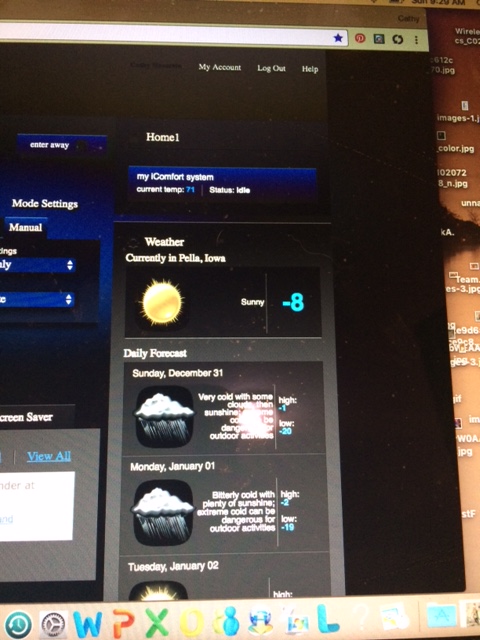
Last week the temperatures dipped far below freezing and someone asked me if there was a point at which ice-melt won’t work anymore. The answer is yes but don’t panic.

These substances work by disrupting the bonds between the ice molecules –making it harder for them join together and make a solid–but there is a limit to which they can depress a freezing point. The first study I could find on this topic was published in 1918 by Worth H. Rodebush.  He measured the eutectic points of various salt solutions, essentially the lowest temperature they can reach before being solid. His figures match those found today so here is a partial list:

Salt,  sodium chloride, NaCl -21 C or 1-6 F (works efficiently to melt ice at temperatures above 15 F). This is what Iowa uses primarily.

Calcium chloride -51 C or -60F ( for practical purposes it works above -20 F)

Potassium acetate -30C or -76F  (safest for grass and concrete and most effective above -22 F)

Magnesium chloride -15 C or -5 F (best above 5 F)

The list above is for salts, inorganic compounds with ionic bonds.

Glycols such as propylene glycol are carbon-based compounds that can be used as deicers. These have a eutectic point of around -55 C which is -67 F. These are most often used on airplanes.

As you can see, these substances do have their limits but thankfully we rarely face these extreme temperatures–although we do on occasion reach -22 F in Iowa.

A temperature of -93 C or –136F has been recorded in Antartica by a satellite device with -128.6F (-89 C) being the coldest official temperature measured by a thermometer. So there’s a spot where de-icers wouldn’t be effective.

What’s the coldest a substance can get? Helium freezes at -458 F or -272 C. You’ll probably never see any of these temperatures so enjoy your de-icers in moderation, using caution below -22 F.

Why in moderation? De-icers can  “aggravate” flaws in concrete and of course when wet, they make part the perfect combination to corrode your car–electrolyte, water, and air. They are the electrolyte. Besides eating up a lot of local and state road budgets, They also contribute quite a lot of sodium and chloride to the local waters.

Don’t forget, the lower temperature of deiced pavements can make pet paws get so cold that they can get frostbite, so protect your pets this winter and travel safely.

Rachel Carson and the Paradigm Shift

Reblogging because my association with the American Chemical Society helped me gain insights that might have otherwise been lost to history. Being educated is one of the most dangerous things a woman can be. Being unmarried also.

Naomi Wilcox-Lee's avatar

In 2007, a member of the United States Senate drafted a resolution to honor the 100th anniversary of the birth of a famous biologist; a woman who had been most at home with her nose in a book or on the shores of the sea. Things didn’t go as planned. Havoc ensued as a senator from Oklahoma mounted an outraged resistance against the woman’s memory. The controversial woman was Rachel Carson.

Carson grew up in Pennsylvania and was born with a gift for words—she talked early and had a story published in a St. Nicholas magazine when she was eleven .

View original post 647 more words