Here is a recipe from my mom. Mom inspired me to not aspire to be a house wife. She couldn’t hide how bored she was. Although she was loving and nurturing, I found myself weaving tales of school that went well beyond what actually happened because I felt the need to entertain her. I was finally busted when I told an elaborate story about having speech therapy. Not only did I not need speech therapy, I claimed that the therapist gave me a Payday Candy bar.
Mom made this cake for my dad’s birthday. I’m not sure why it’s called a Russian Tea Loaf although I once had a Russian tell me that if you have blue eyes, you are part Russian. In the 1950s-80s, the U.S. and Russia were locked in a Cold War which made Russia glamorous. My family lived in Washington D.C. during the Bay of Pigs incident and learned early in life to duck and cover. I practiced running home from school to die with my mom in ten minutes or less. I even had a sleeping bag at school in case the Big One was launched and not detected in time and the school was used as a bomb shelter. If you see older citizens of the U.S. with no savings and their health shot through from bad living don’t judge. They were taught from an early age that they were going to die young. Now we have school lock down drills and terrorist threats so only those who grew up in the 90s escaped that sense of doom and dread that is part of our culture.
As with most mid-century cooking, this uses a pre-made item, the angel food cake, an American invention. It also contains an unspecified package size. Sorry about that. There wasn’t the vast array of choice back then. Cut the cake with a serrated knife.
Russian Tea Loaf
Buy an angel food cake.
Custard filling:
5 eggs–remove yolks and set aside
3/4 cup sugar
1 1/2 cups half and half
1 envelope unflavored gelatin
1/4 cup cold water
1 pt whipping cream
1 tsp vanilla
Beat yolks until light and add sugar. Heat cream in double boiler. Add egg yolks mixture and cook until thick.While custard is hot, add gelatin which has been dissolved in cold water. Let cool and add stiffly beaten whipping cream and vanilla. Cut cake in 3 layers and put custard between layers and over entire cake.
The other day my son asked me for the recipe of something I’d made for the family. I was embarrassed to admit that it was 1950s cooking–meat seasoned with a can of mushroom soup. Nearly as bad as 80s food–think chicken nuggets– 50s food freed the housewife from much of the tedium of cooking. She now had time to think thoughts such as “if I had been born a man, what would I be?” This is the heart of the feminine mystique. (My mother would have been a veterinarian.)
My novel Mixed In looks at the past to form a dystopia. I absorbed a restlessness from my mother that was characteristic of women of her era. But this blog is not about malaise. It’s about “50s” cooking. I hope to publish here on my blog a series of favorite unhealthy family recipes that probably all of us in the U.S. have enjoyed. Most require prepackaged food and a hand mixer.
Let’s start out with Granny’s cheesecake. This recipe is based on Jell-O. Almost lost to history, Jell-O became popular around 1902. I once lived just 30 minutes from the Jell-O museum and sadly never visited.
Jello gives this cheesecake an unexpected lightness. My Granny always had one ready when we were coming to visit. Here is the recipe in her own words.
Granny Grace’s Cheesecake
1 cup of sugar
1/2 package large cream cheese
1 tsp vanilla
1 pkg lemon Jell-O and 1 cup water cooled together
1 13 oz can evaporated milk
1 graham cracker crust in a 9 x 13 pan
Set Jell-O. Put bowl, beaters, and evaporated milk in the refrigerator. Mix cream cheese, sugar, and vanilla with a fork very well.
In a large bowl beat evaporated milk at high speed until volume doubts. Add cooled Jell-O. Pour in cream cheese mixture and fold with a spatula. Pour into crust. Sprinkle extra crust mixture on top.
Crust
12 graham crackers
1/3 cup sugar
1/4 cup melted butter
There you have it. A uniquely 20th century food.
Do you have a favorite 50s recipe to share? Send it to me at hausteinc@gmail.com
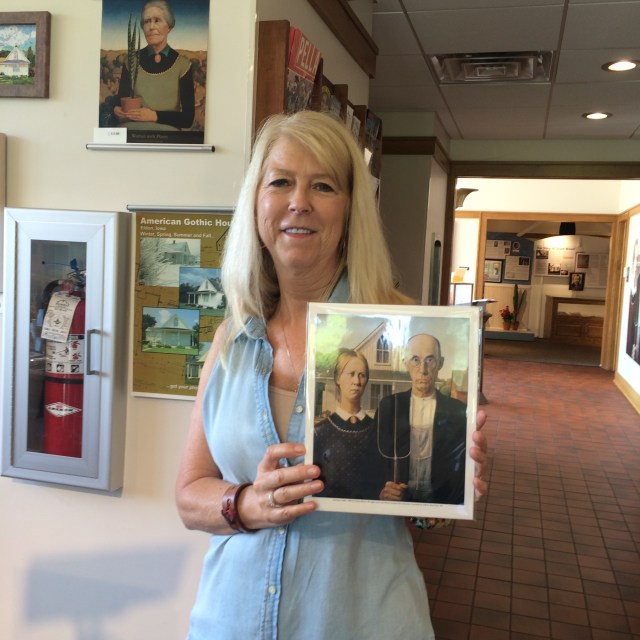
An hour and three minutes from my driveway lies the second most famous house in America–the American Gothic House in Eldon, Iowa. This house, along with painter Grant Wood’s sister Nan and his dentist, is in one of the most recognized and parodied paintings in art history. And it makes for a super cute day trip. My sister and I went today.
The house was built in 1881 by Catherine and Charles Dibble. It was owned by Gideon and Mary Hart Jones when Wood painted it in 1930. The large gothic windows on the otherwise simple structure enchanted him. The original owners wanted to add something beautiful to their new home and thus, the windows. Mrs. Jones watched the artist sketch her home on the back of an envelope and she rushed to take down the lace curtains, wash them, and tidy the place up. Wood never came back to the site and he added his own details to the curtain in the painting.The painting catalyzed his career, marked by a love for his home state and its people. Wood envisioned an arts colony in Iowa and saw this painting as a form of tenderness for the people here. He loved the farm fields–the rows of crops were like designs on a dress or apron. He pulled together the sprawling landscape of Iowa into a neat box with shadows on chickens and farmer tans on the people. He fretted over the loss of the simple culture. He loved the snug homes and plentiful fields. And he promised his sister and dentist that no one would recognize them. How wrong he was. Nan later admitted to loving the fame despite Iowa farm women being critical of her sour expression in the painting. (And she pointed out that no one made a fuss about the looks of the man.)
Nan Wood Graham–herself an artist– enjoyed her role as the model in American Gothic.
In 1970, Carl Smith donated the home to the State Historical Society of Iowa. In 2007, a visitor’s center opened.
Information about the house and Grant Wood plus iconic costumes are at the center. Admission is free. Donations welcome.
Here It is again
American Gothic House showing the summer kitchen on the left.
Here’s the dark side of it.
Back of the American Gothic House. Look! Another gothic window! What a view!An adorable museum and of course a gift shop.What does it take to put together such a charming place? Administrator Holly Berg has two masters degrees–one in museum studies and one in geo science. Her second job is being a college professor.Downtown Eldon is quiet. Bring your own pie and sandwiches–the cafe is closed.
I just signed a contract with City Owl Press for my dystopian novel Mixed In. Here are some fun facts about Mixed In:
It’s set in the near future in the city-state of Cochtonville. I’ve written about Cochtonville before in my story Grave to Cradle (also in The Female Complaint.) To be honest, when I picture Cochtonville, I picture Cedar Rapids gone wrong.
The protagonist is chemist Catrina Pandora Van Dingle, who comes to Cochtonville to work for Cochton Enterprises. Like I am, she is a jack-of -all trades analytical chemist. She comes to Cochtonville to study beans found in the pocket of Thomas Jefferson’s hand me down trousers.
Her love interest is Ulysses S. Butz, owner of The Union Station bar. He does much more than sell drinks at that bar.
She has a friendly lab mate, the hapless synthetic chemist Jester Rana.
I always like to have at least one older female character. In Mixed In, it’s Wilma. Wilma has parties but she doesn’t sell Tupperware.
I looked to the past and the 1930s-40s-and 50s to describe the mood of this place. So you’ll find some prohibition and the modern day equivalent of a Vice Squad. Quite a lot is banned in Cochtonville including any art that doesn’t relate to agriculture.
I began writing this while teaching my Science Fiction and Empire course and let the news my students were talking about in that class and in my Short Story Writing course influence the plot.
This novel doesn’t have religion in it, and by request, is a tiny bit less sweet than Natural Attraction.
My thanks to Sarah E. Gold for proof-reading the initial draft for me and to Susanna Sturgis and Kay Van Wyk for beta reading. Amy Sue Nathan provided feedback on the first fifty pages.
Thanks also to bar owners Steve Bray (Green Gable Inn in Cedar Rapids) and Diane Chaplin (Chaplin’s in Arnolds Park).
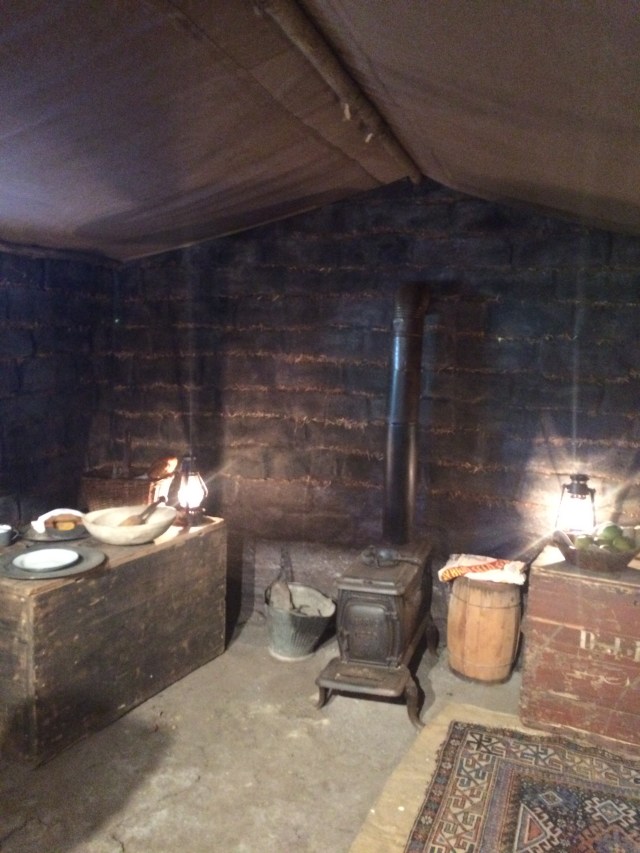
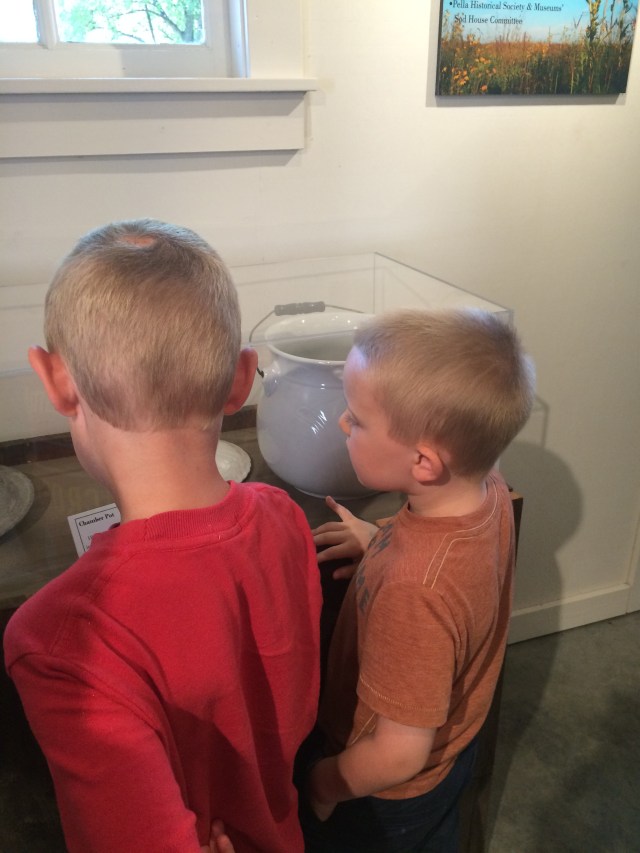
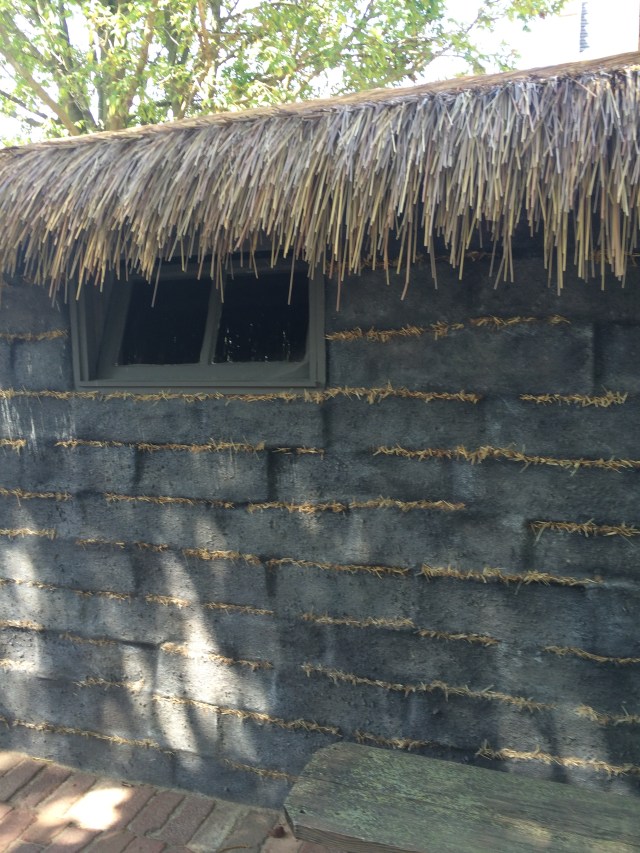
A cozy sod house interiorA chamber pot. The children were slightly horrified.Not much to look at from the outside. I found the inside to be sweet smelling like grass. Early Pella settlers lived in houses like this in 1847. It took about a week to build a sod house. This sod house can be viewed at the Pella Historical Village.
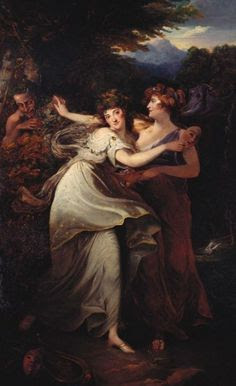
Dora (front) as the comic muse while a creep looks on
My blog post about Dora Jordan is up on Sheroes and it’s my birthday. What could be more magical? But how did I, who tends to write about science, become a fan of this famous comic actress? I met her through Michael Faraday, England’s greatest chemist. I had planned to write a short story with him in it–having previously written one with Isaac Newton— and in preparation read his biography. The man was born poor, worked incredibly hard, invented the electric motor, discovered electromagnetic inductance and several elements, and still, I learned from his biography, as he grew older he had finances to worry about because of his lowly birth status. Several people championed his receiving a pension from the government because of his scientific contributions. The King at the time was William IV and one of Faraday’s champions was Lady Mary Fox, identified in his biography as the illegitimate daughter of the King with actress Dora Jordan. This intrigued me. I read Faraday’s correspondence and there Mary was, writing to him and receiving his reply. There was a story here and a Faraday contemporary. I researched Mary’s mother, the actress. Thus I met the hard working Mrs. Jordan–quite a bit more lively than Faraday and someone who also could have used a royal pension for her service.
She was nearly written out of history. Imagine Amy Schumer, Carol Burnett, or Lucy just disappearing. That unsolved mystery along with my family’s involvement in a Shakespeare Festival means it was like catnip for me to uncover more about her. Not to mention that the whole story points out the capriciousness of social status.
I was entranced by her industriousness, her strong female roles, and ability to work while bearing numerous children–ten born to the prince who unexpectedly became king. There were condoms back them but…
She lived before photography and was a genius with costumes and make-up. Thus, it’s hard to know exactly what she looked like. She had a beautiful singing voice and played several instruments but, alas, before recordings. Known to be a quick study with a jolly laugh, she was much admired. Even Jane Austen was a fan. And she elevated comedy to rival tragedy, which was considered the more “literary.”
Her mysterious death in which she seemed to fade into the cosmos has fascinated people for two centuries, along with the odd dealings with the statue of her commissioned by the repentant King and meant to be put in the Hall of Queens. But the statue notion was really not that odd if you know what scientists did in that day. When Mary Somerville was denied entrance into the Royal Academy of Sciences because she was a woman, her supporters had a bust of her placed inside as a protest. Putting a statue in a spot where a woman wasn’t allowed was a statement and the sculptor Chantrey made the Somerville bust and sculpture of Dora. Like most things associated with William IV, things didn’t go as he planned and the statue was hidden away from public sight for 130 years until being reinstated by the current Queen Elizabeth.
I have an extensive Pinterst Board up for her…with a few of my own theories and opinions tossed in. This one belongs to someone else but contains a fair number of cartoons, first slamming her for taking up with the prince, then slamming him for leaving her and the children as he chased wealthy young women. The excuse for the later was that he needed an heir but in all honesty, there were plenty of other princes (he was the third son) and in fact, one of them fathered Queen Victoria. Since William and Dora had a son who might have been a splendid King, Victoria et al had a vested interest in getting rid of Dora’s memory and in getting rid of women’s rights all together.(However, she was fair to her illegitimate cousins. Some historians say it was because the royal family owed Dora.)
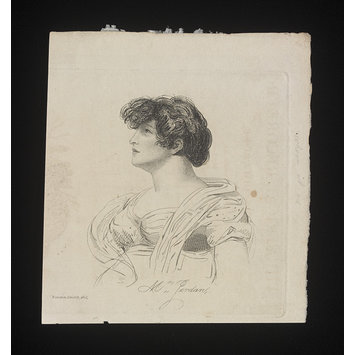
Silhoette of DoraThe famous statue of Dora and two of her children showing comedy mask and pan pipes at her feet. Motherhood does tower over career, doesn’t it? Even the statue almost fell out of history but God Bless the Queen (Elizabeth) for putting it in Buckingham palace 135 years later than it was scheduled. Photo from http://www.douglasjennings.co.uk/images/mrs-jordan-02.jpg
There’s something “researchy” to digging up things about a woman who was once nearly wiped from history. I can’t believe that I even found and bought a theater handbook of hers. For someone that the palace tried to censor, there is a lot of memorabilia about her. And as I have mentioned before, like her I have struggled for my family and known the sting of betrayal despite my generosity and hard work. All I can say is, women have more options now.
I’ve never bought the story of her death and took the liberty to re-write history and fictionalize her story in a novel.
As for Michael Faraday, he got his pension and later Queen Victoria offered to knight him and give him a house. He declined the knighthood but took the house. One can’t help speculating that Lady Mary knew all about the troubles that come to commoners when there is no social safety net and how much they are at the mercy of the whims and of the powerful no matter how much they work or donate to the Kingdom.
Here’s my first 4-leafed clover of the year. It’s gnarled and misshapened but there it is. I’ve given up picking them and just photograph them now, for you see, I have this odd talent of finding them. One time I even found two on demand when my grandsons wanted some.
Perhaps it started when I was a baby. I have some four-leafed clovers taped into my baby book, a gift from my Aunt Lois. Maybe it goes along with my being an analytical chemist. We do find needles in haystacks.
Clovers are a variation of the Shamrock, which represents the Trinity of St. Patrick. Add another leaf to the Trinity and you have a Celtic symbol of luck and safety; the four-leaf clover was held in high regard by the Druids. They saw it as a charm that could bring luck and help the finder spot danger. According to Celtic legend, one leaf is for faith, one for hope, one for love, and one for luck.
Am I lucky? Like everyone else, I am lucky in some things and quite unlucky in others. I don’t gamble and my risks are calculated. Risky chemists don’t last long. I don’t think my gift of clover has given me anything more than an interest. Perhaps I’m good at spotting danger but once again, I contribute that to being a chemist. I do enjoy my “gift” though and of course, since I am white and Dutch, this 4-leafed white Dutch clover could be a personal symbol. I even have some Celtic blood.
It is estimated that in nature about 0.01% of all white clovers are four leaf clovers. The remaining 9,999 are the traditional three-leaf variety. Many people have noticed that lucky clovers can be found in the same place. There is a debate about if the mutation that gives the extra leaf is genetic or induced by the environment. Many scientists hold the idea that four-leaf clovers are a rare recessive mutation.
Some people have found thousands of four-leaf clovers in their lifetime and others have never seen one. But even the traditional three-leaf clover can bring luck to homeowners wishing to cut down on lawn care and its expense. Dutch White Clover (Trifolium repens) can add many nice qualities, a touch of sweet aroma and flare to a grass lawn. The fragrant flowers can range from white to pink and are most profuse in the spring. The leaves are lost each winter, meaning that if you find a four-leaf clover, you might as well pick it. That clover won’t be there next year. Clover lives through the winter in the form of shallow roots that do not like a dry winter. At least that’s one reason to cheer for snow.
Clover doesn’t need fertilizer because it can fix nitrogen. This means it can take nitrogen gas from the air and make it into fertilizer for no cost at all. Clover plants have long roots and a lawn that includes clover does not need aeration. Clover is pest free and competes well with weeds, making herbicides obsolete. It even repels chinch bugs! Clover attracts bees and beneficial insects and is a perfect companion for a back yard garden because clover near apple trees, squash, cucumbers and melons will help with pollination. It does not need mowing as often as grass. It grows to 4-8 inches tall and then stops growing. Clover likes plenty of sun and will grow rapidly with a dose of phosphorus now and then. If you don’t want bees, mowing more often will keep bees away.
Once established, a clover lawn will tolerate drought. This means that it will stay green even in dry weather. Clover does not show dog urine spots. However it is not considered tough enough for play areas. On the other hand, children can spend countless hours in a clover lawn as they search for four leaf clovers and make clover flower crowns and necklaces on lazy summer days.
Not every lawn has clover these days. Until the 1950s, clover was included in lawn seed mixes as it was regarded as a prestigious lawn plant that was soft to walk on and easy to care for. It became a weed when it was considered “just out of place texture wise”, not green enough, a source of stinging bees and slippery when wet. But don’t let these views scare you. Many people still view them fondly and with nostalgia.
If you like mixed textures in your lawn or if you are tired of mowing your grass and looking to cut back on work, clover would be a wonderful addition to your grass lawn. Seeds sprout best when raked into a bare spot. Water until the clover sprouts but after that it should be problem free. White Dutch clover is well adapted to our region. The best time to plant is April and May. (Perhaps Tulip Time would be an appropriate time to toss about some seeds of Dutch White Clover.) I have them and yes, there are bees but if you are looking out for 4-leafed clovers, you can look of for bees as well.
There are clover species native to Iowa that can be planted to provide animal habitat and enhance the educational value of your land. These include the White Prairie Clover, Purple Prairie Clover, Silky Prairie Clover, and Round-headed Bush clover. Some of these get 3-4 feet tall so you might not find them suitable for a lawn but they can be planted as ground covers.
Believe it or not, some cosmologists think that the universe has the shape of a 4-leaf clover. Clovers bring luck, diversity and Oneness with the Universe.
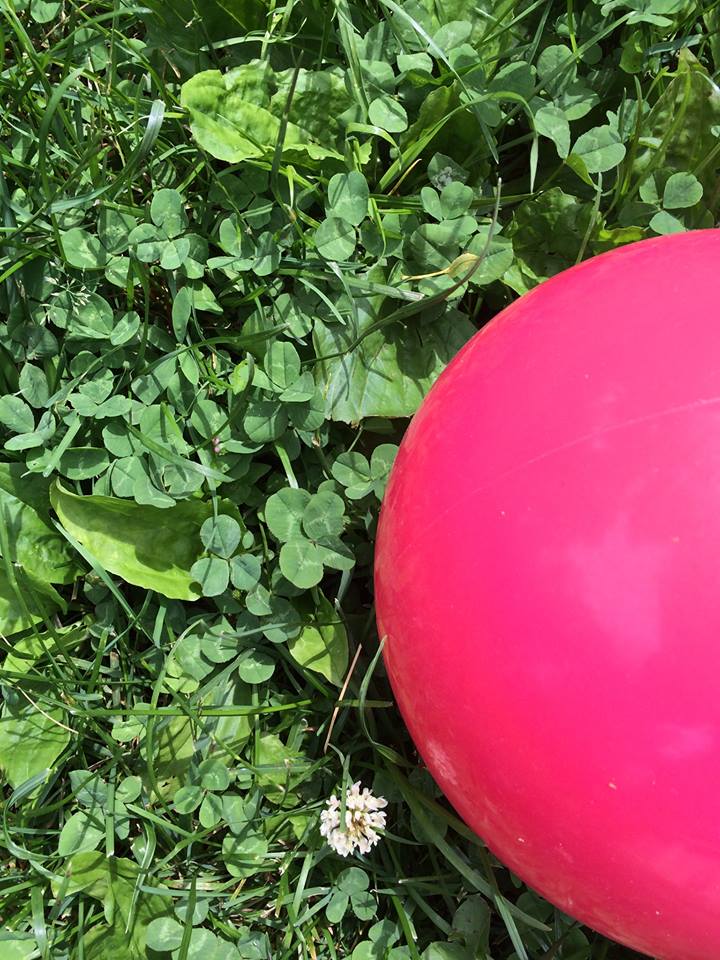
Here’s my favorite photo, for if you look closely, you’ll find two clovers next to the ball.
And believe it or not, I’ve even found a five-leafed clover!
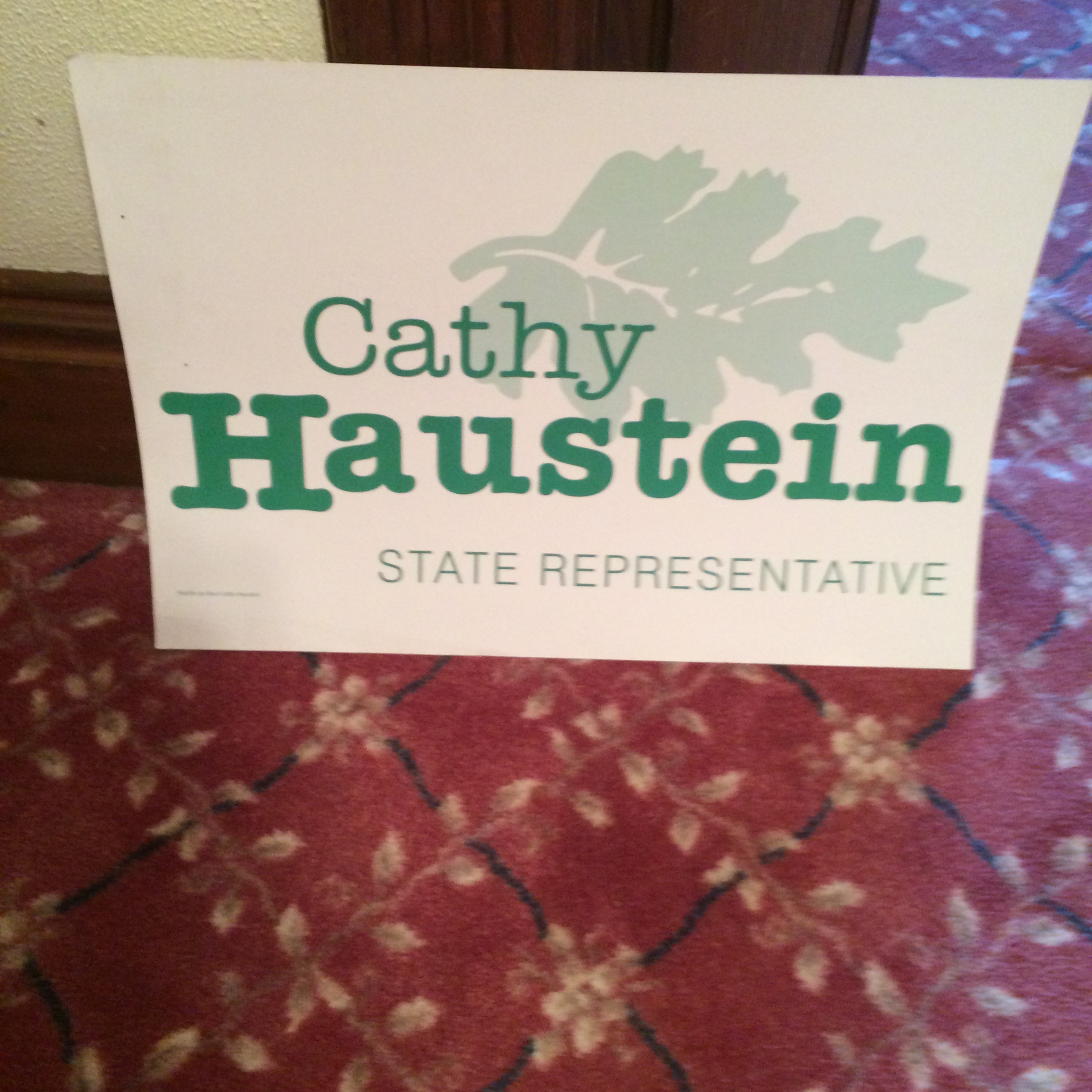
People steal and deface signs so a window sign was the go to.
A while ago I ran for public office. I ran because I was a member of League of Women Voters. We hosted candidate forums. There were two elected officials who came, reluctantly in my opinion, and used the time, not to listen, but to toss out a variety of scare tactics and to be walking, talking advertisements for their special interest donors. One man was a manufacturer who had something to do with plastics and any type of regulation was his enemy. He would ask rhetorical questions about why this or that needed to be regulated and being a chemist, I would answer him with some science. Then I figured it out–he didn’t want an answer.
The other guy struck me as terribly lazy with a million excuses as to why he couldn’t accomplish anything for our district. I got mad. I thought “this an affront to democracy.” They represent us. So I filed the proper papers at the State House and with a lot of help from friends and my husband, my treasurer, I ran against “Sleepy.” I didn’t win, but I learned a lot.
I began by knocking on doors. I would tell people I was running for state representative and almost everyone would say “what’s that?” and “who is it now?” My big issue was water quality.
I had fund raisers. One fund raiser site was toilet papered the night before the event. I ran advertisements. A friend was a sign guy and he made some signs with an oak leaf and my name on them. Another friend had a printing company and made handouts–cowboy cards they are called. My campaign manager was the high school government teacher. Pretty soon, my opponent knocked doors for the first time in his life. He ran advertisements. He had signs. He sent out mailers. I was against God and family apparently. That kind of thing really works in my district. Probably a dead dog could have run on that platform and won. A friend of my parents even ran a radio ad against me.
You learn a lot about politics doing such a thing. You have to disclose who gave you money and you can look up who donates to your opponents. Several people donated to both candidates. When you run ads you have to say who paid for them—have a disclosure statement. One newspaper left off my disclosure statement and I got in mild trouble from the state. The next election, I wasn’t running but another person ran against Sleepy and the same newspaper left off her disclosure statement. I then wrote the election board and said I suspected that this was on purpose and it never happened again.
I got anonymous hate mail. I turned it in to the Post Office. My local party chair told the party chair of the other party (we all know each other here) and said that if it happened again, there would be a federal investigation. (True.) It never happened again,
The local chair of the opposite party called me up and chewed me out for walking down the sidewalk with some cowboy cards in hand, saying it wasn’t allowed. I called the county auditor and as I recall, he called her and said it was allowed. See the pattern here–you run for office for democracy’s sake and people harass you–not about issues or differences of opinion but on stupid “gotcha” stuff.
I saw that people do not show up to candidate forums. (I have even witnessed that the person who did not show up to the forum won the election.) I decided that one thing that would help politics is publicly funded elections.
Here is another thing I learned about politics. If you win, there are perks such as milage to visit your constituents and you get great, and I mean great, health insurance.
I found that I was bad at remembering names. This is not a good trait for a politician.
I took of photo of my opponent’s license plate because you know what, he had plates from the neighboring county. Not even from the place he represented. No matter. I lost. He won. A third party candidate jumped into the race. It was exciting. I spent $4 per vote. The winner spent $16 per vote.The man had to work for his seat for probably the first time ever. This made it kind of worth it to me. I wish I could write a novel about the experience but I can’t think of a single thing earth shaking or inspirational revelation about the process. I did it because I wanted to see a lazy man have to work for once in his life. That I did.
A while ago I was asked what it was like for a teacher to transition into summer.
First thing I did was get my house in a lesser state of randomness. It’s now just chaotic. I am not a tidy housekeeper which would no doubt shame my grandmothers. I am one of those people who can’t find things if they are put away. There are no Nobel Prizes for housekeeping. My lab on the other hand, is clean, as an analytical lab should be. Priorities.
I usually do some sort of laboratory research in the summer. During the school year, a student researcher might work 3-6 hours per week. In other words, at the best of times, each week accomplishes a little less than a day’s worth of discovery and insight. This year, I didn’t plan to do research and in fact, I miss it. As Isaac Newton said, it’s like picking up pebbles on a beach to learn the secrets of nature and they are indeed, right there waiting for discovery. Summer is a great time to make strides in research. I’m sad I didn’t come up with a project but one is on the horizon for the fall that I’m excited about.
This year, I decided to concentrate on reading and writing fiction.I became the teacher of Short Story Writing quite suddenly after my fiction writing mentor, Arthur Johnson, decided to retire. The course has been fun to teach but I’d like to give it a tiny bit more grooming. I’ll be looking for short stories to use as examples of classics and how to do it right. Some of my favorites to use are “The Yellow Wall Paper“, “The Tell-Tale Heart,”(always a favorite of the class),”St. Lucy’s Home for Girls raised by Wolves, ” How I Contemplated, ” “Incendiary Girls,” “Edison, New Jersey, ” (often my students do not understand people trapped in a situation), “Hell Heaven,” and “The Pukey.” What’s one thing you notice about them? There is no problem solved by a gun and no “it was just a dream.” They might just be saying something about the human condition. Maybe there is a beautiful word or figure of speech. I’m going to add something by Constance Fenimore Woolson. Any more suggestions? What’s your favorite story?
I’ll be going to a writing conference, the Iowa Summer Writing Festival in Iowa City. I need a pilgrimage to Iowa City every now and then to give a penance to my younger self for making a poor choice when I moved away from there and started a new job while pregnant. Talk about stressful. One thing I can say about my life is that no one ever rescued me from my bad choices. This summer, I’ll be working with Sands Hall on my third novel.
That is what I’ll be concentrating on during the month of June. In July, I’ll spend time with family, go to some music festivals, and start working on a lab manual for Instrumental Analysis which I’ll teach in the spring. I am very happy with my “Cleaner, Greener” lab manual and now have the itch to write another.
In other words, teachers use the summer to re-gain balance and to plan for the future. It’s a wing spreading time, but come fall, I’ll be happy to see everyone again.
School’s out here in Pella and summer unofficially begins. In Iowa, we will watch our corn grow from the tiny shoots pictured above to up to 12 feet. Imagine every one of those tiny plants as 12 feet tall. It’s supposed to be “knee high by the 4th of July” but is often much taller than that.
Iowa grows about 2.3-2.4 billion bushels of corn per year. (A bushel is 56 pounds.) It’s not sweetcorn. Much is field corn and used for ethanol production, sweeteners, and most of all, animal feed. Ninety-five percent of animal feed is made of corn. Citric acid, used as a food preservative, food additive, beer additive, component of soaps and detergents, and to make artificial lemonade, can also be made from corn. Iowa produces the most corn of any state in the U.S. and about 10-20% of the corn produced is exported.
Like other grasses, corn contains p-coumaric acid which can act as a mild antibiotic and reduce the chance of stomach cancer.
About eighty-eight percent of corn is genetically modified. (2012 statistic)
Herbicide use on field corn has increased as weeds have become resistant.
It’s everywhere in my agricultural dystopia of Cochtonia, too. It grows quickly and some even glows in the dark.
What are my deep, dark feeling about corn? Well, it’s green and that is good. But I’m not from Iowa originally and I have always found it sort of scarier than hell. Yes, it’s true. There is so much of it and it is absolutely everywhere. It even makes it more humid here in Iowa. Honestly, do we need so much of it? It’s a thing you can’t escape. Yes, it is pretty when it sways in the wind and even kind of pretty when it’s dried for harvest. (see below). But if ever there was a zombie plant, it would be, yes, it would be corn.One minute it’s so small and cute and the next minute it’s huge and being sprayed with crop dusters. It’s everywhere. It’s in everything. If I eat high fructose corn syrup I get insanely hungry. Zombie. Believe me. You can’t escape the corn. ***












 ***
*** Catherine Haustein
