



A close look at the stems shows what color they will become.

The friendly grower gives my aunt advice: plant the whole pot in the spring, dig it in the fall, trim the roots and you can enjoy this beautiful plant for another year.



It’s National Novel Writing Month and I have been challenged to put up something from my work in progress. My work in progress is still at a delicate stage but I’d love to share the opening of my novel Mixed In, a tale of chemicals and dystopia. It will be released this spring by City Owl Press. Until that time, here’s a sample. (Danger,naughty word included!)
Creating a beer is much like breeding a dog. Dogs have that one tricky gene, number fifteen, that can cause height variation between 5 inches and 7 feet, more than any other land vertebrate. (Imagine humans ranging from 2 to over 30 feet tall.) Hops are complicated, having intricate aromas, regional differences, and changing chemistry upon brewing.
Sipping the dark and sylvan house ale, I studied the wavy haired bartender. A pretty man with smooth skin, a dark mustache, and little sideburns, he resembled Nikola Tesla, who despite his love for frequency and vibrations, was said to have died a virgin.
I’d taken refuge in the Union Station bar after my bus broke down as I rode it home from work. Officials in black bomber jackets and belts covered with devices that hung like pine cones walked past the window. I hadn’t seen that black uniform before. Those belts loaded with technology told me something. I was in what Cochtonville considered a bad neighborhood.
I wasn’t a citizen of this city-state, carved out of Iowa, with a name pronounced “Cock-Ton” like an enormous penis. I was a chemist from Michigan on a work visa and didn’t worry about the officers. I had a permit to be here and, unlike most of the population, to have seeds. This was my first month in the country and I was struggling to understand my new home and connect with the people here.
Update: Mixed in is now available in print.
One of my favorite Halloween characters is Frankenstein’s monster, the guy created by the scientist Victor Frankenstein from assembled body parts and brought to life by a spark of lightning. The careless scientist was hoping to bring his dear mother back to life. You can’t bales a guy for trying but he violated a rule of science–he worked alone and the hapless creature was created in secret. Only alchemists work in secret. The rules of new science are:
Never work alone in lab.
Keep a carefully detailed lab notebook.
Share your results with others.
Thus, to work in secret is to bring about all sorts of trouble. In 1818 when the novel Frankenstein was published, scientists were just beginning to move away from alchemy and to understand electricity. Batteries made from two metals and an electrolyte were a new thing. Imagine the world-changing perspective of a localized source of energy!
Franklin had established that lightning was a huge static charge and that it was attracted to tall pointy objects. No more would people see a lightning strike as being the hand of an angry God. It was Mother Nature.
Scientists got a charge from electric eels. They began to assume that there is an electrical life current flowing through us. (There is, the oxidation reduction reactions in cells but this is far more complicated than those in 1818 could imagine.) The hope was that all it might take to bring a loved one back alive was a jolt. Creepy experiments were done on executed prisoners and severed heads of the dead were made to twitch with a spark from a battery and they grimaced and fluttered their eyelids.
As for the character of Frankenstein’s creature, he turned out to be intelligent and sensitive, only resorting to menacing his creator once he had been firmly rejected and had no companion to turn to. Like all great writing, Frankenstein says something about the human condition. The novel makes a statement on nature and nurture and the cruelty of judging and rejecting someone based on their appearance.
My favorite version of Frankenstein? It has to be Young Frankenstein.
Happy Halloween Frankenstein! Glad you are still with us!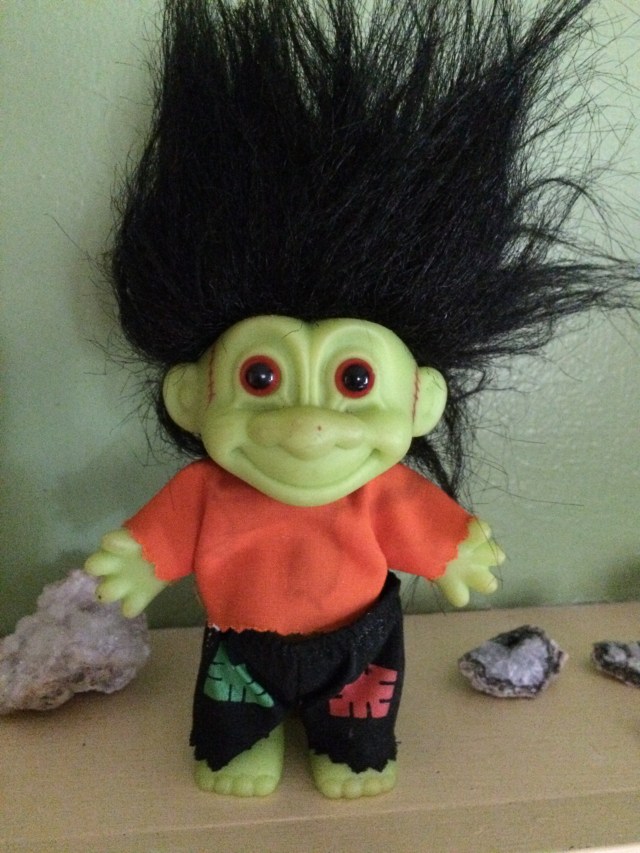
Two years ago I signed a contract for Natural Attraction with Penner Publishing. I’d written numerous short stories over the years but this is my first novel. I’d taken a break from writing fiction to write non-fiction because
1. I needed money and
2.. I didn’t feel very wise.
Having teenagers will do that–make you feel broke and not very wise. And we don’t have dowries now but we do have weddings to pay for. Not that I didn’t adore those years. Quite the contrary. They were a rush of emotions and activity. Bottom line. I didn’t write unless it was for solid money. That meant I wrote about science. I wrote the truth about science. From this I learned at least one thing–don’t argue with editors. They have a tough job and a vision. Plus they won’t pay you if you don’t follow their directions.
I have an MFA in fiction writing and as a child I wrote prolifically. A writer needs something to be passionate about and for me that was science.I like how science changes perceptions. My best advice for those wishing to get into an MFA (Master of Fine Arts) program is this–have an angle. For me, it was science. Writing about science wasn’t enough. I wanted to be a scientist. I honestly love the hands on aspect of laboratory research. I even like fixing equipment–perhaps because my grandfather was a plumber. I like scientists. They’re quirky and unbelievable humble before Mother Nature.
How did I turn back to fiction? I was encouraged to do so by other fiction writers. I sat down to write a short story and it became a quirky novel about a scientist in 1871 who takes a tonic to become a man and falls in love with a preacher. The novel takes a humorous look at gender and class roles in the Victorian Society when they were absurdly strict. My goal was to de-romanticize that time period because in many ways, it was terribly cruel. It also explores how science gradually changed ideas about slavery and human equality. As I said before, that’s what I love about science.
I thank Penner Publishing for taking a chance with this book. I am grateful for its acceptance because it contains a diverse set of characters. The Kindle version is on sale right now. Tomorrow I’ll be at the Pella Author Fair selling copies. Yes, you do have to get out and sell your books and promote yourself as an author. You need to be on social media.
I also thank everyone who has purchased a copy and thank those who have put up a review to help those who might enjoy it.
Did my life change dramatically in the past two years? Not really. I do now get to teach a fiction writing course. My students never fail to impress me with their passion and creativity. And every day –often in the morning and before bed–I spend some time with a new story to tell–weaving in my experiences as a scientist and a female. The bottom line for me now is this: there are not enough diverse stories about the female experience out there. I’m doing the best I can to tell these stories. Once again, to everyone: Thank you!
Wouldn’t this Homunculus be a great Halloween costume?
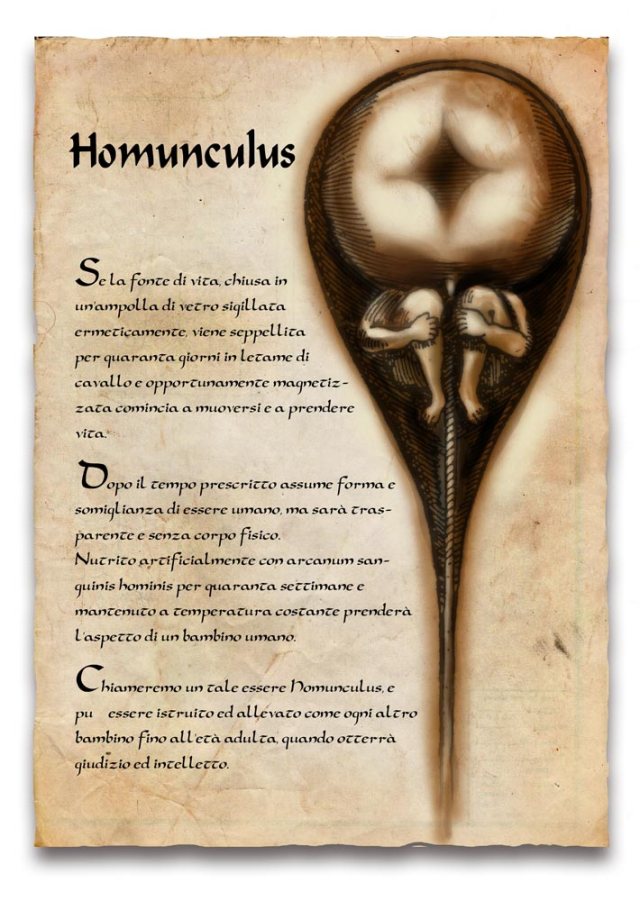
The idea that a tiny person could be made by a man without help from woman is as old as Plato. The no-woman-required homunculus appeared in alchemical writings around 1530. It was wishful misogyny. How dare women do something men could not! But even as late as the 1920s, many people believed that the sperm contained a tiny person and the woman was no more than dirt for the seed to grow. This thought gave people permission to see women as lesser beings who didn’t deserve property rights or the right to their own children. It explains misplaced disdain for older women and women who don’t have children. Even the religious figure Martin Luther questioned if women had souls. Fortunately, science put a halt to this inequality.
The idea of inheritance from both parents, genetics, was first proposed in 1866 by Mendel who determined that peas contained traits from each parent in the same proportion. His work wasn’t widely known until 1900 and his clear evidence that both parents contribute equally to the offspring wasn’t accepted until 1925. The notion that the mother was an equal in the creation of offspring is less than 100 years old. This means that for eons past, a woman was blamed for barrenness or even for being too fertile. Charles Dickens, that great champion of humanity, brought this charge against his own wife as he abandoned her.
Genetic equality gave women more credibility but even still, James Watson, who is a discoverer of DNA, was a sexist man. Old ideas hang on even against clear evidence that they aren’t true. Fortunately, with time, the idea that women are lesser beings and a form of dirt because they bear children is on the way out.
One great thing about being a chemist is, well, chemicals. I was looking through a catalogue the other day and saw Vitamin C serum. Allegedly it’s good for the skin and being an antioxidant, slows down the aging process. Here’s an aside–I have also read that oxidants are useful in getting rid of wrinkles so there’s conflicting advice out there. However, in my case, I just wanted to make and try my own serums and knew that Vitamin C is cheap. (Make sure to get the L form as in L-ascorbic acid.)
I store my Vitamin C serums in brown bottles and try to use them within two-three weeks.
1/4 tsp Vitamin C (L-ascorbic acid)
1 tbs water + 1/2 tsp
2. Moisturizing recipe
1/4 tsp Vitamin C
1/2 tsp glycerin
1 tbs Water
3. Super Moisturizing recipe
1/4 tsp Vitamin C
1/2 tsp glycerin
1/4 tsp Vitamin E
1 tbs water
Shake before using
4. Oil-Vitamin C
1/4 tsp Vitamin C
2 tsp water
1/2 tsp Almond oil
1/4 tsp Vitamin E
1 tablet Coenzyme Q with lechithin –cut open and add contents
Shake well. Shake well before use.
Here’s another product I’ve made
Easy Eye or Night Cream (kind of greasy)
1 tbs coconut oil
1/4 tsp niacin
Mix well.
If desired, add 1/8 tsp Vitamin A. Also optional 1/8 tsp orange oil
As you can imagine, you will need to try a tiny bit first to make sure you don’t have a bad reaction to any of the ingredients.Vitamin C is an acid and niacin (B3) can make some people look flushed so use with caution.
I also purchased a skin cream kit from Lotion Crafters. Here’s a warning on that–the lower volume kits need amounts so small that you can’t easily weigh them out with a kitchen scale.
All in all, I enjoyed making creams and lotions.Here’s what mine looked like when I was done:

Now the real question: did I save money? On the serums yes, probably. However, my formulas don’t have the emulsifiers needed to make them super smooth. They are low budget items. On the kit from LotionCrafters, I’m not certain. Unless you are into mixing chemicals, it might not be worth it. If you don’t enjoy careful measuring, it might not be safe. But I’m into mixing and probably will make these things again.
“Take a moment to streamline your prose,” I told my Short Story Writing students.
To do this
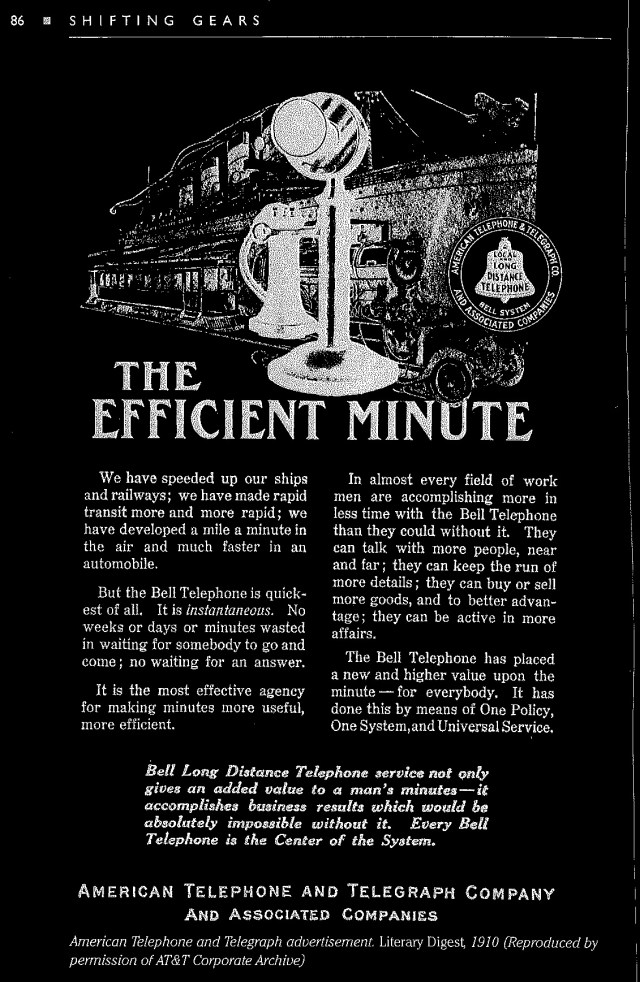
I grew up learning that Hemingway was a great writer. His prose was so simple and unadorned–just like a punch in the gut. There were characters barely described and given names like “the woman.” He was in a word, efficient. Believe it or not, this whole notion came from science and technology.
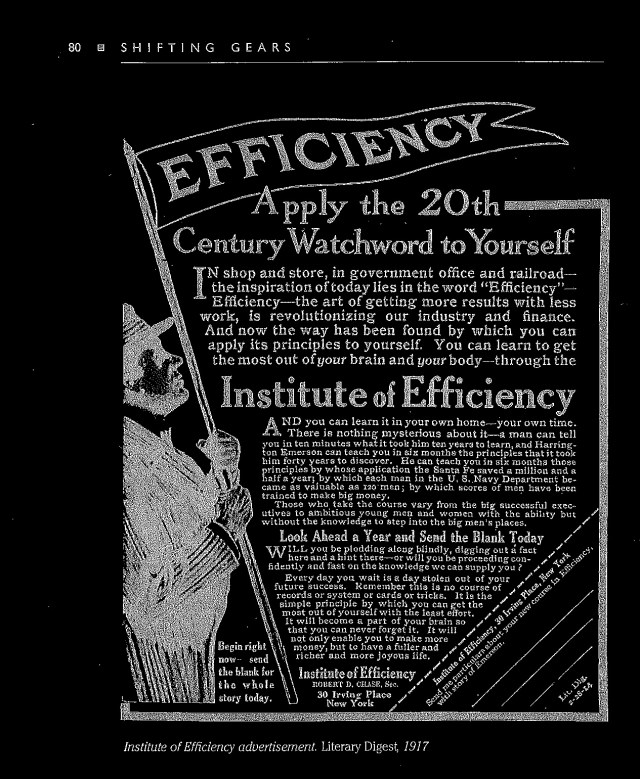
In the 1900s the idea of efficiency, a near worship of it, pervaded society. This idea came from studies of brewing and of machines. An efficient process lost less heat and did more work. This idea began in England with James Joule, the son of a wealthy brewer, who studied thermodynamics but it really lurched to life in the juggernaut that was American culture. Everyone had to work and be useful. The idle rich were a problem. Inefficiency in buildings was a problem. And inefficient prose was a problem as well. Take a look at some of these photos and advertisements.
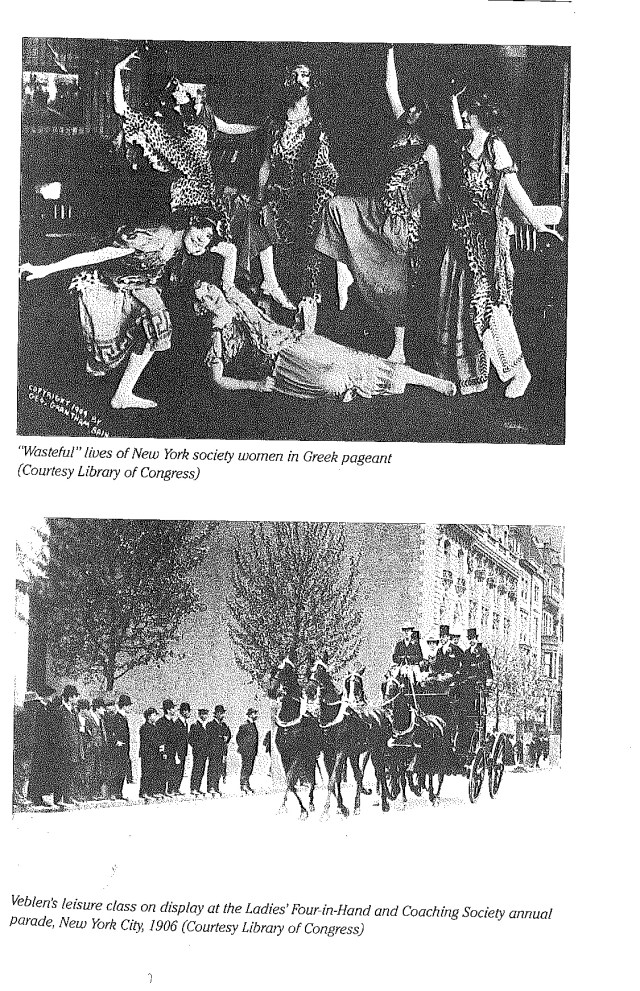


Hemingway came about his efficient prose in an honest way. He was a war journalist and telegraphed his stories back to the U.S.. The telegraph coded letters as dots and dashes and each one cost money. And with the advent of photography, people didn’t need or want the long descriptions of scenery that punctuated older fiction. They only needed enough to set the mood and ground the fiction.
Today, the century old efficiency movement is still with us. We are told to want stories that are sleek, like an Apple product.Some publishers even remove the Oxford comma. Professor Cecili Tichi called this new prose “machines made of words.”
I like machines. Nobody likes rambling or babbling. But sometimes, I want something more delicious. I want the rush of pleasure from abundant words and the keen insights of metaphors and turns of phrase, the dappled light of a brilliant day as was today.
What about you? Who do you read? What’s your style? Sleek? Efficient? Or old school?
I’m not sure it’s accurate to say that I love shoes. It’s more that I need shoes. To be a laboratory scientist means closed toed shoes shoes plus cement floors. According to our Fitbits, professors can walk three miles per lab or up to six miles per day while supervising lab classes. I love labs and would rather walk than sit all day. However, I’m ever in search of the elusive comfortable shoe and I join a plethora of health care workers, teachers, beauticians. craftspeople, and sales staff in my quest.
What shoes do hard working cement walkers wear? I asked my Facebook friends: what shoes do you recommend? Here are some of my findings:
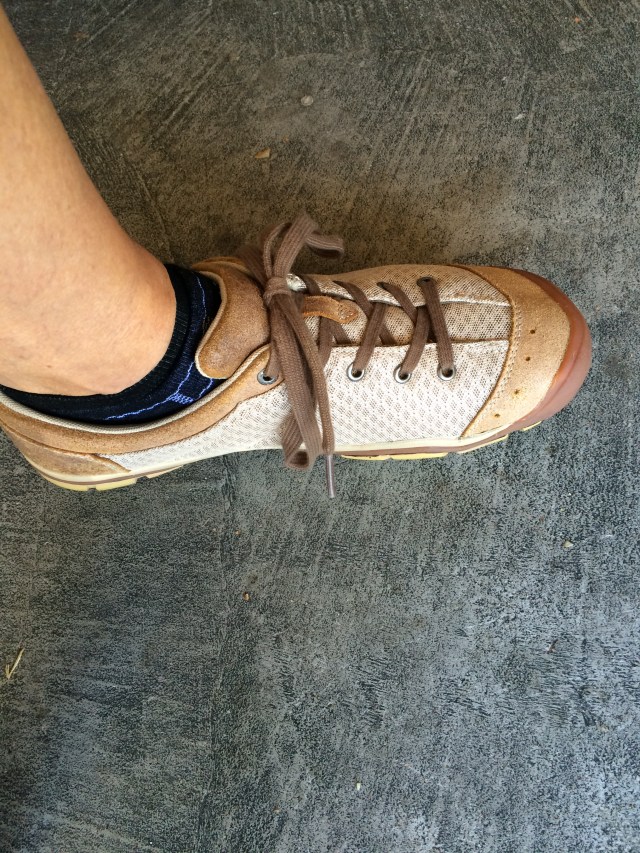


I went to the local shoe store to compare my Hokas with other shoes.
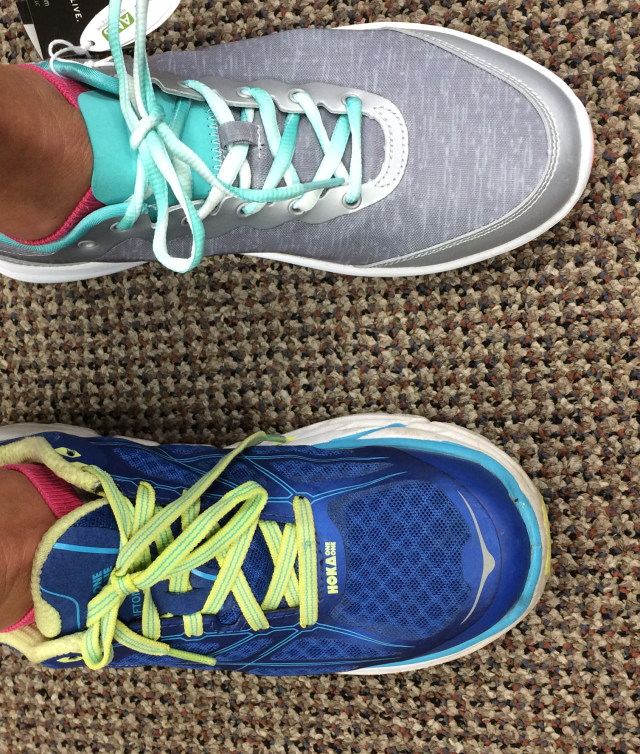


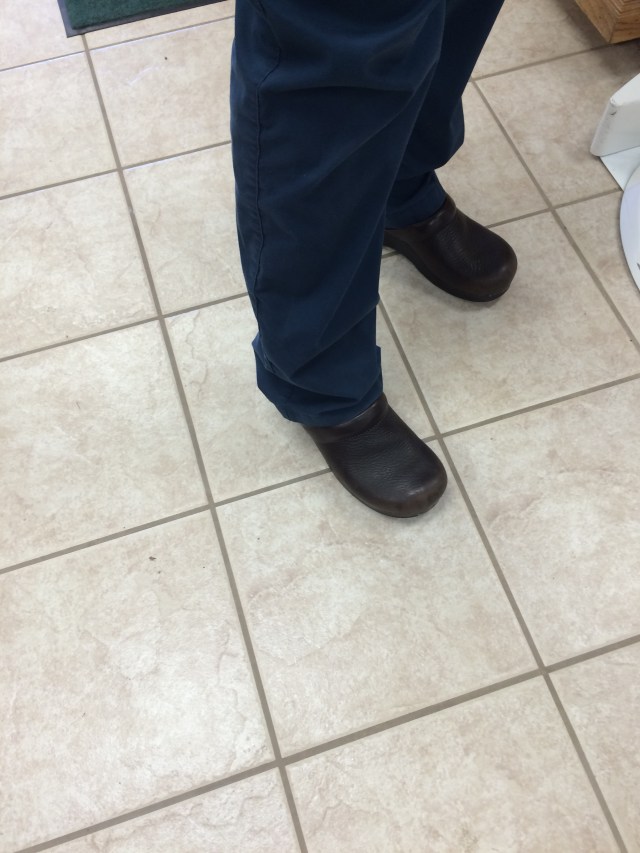

When the going–and weather– gets tough, many cement floor professionals don hiking boots.
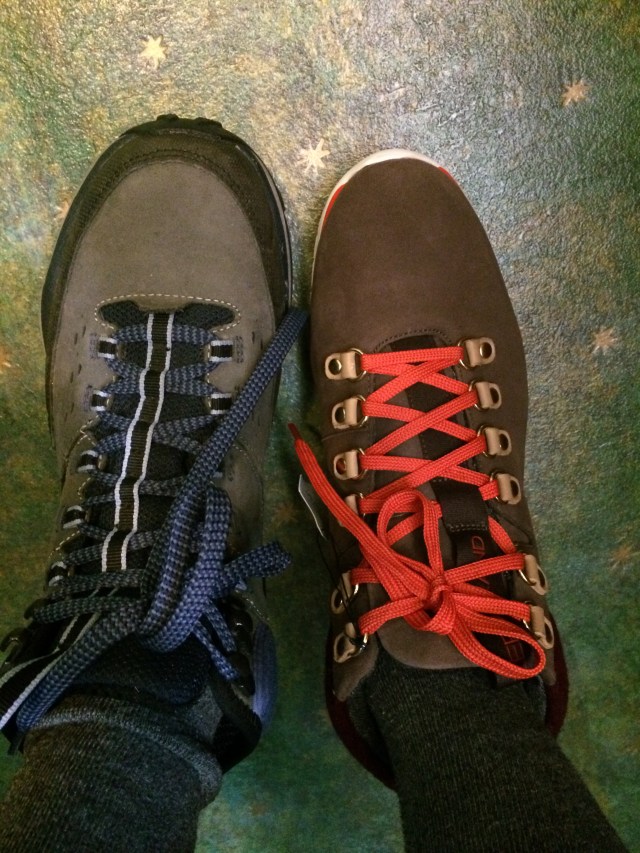
Timberland boots were also recommended as “are more than comfy. I constantly walk for 45 or so hours a week and my planters fasciitis isn’t even visible.”
A veteran of trade shows gave this advice: change your shoes at least twice a day and get a foot massage. She explains, “My feet sweat, so not only did I change my shoes I changed my socks too. I gave myself a food massage when I changed shoes (just a couple of minutes starting at the toes and working back). It truly was the only thing that kept me upright for 12-14 hours at the shows.”
Here’s to all who spend their day on cement! Maybe some day my lab floor will be covered with an anti-fatigue mat. Until then, I’ll search for the Holy Grail of shoes–and take that advice to change pairs frequently.
I’m busy making final edits to Mixed In. Here’s an interview with me on my publisher’s web site. Yes, I do love mixing things–chemicals, food on my plate, and even genres.
The marriage rate has fallen in China as young women opt for self sufficiency. The oldest person in the world credits her early divorce and refusal to remarry as part of the secret to her 116 years. It makes a person wonder, if not for social rules, would women get married at all? Please take a moment to answer this poll and/or add your insights.
 Catherine Haustein