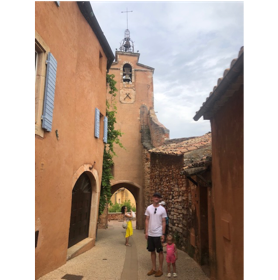
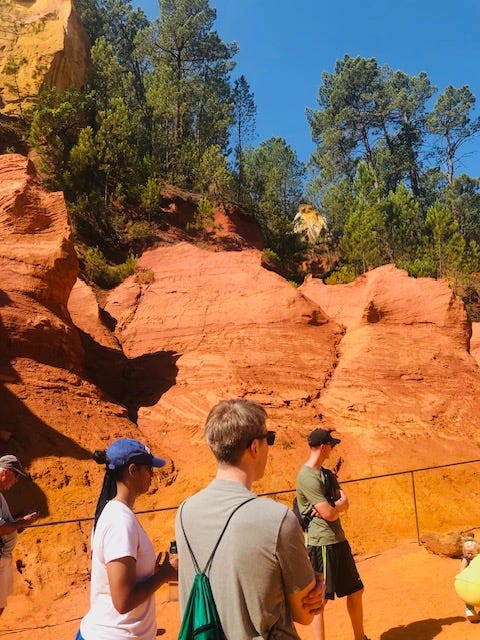
The family recently took a trip to France. We spent most of the time in Provence in the Luberon region, nesting in a villa in the quaint town of Roussillon.
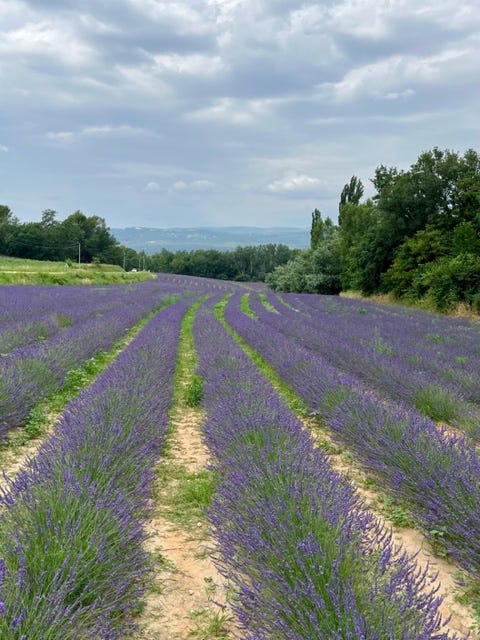
One thing you notice in France is how good it smells! The agriculture here includes melons, herbs, olives, wine, and lavender.
My son took the photos of the lavender fields.
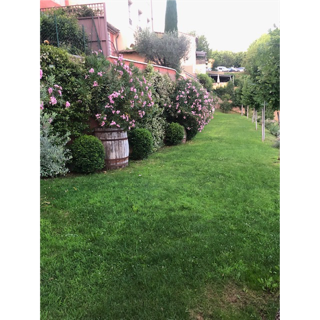
Everywhere you go are flowers and olive trees.
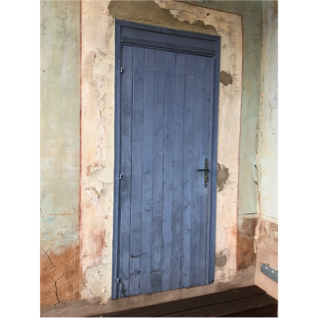
The ochre tinted buildings have colorful doors and shutters.
Roussillon is known for its ochre. You can even tour a mine—not at all rigorous.
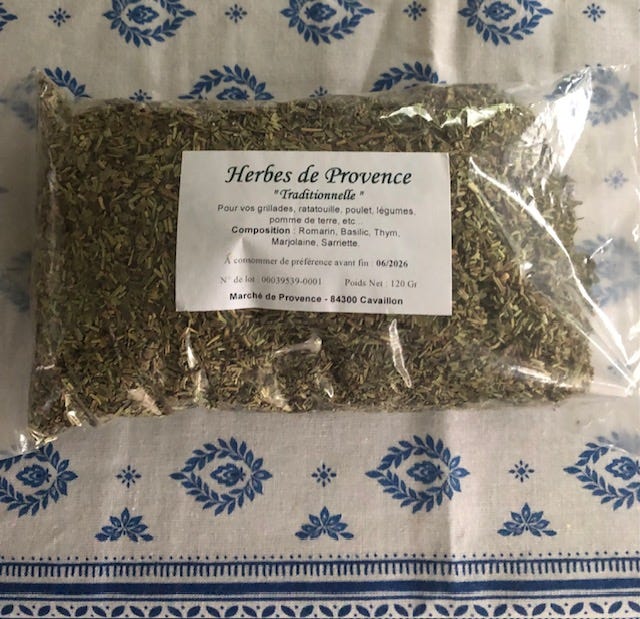
The iron rich soil along with limestone and plenty of silica stimulates the growth of many different plants including orchids, chestnuts, pines, heather, and the herbs found in Herbs de Provence.
It’s also got plenty of cute shops and art stores.
No photos allowed at the art stores but the region is also known for fabrics.
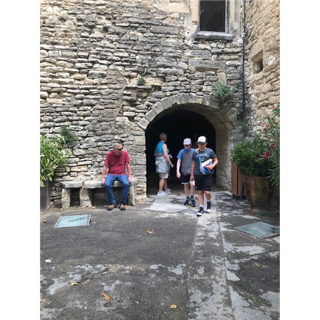
Nearby, the beautiful town of Gordes is made of sedimentary rocks and perched on a mountain.
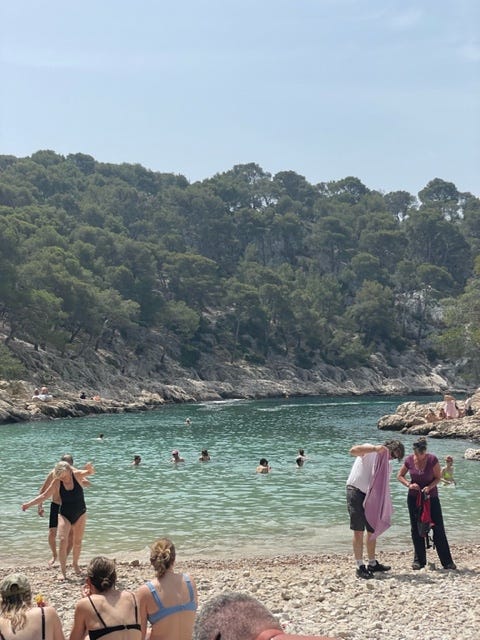
One day, we took a trip to Calenques of Cassis. Click on this link and see the cliff we walked along to get to a beach. No thanks Google maps, for not warning us of the steepness. We lived. No one fell off. I’m not sure how. Somehow this route to Port Pin was not as easy as it’s rumored to be.
This was our reward when we reached our destination. Fortunately, we found a safer path back to our car.
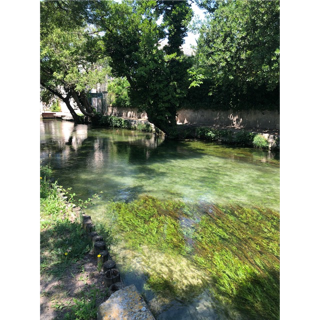
L’Isle-sur-la-Sorgue is a pretty town filled with canals and a lively market. Getting there involved a lot of twists and turns. Some of us (not me, I was a tagalong) rented cars and navigated the massif. Somehow, this area is advertised as good for cycling. I’m not sure about the bicyclists but we in our cars only screamed a few times as we squeezed through the narrow roads, far less than when we drove in Italy.
I wished I had my water testing equipment. I could show the people of Iowa what water can be—so clear and filled with fish.
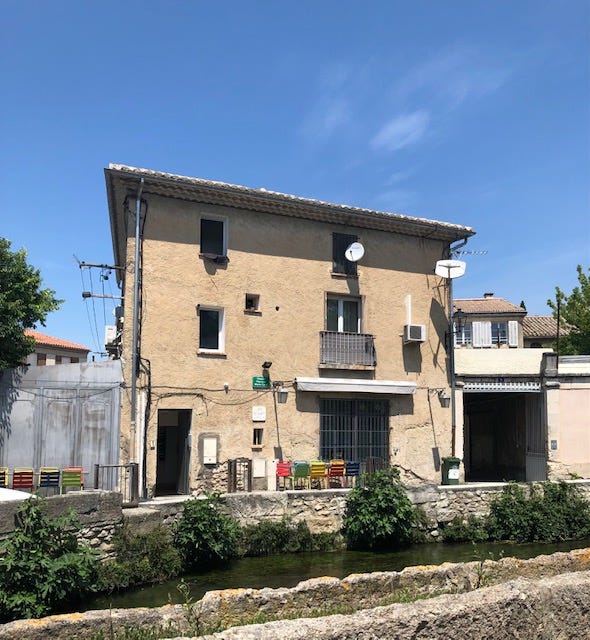
This says Pierre and Marie Curie Chemin. I thought “chemin” meant lab but really, it’s a street. When in France, try to bring someone along who speaks French. The locals aren’t dying to practice their English, although I found the French merchants very good at upselling.
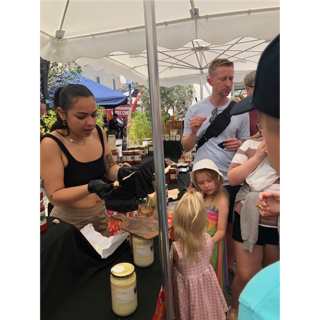
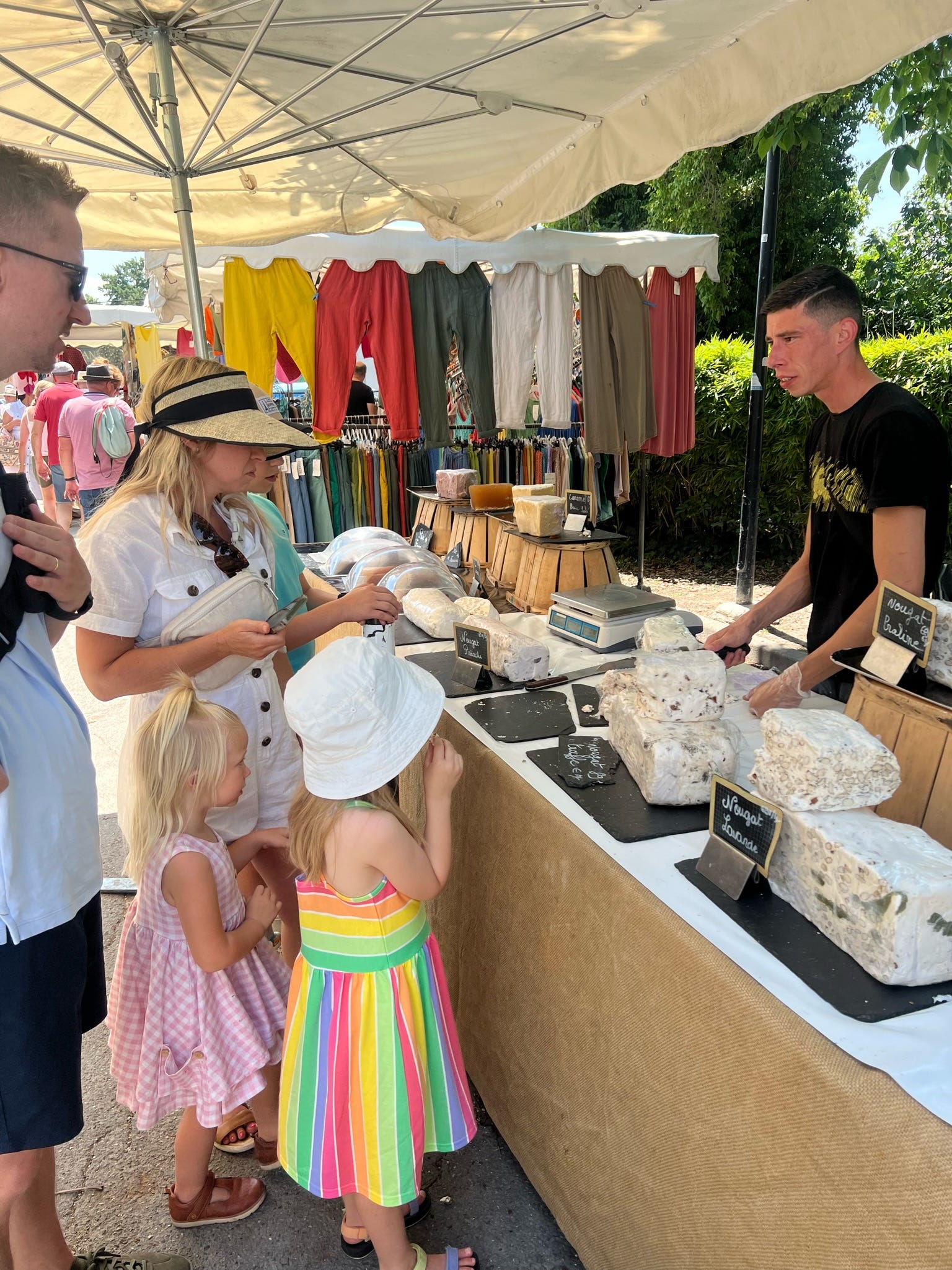
The merchants are very liberal with samples.
Nougat is made from sugar, honey, and nuts.
Before you know it, you’ll have sampled your way into many euros worth of nougat.
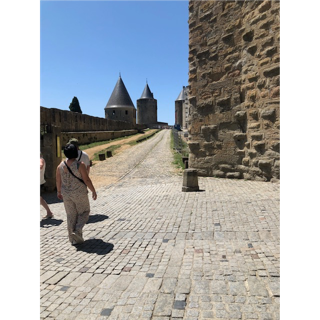
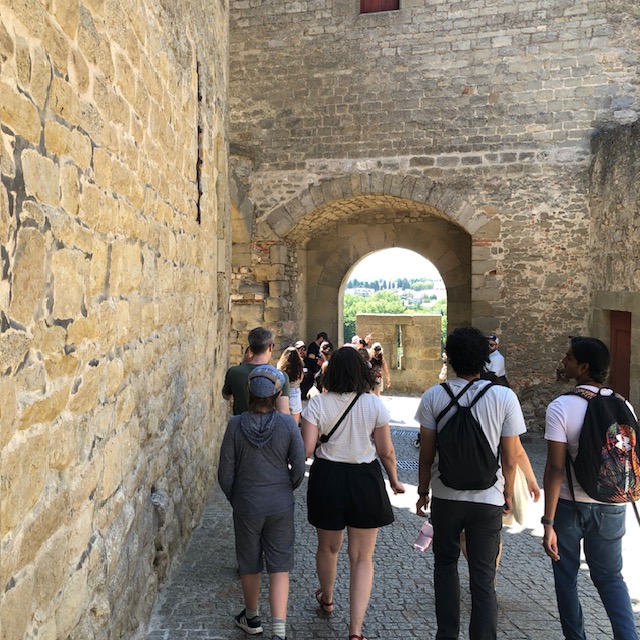
Southern France also has plenty of castles for exploring many built for by the Cathars as they tried, ultimately in vain, to keep religious Crusaders from exterminating them. One of their many beliefs was equality between men and women—very unpopular with the pope! Lesson here—watch out for those religious authoritarians! They’re mean.
Here are some photos from Carcassonne, some of which is now a lively marketplace.
Now I’m back to the land of corn and soybeans. I wish we had some lavender fields or at least better smells. Flowers are where it’s at. Barnswallow Flowers, I’m talking about you!
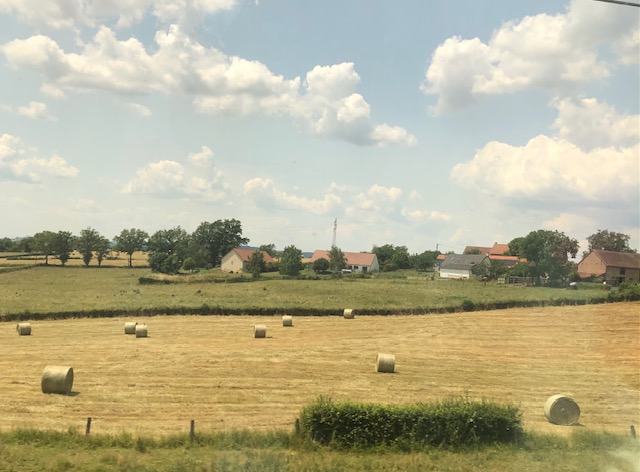
Not long ago, I was in France and took a picturesque train ride from Avignon to Paris. You know what I saw? Farms. Farms producing grains, lush melons, olives, flowers, orchards, and vineyards along with fields of dairy and beef cattle. The scene was idyllic.
Above: passing by a farm in Southern France
France is food independent, producing the most sugar beets of any country in the world. They also grow grapes for wine (of course), and corn for cattle and goats and other animals. A map of the farming areas here. They’re pretty proud of it, too, as evidenced by this cereal “Made and cultivated here in France.”
As an Iowan, I was always told to shut up any criticism of our monoculture farming. “We feed the world” is an oft repeated mantra. Clearly, Iowa doesn’t feed France. They have their own farms and vineyards. The fresh produce in the markets isn’t from Iowa. I got to wondering, does Iowa feed anybody? The answer is it can’t be relied upon for a healthy diet.
In other words, Iowa doesn’t feed the world. On a state by state basis, Iowa ranks tenth in the amount of land converted to farmland. What are we doing with all that land? What are we producing? Corn is by far the most abundant commodity followed by hogs.
A whopping 57%-41% of Iowa corn goes to making ethanol to put in gasoline. As for ethanol, I try to avoid it. I have a hybrid car and rarely have to fill the tank. Under these conditions, ethanol can be corroding.
Iowa feeds the world meat and processed corn products and ethanol. If you look up the top ten farm products in Iowa, you’ll not see a fruit or vegetable. This isn’t a healthy diet. For fruits and vegetables, we need to turn to another state–California is the nation’s top agricultural state.
France looked delightfully pastoral, a lot like Iowa in the old days, before ethanol took over with added windmills for energy production. I’m not saying what we have now is worse, although the visual appeal of today’s monoculture is lacking. Ethanol’s driving force is to rely less on other countries for oil by replacing it and its feedstocks with bio-based materials. It made sense but with more fuel, all we did was use more.
What’s wrong is the refusal to consider the downsides and to plan for the future. It seems like asking for trouble to make so much “food” into fuel. Can we explore other energy options here and return in part to cultivating more food? Other countries have been working on it. We should, too. There’s nothing wrong with being proud of your place. But let’s be honest. Iowa doesn’t feed the world. To say we do is a lie. it’s arrogant. I can’t be proud of that.
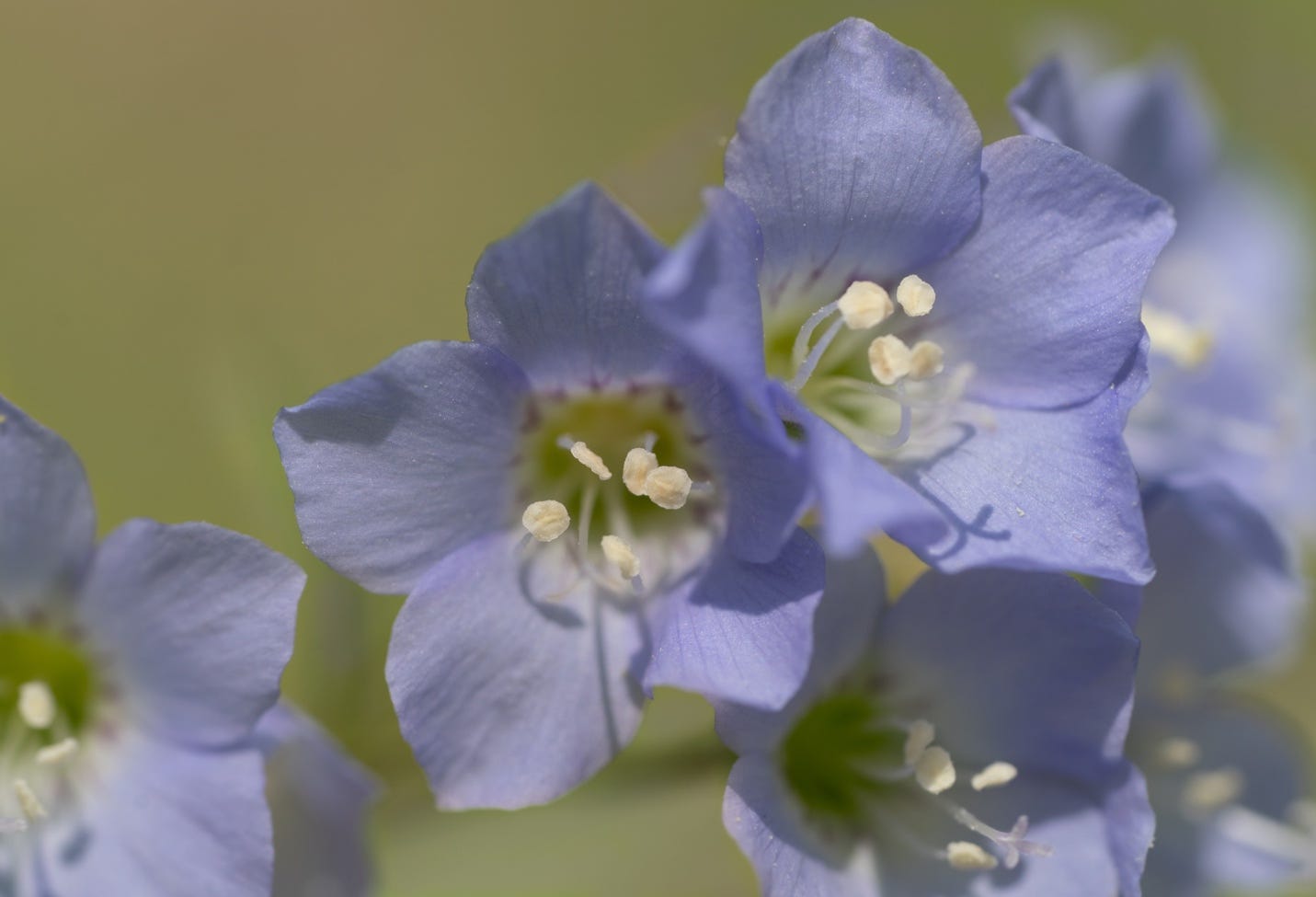
If you want to understand how living populations work together, a walk through Big Rock Park to view the spring ephemerals will do it. Kristen Siewert and Tom Rosberg each lead a foray into the Big Rock Park bur oak savanna this spring to help nature lovers do just that.
Pictured above: Jacob’s ladder by Kayla Lindquist.
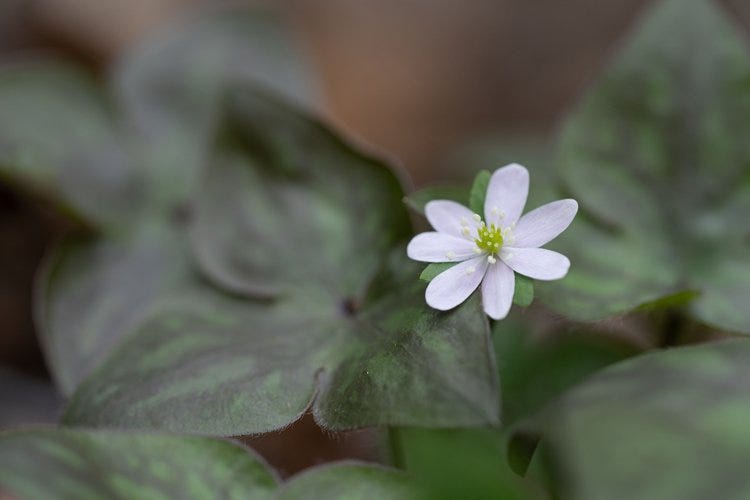
Although the trips were only a few weeks apart, the flowering plants weren’t the same because they were, well, ephemeral. Ephemeral plants have a brief blooming season, popping up sequentially and providing pollinators’ first food. They almost take turns flowering and as Tom Rosberg explained, this means they don’t compete with each other for pollinators. When the trees leaf out and the forest light dims, they stop flowering.
Spring ephemerals are an important source of food for bees and butterflies. The red admiral butterfly winters here in Iowa, making these first flowers of spring necessary for their survival. A popular ephemeral with them is the Spring Beauty.
Spring beauty and Dutchman’s britches, shown above, are plants which rely on ants to disperse their seeds. They produce seeds containing elaiosomes which are oil-rich packets of nutrient which act as smorgasbords for ant. The ants carry the seeds, discard them, and feed their larva the elaiosomes. You can read more about this here.
Spring beauty can be white or pink and variations in-between, including white with pink stripes. Pink seems to be the favorite for pollinators and those with pink pollen are especially prized by miner bees. Deer and rabbits prefer the pink flowers as well.
Some of the earliest spring ephemerals are the trout lilies. Trout lilies are so name because of their leaves resemble trout swimming in a stream. They are listed as being“special concern” and threatened species.
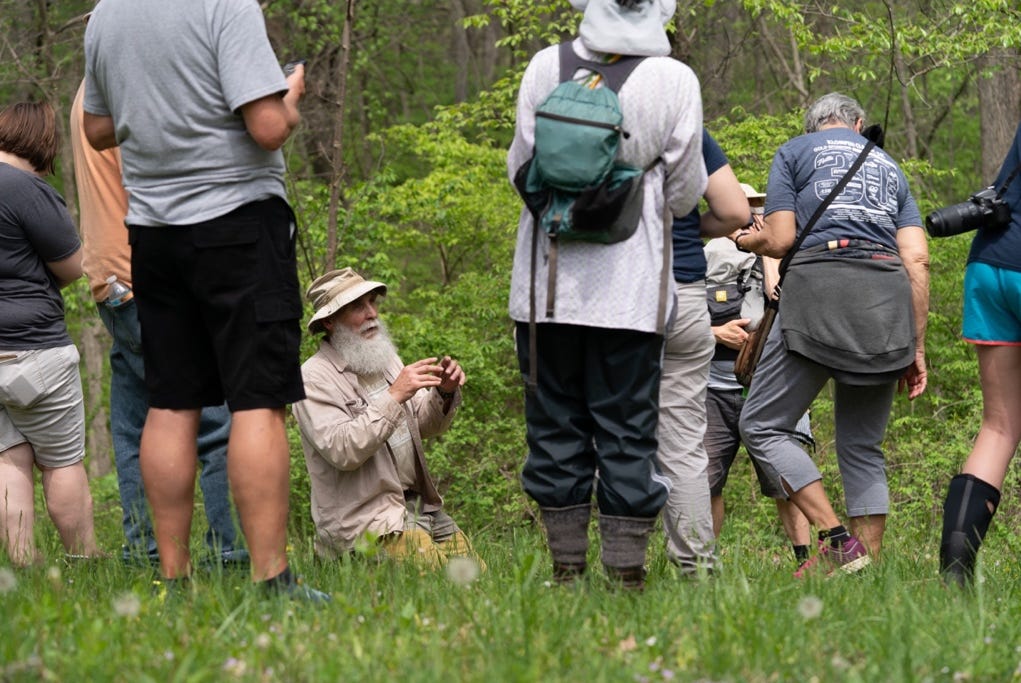
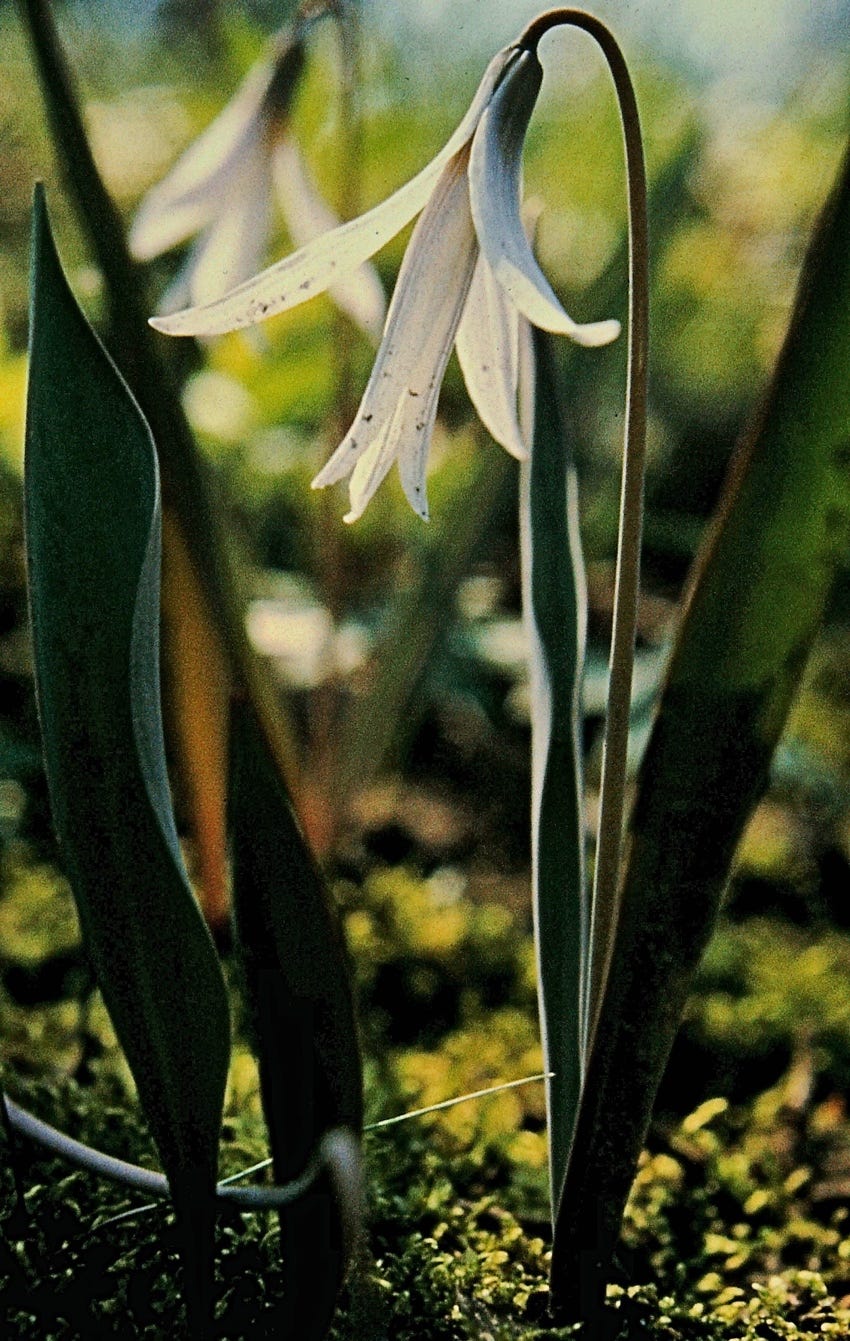
If we had an official flower of Big Rock Park, it might very well be the prairie trout lily also called the white fawn trout lily or Prairie Fawn Lily. Not only does Big Rock Park have a large population, the flower looks like a Dutch bonnet from Volendam, making them a perfect icon for the town of Pella. A very similar species with more mottled leaves, the white trout lily, can be found near the white fawn lily in the more open meadow area of the park.
Below: Dr. Rosburg discusses the intricacies of the Prairie Fawn Lily. Photo by Kayla Lindquist.
Below: Prairie Fawn Lily (photo by Steve Johnson) Big Rock Park has the biggest population of this plant in Iowa! They are now in hibernation and will reemerge next April.
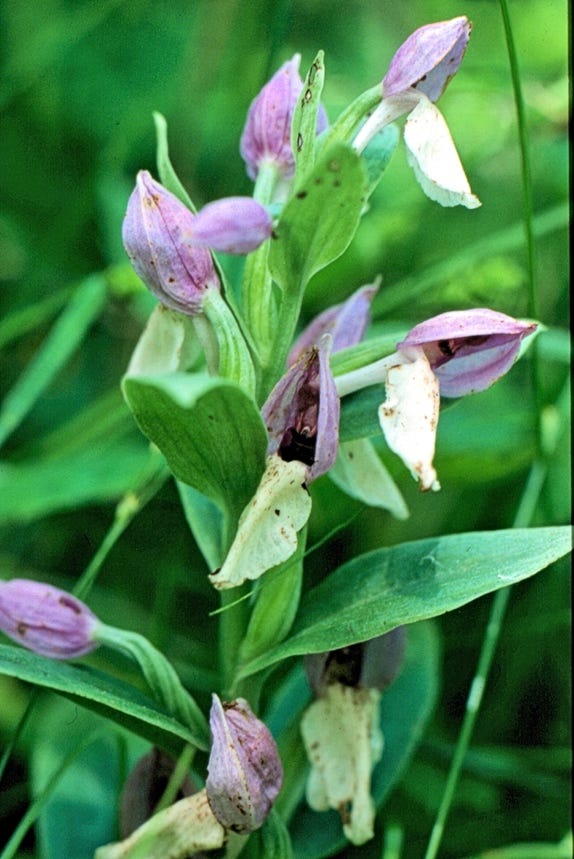
For those lucky enough to find it, the showy orchis is one of several native wild orchids in the park. It resides in the southern part of the park but is hard to find. At one time, it was trampled by paintballers! Invasive honeysuckle has spread into its territory, helped along by digging for new sewer lines at the parameter of the park. Hopefully the park can someday be declared a natural wildlife area and the ephemeral orchid will thrive again.
Photo by Steve Johnson
Above: Kristen Siewert and Kayla Lindquist enjoying the fine art of “forest bathing” and standing on the rock.
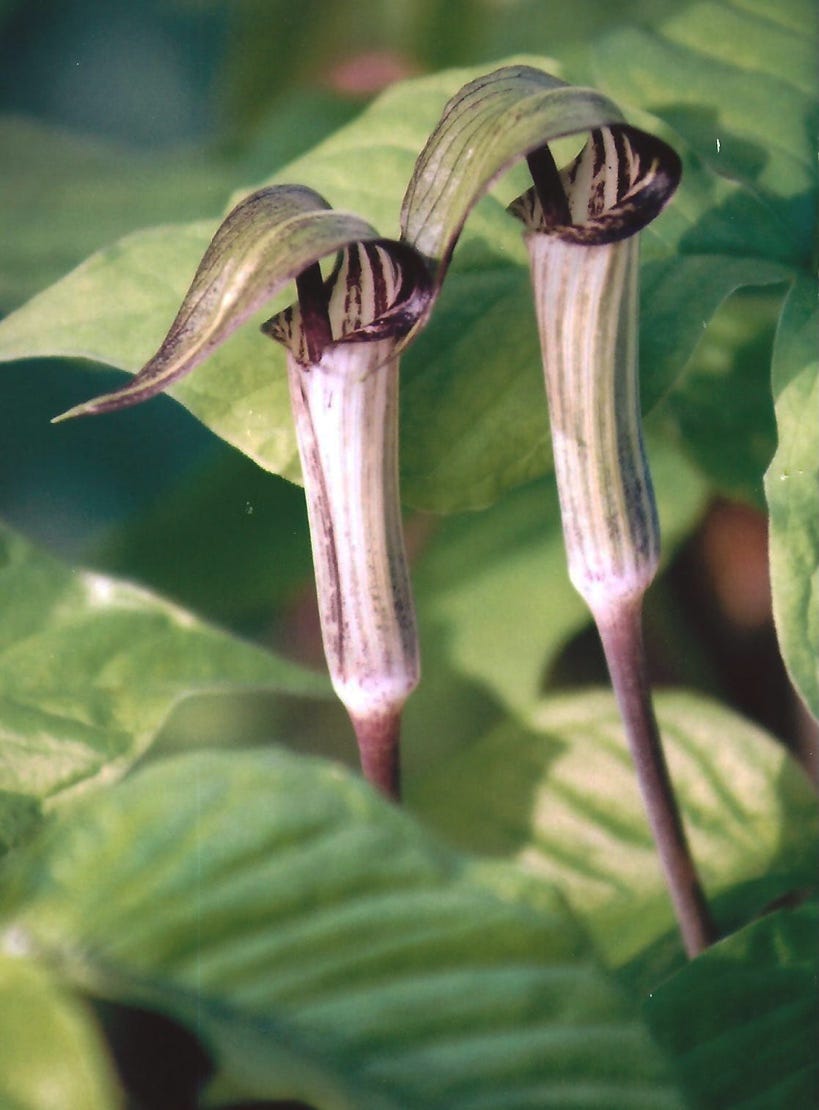
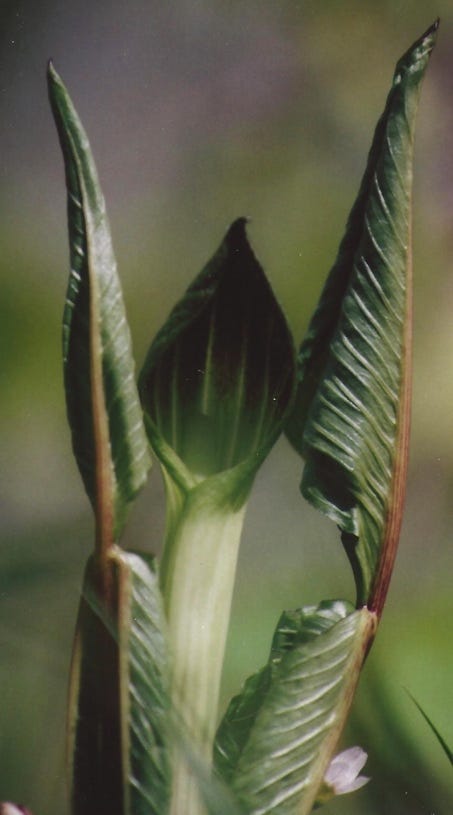
Although technically not ephemeral, Jack(or Jill) -in -the-pulpit pops up and flourishes from March to June in Big Rock Park. These plants have male and female flowers (the females have two leaves and some biologists say they are greener, photos here). In general, better nourished and more mature plants become females. The flowers can also be bisexual. The plant’s sex can change from year to year.
Two jack-in -the -pulpit showing maroon spadix. Dark colors guard plants from too much light and can warm the interior of the flower.
A young Jack or Jill emerging. Photo by Steve Johnson.
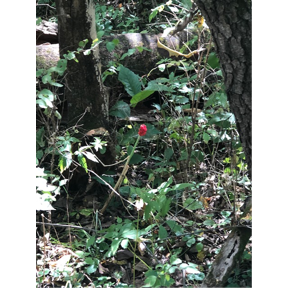
One biologist pointed out that maroon flowers often attract flies and don’t smell good. This is true for the jack-in -the -pulpit. They emit a smell that resembles fungus. When fungus eating gnats come to get a meal, they fall into the pulpit. Male flowers coat them with pollen and have an opening for the flies to escape. The females trap the (hopefully) pollinated flies, which have no escape but they bring the pollen. Some studies have found that the flowers emit a smell that resembles a female fungus gnat, luring male gnats into the plant. The female plants will go on to form a stalk of red berries which can be found throughout the park in the fall. Be careful! Every part of this plant is poisonous. Click here for photos.
Photos of the Jack and Jills- in-the–pulpit taken by Steve Johnson. Photo of berries taken by Cathy Haustein
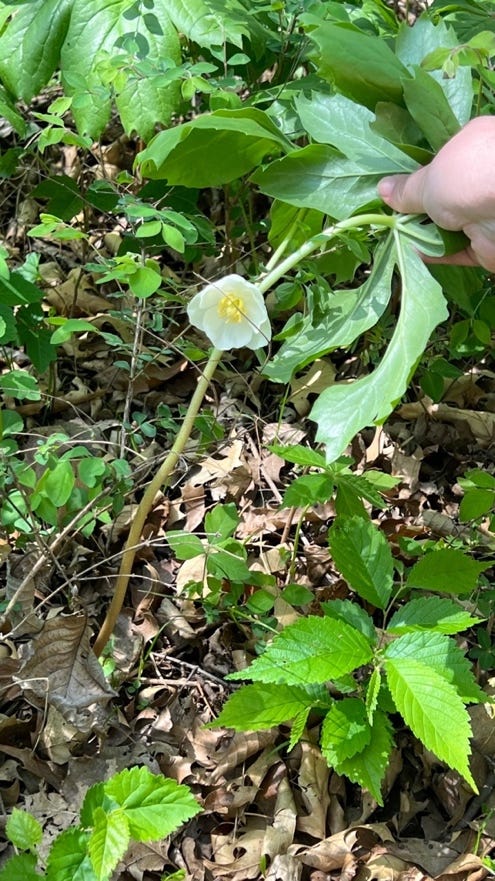
Mayapple is another common spring flowering plant at Big Rock Park, prevalent in the north west side of the park. Mayapples are big and green and nearly dwarf their one white flower.
Photo above by Sheril Graham.
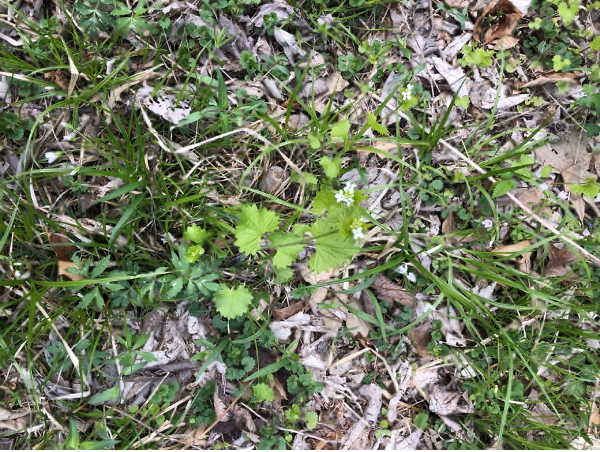
Garlic mustard is an invasive species in the park. Bees love it and it’s edible but it puts out chemicals that kill other plants, including trees, disrupting their symbiotic fungi. We didn’t feel at all guilty pulling it up but to really get rid of it, the plant should be put in a plastic bag, sealed up, and dumped in the trash. If you walk through some of it, brush off the bottom of your shoes or you’ll bring it home.
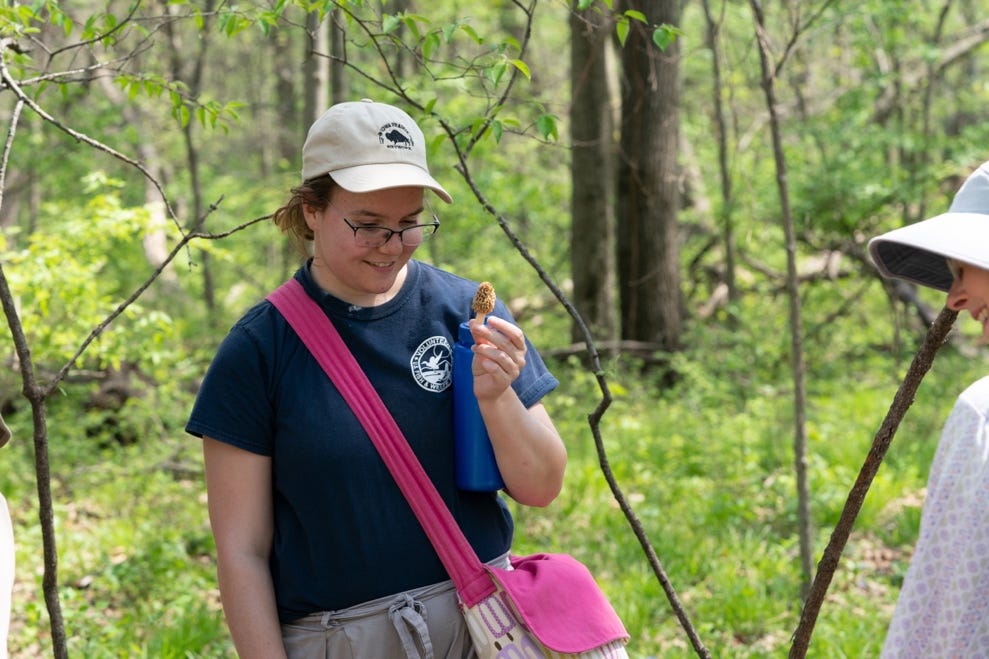
This article has mentioned fungi several times and fungi are prevalent at the park, including the sought-after morel mushroom.
As we transition into summer, most of these spring finds have settled down beneath the surface or have traded blossoms for berries. They’ll be back next spring to nourish our souls along with the pollinators!
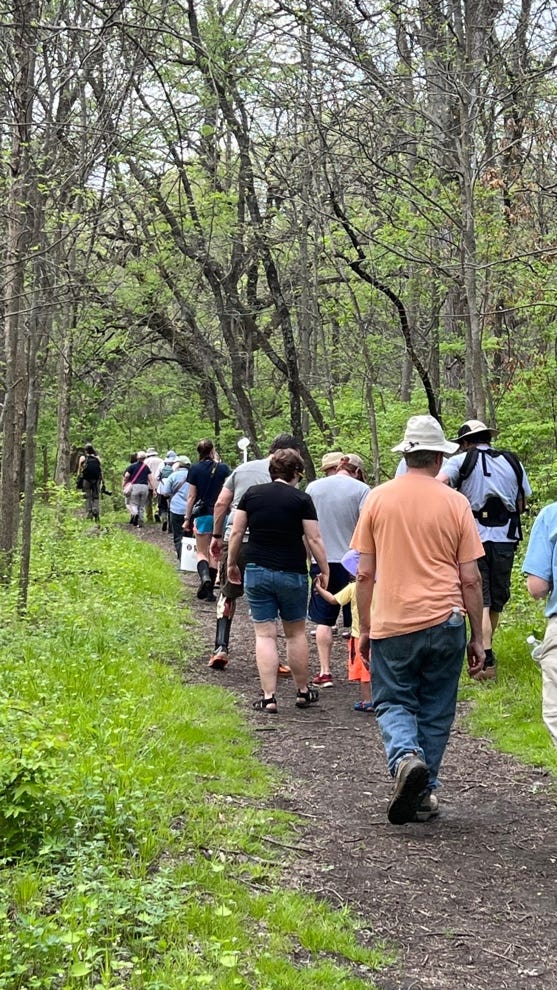
Above: a large group follows Dr. Tom Rosburg on May 7. Photo by Sheril Graham
Thank you to Marion County Community Foundation and Pella Community Foundation for sponsoring the nature walks.
A few weeks ago on the eve of Tulip Time, I saw this hanging from my pine tree in the back yard near the clothesline. At first, I thought a shirt had blown off the clothesline and ended up in the tree.
On closer inspection, I saw it was a swarm of honeybees! I was scared of them at first, especially since the dogs thought they might be worth jumping at. The Klompen Classic was set to begin in an hour with the path going right past my house. Would the runners be greeted with bee stings? And the next day was Tulip Time.
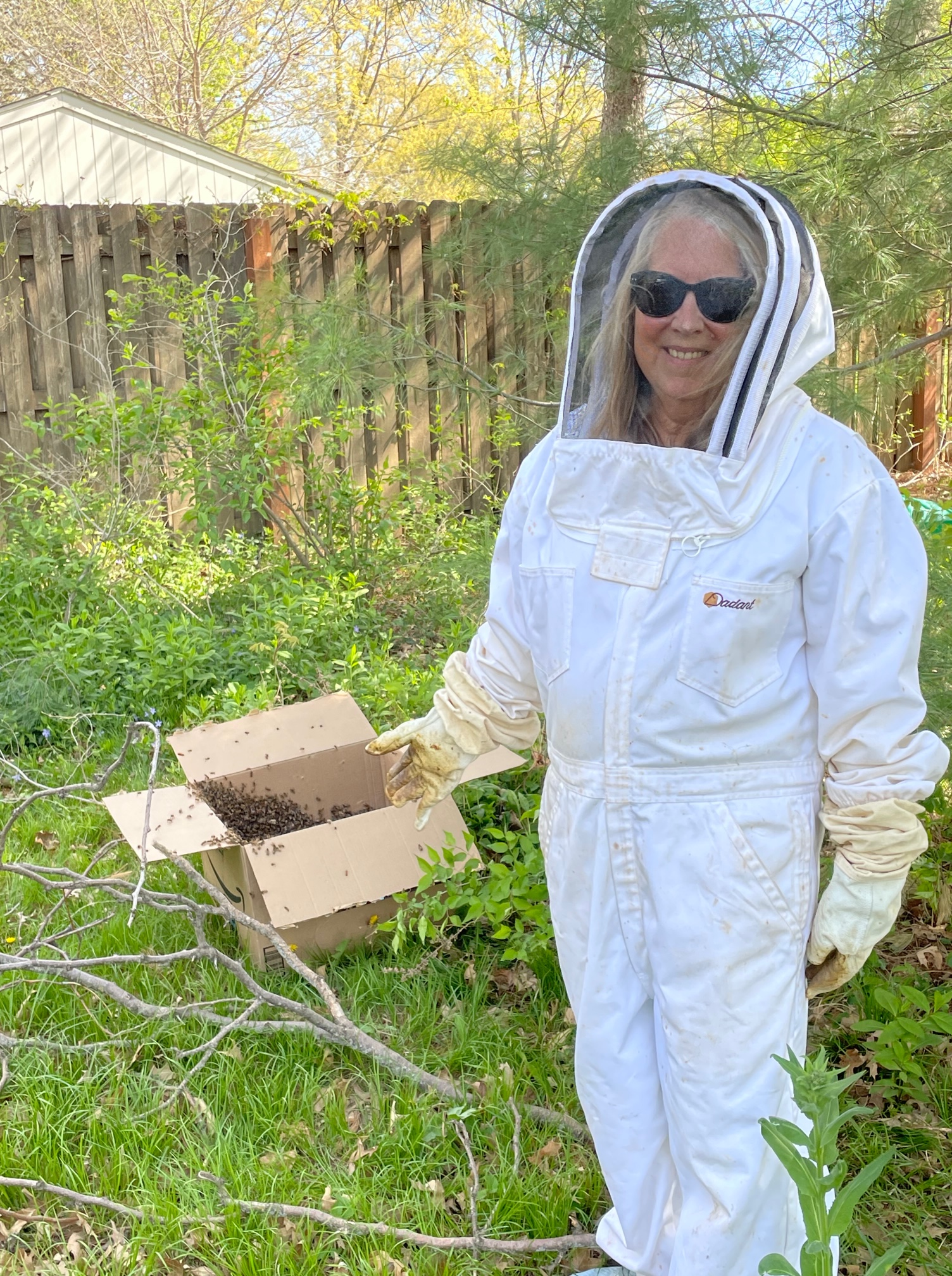
Not sure what to do, I texted a few people. Dr. Paulina Mena assured me that bees are only aggressive when they have their own hive. These bees had left a too full hive, following the queen who wanted a new house. Paulina had the perfect place, a bee box at Central College was empty. The next morning, her student, Lauren, came to get the swarm. She brought bee suits, duct tape, and a cardboard box.
Yes. I did want to put on a bee suit. She’d never collected a swarm before and I’d never seen one. We had so much in common! I did NOT want two active hives in my yard. The queen inside of the swarm, directing her subjects with pheromones, was well-fed and fat. She wouldn’t be going far. The other hive was still somewhere nearby, probably in a tree, with a new queen ready to emerge.
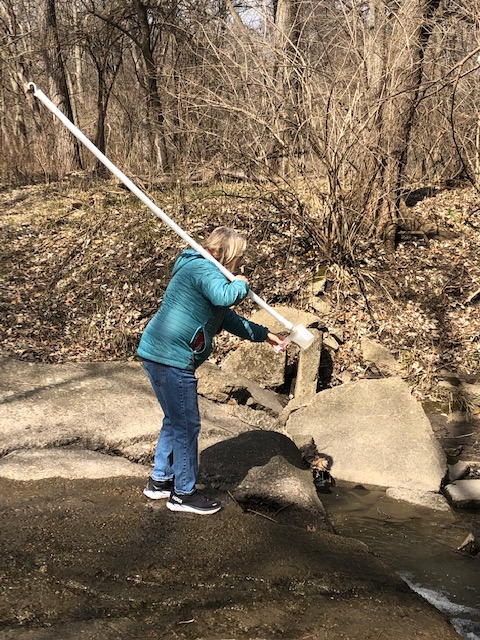
One of the first things Lauren did was drop the bees into the box. She used her hands and I had a big dipper used for water testing for her to use for scooping them. Once most bees were in the box, she looked for the queen. Yes, she was there.
Lauren identifies the queen bee.
As yard bees, these were always friendly, not aggressive. In order to collect all the bees, I snipped the branch they’d swarmed on into the box.
I look like I’ve done a lot but in reality, it was a lot of watching.
Lauren taped up the box and drove them to their new location, a mile away.
The queen was put into the bee box and fed some honey to keep her happy. Otherwise, she might have taken off to find better digs. Her subjects followed her into the new palace; even the few who were left behind would be able to fly a mile, following her pheromones.
Here’s more about the ethics of capturing swarming bees. Basically, if they don’t like the new home, they’ll just leave. Bees are never truly domesticated. And the best chance of success comes when bees are not moved far from the climate and location they are used to.
I went to visit the bees today, exactly three weeks after I first encountered the swarm. A few bees flew over, as if to greet me. They looked happy in their new box. I must admit, I feel a little guilty in not letting them find their own new home, but they wouldn’t have gone far and my yard is an active place. One they established a colony they might not be so kindly. What if they found a place only to be sprayed with insecticides?
If you look closely, you’ll see a good number of bees at the bottom of the hive box.
There seem to be plenty of bees left in my yard coming from a now smaller population with a new queen in a place unknown. I do miss those swarmers. If it happens again, I’m going to let them stay.
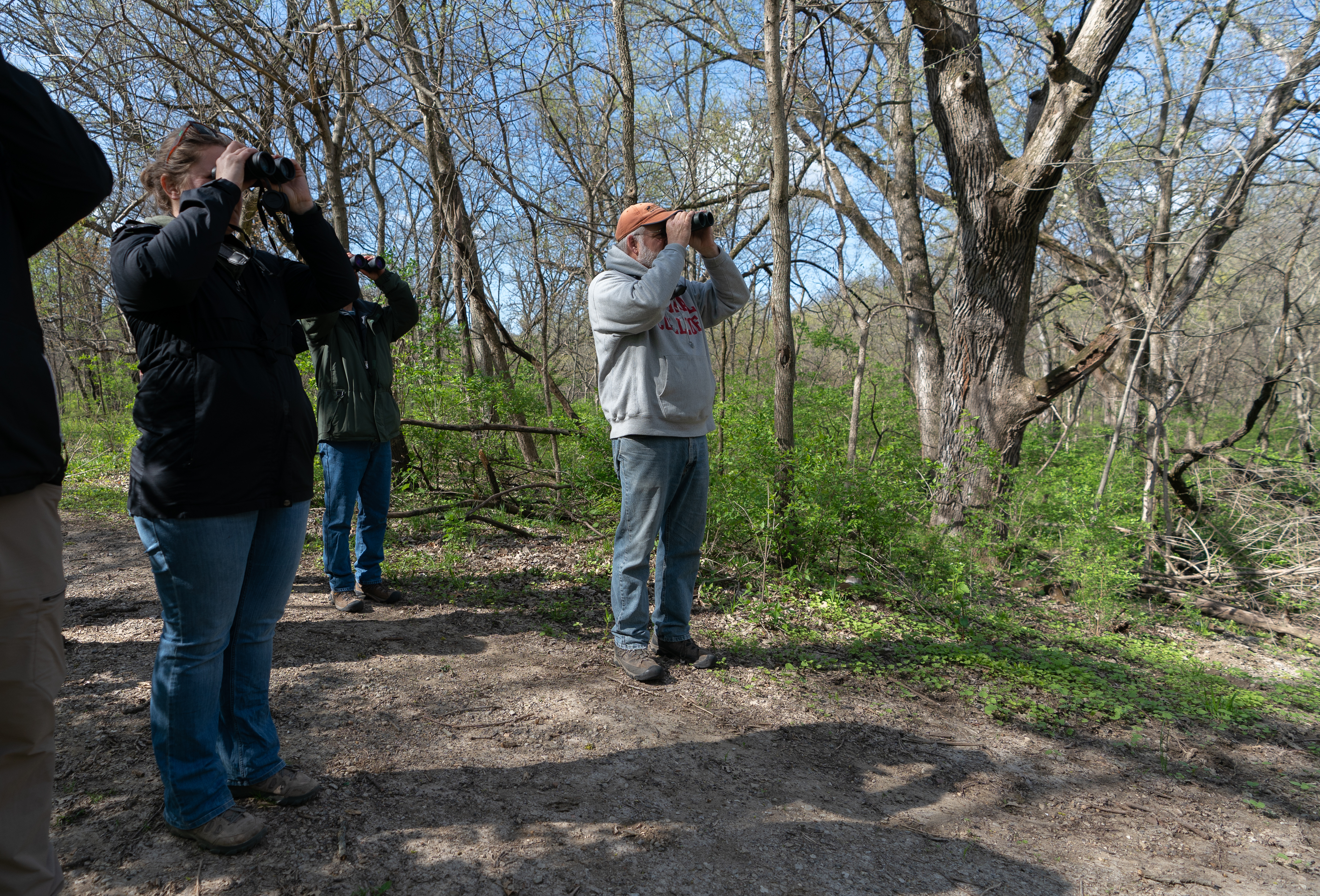
On April 29, a band of nature lovers met with Dr. Russ Benedict to learn about the birds of Big Rock Park. The Central College naturalist began with a lesson on how to use binoculars and then led us on a mile walk around the woodsy exterior of the park while he talked about avian migration patterns and all things bird. Some birds such as robins are generalists and will live anywhere. Others such as the tufted titmouse, are very picky about their habitats and will only nest in diverse oak forests as found at Big Rock Park. Spring migration is a race against time and weather to establish territory.
Below: Binoculars Up! Focus binoculars, spot the bird, quickly raise the binoculars. Photo by -Kayla Lindquist www.kaylalindquistphotography.com
One prevalent bird was the Yellow-rumped warbler or butter butt—one of the few birds that can eat waxy fruit such as bayberries and will even eat candles! This helps them survive brutal winters.
It was a beautiful and sometimes noisy walk. Carolina wrens popped up and scolded while hairy woodpeckers worked on making their holes in soft wood. A woodpecker will make a new hole every year!
In terms of migration, the over 400 species of Iowa birds fit into one of these categories:
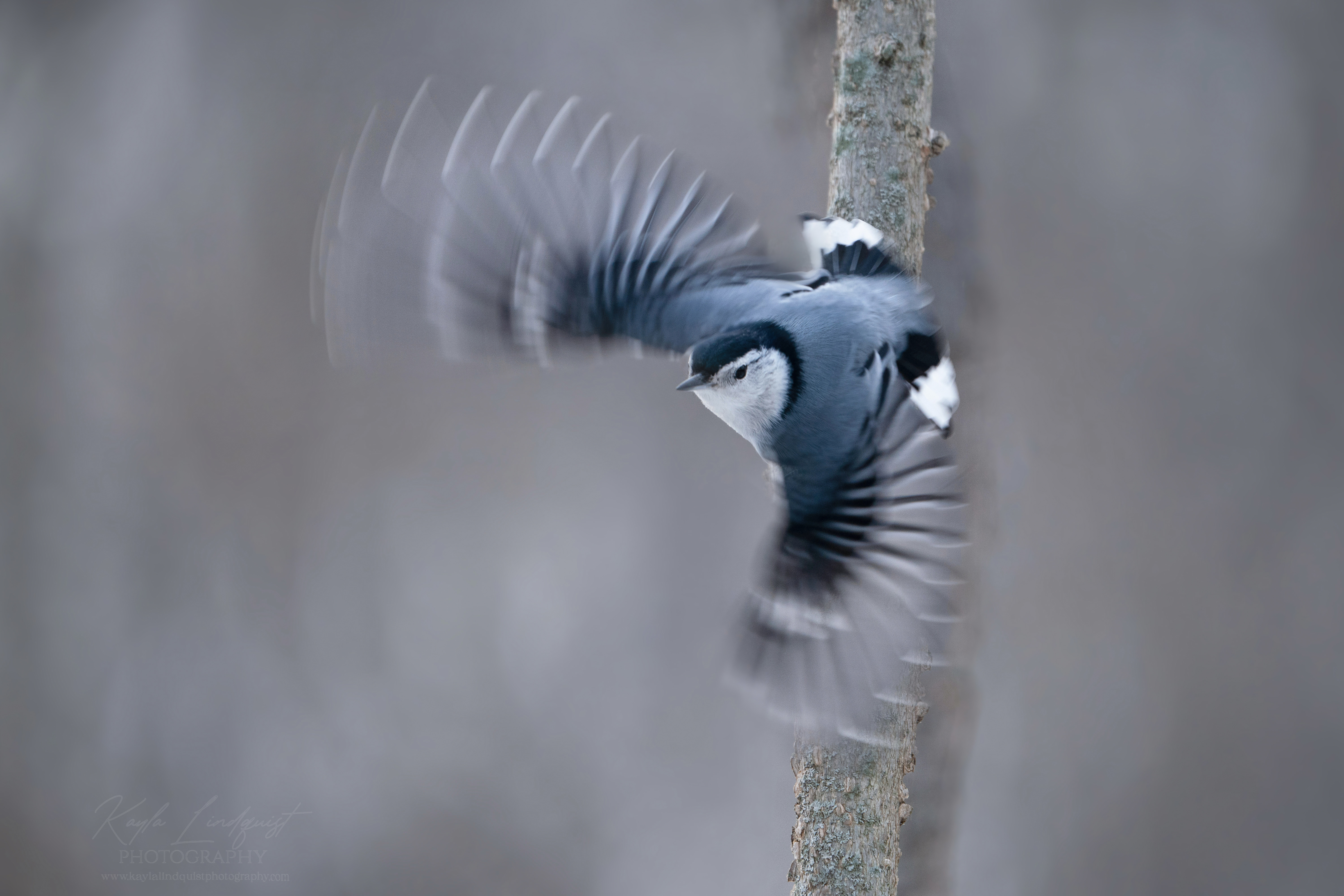
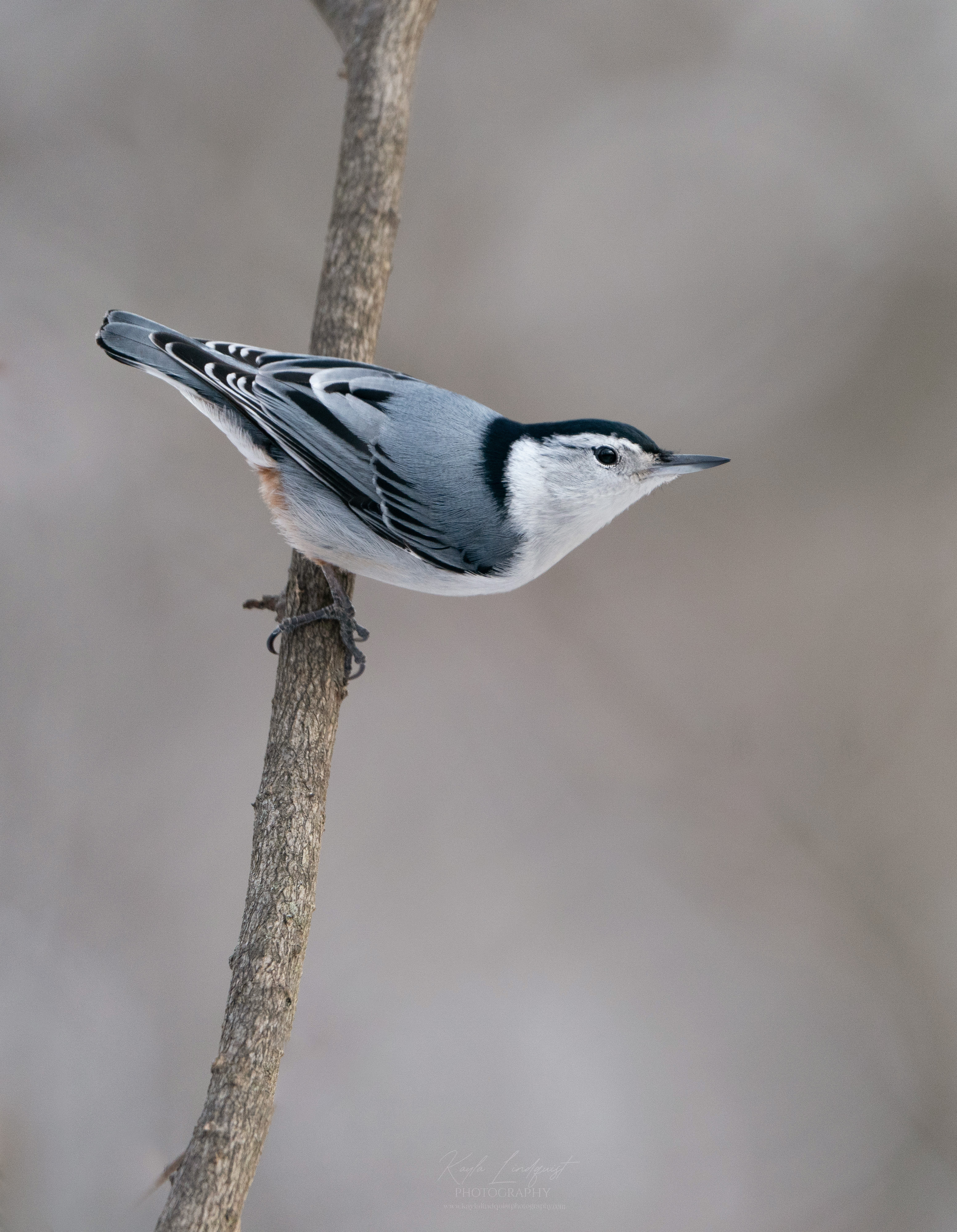
Permanent residents such as cardinals, blue jays, owls, crows, and nuthatches. Chickadees not only are permanent residents, they rarely move more than three miles from their place of birth. Another fun fact about chickadees is their call. The more “dees” you hear, the more alarmed they are about their situation.
Nuthatches, as shown below, usually don’t migrate and prefer to live near mature trees as found at Big Rock Park. These photos were taken by Central College student Kayla Lindquist. Be sure to take a look at her other photos at www.kaylalindquistphotography.com
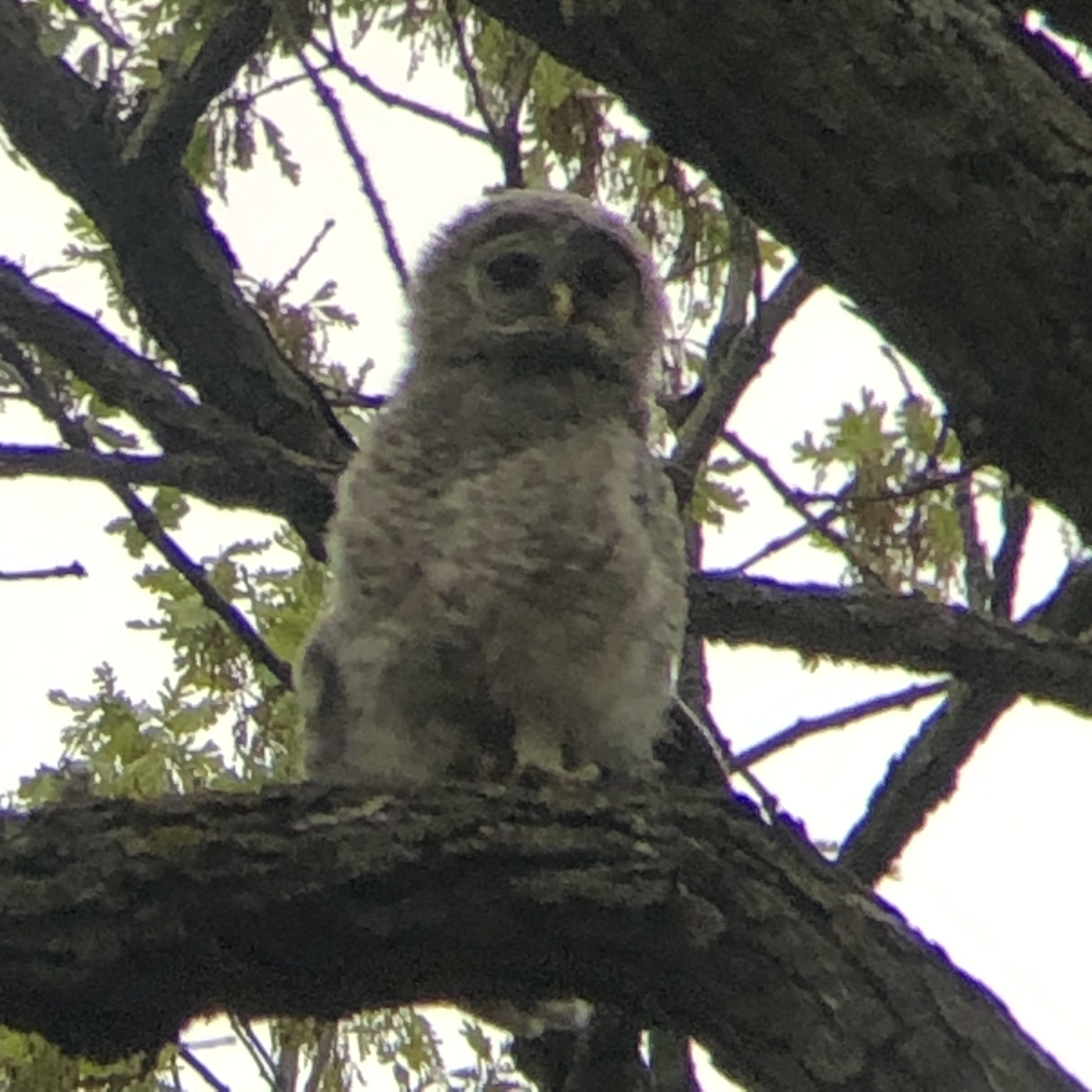
Barred owls rarely move from their roost. They can be seen in Big Rock Park year around.
(photo by Sheril Graham)
Regular Breeding residents who migrate here for the spring and summer as seen with many song birds including warblers and thrushes (such as robins), hummingbirds, bluebirds, and catbirds. These birds usually fly at night and stop to eat and rest in daylight. Turkey vultures migrate into Iowa in the spring since they can’t eat frozen roadkill. Turkey vulture watchers say the big birds are arriving earlier and earlier due to climate change.
Snow birds who winter here and fly north to breed such as eagles, juncos, gold finches, and tree sparrows.
Passage birds who fly through on their way to someplace else including many water birds and grackles.
When birds migrate, the males usually take flight first. They want to establish a territory. In the first wave of migrators, you’ll find the seed eaters, followed by insectivores, and lastly, caterpillar eaters. Usually, daylight patterns (photoperiods) prompt birds to migrate. In the spring, some might try their luck and migrate earlier or farther north than usual. This poor male Summer tanager came here too early and starved.
Females pick males based on territory, but courtship plays a role, too. Birds will have specific behaviors such as twittering their wings and singing to attract a mate. The most appreciated males croon for a long period of time. In birds such as blue jays, catbirds, and mocking birds, the most virile are those who sing up to five minutes without repeating a pattern.
Bird populations are declining in the US and across the globe. Grassland birds such as meadow larks are suffering the biggest loss while water birds are faring the best. Here in Iowa, loss of habitat and CRP fields due to ethanol are big contributors to the decline along with fewer insects.
Ways to save birds include putting up nest boxes which was highly successful with bluebirds. Turning off lights and putting up curtains to keep birds from hitting windows and buying shade grown coffee are a few more ways to help birds. Keeping wild places like Big Rock Park is one of the best ways to help keep bird populations alive. (Click the link for more ideas.)
Birdwatching is inexpensive and hip. A helpful resource for newbies and experienced birders is the All About Birds site. Big Rock Park offers an easy walk. Come fall, the migratory birds will leave the park at a much more leisurely pace than they arrived. If you want to hear the chorus and watch their spring frenzy, now’s the time.
If you want to see bees, find a flowery meadow above 50 degrees F with no wind. April 23 was not one of these days. It was cold and breezy. Despite this, the session on Native Bees of Big Rock Park lead by Dr. Paulina Mena was well-attended and the bees were there for it.
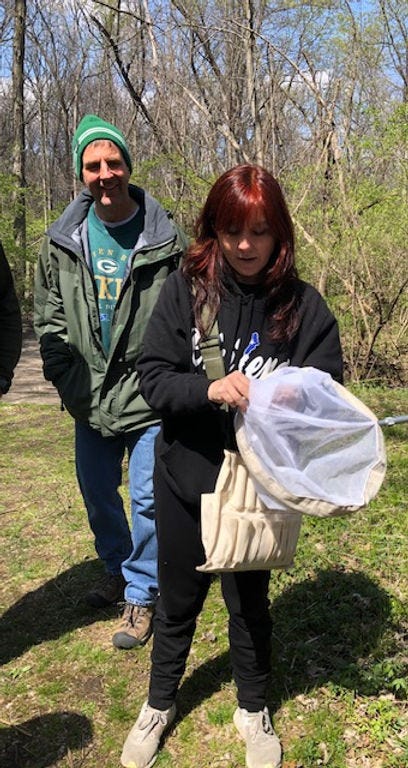
Above: Dr. Mena teaches attendees the proper bee netting technique.
Iowa has over 400 species of native bees, all better pollinators and more well-adapted to our climate than the well-known but non-native honeybee. Iowa bees have co-evolved with native Iowa plants. They are important to our Big Rock old growth savannah ecosystem and to the overall ecosystems of any place that has bees.
Even better, most native bees are mild mannered, having no hives to protect. Unlike honeybees, they can sting many times but without venom, making the stings less painful. Aggressive honeybees and wasps will tag intruders with pheromones and the hive will follow them in attack mode. You’ll get none of this aggression with native bees. 75% of US plant species require pollinators and even those that don’t have higher yields with visits from bees.
Many native bees are specialized pollinators, fitting in well to their plant niches. Squash bees for example are early risers, pollinating the morning blooming squash blossoms and napping in the withered blossoms. Most native Iowa bees are buzz pollinators.
Buzz pollinators such as bumble bees and mason bees are essential for the pollination of plants with deeply held pollen. Food crops such as eggplant, tomatoes, and blueberries rely on these bees to produce fruit. These calm bees are not likely to sting. Bumble bees nest in the ground and the magnificent queens can chose the sex of each egg as they lay it. Each queen will make a honey pot filled with nectar as a food storage for herself as she incubates her eggs and for the emerging young.
Our Big Rock Park group found a beautiful, fertilized bumble bee queen looking for a nesting place. After admiring her, we released her.
It’s incredibly difficult to identify most native bees by sight. People who can do this, taxonomists, are older and retiring. Modern bee enthusiasts use DNA testing to help identify bees.
Over thirty unique species of bees who call Big Rock Park home have been identified by Dr. Mena and her students. The most prevalent bees catalogued have been Augochlora pura, a common bee that nests in rotting wood and is a walnut pollinator, Calliopsis adreneformis, a ground nesting bee and important pollinator of many flowers, including phlox, and Coelioxys modesta, a parasitic species and pollinator which nests in the soft soil in the park. Another common bee is Megachile companulae, also known as the Bellweather resin bee is a special pollinator of tall American Bellflower.
One of Dr. Mena’s exciting findings is that Big Rock Park may be the home of a formerly undiscovered species of bees! This species would be in the genus Andrenaand was first found by Dr. Steve Johnson. This type of bee is an important native pollinator, especially for apples, cherries, strawberries, and blueberries.
Here’s a link to a presentation about the science behind discovering the bees of Big Rock.
Honeybees may be well-known but our native bees are hard-working pollinators and we need them. Ways to help them in your yard are to refrain from planting pesticide treated seeds and to not burn downed wood in the early spring when the young Augochlora bees are emerging. Although they don’t produce commercial honey or wax, native bees are better pollinators and pollen collectors than honey bees and are more friendly. As we found out last Sunday, they are more active on non-sunny, windy days than are honeybees. Since these bees nest in the ground and in old wood, we must preserve their habitats—wild spaces like Big Rock Park—or we’ll lose these splendid, valuable creatures.
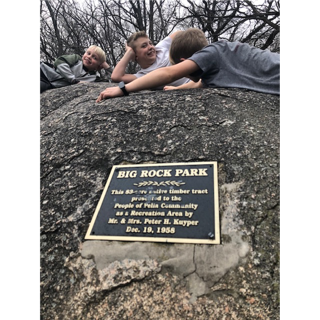
I’ve been an analytical chemist for a long time. For most of my life, I was a professor at Central College. These days, I freelance and right now I’m finishing up a study at Big Rock Park in Pella, Iowa. It has a little creek running through it, totally natural in some places and filled with concrete slabs to prevent erosion in other spots. The creek runs though a west Pella neighborhood. Houses boarder the creek on one side and a farm on the other. The friends of Big Rock Park wanted to know if the water was clean and safe for wading. Kids love to wade there and hike to the rock to climb it and take cheesy photos.
I started the study not sure what I’d find. One delight was that paper and strip-based color tests, like the ones you use to test an aquarium or swimming pool, have expanded significantly. Paper strip tests were one thing I worked on for my PhD thesis long ago. (Click here for more on my laboratory past.)
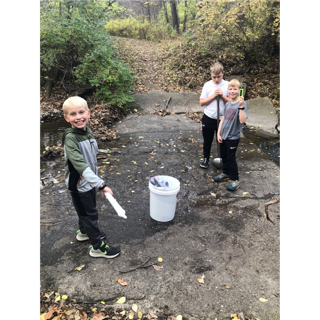
For my current project, I made a little laboratory stockroom in a portion of my study and I was all set to go—much like computers getting smaller, so did my lab. Small portable meters such as for dissolved oxygen and dissolved solids became available during the course of the study. The ease of testing allowed me to engage the public, even kids, with water testing.
The results in the end aren’t surprising. Whatever people put on their land ends up in the water. When salt goes on the roads in the winter, it ends up in the water. When people fertilize their lawns, it ends up in the water. It’s surprising how fast the fertilizer shows up.
One twist to my study which I should have expected but didn’t is that the overwhelmingly most concentrated and persistent pollution was bacteria—particularly E. coli. This bacteria, coming from fecal matter, showed up in early May and persisted through December. Farm run-off has been pin-pointed as a source of this and many other pollutants.
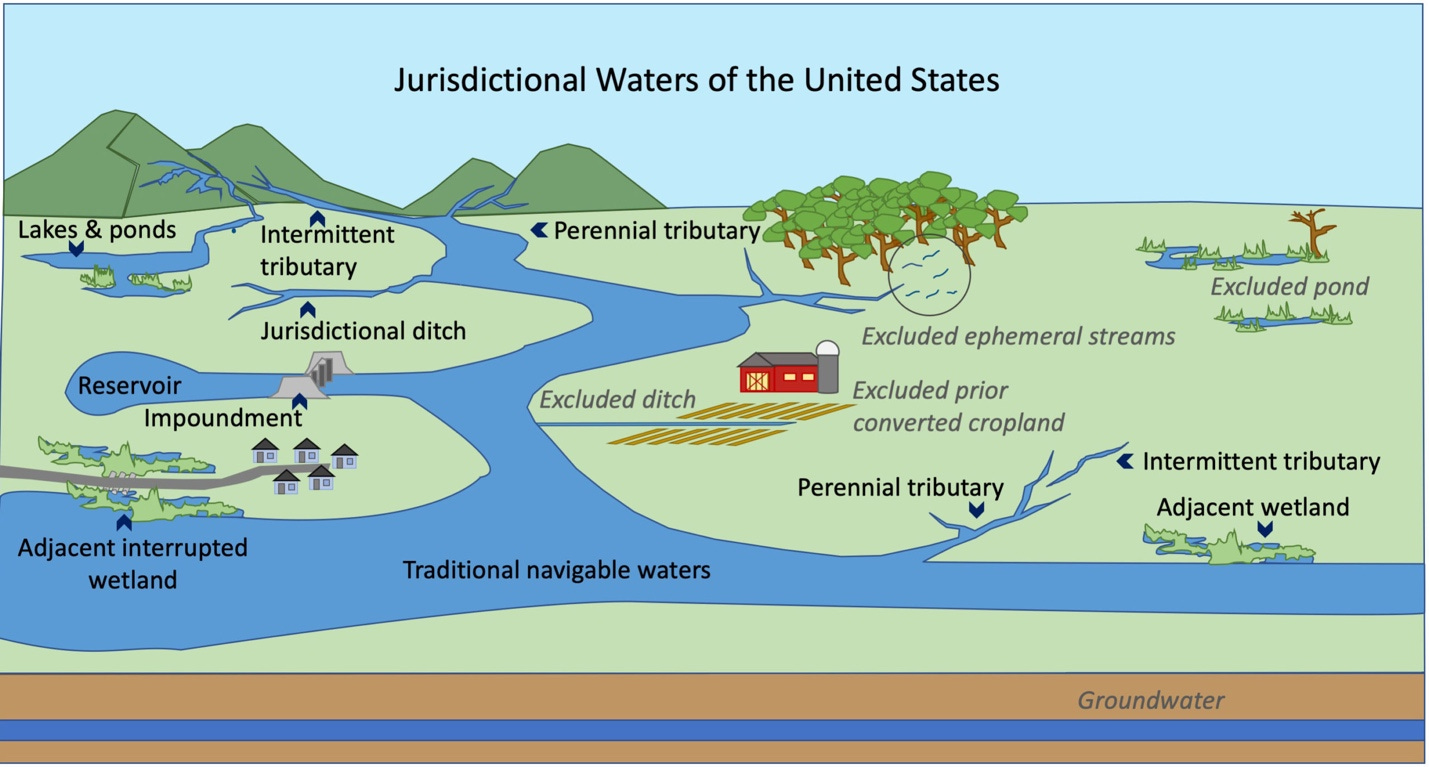
As part of WOTUS, these waters are protected: Navigable waters, Territorial seas, Interstate waters, Impoundments (dam created reservoirs such as Lake Red Rock), and Tributaries
Adjacent wetlands and additional waters are also considered WOTUS if they meet either the “relatively permanent” standard or the “significant nexus” standard, meaning they are likely to affect the other protected types of waters.
Here’s an illustration, also shown below, credit to Sarah A. White of Clemson University.
These waters are exempt : prior converted cropland, waste treatment systems, ditches, artificially irrigated areas, artificial lakes or ponds, artificial reflecting pools or swimming pools, waterfilled depressions, and swales and erosional features.
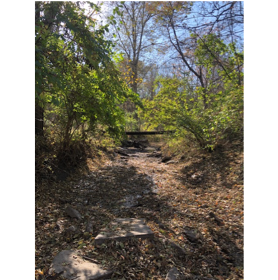
WOTUS covers less than the Obama-era rule but more than the Trump-era rule. It would include the Everglades for example and intermittent streams. Big Rock Park’s creek would fall under this as it dries up at times of drought, as shown in the photo below.
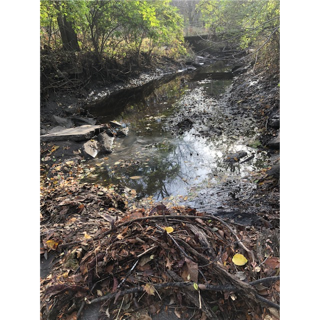
A downpour filled the creek bed and brought all sorts of leaves, sticks, and trash, showing how vulnerable these intermittent creeks are.
The new rule has human health as a focus and looks at both microbial (such as E. coli) as well as chemical pollution. Not only is it projected to lower the cost of clean water, it looks to avert future problems such as pipe corrosion as in Flint, Michigan, where road salt contributed to corrosion. It also supports fisheries.
WOTUS is a good rule which doesn’t go quite far enough in my opinion.
Being mad about WOTUS is more showmanship than anything. Its controversy is unfounded and made to stoke resentment of rural people, who suffer cancer at a high rate and need to be protected. In the meantime, enjoy our local park. Be sure to use hand sanitizer after touching the water, especially after manure applications on farm fields makes its way into local waters.
I had a delightful chat with the Book Nook and Vick Mickunas about my book series and the upcoming Snakes in the Class.
If you are at all curious about what I see as Iowa’s future or are looking forward to my monster academia, or if you are just plain bored and want an entertaining podcast to listen to
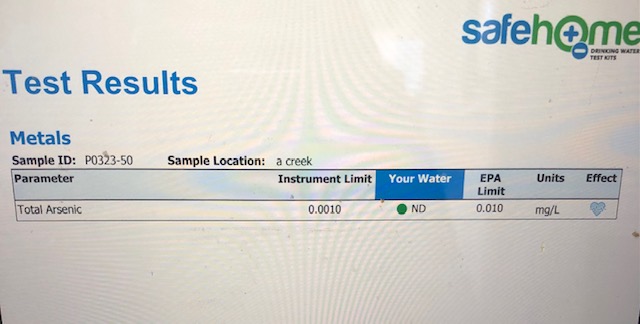
I’ve been doing some water testing for a creek that runs through a local park. You can read about it here. One reason for doing the testing is to determine if the water is safe for people to wade and fish in.
This month, I decided it was time for an arsenic test since arsenic is common in Iowa soil and water. Arsenic occurs naturally and has been known about as far back as the ancient Egyptian and Ming dynasties. It usually occurs in nature as salts and not as a free metal. The first recorded reaction yielding metallic arsenic was done by alchemist Albertus Magnes. Not even a chemist, an alchemist. Let that sink in.
Historical uses include using salts of arsenic as a green pigment and as an insecticide,
Today arsenic is primarily used as a wood preservative, although it’s found in semiconductors and the metal itself is a semiconductor. (Arsenic treated wood will take on a blue or green tint because the preservative is mixed with copper.)
Most arsenic used today is produced by China, Chile, and Kazakhstan.
Why is it toxic? Arsenic, abbreviated As, is the same column as nitrogen on the periodic table and can get involved with biological reactions involving nitrogen in a bad way. We all know it can act as a poison. It can kill slowly as well, causing bladder, skin cancer and other cancers. It can increase cholesterol and mess up your thyroid. High levels in the soil can cause birth defects.
Arsenic in Iowa hasn’t been thoroughly studied but it is concentrated in northern Iowa.
Arsenic as found in food and water has no taste or smell. Testing for arsenic poisoning was tricky until 1836.
Today, testing instruments are used. I’ve put a video of me explaining a similar technique at the bottom of this post. However, this time I didn’t do the testing myself. I sent a water sample off to a lab. It was much cheaper than paying me to run the test.
The results came back this week. The news is good! No arsenic detected!
This is most certainly As you like it!
This technique is similar to the one used to detect arsenic, but a little simpler.
A few years ago, I wrote a blog about biologist Frances Hammerstrom (1907-1998). One thing that struck me when I read her biography was that when she and her husband arrived in Wisconsin to study prairie chickens, the local people shyly asked how they could be married and only have a couple of kids. Many Midwesterners of 100 years ago had no idea birth control was possible. Thanks to the Comstock Act, even talking about birth control, much less using it, had been illegal until 1915.
Birth control and sexuality taught in schools didn’t begin until the AIDS epidemic in the 80s. It became part educating about sexually transmitted infections. Before that time people maybe read pamphlets or possibly a comic book in which sex or disease was discussed. Confusion reigned. A roommate of mine told me that all her parents mentioned to her about sex was that her mom gave her a douche bag and told her she was going to need it after she was married. I recall being confused when someone gave me the finger and said it was what happens before babies are born. I thought a doctor had to somehow open a woman to release the infant. And let’s not forget the numerous tales, told by men, of those who got blue balls and were made gay because women who were lesbians wouldn’t have sex with them. Sexual coercion wasn’t discussed back then in case you were wondering.
It goes without saying until the 80s a lot of people were in the dark about sex and birth control. I went to school in the 70s and we all had stories about relatives or friends from high school or people we knew who were pregnant and didn’t even know it. One particular case involved someone who went to the hospital with pains nine months after prom and gave birth to a baby. Fortunately for her she thought it was somewhat humorous that her parents never told her anything about sex and she ended up with this surprise kid.
Possibly people are familiar with the book or movie Carrie in which the main character gets her period and thinks that she is dying of this horrible disease because their parents didn’t tell her anything. Yep. There were people like that in school. It was the job of the PE teacher to tell them about feminine hygiene. Fortunately, around the mid-century point, science decided that sex was worth studying and people began talking about it as an educational compoent.
I was lucky. My mom wasn’t excited to talk to me about sex but she did give me the book Everything You Want to Know about Sex but Were Afraid to Ask. As someone who had a stream of kids two years apart, she was more than happy to advocate learning about birth control.
Studies of and information about sexuality exploded since the days of Hammerstrom. Sex education in schools has numerous advantages over the “self-taught” method including delaying sexual encounters, decreasing sexual risk taking, and improving academic performance. We’ve now reached the point in the US where most pregnancies are intended. We still fare worse than Canada and Europe for unintended pregnancies.
We need to ask ourselves, why is prudery suddenly rearing its ugly head politically? I’m not going to argue when people should have sex or who they need to have it with, but I do wonder why we have sudden interest in not talking about it.
Here’s the thing about sex in a book: a good book will include emotional content as well as consequences. You can’t get that from a YouTube video or from peers which is probably where kids will go if information isn’t available in school. In fact, most teens have watched porn, some of which isn’t too wholesome. Just in terms of how long it takes to read a book vs watch porn, I’m going to say that a book with sexual passages is more healthy, although I have my concerns about rape as entertainment.