Iowa was once a sensible state but it’s been heavily influenced by crazy as of late. Recently, a man introduced a bill to make miscarriages and causing them illegal–or at least subject to investigation.
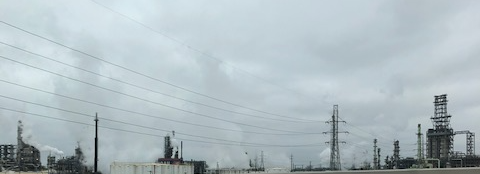
Detroit Refinery, owned by Marathon Oil, sits beside one of Detroit’s poorest neighborhoods.
I’m sensitive to health and safety regulations being cut. To me, these are protections. As a chemist, protections mean a lot to me. As a baby, I was given a lot of tetracycline. When my permanent teeth came in, they were grey and stained. This has affected my whole life. Yes I have crowns but that is not the same as real teeth. They need more maintaining. They need replacing at times. They make me self-conscious–but I still like to smile. And I have not gotten one penny of compensation for it all.
This is why, when I wrote about a dystopia in Mixed In, it was one in which there were no consumer protections and no environmental protections. The only regulations were for personal behavior.
Pollution can make people and animals more susceptible to disease. and this occurs at a genetic level, meaning, future generations will suffer. For example, fluorocarbon pollution from substances such as fire fighting foams and water proofing chemicals found in food packaging have been linked to a weakened immune response. The result in humans is that those exposed get more colds, respiratory infections and gastroenteritis. This is particularly common in young girls. These changes are at a genetic level–in other words, will be passed on. Additionally, those exposed are less protected by vaccines. which work by boosting the immune system.
In other words, unregulated pollution can doom generations of people while making pathogens stronger.
Another thing about pollution: It’s racist. African Americans are most likely to live in the shadow of pollution and are the least likely to profit from it. Do you think they don’t know it? Of course they do. And so do the politicians who spout the phrase “job killing regulations.” These guys know exactly what and who pollution harms and they don’t care. The question is: do you?
When visiting Detroit, the Charles A. Wright Museum, located downtown, is a must see. The first thing you notice is that it is not packed with stuff. It’s an airy and open venue used for everything from weddings to school trips.
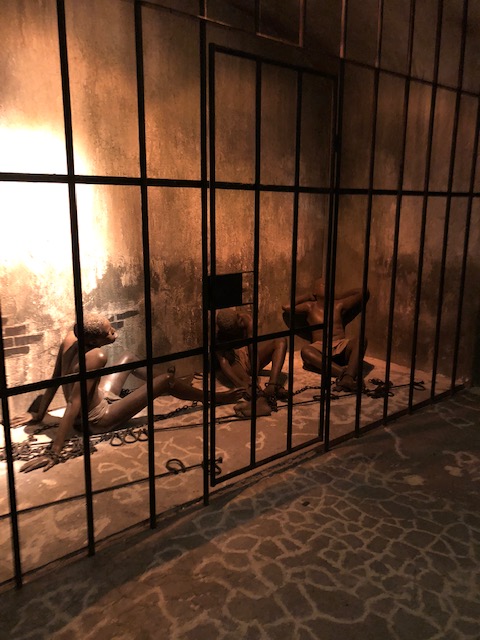
In this era of President Bone Spurs, consider what it is like to begin with absolutely nothing. Taken from your home, you can’t have a family. You are not even permitted to own a dog!
You might not even be considered human.
Am I not a man and a brother? These tokens, made by Charles Darwin’s family, pushed the idea that an African was indeed a “man” I’d seen photos of them but here is the real thing, smaller than I imagined. Another thing I learned was that Saudi Arabia was active in the slave trade. And most slaves were Christians. East Africa embraced the religion in the 1300s.
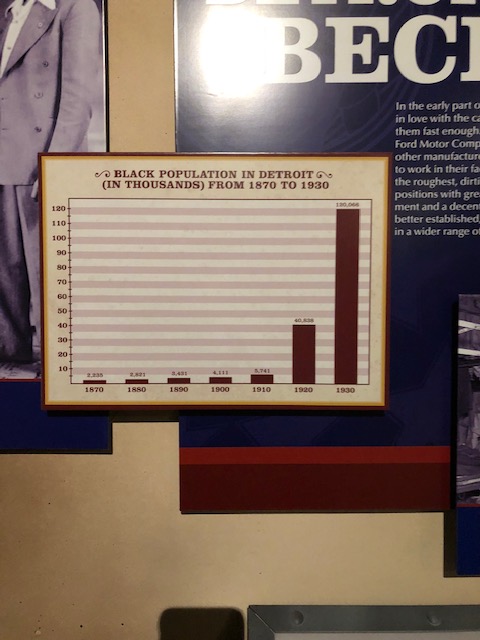
Driven from the South after the Civil War, African-Americans found a home in Detroit, where their assembly and sewing skills were welcome and contributed to the affluence of the city.
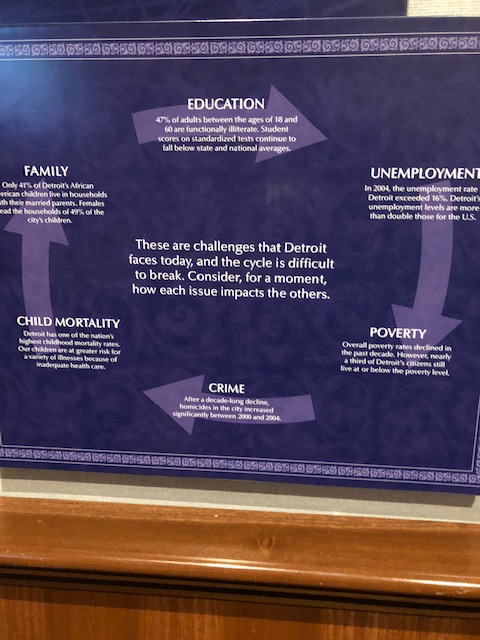
Today, literacy is more important than “hand skills” since labor is cheaper overseas. Illiteracy is a looming problem that the city is determined to solve.
But don’t think for a moment that Detroiters don’t love their history and heritage.
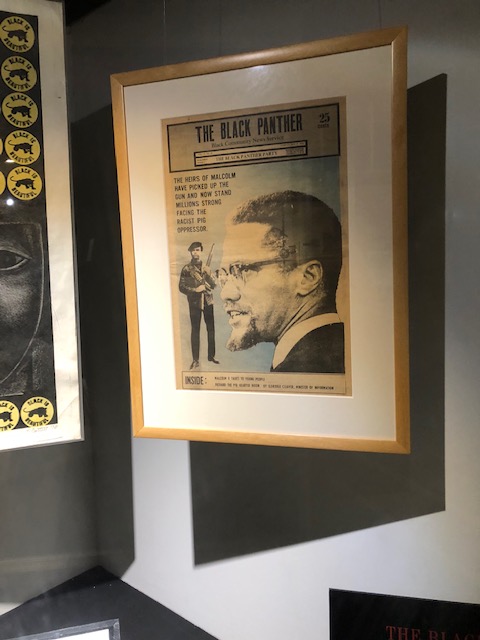
My Mom was . a big fan of Malcom X.
You might find yourself on a street in 1920s Detroit.
Or looking at Aretha’s first record.
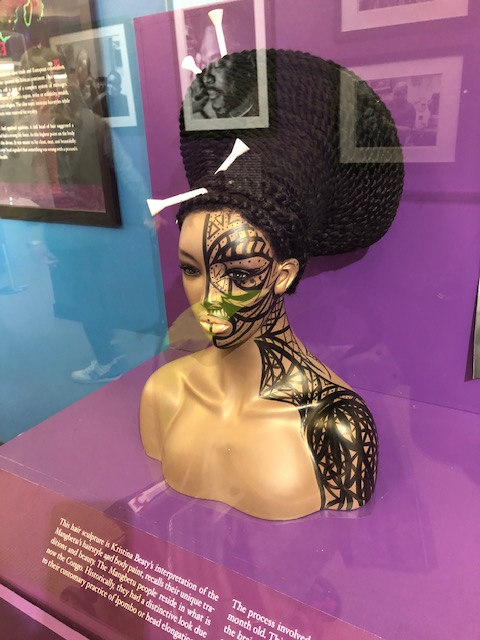
We took in an exhibit about African-American hair stylists.
A traditional headrest from Africa kept people from messing their styles when they slept.
Modern hairstyles were part of an exhibit about being fancy.
This unicorn style celebrates European culture. Inclusivity is important. After all, unity is a part of Kwanzaa, which by the way, lasts from Dec. 26 to January 1. The important message of the exhibit was to love the way you are.
In my forthcoming novel, there’s a palipitable divide between rich and poor; it’s a dystopia, after all. And who are the poor in this fictional society? Although people in the city of Cochtonville struggle, the true poverty is in the rural areas. This is realistic. Although not all sources agree, most of the poor in the United States are rural. How does a rural area become poor?
Rural poverty is a world-wide problem. A study in China found these complicating factors to rural poverty: an abundance of children, low education and skill levels in rural workers, and poor health in rural communities. (Zhang, Jinping, et al. “Analyzing Influencing Factors of Rural Poverty in Typical Poverty Areas of Hainan Province: A Case Study of Lingao County.” Chinese Geographical Science, vol. 28, no. 6, 2018, p. 1061+. Academic OneFile, )
In a recent study, rural high poverty communities were found to have “food insecurity,” limited access to health care, chronic disease, and a lack of transportation. Believe it or not, rural people have trouble accessing and affording fruits and vegetables. They often rely on food pantries and this is associated with being over-weight. Why? Food pantry diets are mainly shelf stable, low cost foods which are less nutritious. When poor people have food, they binge due to insecurity. They need help making healthier choices and they need access to healthier choices. (Stlika et al. BMC Public Health, 2018. 18:1055.) Canned foods can be nutritious and even fresh food, if stored extensively, may lose nutrients. The key is to make sure enough of this food is available.
One thing poor do not need is being shamed. The notion that the poor are culpable for their fate goes back a long way and is most often used by those who don’t want people to vote to help the poor. It leads to poor people hiding their poverty in shame. Most people in this country are not poor. When the poor are segregated from others, it is easier to foist the notion of undeserving poor on an naive public.Public spaces are one arena where poor can share in society. When these places are privatized or segregated due to fees, we as a nation lose the ability to understand poverty. Then, we believe fictions about them.
Each year since I’ve been a chemist, I’ve measured a higher level of background carbon dioxide in my lab. Every year more, like an invasion of ants marching. Like a steady diet of candy. Like one more blanket when you are in front of a fire. Carbon dioxide is natural but too much of it warms the Earth and causes changes in weather and ocean current patterns! What will happen if this continues and our climate is irreversibly changed?
Here in the Midwest, we face temperature extremes, flooding and droughts alternating with deluges. Tornados could become more damaging. Some crops will not grow as well with elevated carbon dioxide. Corn is one of those crops. Other plants will grow but have fewer nutrients.
Do scientists believe that human activity, mostly burning fossils fuels, is changing the planet?Yes they do.
97% of climate scientists say it is undoubtedly happening and a whole host of scientific organizations agree.
Chemists have been warning about this since the 1890s. The American Chemical Society, of which I am a member, has this to say:
“Comprehensive scientific assessments of our current and potential future climates clearly indicate that climate change is real, largely attributable to emissions from human activities, and potentially a very serious problem.” (2004)4
The American Physical Society (physics folks) released this statement “The evidence is incontrovertible: Global warming is occurring. If no mitigating actions are taken, significant disruptions in the Earth’s physical and ecological systems, social systems, security and human health are likely to occur. We must reduce emissions of greenhouse gases beginning now.” (2007)8
There is not a debate. There is more carbon dioxide in the air and it is changing our climate. Here is the evidence.
Sometimes denier die-hards say “What about global cooling? Didn’t scientists predict that? A couple of scientists did. The idea was that pollution in the atmosphere would reflect the sun. This does cause cooling; there is cooling after volcanic eruptions for example. However, these few guys vastly underestimated the extent of global warming from human sources and used outdated computer models to make their prediction. You would not use a computer from the 70s to do any research today. Why would anyone think scientists would find information, pushed by a few scientists, and disputed by others, was worth anything today? The real question is, why are people still repeating this erroneous claim? Who is spreading this misinformation?
Who funds them? Most of them in the U.S. claim to be “Libertarian” and have ties to the Koch Brothers. The Koch Brothers are known to educators because they send out books about why scientists don’t believe climate change. I got one myself. It was BS.
Other deniers, such as the science writer for the Wall Street Journal, are connected with the petroleum industry.
There are 100 companies, and their investors, who are responsible for much of the climate problems we face, everything from extreme weather to physical symptoms.
The people making big bucks from this impending disaster think they have enough money to save them from the consequences. They probably are banking on making money from the natural disasters. They will be happier with fewer riff-raff in their neighborhoods. Do you have billions of dollars to save yourself or do you want to do something meaningful with your life over he next 12 years?
What can you as a private citizen do when there are so many greedy people in the world? Some of the top evil doers are not even in the same country–companies from China, Saudi Arabia, Iran, and Russia top our own as polluters. Here are a few suggestions of what you can do to help: (click link )
The best thing you can do is Do not vote for climate change deniers. They lie and block any solutions. They are propped up with money and lies supplied by those who are causing the havoc. Here are the well established deniers in Iowa.
Climate Change is real. No, scientists are not debating, unsure, or getting rich talking about it. If the later was true, climate scientists would be the billionaires and could buy their own politicians. Scientists make money telling the truth and coming up with solutions to problems. Help them.
Did you know that the Violence Against Women Act is up for renewal and that many in Congress, including Chuck Grassley, have voted against it in the past?
Abusive People often can’t express themselves and are unable to communicate effectively with others. Furthermore, they are “fearfully attached” to their partners. Some studies have identified these traits in abusers: highly sensitive to criticism, blame the victim and or circumstances, do not take responsibility for their actions, do not fit in well with society, have low levels of empathy. They do not like themselves–they have a lot of shame about what they are doing to their partners. They become frustrated easily, can be irresponsible and find it hard to have fun. Click here for more.
Fortunately, this behavior can be modified through therapy and by society.
What about rapists? They are a more complicated bunch, and society cheers them on in subtle ways. Around 600 women in the United States are raped by men each day. Most often, these are women under the age of 24. Rape is a crime that is reflective of society.
“Young people who gang up on and violate a semi-conscious woman and post pictures on Facebook are not acting on some individually dreamed up sexual fantasy but rather following group norms. We know from psychological research that once a group is established, the immediate pressure to adhere to the in-group code will often override the desire and ability to reach across to a member of the out-group.”
Men are most likely to rape and coerce women when they have peers who express hostility towards women. However, rapists may also be anti-social people. who express hostility on-line or to themselves. We can’t so quickly write off rape as a crime done by a person outside of social norms as is more often seen with domestic abusers. Sometimes, people learn from movies and other aspects of our culture that rape is okay if the woman is drunk or you are a cool. Click here for a very good link.
Most men who violate women see it as a part of being masculine. Some see it as an entitlement, such as they bought the woman something or they are rich and famous. These rapists, unlike many perpetrators of other forms of violence, are self assured and entitled.
Often, these people objectify women. “Sexual objectification changes the way people view women by reducing them to sexual objects—denied humanity and an internal mental life, as well as deemed unworthy of moral concern.”
In other words, people who see women as sexual objects do not care about their feelings when the women are wronged.
Women can be complacent in violence against other women. A person can be a women or have daughters and still be a part of society’s acceptance of Violence Against Women. Laws against violence help prevent violence but even more, social shunning of violence is important in halting it. Unfortunately, we have a whole cast of ugly characters in office who normalize it at this time.
All is not lost but everyone, everyone must speak up, now more than ever. Urge your congressional representative to renew VAWA. Grassley has voted against the Violence Against Women Act twice. He has also voted against MLK Day. Vote him out in 2020. There is no place for perpetrators and supporters of violence in our society and certainly not in the senate!
Mercury is an element, meaning it can’t be broken into anything smaller. You can’t get rid of it by burning it up, for example.
In fact, you do not want to burn mercury. It is a metal but with very weak bonds between atoms. It has a low vapor pressure and heating it makes it into a gas. This gas is very toxic. It is easily absorbed into the lungs. It moves to the brain where it causes central nervous system poisoning. Mercury is toxic via all routes: ingestion, inhalation, and skin contact.
Mercury can get into the air from burning coal and oil. Forty two percent of mercury in our air comes from coal burning. Since mercury is heavy and doesn’t change into anything else, this can be breathed in, and get into our water and soil.
Mercury is a dense metallic liquid. It was once known as quicksilver. The word mercurial means flighty or fast.Can there be a much better name for a shoe than Mercurial Superfly? https://store.nike.com/
It’s about 14 x more dense than water, meaning that a gallon of mercury would weigh 113 pounds.
It has the symbol Hg meaning “liquid silver” or “hydroargyrum”.
Mercury is found as the ore cinnabar, chemical name mercury (II) sulfide, HgS. Most of mercury used today comes from mines in Spain or Italy.
Mercury pollution has caused Minamata disease, a birth defect harming the skeleton and a pollution related disease. Click here for more about the people who were affected.
Many people think of the Mad Hatter when they think of mercury poisoning. Mercury was used in felt processing and hat-making from the 17th century up until 1941.
Mercury was used to treat syphilis up through the early 1900s.
A mercury salt with fluorescein, mercurochrome, is still used as an antiseptic in some places.
Mercury can exist in several forms: elemental (as found in the Iowa bar) , inorganic (cinnabar), and organic (the most toxic).
Mercury is water soluble. It builds up in fish and seafood–the larger the animal, the more mercury. This diagram shows that the elemental mercury becomes organic mercury and bioaccumulates in the food chain.
Mercury is in some vaccines in a small amount. Consider the alternative which is getting the flu.
Mercury is heavy and exists in the depths of the Earth. Besides mining and coal burning, volcanos release tons of vaporized mercury into the air, especially Pacific volcanos.
Mercury poisoning continues today. “Analysis of hair samples from 1044 women of reproductive age in 37 locations across 25 countries on 6 continents revealed that 42% of women sampled had mercury levels over the US EPA limit level of 1 ppm, above which brain damage, IQ loss, and kidney damage may occur. Additionally, 53% of the global sample exceeded the level 0.58 ppm of mercury, a level now associated with the onset of fetal neurological damage. Exposures were higher and more pervasive in communities near mercury gold mining, in the Pacific Islands, and in communities near industrial contamination.”
New laws will weaken our restrictions on mercury emissions. We will be dooming people to nervous system, skeletal, and blood disorders and putting poison in our oceans. Thes laws are a “major weakening’ of mercury rules. Folks, that’s madness!
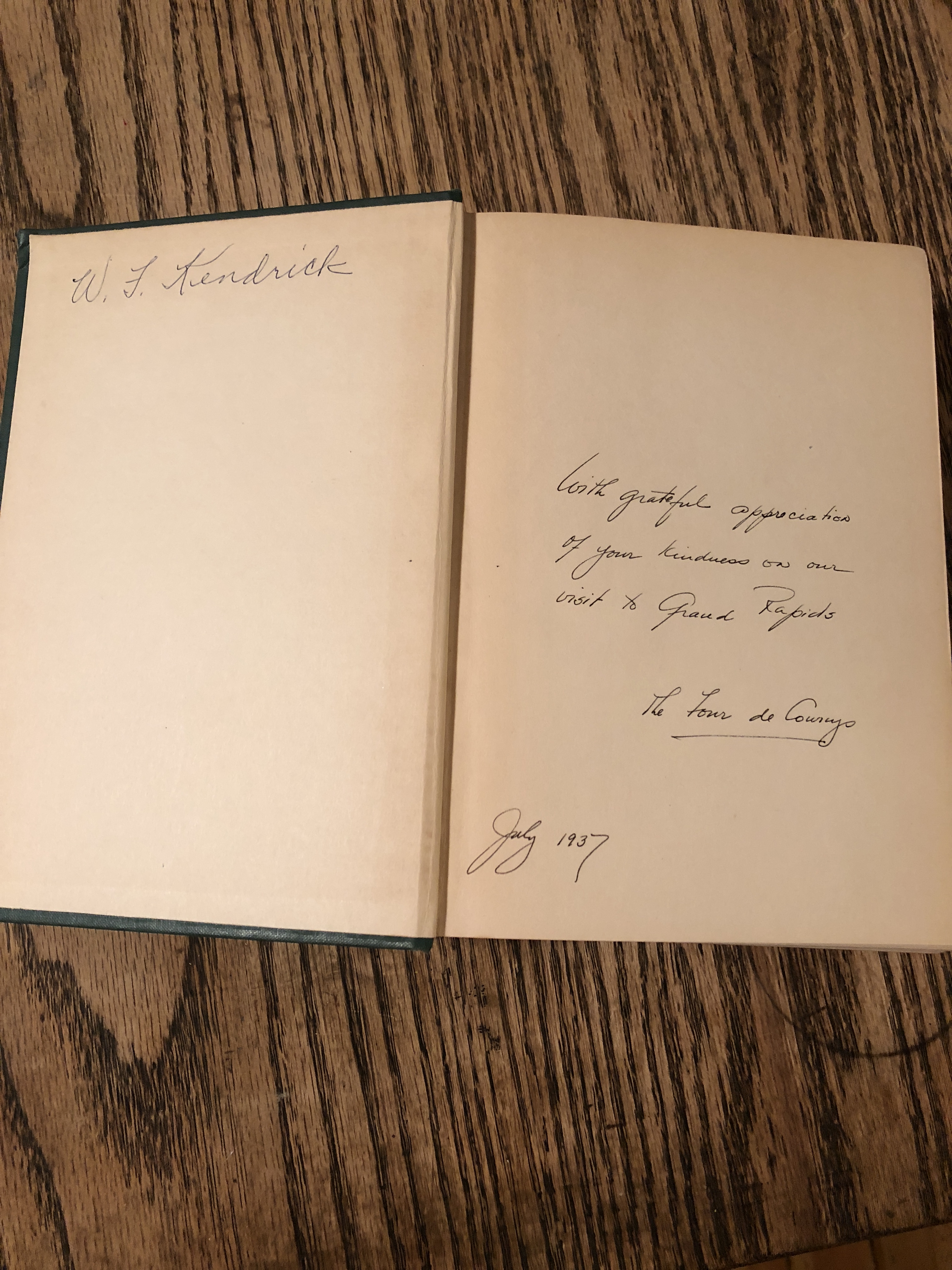
My great grandfather’s copy of The Last Puritan with a green cover. Keep or throw? Read below.
My first published novel will soon be out of print! The publisher, a small one, decided to close because of declining e-book profits. Ebooks have been good money makers for small and independently published books. They offer a better percentage payback for authors. They are low risk and low-cost alternatives to print books. At one time, a third of all readers bought them. But sales continue to drop. And I understand it. I haven’t read from my Kindle in months. Reading from a screen is not relaxing for me.
There’s a reason that people don’t enjoy e-books. Reading from “plasma” is different neurologically from reading on print. Screen reading is superficial and less deep. Your eyes jerk more. Your brain reads less completely. It’s skimming. It affects you. You become “cognitively impatient.” When you search for answers, you will tend to grab onto the simplest one, not the one that fits the data or information the best. You don’t dig in.
People don’t relish the page as they used to due to cognitive impatience. Novelists have adapted by writing “quick reads”–page turners– that are easy to follow and understand. Sometimes, this writing is formulaic. Critics say it is not “internal” enough and moves too quickly. Supporters of the new, fast style say that these books are fun and exciting and less about the boring psychological struggles of rich, white people. I aspire to write in the middle in a niche form known as upmarket. You can see from my critics that I at times get blasted from both sides. However, it seems that “real” readers are rebelling not against the form but in the way it is presented. They demand print books. And yet, when an author submits a book for consideration, it’s understandably electronic, creating a gap between writing for print and getting your book in print.
This I find that cognitive impatience gets in the way when I grade on-line. I’m okay for the first few papers and then, suddenly, I can’t take it all in. This is why when I grade a short story or research paper, I always print off a copy and write on it. Yes, I know that I can use many programs to allow me to comment on student papers electronically. It isn’t as deep. I write comments on their papers. Sometimes my students say that reading handwriting reminds them of their grandparents. I see this as a good thing.
The same thing is true when I write novels. I compose electronically but I must read paper, and over and over, as I polish the manuscript. Does this create a disconnect with readers? Who should I write for–print lovers or e-book fans? My latest book has sold more ebooks than print.
The situation is even murkier for professors. Print books are expensive and students use them for a limited time. They must be shipped and if students don’t order them promptly or if the books are backordered, they can miss many assignments. E-books are cheaper, easier to get, and create less waste. However, I once had my students purchase an electronic lab manual, the only manual that came with our text, and they had a terrible time following the instructions. Now, I write and self-publish my own print manual and stress writing, on paper, a solid conclusion based on data for their lab reports.
There is also a mild debate about e-books in grade school. These can engage students, although some studies say that students have lower comprehension with e-books. Things such as flipping the pages of a book help with a tactile sensation that promotes understanding. My students tell me that unless they travel by air, they prefer print books. They agree that even the feel and smell of books is part of the experience. One says, “A sign of a good purse is how many books you can fit into it.”
Another concern is that although blue light from computer screens is safe for adults, it may damage the eyes of children. Blue light creates alertness which is probably why we love screens. Blue light before bed can mess up our sleep cycles and cause daytime sleepiness and poor performance in school.
It’s a good idea to periodically cull old books from your shelves for the health reasons outlined above. You can always store your favorite classics on your e-reader. My great-grandfather’s book ( shown above) is worth about $15 at most. It made me cough when I opened it. I’m not sure I can part with it just yet because it’s one of the only things I have of him.
As for brains maxed out on high tech reading, neuroscientists recommend a two week respite from-e-reading to help your brain recover. So if you need a break, go ahead, get that big purse or backpack–large enough for two weeks of print reading and take it along on your next vacation.
Magic or mildew? An old book could carry both. Replace those old copies!
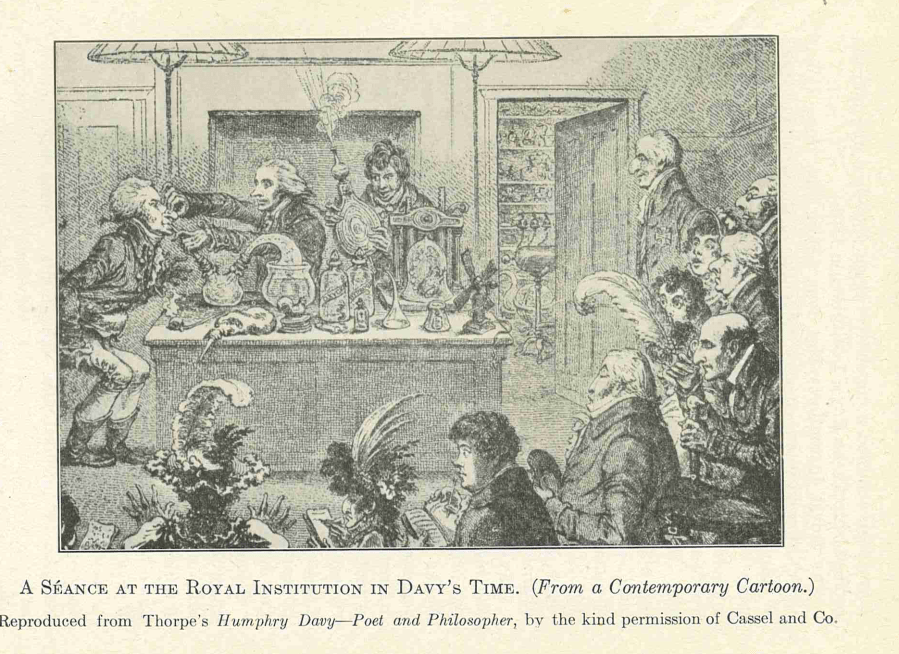
Laughing Gas, nitrous oxide, was first created by Cornish chemist Humphry Davy in 1799…although some credit the reclusive Joeseph Priestly with this. In any case, it was Davy who brought laughing gas to the world and with it, won prestige.
Humphry Davy was born the son of a farmer and wood-worker. The athletic and garrulous Davy was not the best of students. He was, however, good at preparing remedies for a local doctor and even better at making explosions and gases intended to affect people’s health. Gases were created chemically and collected in silk or later, rubber bags and people took sucks of the bag while holding their nose to receive treatments. One use of gases Davy explored was as anesthetics. The only anesthetics in those days were alcohol and opium. Surgeons had to operate quickly–amputating limbs in a minute or two–three at most. The use of laughing gas as an anesthetic was slow to catch on– it wasn’t until 1844 that it became used by a dentist and not until the 1870s that use became routine. (The man who pioneered its use in dentistry later became deranged.)
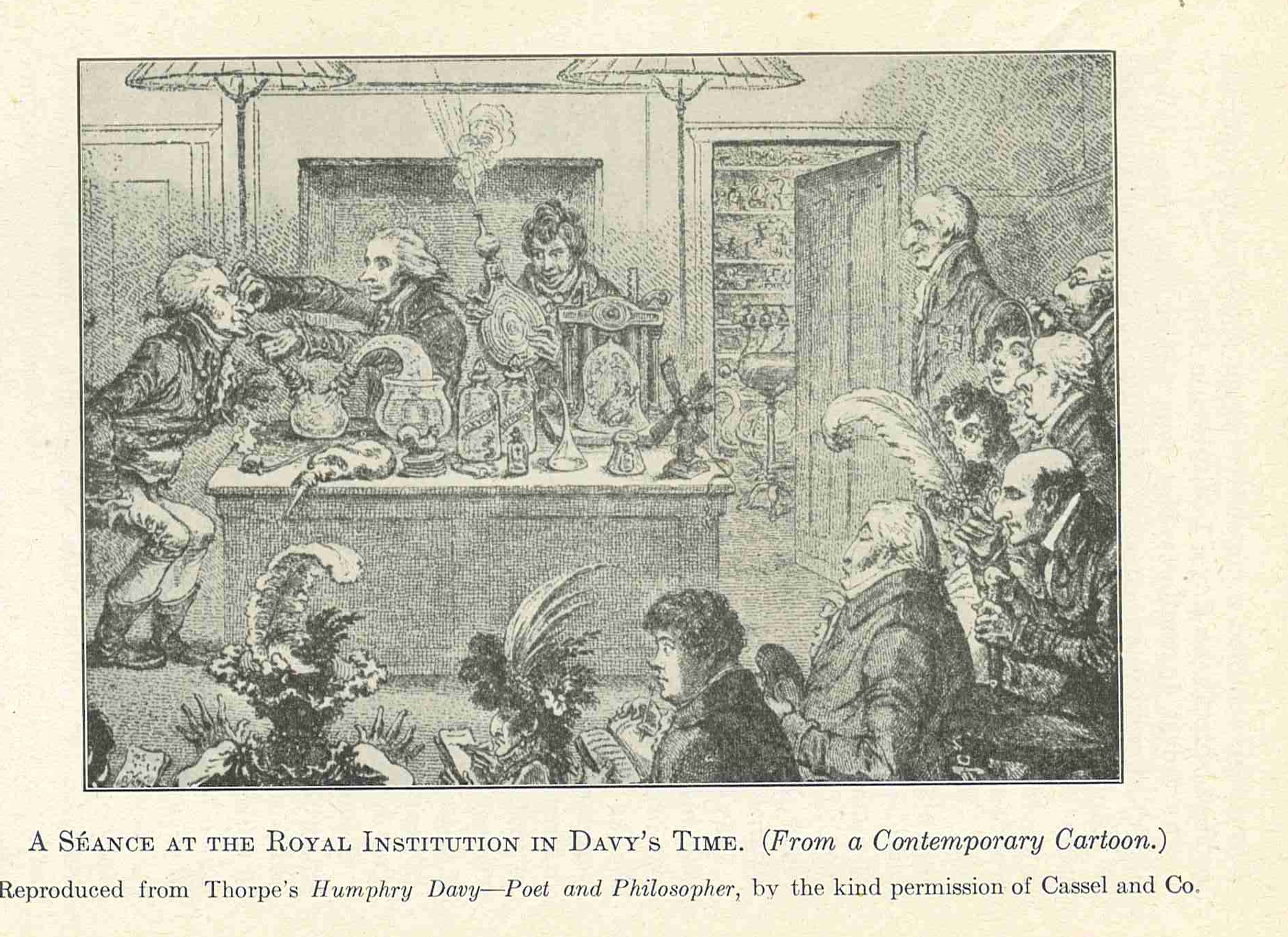
Shunned as an anesthetic, the euphoric properties of nitrous oxide made it a popular party drug, sometimes administered in traveling entertainment tents bearing Davy’s picture. Davy called nitrous oxide inhalation “pleasurably thrilling.”Others have described it as “you’re all rubbery and relaxed and silly laughing usually. The rooms can seem to be collapsing and spinning but in a fun way with sort of swooshing wavy sounds.” The nitrous oxide promotion propelled Davy into fame–it was a fad that won him a prestigious appointment to the Royal Institution in 1801 at the young age of 22. In this capacity, he lectured and popularized science to the point that he was knighted at the age of 34 and later made a baronet.Davy also discovered ether and chloroform. Although he did help his assistant Michael Faraday achieve fame, Davy clung to his superiority as if he had been born into it.
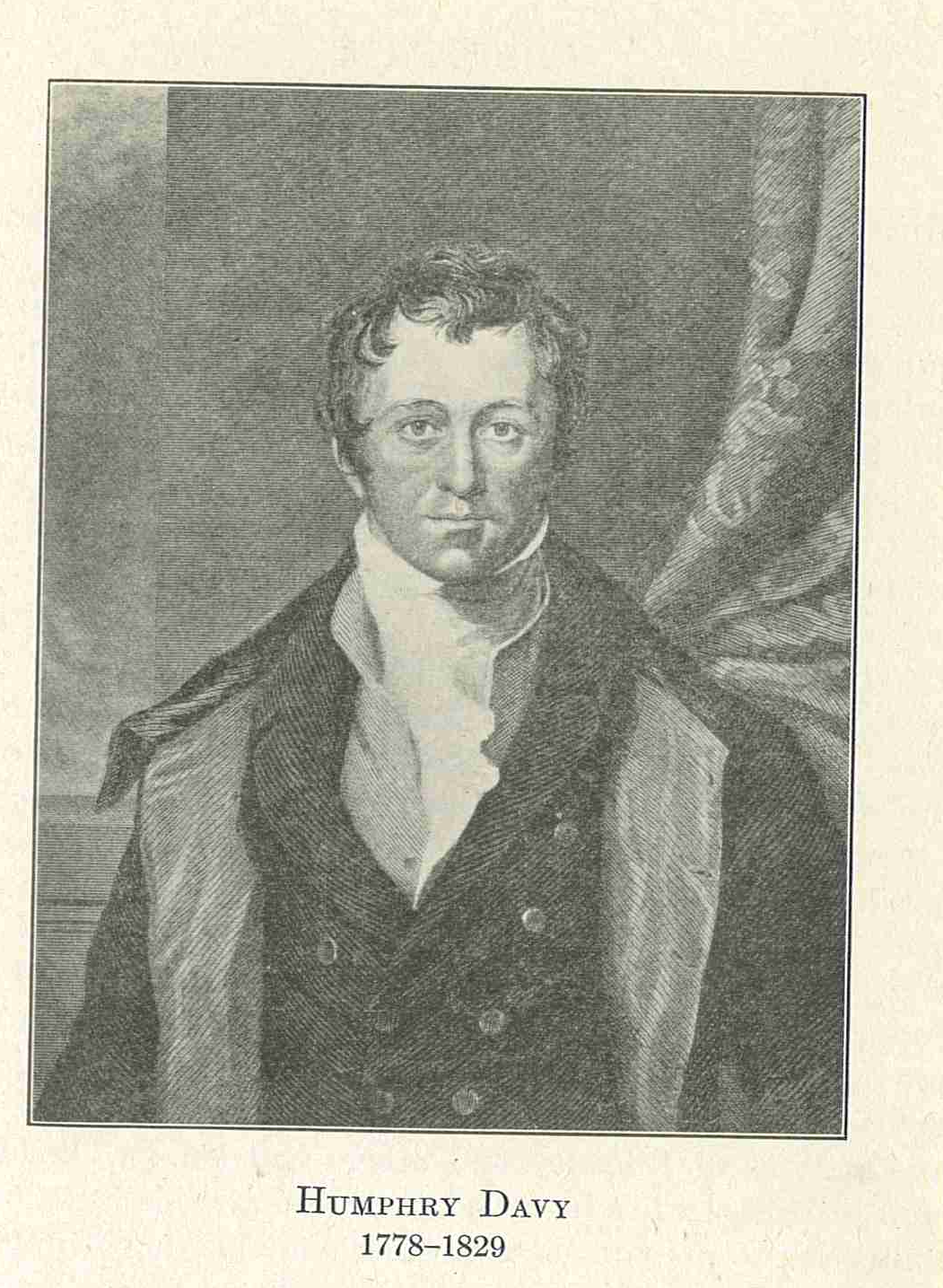
In retrospect, nitrous oxide has some harsh side effects. It can suppress vitamin B12 uptake, destroy your body’s Vitamin B12, and cause brain damage if over-used. There have even been cases of paralysis and spinal degradation in frequent users. However, as anesthetics go, it is one of the safest. Perhaps this brain damage created his snobbish treatment of Michael Faraday later in life. Faraday attributed some of this to his high class wife, Lady Jane. (My Mom used the term”Lady Jane” to refer to a snotty attitude but it has taken new meaning these days).Lady Jane and her money can be thanked for numerous portraits of the handsome Davy in those pre-photography days. In any case, I digress.
This photo was taken from A History of Chemistry by F.J. Moore third edition 1939
Laughing gas is used today in dental offices where it eases the pain and anxiety that come with dental work. It’s used to aid the torment of childbirth and can create “giggly, happy women during birth.” It’s used as a whipped cream propellent and also as a recreational drug known as “whippet” and “Hippie Crack.” It can also be found in fumes from burning coal and is a greenhouse gas.
We now know that nitrous oxide keeps nerve impulses from reaching their target. It blocks the gap between the nerve endings. Ketamine acts in the same way. It also causes the release of opioid-like hormones and increases blood flow to the brain. It should be used infrequently. It hampers both male and female fertility. Indeed, neither Davy or his pupil Faraday had children.
Manet’s woman with parrot (1866) http://www.manet.org/woman-with-a-parrot.jsp (This is not Dora Jordan or her parrot.)
To prepare for writing Wolves and Deer, I read some of Dora Jordan’s letters to Prince William, Duke of Clarence, later William IV. Copies of these were available from The Huntington Library. It was easy to get access to the copies but not easy to read them. I’m losing the ability to read handwriting, or at least, old school handwriting. From what I could decipher, she was a faithful and warm correspondent with no inkling of the betrayal that was to come.
In one letter, she expresses concern for the family parrot, Polly. I was captivated by her concern for poor Polly, who seemed to be lonely and in need of a parrot companion which she planned to purchase. It made her seem both romantic and a little indulgent. Her children, it seems, had plenty of pets, and plenty of love. But what about the parrot? How did tropical parrots come to be popular pets stuck in a most un-tropical country–England? It all started with Columbus.
When he landed on San Salvador, the natives gave him a generous gift of 40 Bahaman parrots, a cultural icon. Upon his return to Spain, the parrots caused a stir and parrot exporting began immediately. Parrots were elevated to status symbols and considered a little bit of paradise for the rich to cherish, fawn over, and feature in their portraits. Amazons and macaws appear to have been among the most popular parrots. Royalty and clergy in particular prized them as pets. Some claimed that parrots were prophets! It is believed that Henry VIII had a parrot. Since the birds were exported from the caribbean across the seas, pirates probably did have parrots, although some sources say it is simply a fiction made popular by Treasure Island. It is believed that as far back as 1582, a pirate captain used parrots to bribe officials.
By the 1600s, parrots were so common in Spain that ornithologists stopped listing them as exotic birds. Parrots were commonly sold in London markets and many middle class families had one. As parrots became more common, they became less of a status symbol and more an agent of comedy. Their mocking of human speech was seen as entertaining. In literature, they became symbolic of an endearing, entertaining servant who was not too bright but well-meaning and sometimes insightful. Parrots in literature and sometimes in real life, often blurted out either the right thing (who the murderer was) or something inappropriate such as a string of cuss words. Owners viewed parrots as objects that a master could train and “subjugate.” To the most snobbish, parrots were associated with servants in that they could talk but were not too smart. Servants must not be human since even parrots can talk.
Why does Polly want a cracker? This is somewhat obscure. Pet birds were fed seeds and nuts and something called “german paste” that was a mixture of cooked grain, chopped eggs, and seeds. Minerals were added to birds’ diets by placing a rusty nail in the pet’s drinking water twice a week. Crackers were first introduced to the public in 1801 and commercial bird food in the 1840s. No doubt since both crackers and parrots were novelties in the early 1800s, Polly was often offered a cracker, especially in the days before bird food.
Parrots can get depressed and manifest this by screaming, biting, pulling out their feathers, and mutilating themselves.
One problem that owners can have with parrots is that a parrot will view the human as a love interest, want no other, and become sexually frustrated. I asked people I know to tell me their stories of parrots in their lives. The answers were a lively mixed bag of joys and sorrows.
“We kept his wings clipped so he spent most of the time on an open stand by his cage which he would go into by himself when wanted to. He knew the whole intro to The Days of our Lives and would sing along. We had a Husky that he would whistle for, call her name, then climb down from his perch and nip her on the nose, laughing as he climbed back up. My favorite thing was that he would imitate the smoke alarm whenever my wife would start cooking. Piss her off. Lol”
“My aunt had an African Grey parrot with many words. It was caged and not too messy. They lived in California. Her sister in law, from the Midwest taught it to say ‘Gen Dobry’ while visiting and it became a favorite expression after she left. Then her brother in law—also visiting from Chicago would whistle at the bird so when he left that is all Kukla would do after greeting you in Polish.”
This story belongs in a novel! “An African Grey, had belonged to a man who had lived a rough life including a stint in prison. Apparently the parrot picked up some colorful language. His new owners, the man a Presbyterian minister, were trying to teach him to say: “I’m a Presbyterian” so he could impress a gathering of Presbyterian pastors at their home. When the time came, they said: “Alex, say ‘I’m a Presbyterian!” And Alex said loudly and clearly: “F@#$ you!”. When I stayed with them, he would hear me get up in the morning and ask: “Wanna go outside and go potty?” When the phone rang, he answered: “Hello!” In the voice of one of his humans. And he yelled at the dogs!”
“Best friend and great company.”
One person mentioned “They produce a lot of manure, can bite hard, throw food and are noisy.”
Another said, “They do have lung issues – they can’t take drafts. We had one die without knowing that. And we had one with wings clipped, not a good idea either. Our new kitten got him.”
A friend of a parrot owner remembered this: “He jabbered away nonstop sometimes, often sounding like half of a telephone conversation, with all the inflections, but rarely using discernible words. He laughed like a maniac! While I cared for him he became very protective of me, sitting on my shoulder and sometimes flying at anyone who got too close to me. Once when perched on my shoulder, I moved too suddenly and must have startled him, because he grabbed my nose right between my nostrils and was actually HANGING from MY FACE! He often shared breakfast with me, scraping the top layer off my buttered toast. It was interesting to see him work his tongue around inside his mouth — it was like a black bean but the surface was like soft black leather. Looking back, I feel sorry for the bird. He was kind of anxious, and started pulling some of his feathers out. He’d pick at shoulders of his wings until it was like raw meat or hamburger. He had to wear the cone of shame while it healed, but then he’d do it all over again. He didn’t live all that long, probably owing to the access to a diet that was totally unnatural for him (buttered toast?). I’d never have one again, I really think it’s just wrong.”
Some parrot stories are more like horror tales: “Years ago I had one for a few months. Thing wouldn’t shut-up even when covered and was aggressive. Worse pet I ever had, couldn’t wait to get rid of it.”
“My grand-daughter had one and it almost ruined her marriage. All that noise in the morning! They bond to one person and this one was jealous. Yikes! I think she sold it back to the pet store. They live forever. It’s an amazing commitment. And yes, messy. If you let them out of their cages….well, you can extrapolate. Also, the beak is a lethal weapon! I never met the bird, but a cockatiel my nephew had took a shine to me and was nibbling on my hair which was really cute until I realized he also damaged my hollow gold hoop earring!”
“They’re flying wild birds, not domesticated. You have to clip their wings if you want them to be unable to live their instinctual life after they’ve been trapped in the jungle. Even those born and raised in a cage are still technically wild. You also need to take the case outside daily so they can get fresh air. They’re meant to live among dense foliage, so their lungs get miserable in our thin-aired homes.”
“We bought things at the estate auction of a couple who had owned an obnoxious parrot. Bought a box of books that included one on keeping parrots that the bird had pecked all to heck. We also bought a beautifully woven antique basket from the Southwest; the parrot had pecked up the rim😕
After the couple died, heirs had trouble getting anybody to take the parrot. The woman had had a deep, “smoker’s” voice, and the bird sounded like her loudly saying “A..hole!! A..hole!!” a LOT. Think they finally persuaded a granddaughter to take the ornery thing.😜”
As a child, I had a parakeet, a tiny parrot native to Australia. He was a delightful but messy little thing who lived longer than the dog we got around the same time. Imitating my Mom, he often called for the cat, which, thankfully, ignored him.
Parrots are a huge commitment. We must remember that Dora Jordan and Prince William had numerous servants to clean up after Polly. And although he was incompetent at almost everything he did, William was once a sailor and having a parrot might have been a part of his image. I can imagine him teaching it swear words and laughing–he was that kind of guy. Dora’s worries about Polly preceded her betrayal by William by a couple of years. Is it possible that Polly knew something was afoot and that soon the lives of Dora and her family would be upset forever? Who knows what William was up to as Dora was off earning money to pay the family bills? One thing we do know, he wasn’t looking for a companion for his parrot. That, and most everything else, was left to Dora.
To read more about parrots as British pets in the 1700 and 1800s, click here.
I am grateful for the article “Men, monkeys, lap-dogs, parrots perish all” by Bruce Boehrer, published in Modern Language Quarterly (June 1998) for the information linking parrots, servants, and discrimination. He has an entire book about Parrot Culture.













 Mercury is an element, meaning it can’t be broken into anything smaller. You can’t get rid of it by burning it up, for example.





 Catherine Haustein
