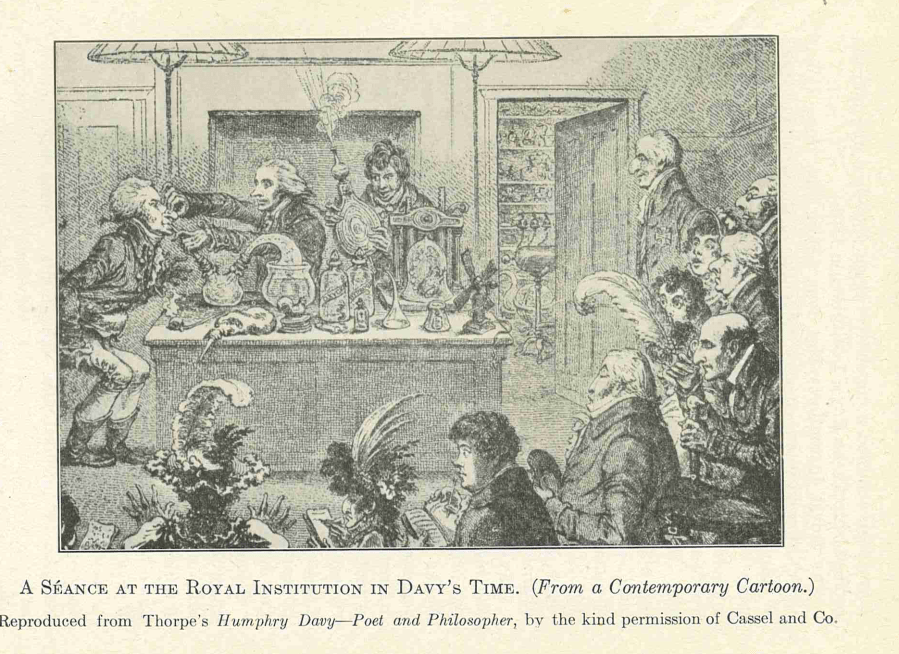
Laughing Gas, nitrous oxide, was first created by Cornish chemist Humphry Davy in 1799…although some credit the reclusive Joeseph Priestly with this. In any case, it was Davy who brought laughing gas to the world and with it, won prestige.
Humphry Davy was born the son of a farmer and wood-worker. The athletic and garrulous Davy was not the best of students. He was, however, good at preparing remedies for a local doctor and even better at making explosions and gases intended to affect people’s health. Gases were created chemically and collected in silk or later, rubber bags and people took sucks of the bag while holding their nose to receive treatments. One use of gases Davy explored was as anesthetics. The only anesthetics in those days were alcohol and opium. Surgeons had to operate quickly–amputating limbs in a minute or two–three at most. The use of laughing gas as an anesthetic was slow to catch on– it wasn’t until 1844 that it became used by a dentist and not until the 1870s that use became routine. (The man who pioneered its use in dentistry later became deranged.)
Shunned as an anesthetic, the euphoric properties of nitrous oxide made it a popular party drug, sometimes administered in traveling entertainment tents bearing Davy’s picture. Davy called nitrous oxide inhalation “pleasurably thrilling.”Others have described it as “you’re all rubbery and relaxed and silly laughing usually. The rooms can seem to be collapsing and spinning but in a fun way with sort of swooshing wavy sounds.” The nitrous oxide promotion propelled Davy into fame–it was a fad that won him a prestigious appointment to the Royal Institution in 1801 at the young age of 22. In this capacity, he lectured and popularized science to the point that he was knighted at the age of 34 and later made a baronet.Davy also discovered ether and chloroform. Although he did help his assistant Michael Faraday achieve fame, Davy clung to his superiority as if he had been born into it.
In retrospect, nitrous oxide has some harsh side effects. It can suppress vitamin B12 uptake, destroy your body’s Vitamin B12, and cause brain damage if over-used. There have even been cases of paralysis and spinal degradation in frequent users. However, as anesthetics go, it is one of the safest. Perhaps this brain damage created his snobbish treatment of Michael Faraday later in life. Faraday attributed some of this to his high class wife, Lady Jane. (My Mom used the term”Lady Jane” to refer to a snotty attitude but it has taken new meaning these days).Lady Jane and her money can be thanked for numerous portraits of the handsome Davy in those pre-photography days. In any case, I digress.
This photo was taken from A History of Chemistry by F.J. Moore third edition 1939
Laughing gas is used today in dental offices where it eases the pain and anxiety that come with dental work. It’s used to aid the torment of childbirth and can create “giggly, happy women during birth.” It’s used as a whipped cream propellent and also as a recreational drug known as “whippet” and “Hippie Crack.” It can also be found in fumes from burning coal and is a greenhouse gas.
We now know that nitrous oxide keeps nerve impulses from reaching their target. It blocks the gap between the nerve endings. Ketamine acts in the same way. It also causes the release of opioid-like hormones and increases blood flow to the brain. It should be used infrequently. It hampers both male and female fertility. Indeed, neither Davy or his pupil Faraday had children.
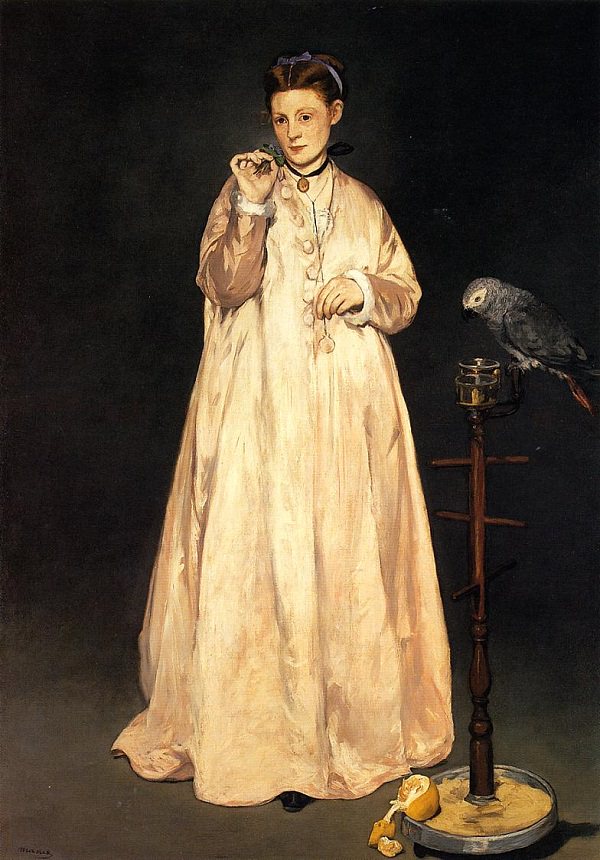
Manet’s woman with parrot (1866) http://www.manet.org/woman-with-a-parrot.jsp (This is not Dora Jordan or her parrot.)
To prepare for writing Wolves and Deer, I read some of Dora Jordan’s letters to Prince William, Duke of Clarence, later William IV. Copies of these were available from The Huntington Library. It was easy to get access to the copies but not easy to read them. I’m losing the ability to read handwriting, or at least, old school handwriting. From what I could decipher, she was a faithful and warm correspondent with no inkling of the betrayal that was to come.
In one letter, she expresses concern for the family parrot, Polly. I was captivated by her concern for poor Polly, who seemed to be lonely and in need of a parrot companion which she planned to purchase. It made her seem both romantic and a little indulgent. Her children, it seems, had plenty of pets, and plenty of love. But what about the parrot? How did tropical parrots come to be popular pets stuck in a most un-tropical country–England? It all started with Columbus.
When he landed on San Salvador, the natives gave him a generous gift of 40 Bahaman parrots, a cultural icon. Upon his return to Spain, the parrots caused a stir and parrot exporting began immediately. Parrots were elevated to status symbols and considered a little bit of paradise for the rich to cherish, fawn over, and feature in their portraits. Amazons and macaws appear to have been among the most popular parrots. Royalty and clergy in particular prized them as pets. Some claimed that parrots were prophets! It is believed that Henry VIII had a parrot. Since the birds were exported from the caribbean across the seas, pirates probably did have parrots, although some sources say it is simply a fiction made popular by Treasure Island. It is believed that as far back as 1582, a pirate captain used parrots to bribe officials.
By the 1600s, parrots were so common in Spain that ornithologists stopped listing them as exotic birds. Parrots were commonly sold in London markets and many middle class families had one. As parrots became more common, they became less of a status symbol and more an agent of comedy. Their mocking of human speech was seen as entertaining. In literature, they became symbolic of an endearing, entertaining servant who was not too bright but well-meaning and sometimes insightful. Parrots in literature and sometimes in real life, often blurted out either the right thing (who the murderer was) or something inappropriate such as a string of cuss words. Owners viewed parrots as objects that a master could train and “subjugate.” To the most snobbish, parrots were associated with servants in that they could talk but were not too smart. Servants must not be human since even parrots can talk.
Why does Polly want a cracker? This is somewhat obscure. Pet birds were fed seeds and nuts and something called “german paste” that was a mixture of cooked grain, chopped eggs, and seeds. Minerals were added to birds’ diets by placing a rusty nail in the pet’s drinking water twice a week. Crackers were first introduced to the public in 1801 and commercial bird food in the 1840s. No doubt since both crackers and parrots were novelties in the early 1800s, Polly was often offered a cracker, especially in the days before bird food.
Parrots can get depressed and manifest this by screaming, biting, pulling out their feathers, and mutilating themselves.
One problem that owners can have with parrots is that a parrot will view the human as a love interest, want no other, and become sexually frustrated. I asked people I know to tell me their stories of parrots in their lives. The answers were a lively mixed bag of joys and sorrows.
“We kept his wings clipped so he spent most of the time on an open stand by his cage which he would go into by himself when wanted to. He knew the whole intro to The Days of our Lives and would sing along. We had a Husky that he would whistle for, call her name, then climb down from his perch and nip her on the nose, laughing as he climbed back up. My favorite thing was that he would imitate the smoke alarm whenever my wife would start cooking. Piss her off. Lol”
“My aunt had an African Grey parrot with many words. It was caged and not too messy. They lived in California. Her sister in law, from the Midwest taught it to say ‘Gen Dobry’ while visiting and it became a favorite expression after she left. Then her brother in law—also visiting from Chicago would whistle at the bird so when he left that is all Kukla would do after greeting you in Polish.”
This story belongs in a novel! “An African Grey, had belonged to a man who had lived a rough life including a stint in prison. Apparently the parrot picked up some colorful language. His new owners, the man a Presbyterian minister, were trying to teach him to say: “I’m a Presbyterian” so he could impress a gathering of Presbyterian pastors at their home. When the time came, they said: “Alex, say ‘I’m a Presbyterian!” And Alex said loudly and clearly: “F@#$ you!”. When I stayed with them, he would hear me get up in the morning and ask: “Wanna go outside and go potty?” When the phone rang, he answered: “Hello!” In the voice of one of his humans. And he yelled at the dogs!”
“Best friend and great company.”
One person mentioned “They produce a lot of manure, can bite hard, throw food and are noisy.”
Another said, “They do have lung issues – they can’t take drafts. We had one die without knowing that. And we had one with wings clipped, not a good idea either. Our new kitten got him.”
A friend of a parrot owner remembered this: “He jabbered away nonstop sometimes, often sounding like half of a telephone conversation, with all the inflections, but rarely using discernible words. He laughed like a maniac! While I cared for him he became very protective of me, sitting on my shoulder and sometimes flying at anyone who got too close to me. Once when perched on my shoulder, I moved too suddenly and must have startled him, because he grabbed my nose right between my nostrils and was actually HANGING from MY FACE! He often shared breakfast with me, scraping the top layer off my buttered toast. It was interesting to see him work his tongue around inside his mouth — it was like a black bean but the surface was like soft black leather. Looking back, I feel sorry for the bird. He was kind of anxious, and started pulling some of his feathers out. He’d pick at shoulders of his wings until it was like raw meat or hamburger. He had to wear the cone of shame while it healed, but then he’d do it all over again. He didn’t live all that long, probably owing to the access to a diet that was totally unnatural for him (buttered toast?). I’d never have one again, I really think it’s just wrong.”
Some parrot stories are more like horror tales: “Years ago I had one for a few months. Thing wouldn’t shut-up even when covered and was aggressive. Worse pet I ever had, couldn’t wait to get rid of it.”
“My grand-daughter had one and it almost ruined her marriage. All that noise in the morning! They bond to one person and this one was jealous. Yikes! I think she sold it back to the pet store. They live forever. It’s an amazing commitment. And yes, messy. If you let them out of their cages….well, you can extrapolate. Also, the beak is a lethal weapon! I never met the bird, but a cockatiel my nephew had took a shine to me and was nibbling on my hair which was really cute until I realized he also damaged my hollow gold hoop earring!”
“They’re flying wild birds, not domesticated. You have to clip their wings if you want them to be unable to live their instinctual life after they’ve been trapped in the jungle. Even those born and raised in a cage are still technically wild. You also need to take the case outside daily so they can get fresh air. They’re meant to live among dense foliage, so their lungs get miserable in our thin-aired homes.”
“We bought things at the estate auction of a couple who had owned an obnoxious parrot. Bought a box of books that included one on keeping parrots that the bird had pecked all to heck. We also bought a beautifully woven antique basket from the Southwest; the parrot had pecked up the rim😕
After the couple died, heirs had trouble getting anybody to take the parrot. The woman had had a deep, “smoker’s” voice, and the bird sounded like her loudly saying “A..hole!! A..hole!!” a LOT. Think they finally persuaded a granddaughter to take the ornery thing.😜”
As a child, I had a parakeet, a tiny parrot native to Australia. He was a delightful but messy little thing who lived longer than the dog we got around the same time. Imitating my Mom, he often called for the cat, which, thankfully, ignored him.
Parrots are a huge commitment. We must remember that Dora Jordan and Prince William had numerous servants to clean up after Polly. And although he was incompetent at almost everything he did, William was once a sailor and having a parrot might have been a part of his image. I can imagine him teaching it swear words and laughing–he was that kind of guy. Dora’s worries about Polly preceded her betrayal by William by a couple of years. Is it possible that Polly knew something was afoot and that soon the lives of Dora and her family would be upset forever? Who knows what William was up to as Dora was off earning money to pay the family bills? One thing we do know, he wasn’t looking for a companion for his parrot. That, and most everything else, was left to Dora.
To read more about parrots as British pets in the 1700 and 1800s, click here.
I am grateful for the article “Men, monkeys, lap-dogs, parrots perish all” by Bruce Boehrer, published in Modern Language Quarterly (June 1998) for the information linking parrots, servants, and discrimination. He has an entire book about Parrot Culture.
The launch of Wolves and Deer has been fairly successful. One thing small press authors do is have a small party with prizes to generate interest. It’s going on here if you care to join me.
Your work of fiction is done. You’re aching to connect with readers. You dream about where you will publish it. Brimming with enthusiasm, you tell people about it. But how can you condense this intimate experience known as your story into something that won’t take as long to explain as it does to read? How do you let readers know that your fiction is worth their precious time? You need a pitch and a tagline.
The tagline is a phrase that gives the essence and emotions of the book or story. The pitch lays out the basic conflict–what the protagonist wants, what stands in the way, and what the consequences are.
A new author might find it painful to squeeze their work into such a small printed space. A paragraph? A sentence? After all that struggle! But not only does doing this help your potential audience, it helps you focus on what your tale is about.
You can get a feel for pitches and taglines by looking at your favorite books and movies. Here are two familiar ones.
THE HANDMAID’S TALE
TAGLINE: In the World of the Near Future, Who will control women’s bodies?
PITCH: Offred is a Handmaid in the Republic of Gilead. She may leae the home of the Commander and his wife to walk to the food markets whose signs are now pictures instead of words because women are no longer allowed to read. She must lie on her back once a month and pray that the Commander makes her pregnant, because in an age of declining births, Offred and the other Handmaids, are valued only if their ovaries are viable.
HIDDEN FIGURES (Movie)
TAGLINE: Meet the women you don’t know behind the mission you do.
PITCH: Three brilliant African-American women at NASA — Katherine Johnson (Taraji P. Henson), Dorothy Vaughan (Octavia Spencer) and Mary Jackson (Janelle Monáe) — serve as the brains behind one of the greatest operations in history: the launch of astronaut John Glenn (Glen Powell) into orbit, a stunning achievement that restored the nation’s confidence, turned around the Space Race and galvanized the world.
When I began writing and submitting and getting rejected, I found pitch and tagline creation painful and limiting. Here’s the good news, you get better at it.
TAGLINE: What happens when a traveling preacher who’s never been kissed inadvertently shares a love potion with a young female scientist who has taken the guise of a man?
PITCH: Clementine is an ambitious young Dutch-American naturalist from Spookstad, Michigan, who hopes to make her mark as a scientist in the post-Civil War United States. She takes a tonic, which causes her to appear male, so she can join a prospecting expedition as a naturalist. She wins the heart of the expedition preacher, Wesley, who will be her unflinching companion, as she travels the country facing acts of nature, cowboys, freak shows, ambitious bosses, unique rodent species, a trippy sage and even the Chicago fire. Wesley is betrothed to another and Clementine fears her affection for him will hinder her dreams of becoming a well-renowned scientist and his of gaining a small parish. When Wesley disappears and Clementine can no longer hide her gender or her feelings, she must accept her true identity and keep his secret or lose everything she’s worked so hard to gain.
Penner Publishing worked with these a bit and came up with this transformation.
TAGLINE: To get ahead she’ll have to become a man–and a man, she always thought, never lets love get in the way…
PITCH/BOOKBACK: Clementine dreams of being a naturalist—a career that leaves no time for romance. To sneak on an adventurous prospecting expedition, Clementine will have to convince everyone she’s a man. A mysterious tonic offers her just that disguise.
But “Calvin,” as she calls herself now, had no idea what she was giving up. When Wesley, the expedition’s gentle preacher, catches her eye, she can’t get him out of her head; not his lush lips, wide brown eyes…or broad chest. Dare she reveal her secret to him? Can she keep her career if she does?
Among run-ins with cowboys, natural disasters, and traveling shows, Wesley’s most fascinating adventure is meeting Calvin. Though Wesley’s betrothed to another, the cute, clever naturalist threatens to make him fall into temptation.
MIXED IN
My second novel, MIXED IN, was submitted with this pitch and no tagline:
When Catrina moves to Cochtonville to work for Cochton Enterprises, she has no idea how dangerous it is. A chance meeting with Ulysses, owner of the Union Station bar, plunges her into a world of illegal condoms, vibrators, and art. Their relationship puts them both in peril as Catrina begins to understand the dark side of her employer and their society.
Working with my editor and asking friends what they thought, I came up with this pitch (now used as the book back) and tagline:
TAGLINE: When passions are regulated, which laws will you break?
PITCH/BOOKBACK: When Catrina moves to Cochtonville to work as a chemist for Cochton Enterprises, she has no idea how dangerous her life is about to become. A chance meeting with Ulysses, owner of the Union Station bar, plunges her into a world of illegal condoms, vibrators, and art. As their loneliness draws them together, they become allies in what will become the fight of their lives in the sexually repressive and culturally backward dystopia.
Catrina’s invention, No Regrets—a scanner to test for pregnancy and sexually transmitted infections– brings increased scrutiny from the town’s Vice Patrol, made worse by an ambitious new agent who hangs around Union Station and takes up with Ulysses’s vindictive ex. Catrina’s relationship with Ulysses and her company’s new products put them both in peril as she begins to understand the dark side of her employer, her society, and science without humanity.
But science is all she’ll have to spare the men of Cochtonville a mortifying fate and to save the life of Ulysses.
You can see that the pitch got a lot sexier–and something you might not want to show your Mom or Aunt or your students if you are a teacher. However, it immediately helps the reader know if they are going to be the right audience for such a tale.
By the time I wrote my third novel, I had learned the secret. Work on your pitch and tagline as you are writing. This helps you, the author, focus. Here’s an example:
WOLVES AND DEER
TAGLINE: Whatever happened to the actress and the prince?
This was changed by the editors to
A CRUEL BETRAYAL. A MYSTERIOUS DEATH
(Note that this has more emotion.)
The pitch did not get much editing because with time, I got better at pitches and had a group of people I could run my pitches past.
Here is the banner with the tagline and the pitch. And here is a link to purchase.
In summary, taglines and pitches aren’t simply a crass commercialization of your creative work. They help you distill the essence of it. And with time, you’ll come to enjoy them.
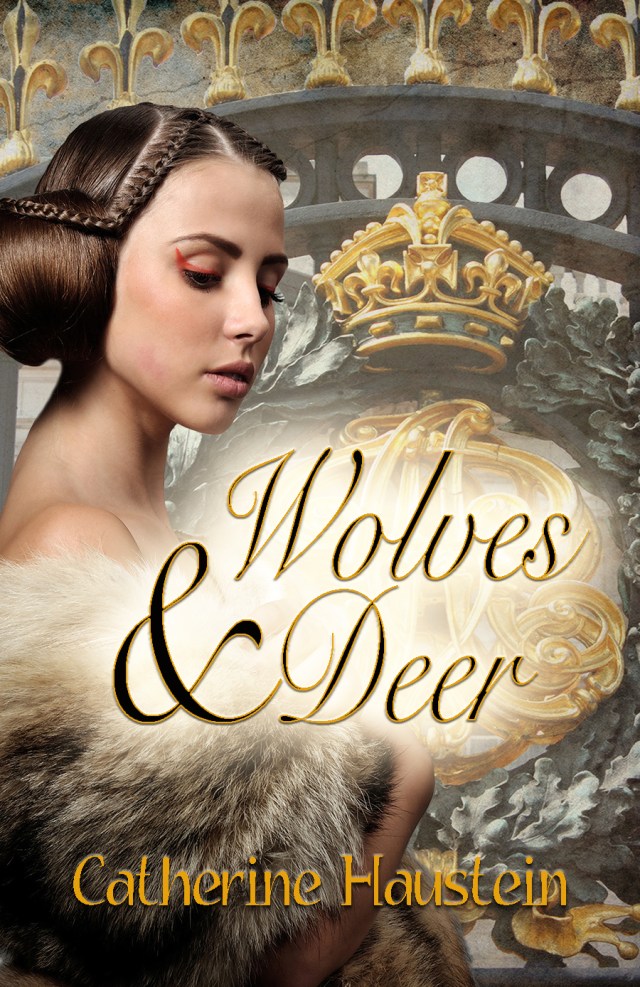
It’s here–the cover for my upcoming novel Wolves and Deer. This novel is being published by a small press and with small presses, the cover is often assembled from stock photos and art. Here’s how this one went down:
After the novel was accepted for publication, the editors asked me to look through art sites and find agreeable images that reflected the content and the characters.
I looked at animal photos of wolves and deer but none were to my liking.
The novel takes place in post the Regency era, just before Victoria, but I didn’t find any images I really liked for the cover among Regency era stock photos.
Some of the novel takes place at the Royal Institution in London so I considered old-time lab photos but the main plot isn’t about science–it simply has science in it. It’s really about betrayal and revenge. Wolves and Deer has a good dose of humor along with the pathos and mystery. In the end, I liked a photo of a woman wearing a wolf skin. It had the element of humor I wanted along with a “Red Riding Hood gets her revenge” feel. It also hinted that the novel might have a little sex in it. The woman had dark hair and a pointed nose as would be possible for the daughter of Dora Jordan. I suggested that the background be something to do with royalty. The cover artist came up with this cover.
I had a decision about the back cover–the grave photo the cover designer suggested didn’t match the grave as described in the novel or the grave of Dora Jordan. I decided it should remain as the illustrator wished because it is so highly discernible as a grave. I made the same decision with the Royal gate on the front cover. The King in question spent most time at Windsor and Clarence House but they aren’t immediately recognizable to people in the US.
I also did not want my name highlighted or larger. I’m by no means a famous author. Like most, I struggle for my sales and good reviews. I don’t consider myself a selling point.
By the way, the cover for Mixed In is up for an award. This cover was also a collaboration with an artist. I wanted a splash of beer on the cover since much of it takes place in a bar.
The cover of Natural Attraction was selected by a vote of readers.
That’s how I got my covers. In all cases, the publisher had the last word of approval for the covers.
What do you think? Is there a type of cover that draws you in?
I asked friends for their lawnmower horror stories and they were pretty gruesome.
“There was an old man in my hometown who was mowing the ditch that had standing water at the bottom. The rider mower tipped over and he tumbled to the bottom and the mower got on top of him. He drowned there.”
“My husband had a guy who worked for him who tripped while mowing with a push mower. Instead of letting go of the mower handle so the mower would stop, he pulled the mower backward in an effort to keep his balance. He pulled the mower over his foot and lost part of his foot. He was off work for quite a long time but, eventually came back. He still limps.”
“My uncle was push mower cutting our family plot at the cemetery. He was backing up & fell over a tombstone. The mower came back over his foot & cut off his big toe. He found a bag to put his foot into to contain the blood. The toe did not survive.”
Most lawnmower accidents involve cutting things off. Amputations. Even when the mower is turned off, the blades on many mowers, older models in particular, can still turn. An Emergency Room nurse summed it by saying,”People cut their fingers and toes off with them fairly frequently.”
Lawnmower accidents go beyond amputations. Burns can occur and even house fires. A friend said
“Mine got too hot on Friday, blew the cap & oil all over. I didn’t get hurt or anything but I haven’t tried to run it again.”
Running over things is common. People remembered running over everything from snakes to bunnies to sentimental toys. Possibly the worst running over story that didn’t involve a projectile was this one:
“A few years ago I was mowing, wearing shorts, and ran over a in-ground bees’ nest. Got stung about a dozen times on each leg before I realized what the sudden pain was and could run far enough away. So, my tip is wear long pants.”
Lawnmowers can toss objects at a speed of 200 miles per hour. Projectile accidents are more common and more dangerous than you might think. For example:
“When I was younger, my mother told me about some friends whose child was in the yard while the dad was mowing. He ran over a piece of metal he didn’t know was there. It was thrown out of the mower, hit the child in the head and killed him.”
“When I was a kid, I was wearing tennis shoes while mowing the lawn & hit a wire. It lodged in my fourth toe. My dad pulled the wire out with a pliers & then we headed to the doctor for a tetanus shot. Never wore tennis shoes to mow again”
“A young kid who was mowing had the riding mower tip over on him, slicing his guts open.(The doctor) had to work fast and try to pull some muscles over the area and stitch it up. Not pretty. “
“When I was at Mayo as a student, I took care of a kid who had an above the knee amputation after his dad accidentally ran him over with a lawn mower. The child was only 5 years old. While it was super sad that the kid lost his leg, it was also so hard to watch the dad interact with his child. You could tell how horrible he felt and was in tears more than the child. I’m sure the child now has a prosthetic and is living as normal of a life as possible (I have friends who design prosthetics and the functionality of them is pretty amazing). But, that dad will always have a reminder of that horrible day when he accidentally ran his kid over.”
“When I was young, my mom was teaching me how to use the riding mower. We were mowing around a shed in the backyard. I heard a big rock shoot out, and I leaned to the right to look over my shoulder behind me, and the edge of the shed sliced right down my neck on the left side. As the mower kept moving forward, I though my head might be ripped off. I had “rug burn” down my neck for weeks. Also my grandfather lost his leg mowing a ditch. Mowing is not my favorite chore.”
New lawn mowers have some safety features including a foot shield and a blade break (clutch chute) that stops the blade when the handle is released. There is still a potential for injury as you can read above. Many ride-on mowers have Rollover Protection. This along with a seatbelt is recommended by OSHA. All mowers should have deflection shields on the discharge chute. These push projectiles down instead of out.
Don’t mow when the grass is wet. The mower will clog more and slips are more likely.
Use a push mower on slopes and a string mower on extreme slopes. Use OSHA’ s slope guide.The Consumer Protection Safety Commission recommends mowing across a slope with a push mower and with the slope with a ride on. Don’t make sharp turns or sudden starts with a riding mower, especially on hills.
Don’t walk away from a running lawnmower.
Wear long pants and sturdy shoes and safety glasses when mowing.
Fill the mower with gas before mowing. If you run out of gas, let the mower cool completely before refilling.
Make sure the mower blades have stopped and the mower is off before cleaning the blades.
Let the mower cool down before putting it away. House fires have been stared due to hot lawnmowers!
For a healthy lawn, keep your grass at the proper height. This depends on the type of grass but don’t let it get shorter than an inch or longer than three inches. Grass needs some height to develop roots. In the summer, setting the blade to the highest setting and cutting only the top third is recommended. Letting your grass get too long makes it difficult to mow. Most people mow once a week.
Can you spot the E. coli in this contaminated water?
Here is a recent news headline: E coli closes a local beach. As you probably know, E. coli, or Escherichia coli as it is named by genus and species, is a bacteria. Bacteria are simple single-celled creatures, a step down from amoebas. Unlike viruses, they can reproduce on their own (by splitting) and have a metabolism. This means they take in food and produce wastes. The waste can be beneficial or harmful. E. coli grows easily in air or without it. It isn’t picky about its temperature for growth although it prefers near body temperature. It’s found in the intestines of animals and different animals contain different strains.
Microbiologist Lee Macomber points out that a high E. coli count in water means that the water is contaminated with fecal matter. E. coli is easy to grow in the lab and it is an indicator of water cleanliness. E. coli serves as the bellwether species. There very well could be more dangerous bacteria including gastroenteritis and viruses such as Hepatitis A in contaminated water.
E. coli is a contaminant in water but is it all bad? It’s needed in our intestines. The bacteria produces Vitamin K and helps break down food for digestion. But it can turn up in the wrong places and some strains take a deadly turn. The most notorious strain is E. coli O157:H7–which is found in the digestive tract of healthy cattle. This bacteria produces Shiga toxin and other by-products that make people violently ill with diarrhea that is at its worst “all blood, no stool.” E. coli can infect meat when slaughtering is done carelessly. It can get into milk from animals and via dirt, animal bedding, and possibly by wind-borne dust. It is more puzzling how it gets into lettuce but animal and bird droppings, dust from nearby slaughterhouses and feed lots, and contamination from wild animals have all been cited as causes. E.coli clings to greens effectively and is hard to wash off. It can spread from person to person via poor hygiene. My students found E coli in ice from a soda dispenser once. It had to have gotten there from a worker’s dirty hands,
People with Type A blood are the most susceptible to E. coli related infections. The most common food source is ground beef. The most likely place to get an infection is in a developing nation and children under two are most vulnerable. Believe it or not, a large mussel population in a lake can filter E. coli from the water so the Great Lakes, especially Michigan, are rarely contaminated.
E. coli infection has been in the headlines lately. It’s been a contaminant of romaine lettuce since the start of the year and has shut down daycare centers and sickened kids in Tennessee. The most commonly affected foods are ground beef and other meats, green leafy vegetables, unpasteurized juices, raw milk, and soft cheeses made from raw milk. Symptoms include severe stomach cramps, diarrhea (often bloody), and vomiting. Hemolytic-uremic syndrome can cause kidney damage as well as death. E. coli can be blamed for most UTI infections, traveler’s diarrhea, and neonatal bacterial meningitis. If you have E.coli poisoning, staying hydrated is a way to dilute the toxins. Antibiotics, sometimes a cocktail of them, could be needed to rid yourself of the bacteria.
Four out of every 100,000 children in the US will be hospitalized for an E. coli related illness this year. E coli infections spike between June and September.
Cook meat completely. E. coli is killed by proper heating.
Thaw meat separately from other foods
Use a different plate for raw vs cooked meat when cooking and grilling
Wash food preparation surfaces and utensils
Clean your refrigerator weekly
Wash faucets and soap pumps daily. (Pump soap is more germy than bar soap.)
Wash dish towels daily
Promptly refrigerate perishable foods
Make sure your refrigerator keeps a temperature of 35-38 degrees Fahrenheit.
Wash your hands before and after preparing food.
Scientists are developing an E. coli vaccine but until that time, I’m keeping my kitchen clean and staying out of the local water.
However, frightening it can be, E. coli is beneficial to medicine and makes many drugs more affordable. E. coli is easy to grow and is genetically simple. It has one large chromosome in the shape of a ring. It is the microorganism of choice for cloning. The chromosome can be modified to change the bacterial waste products. It can be altered to produce insulin for example. In this case, the gene that made human insulin was cut from a human cell and inserted into the bacteria. Click here to see the process in pictures. It can be used to produce human growth hormone by inserting a different gene. Erythromycin and other drugs are made this way. It can even produce by-products that can be made into plastic, should we need more plastic.
Did to recognize the E. coli? It’s the hairy yellow critter left of center in the photo up top.
In my next novel, I’ve got characters who are angry. I did some research about anger to help me understand them better. I’ve learned a lot about it, especially from this reference, and I thought I’d share some of it.
Anger is learned behavior. Hostile and angry people are that way because they saw it play out somewhere. They learned that people bully, belittle, and argue with each other and that this gains respect. The hostile environment can be at home but school and the workplace are also places where people learn that anger works.
The true emotions behind anger are frustration, hurt, disappointment, and threat/fear.
Angry people want others to feel the way that they do. If they are hurt, they want others to hurt, if they are ashamed, they want others to be ashamed.
The average adult will be angry once a day.
People who use emotion rather than logic to guide their reasoning tend to be more angry. Emotional reasoning can lead people to misunderstand social cues.
Stress causes low frustration levels and can make the stressed out person see threats that don’t exist or have unreasonable expectations.
Labeling and derogatory perceptions of other groups of people —people rating–causes anger. If we look at the recent mass killers in the US most are misogynists and supremacists.
Physical pain, drugs, and alcohol can exacerbate anger and frustration. Even a spate of minor irritations can build up and cause anger.
Anger is not always bad. It can be motivating if used as a positive catalyst for change.
Physically, anger causes a release of both glucose and stress hormones. It creates strain on the heart and pancreas. Eventually it will affect the brain, creating a hyperactive amygdala (the seat of fear in the brain) and dampening reaction in the prefrontal cortex (the part of the brain that controls reasoning and social behavior.)
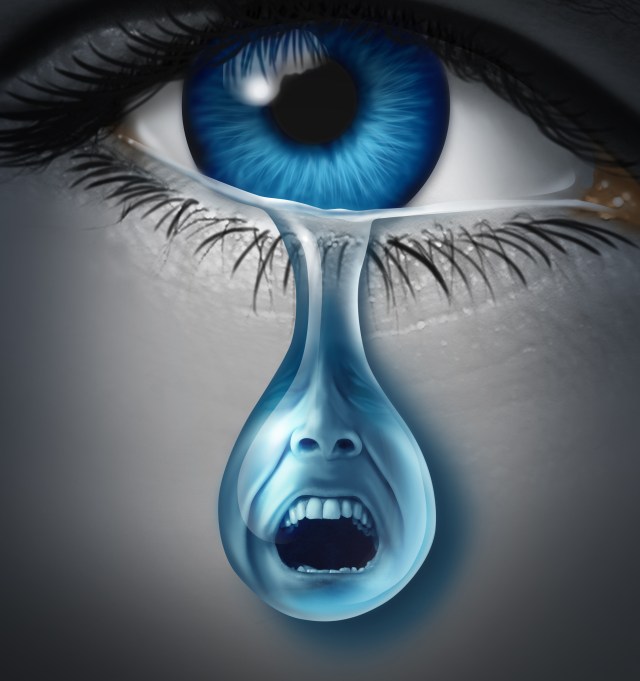
Anger can be dealt with easily by most individuals. The amygdala quickly returns to normal. Crying can help bring the brain back to normal.
Ironically, people who are taught to suppress emotions such as sorrow are more likely to became angry or depressed (the passive form of anger.) Boys who have been shamed for showing pain or sorrow often find that anger is the only socially acceptable emotion they have.
Type A people are often rewarded for their drive and determination. They can give others the impression that they are best able to respond to threats. They are more likely to be angry and focus on the weaknesses of others and in turn, make themselves sick.Angry people are more likely to have colds, skin problems, and arthritis. Being Type A is hard on the immune system. The stress of anger causes other problems such as weight gain, ulcers and acid reflux.
Since anger produces cortisol, angry people suffer from hormone imbalances and the result can be thyroid problems and decreased bone density.
Angry people are poor communicators and even worse listeners. They are often impatient and in a hurry.
I’m excited that Mixed In has been nominated for a Rone Award in the category of Science Fiction and Time Travel. The first stage of this award is reader voting followed by judging. I’d love to be judged but to get there, I need some votes. If you are so motivated, please vote for me by following this link.
If you haven’t yet registered, you’ll need to do so. Then you’ll get information and reviews about small and independently published books from Ind’ Tale Magazine. I’ve found publishing with a small press to be satisfying–although not lucrative. If you want the big bucks, get an agent and hold out for a big publishing house. If you want to be happy, small press might be for you. I enjoy my interactions with small press editors. They are nice, helpful, and keep current with publishing rends. Why don’t I self publish? I can’t go it alone. I need editors and proof readers to help me. Before I even submit a novel for consideration, I hire a beta reader and then a proof-reader/copy editor. In my case, the more comments I get the better.
Mixed In is a milieu novel with an agricultural theme. It’s a little naughty. If that’s for you, please lend me your vote and sign up for the Ind’Tale newsletter.
The challenge to writing a novel set in the past is that the past disappears. In London of 1832, the setting for Wolves and Deer: A Take Based on Fact, today’s familiar landmarks were not yet in place including the Houses of Parliament and Big Ben. There were no steel framed buildings. Making steel required hand stirring until 1856 and the British were slow to incorporate the material into their structures even after the Bessemer Process was developed (in England ironically). Buildings were wood frame and flammable and flames took Dora’s Drury Lane Theater in 1809. It was rebuilt shortly before her death and can be found in Covent Garden (see below)
I can’t say that I learned much more about Dora Jordan during my recent visit to London although I enjoyed visiting such a vibrant and cohesive city.
Covent Gardens
A bust market place and theater district
Walking around London, I imagined the places Dora Jordan and my protagonist in Wolves and Deer: A Tale Based on fact, Grace Clare, had been.
Theater Royal Haymarket was standing during Dora’s day and she played here.
A street such as this one and a child’s “photobombing” head would have been a familiar sight to Dora.
What did I learn about William IV during my trip? I came to understand how little he got from being King. Most notably, as King, he had a marble statue of Dora commissioned and it’s now in Buckingham palace. Where’s is his statue? There isn’t one. He is remembered for the Fourth Plinth, a pillar in Trafalgar Square with no permanent statue because, the story goes, he left no money for one. The only trace of William I saw was this plinth with its temporary sculpture during a bus tour and the tour guide was quick to mention his lack of funds. Didn’t get a photo but this was there.
He comes up lacking at the Tower of London as well. Among the Crown Jewels and regalia only the Queen consort’s ring 1831 ( no names attached) was displayed. This was a gift to Queen Adelaide, the one woman who was unfortunate enough to marry him when he was at an advanced age, had ten other children, and was acting erratically. Together, the pair wasn’t able to produce an heir. Victoria was their niece. William ruled for seven years. He’s is known for his support of slavery which was abolished during his reign and opposition to reform (before reform, parliament members were representing districts with no people in them) which was accepted during his reign. He became King through a series of unfortunate events, left the mother of his numerous children in a bind, and produced no heirs. Additionally, he carefully saved Dora’s letters to him, yet had his own correspondence burned. His legacy is an empty base for a statue and that’s about it.
Wolves and Deer is the story of Grace Clare seeking answers about the death of Dora Jordan.What really happened? Who is to blame? Should she seek vengeance? And most importantly, how much power should our rulers have over us?