

The link between lead and crime has been published everywhere from science journals to Forbes to Mother Jones. Violent crime in the United States rose in the 1960s, spiked in the 90s, and has plummeted since then. Why did the generation associated with peace signs and hippies turn out to be the most violent in recent history? Many scientists point to one reason–lead in gasoline during their childhoods.
Lead in the form of tetraethyl lead was added to gasoline in the 1920s in to help electric igniting engines operate more smoothly. It worked well despite one problem with it. The additive was known to cause “madness” and hallucinations. This had been first documented in the 1850s. In fact, workers at the first lead additive manufacturing plant died after going “looney.” Despite this, the additive worked effectively and was cheap so the companies that made it pushed forward to add it to gasoline. It was temporarily banned in parts of the nation–not the Midwest however–making the breadbasket of our nation a rich source of environmental lead. With careful marketing and lobbying by the companies that made the additive, the health effects were downplayed and the new technology was given a clean bill of health by the U.S. Surgeon General in the late 1920s.Thus, leaded gasoline was heavily used across the United States for over forty years.
Analytical chemistry upped its game in the 1970s, finding that the lead persisted in the environment and in people. Many states began phasing it out in the 70s and 80s. It was banned state by state and eliminated from car gasoline in 1996. But since it is an element, lead can’t break down into anything simpler. Scientists believe that everyone over 40 in the U.S. has some degree of lead poisoning. Lead can be cleared from blood by the body but it resides in bones for 30 years or longer. Lead still lingers in many locations in the U.S.–including the poorest most violent neighborhoods. And of course, it has recently been found in water in Flint, Michigan thanks to corroding old pipes. Old paint and even old cans can also add lead to our bodies. However, lead in gasoline has been by far the most egregious contributor. As use was curtailed, lead in blood began to drop dramatically. Crime did as well.
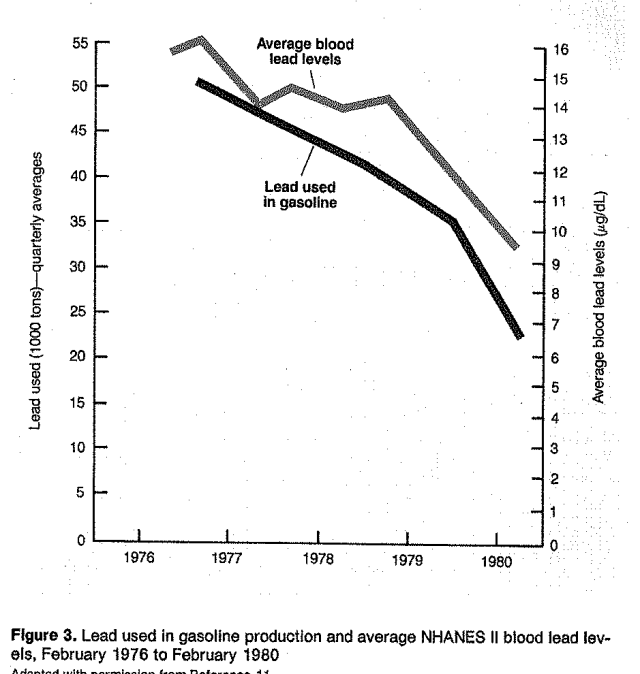
Why is lead so nasty? Lead impairs brain growth and poisons neurons.. It lows IQ and leads to life-long mental impairment. It damages the areas of the brain that control aggression and is more toxic to boys than to girls. It contributes to ADHD. It encourages cancer. Even teen-pregnancy has been linked to lead exposure. The poorer a person is, the more likely they are to have a high blood lead level.
It’s no surprise that lead is found at high levels in shooting ranges. These are regulated by OSHA and there are rules demanding clean up but these rules are not always followed. Eating meat shot with lead is also dangerous, especially for children. Adding vinegar to game shot with lead bullets makes the lead even more soluble in the meat and increases the toxicity.
Shooting ranges are not the only source of lead in the environment. Fuel for small airplanes contains lead and they are one of the major contributors to lead pollution today.
The link between lead poisoning and crime needs to be explored more fully. The tragedy of lead poisoning in the Unites States is a sad tale of greed and lack of regulation. Every one of us has suffered to some extent from exposure to lead. The cautionary take-away is that when it comes to chemicals, we need more regulations and more care taken before approving them for use in consumer products.

 The idea that birth control is lewd and promotes bad behavior has a long history in the United States. Bans or partial bans were a part of our history from the 1870s to the 1960s and there is one figurehead presumed to be responsible for it all.




 Catherine Haustein