
Tulips in Pella

photo 1-18
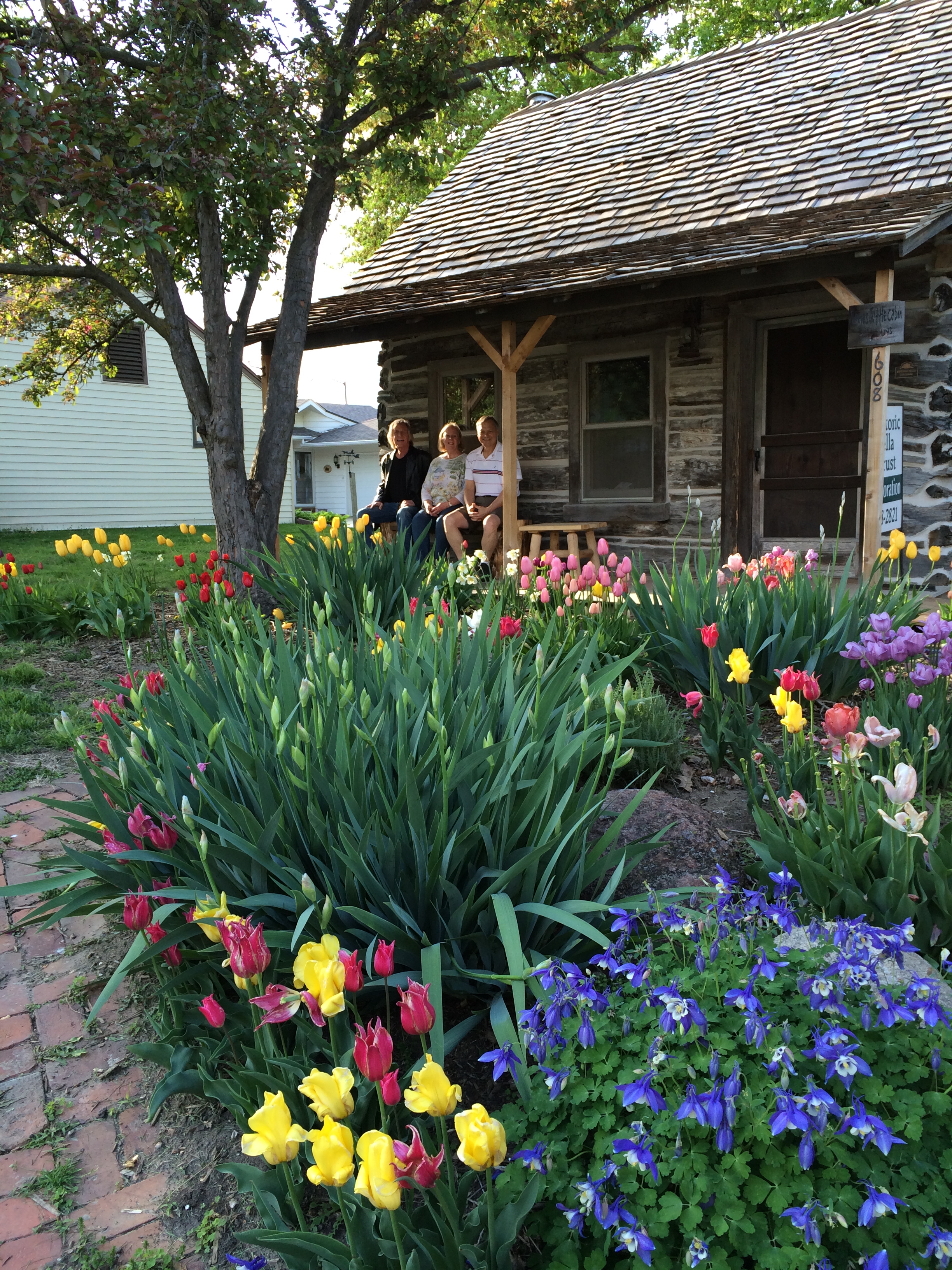
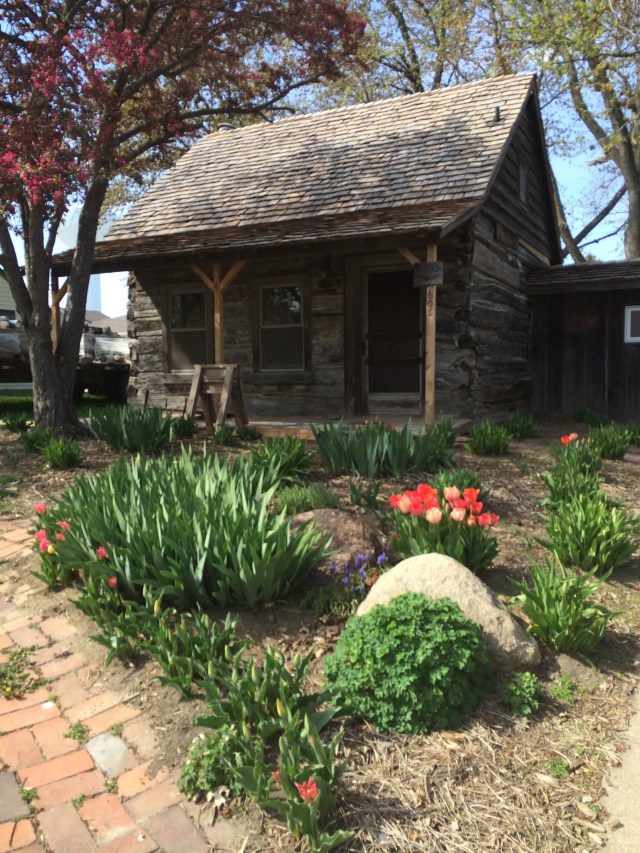
Tuttle cabin and tulips.


photo 2-21
Sunken Gardens tulips:Pink/Purple/White Mix w/ Yellow Fritillaria

It’s thought that their name is a botched European translation of the Persian world for turban.They were first written about in Turkey and a religious symbol of paradise on Earth in the Ottoman Empire. They were later popularized in the Netherlands and reworked into a reminder of the brevity of life since each blossom lasts a week or less. It’s nearly Tulip Time in Pella so I did a little library research on tulips. Or tried to.

There haven’t been many studies on the chemical properties of tulips. They contain anti-fungal latex-like chemicals called tuliposides and tulipalins that may cause allergic response, especially dermatitis in some people. The bulbs also contain calcium oxalate which is irritating to the skin. Several of the tulipalins are toxic to dogs, cats, and horses. However, some people use the petals in cooking to give a mild onion flavor.

It’s best to plant tulips in the fall. Despite their chemicals, they tend to rot and fall is usually drier than spring. They like cold winters and dry summers.They need the pattern of cold in order to break dormancy and begin to grow. Requiring a specific type of condition in order to sprout is known as stratification.This is a defense mechanism that prevents seeds from sprouting when environmental conditions are unfavorable. It’s terribly complex, with different proteins being produced and protein levels rising and falling. You thought seeds were just sleeping? Not really. They are experiencing life changes.

To keep tabs on Pella’s tulips and if they are blooming, click here for a map of each tulip bed in town.photo-170


The Sunny Side of Dandelions

Admit it. When you were young at heart, you loved dandelions. You loved their cheery yellowness. You loved blowing their seeds and making a wish. I loved them then and still do. Just recently, my grandson brought me my first grandmotherly bouquet of dandelions,his face shining with pride. I never have understood why they are a weed, except that lots went wrong during the Victorian era and green lawns with servants to pull the weeds became a status symbol here in the United States. Dandelions are edible and healthy.

Dandelions contain  inositols–chemicals with wide ranging health effects such as controlling high blood pressure, polycystic ovaries, psoriasis, and high cholesterol.Other chemicals in dandelions can help bile production and blood glucose regulation.Dandelions can prevent liver damage.  For a list, along with some experiments that didn’t yield results, go here. However, be careful where you get your dandelions. Avoid those near roads and factories  as they take up pollution. 

The root can be made into a trendy coffee-like beverage. The French make dandelions into soup. They are packed with potassium, calcium, Vitamin A, and Vitamin C. The only worry might be that you could get heartburn from them.

Dandelion roots break up hard soil. There is no reason to spray them and your family with poison. Enjoy them. Put them in salad. Boil the leaves. Make soup.And when you see them, think happy thoughts. You might even make a wish.

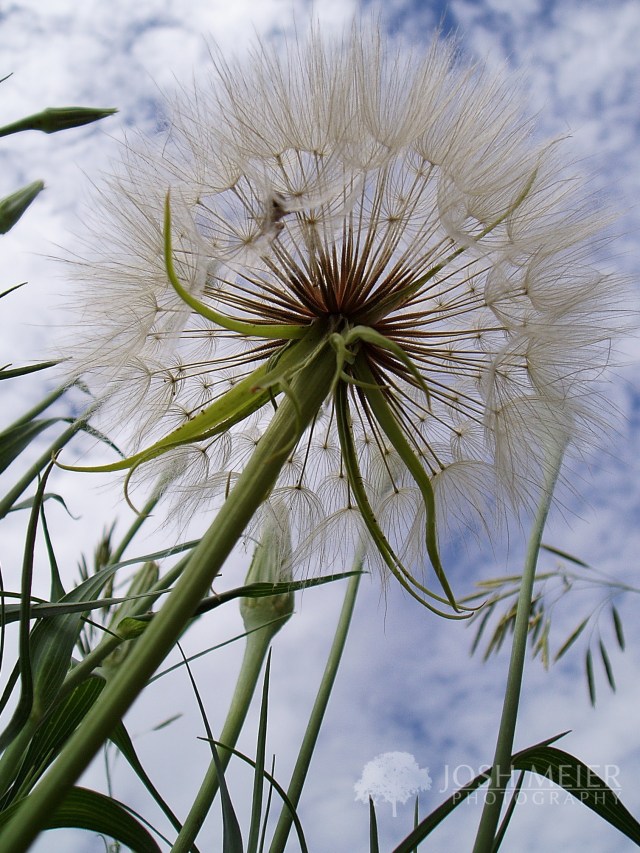
goatsbeardThanks to Josh Meier for the use of this photo. View his website here. There’s a secret about this photo. Can you spot it?

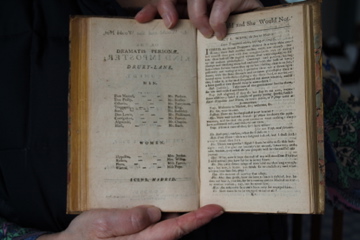
Theater Royal Manager’s Handbook: 1795

handbook

I was excited to get my hands on a theater manager’s handbook from Theater Royal on Drury Lane. The manager at the time was Richard Brinkley Sheridan known for writing School for Scandal. In the cover of the book is some handwriting, Dora Jordan’s perhaps–it matches hers, and the notation that there were six plays and six handbooks.

Mrs. Jordan as Hippolyta
A caricature of Dora Jordan from The Manager’s Book at the Theater Royal, Drury Lane, printed by R. Butters. Playing a man allowed audiences to see her lovely legs and also let her wear her hair naturally during the time of high hair and tight corkscrews. This gave people a lot to gossip about. Compare her shoes and hat with those of an actual man below. Clever costuming, is it not? Since the players owned their costumes, this cleverness can be attributed to the actress herself. It was also somewhat expected.


she would pages
Cast list and first page. The long s indicates this was printed before 1800.


Above is a cast list and the first page of the play “She Would and She Would Not.” Note the long s, showing that this was pre 1800.

Mr Lewis
Mr. Lewis wasn’t as famous as Mrs. Jordan. As best I can tell, like Mrs. Jordan, he’d previously worked for Tate Wilkinson in the Yorkshire circuit. The play is The Suspicious Husband
cover
After two hundred and twenty one years, the cover is not in great shape

I’d be glad to answer further questions about this book for all who are curious about its history.

Those who know me know that I love live theater, especially old  comedies. I like live theater so much, I don’t even care if it’s bad. Natural Attraction includes some bad theater and a traveling cast of “actors” as was common in the days before movies and television.


Wolves and Deer is a novel about Dora Jordan herself. If you’re a theater fan, be sure to check it out.

Pella’s Tuttle Cabin

photo-141
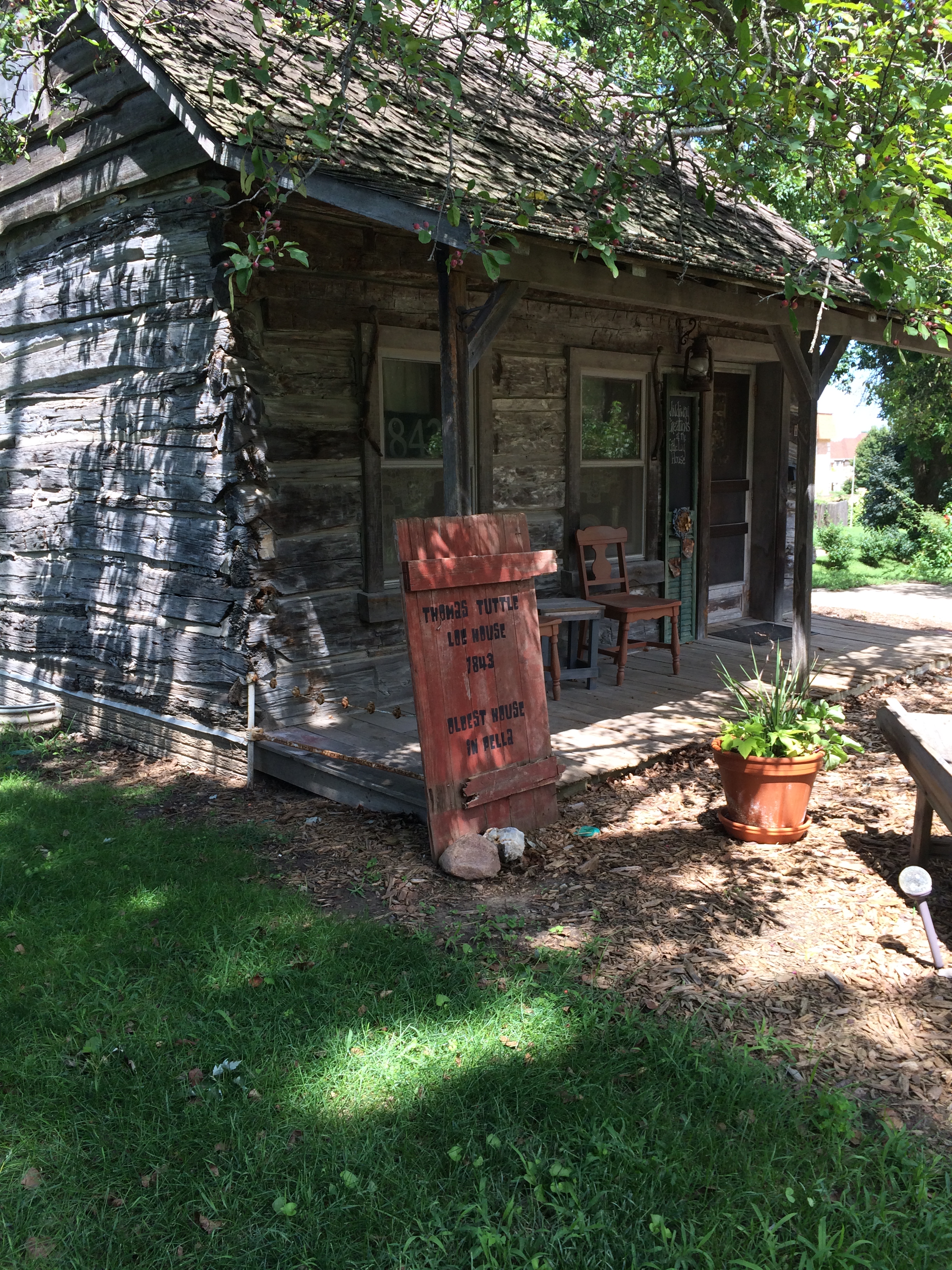
Tuttle cabin 1843

photo-31
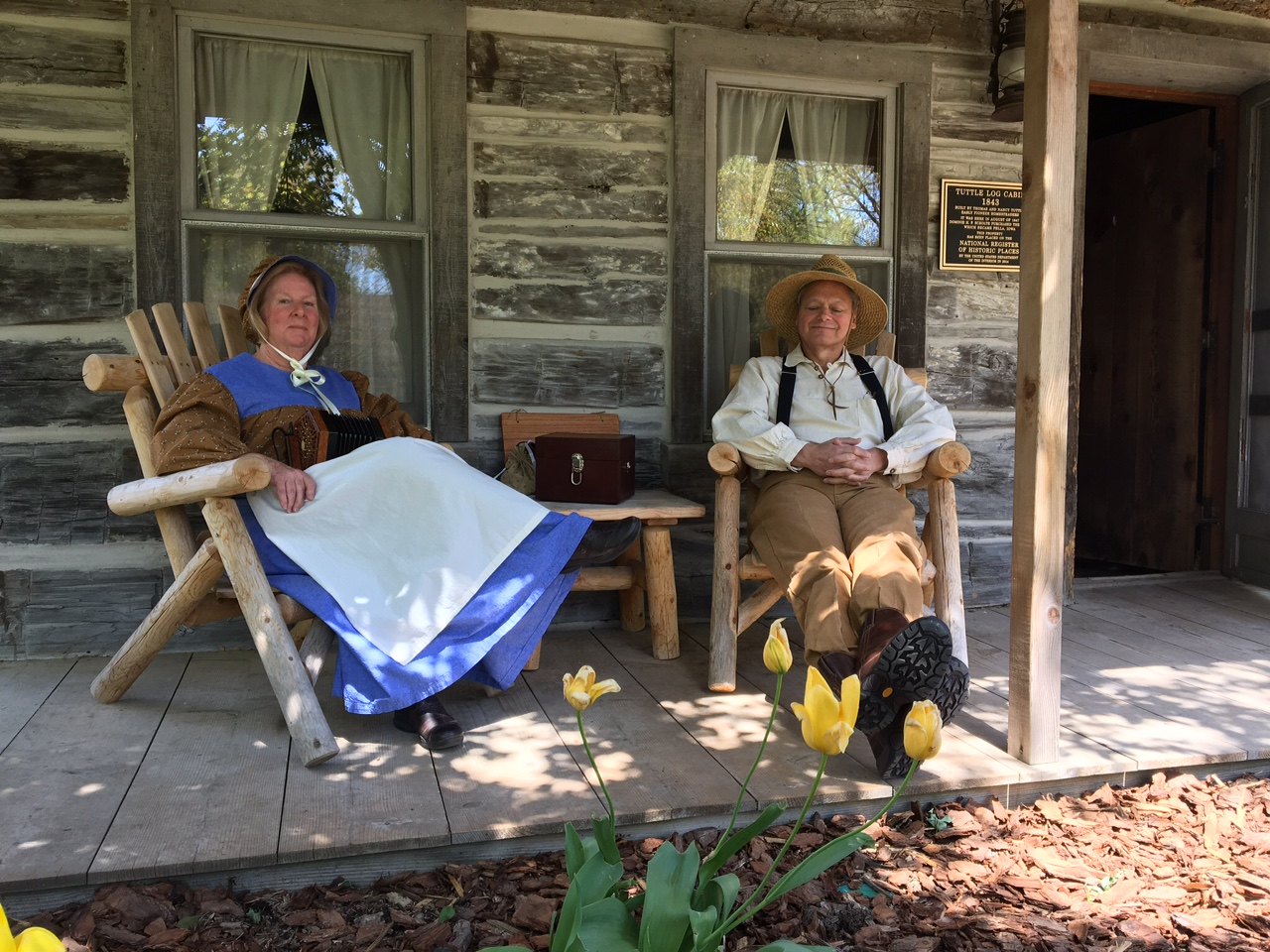
Tuttle relations sit in front of the Tuttle cabin in Pella in May.


Have you ever wanted to see an authentic log cabin? There’s one in my hometown of Pella, Iowa.  It’s Pella’s oldest known structure and was built by Thomas and Nancy Tuttle in 1843. At the time, the land was bordered on the north by timber. The Tuttles split their own rails, dug a well, and made their home on the present site of Pella. They later sold their home and small farm to the Dutch settlers, who paid in gold. The town of Pella grew around the little cabin, which still stands today just to the east of Lincoln School and to the south of Sunken Gardens Park. It was an artist’s studio for many years but was sold to the Pella Historic Trust and was renovated.

Believe it or not, my husband’s family is related to the Pella Tuttles via Simon Tuttle who was born in Northamptonshire, England in 1565.  The Pella Tuttles are descended from John Tuttle who was born in Northamptonshire, England in 1596.My family is from John’s brother, William Tuttle, who was born in Northamptonshire, England in 1607. The brothers, along with a third brother, came to the US together  in 1635.  Some time after their arrival in Boston they settled in New Haven, CT before heading west to Iowa.

IMG_2032Tom and Nancy Tuttle–portrayed by Tuttle decedents–relax in front of the cabin during Pella’s Tulip Time 2017.

The cabin is located just around the corner from Sunken Gardens Park at 608 Lincoln St. in Pella.


Old words and phrases translated

A Shakespeare (1582-1616)  troupe will be in Pella this week. I must confess, I find Shakespeare’s comedies really funny. The wording is hard to understand sometimes though because commonly used colloquial phrases have changed quite a lot. In honor of this, I’ve put together a list of words and phrases used back in the 16-1700s. I got these not from Shakespeare but from a play called She Would and She Would Not by Colley Cibber 1671-1757. (This play caught my eye because it has a strong female lead character who was one of Dora Jordan’s greatest roles.) Can you figure out what they mean? What phrases of today will be confusing to future generations? Have I missed any of your favorites?

1.Pry’thee

2. Artful vs artless

3. I’ll Break no square

4. Quotha

5. Odzooks

6. Puppy

7. How now?

Ready for the answers?

Key:

  1. Pry’thee also prithee means “pray thee”. It sounds nice. Almost like please. But it was more like WTF.
  2. Artful vs artless We’ve all heard of Artful Dodger. Someone artful is shrewd, crafty, skilled. Artless sounds like the person would be a clod but it means without deceit, innocent, natural.
  3. I’ll Break no square– my best guess is that this means I’ll not step out of line or formation.
  4. quota “quoth he” but not particularly nice, kind of like “so he says” or “yeah right”
  5. odzooks  similar to gadzooks (aka “yikes”)  meaning God’s hook or the nails that held Christ to the cross. Creepy, don’t you think?
  6. puppy can mean a vain young man, a puppet, or a dog, the former in She Would and She Would Not 
  7. How now? means “what” or more often, “what’s up?”. Famously used to show skill in elocution as in How now brown cow?”


Periodic betrayal or clueless man?

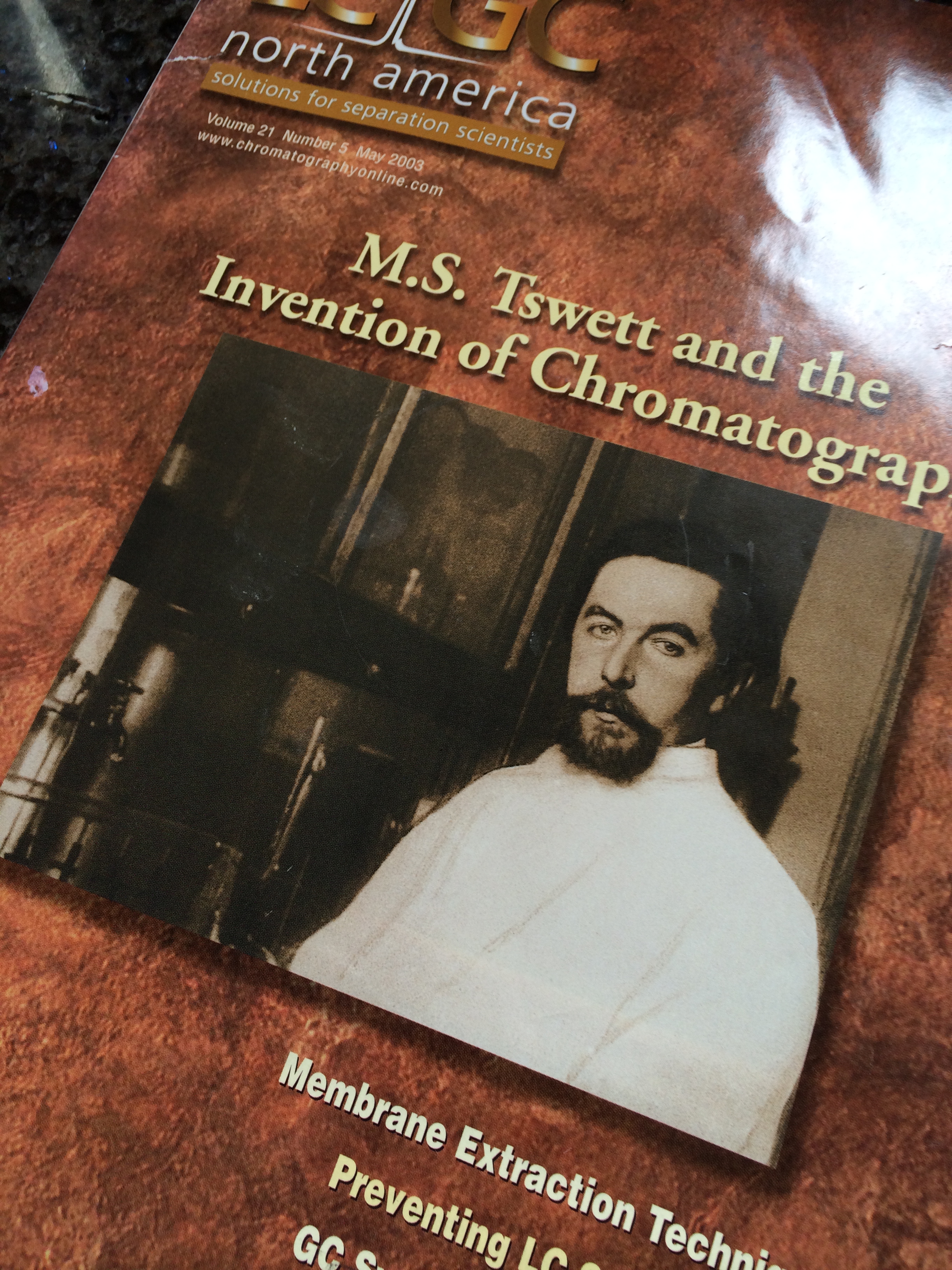
thIn every profession, the newcomers rely on the old guard to help them make their way. There are many tales, as that of The Tragic Triumph of M.S. Tswett, where the established powers fail to recognize the achievements of the outsider. Sadly, science is a human endeavor and one can’t write about women in science without mentioning bias and harassment. My observation is that this is most common in that bastion of male dominion, physics. In a recent study of women in astronomy, 82% of them had heard sexiest remarks, 57% had enjoyed verbal sexual harassment, and 9% physical harassment. To put it into perspective, part of getting a Ph.D. is to put up with the abuse of the powerful, but this shouldn’t include sexism. When you reply on those who sexually harass you for approval and letters of reference, it’s a powerless place to be. This is nothing new.

Lise Meitner is a famous case of sexism and betrayal. This occurred at the hands of a male colleague who she considered a close friend. Did this happen hundreds of years ago? No. Less than 100 years ago, in the 1940s science saw perhaps its most infamous blackguard in the person of one Nobel prize winner, Otto Hahn.

Dr. Meitner earned a doctorate in physics in 1905. In 1918, she and her lab partner, Otto Hahn, discovered protactinium. They began a series of experiments designed to make a heavier element than uranium, the largest natural element. They did this by hitting uranium with subatomic particles known as neutrons. Instead of getting larger, the uranium got smaller. It was surely puzzling.

Lise was born to a rich Jewish family and had to flee to the Netherlands during this time of Hitler’s power. However, she had plenty of time to think and wrote to her partner, Hahn, about a new process that they were observing: fission.

Hahn published and later won the Nobel prize for his discover of fission. Did he take the trouble to mention his lab partner of thirty years, who interpreted the results of the experiment for him? No. He did not. In fact, he spoke badly about her behind her back. His excuse: She was in exile when the famous paper had been written. She had won a “Woman of the Year” prize. Wasn’t that enough for her? She was portrayed as having fled Germany with the secret of the bomb and giving it to the Allies. For this, Hahn saw her as a traitor. This whole treatment shattered her self confidence.

Lise herself spoke of the overt sexism she faced. She said that being a woman was “almost half a crime.” She was sad about her treatment by Hahn, but never did despair about not getting the Nobel Prize for her discovery. It had been used to make a weapon and for this she held remorse. Hahn himself never rested easy with it. To honor Lise, element 109 was named Meitnerium. Is there a Hahnium? Well, it was once proposed as a name for element 105, but in the end, this element was named Dubnium after a town in Russia. At least on the periodic table, there’s no place for a sexist jerk.


Leap Year and Forget-Me-Nots

Forget-Me-Not-2_small.jpgphoto from here

There’s a connection between Leap year and Forget-Me-Nots. It’s said that Forget-Me-Nots should be given to friends who depart on a journey on Feburary 29th.

The pretty perennials which are able to grow in the shady and wet places in a garden are associated with other legends as well. It’s said that they were the flower of Henry IV when he was sent off to exile. They are alleged to be the flowers that remind old folks of their young lost loves. Religious lore says they got their name when God named all the plants and animals and nearly forgot them because they were so small. It’s hard to imagine them being forgotten, as these plants are pervasive. Perhaps their tendency to spread is why they are a symbol of everlasting love.

They are members of the Borage family and used in some medicines including those for eczema, ADHD, and milk production. They can be found in over the counter skin care products. However, they contain Pyrrolizidine alkaloids that can drop a mouse dead in five minutes so don’t try self-medicating. Related plants are bluebells and Hounds tooth (burs). They are the State Flower of Alaska.

Here’s hoping you have a wonderful Leap Year and remember those you wish to and forget the rest!

The Tragic Triumph of M.S. Tswett

photo-155

My heart breaks for a lot of people in history. Without any sort of social safety net or obstetrics or valid peer review, life was pretty crummy for many of them. M.S. Tswett is one of those heartbreakers. Almost every week, I use one of his discoveries with applications very similar to his, for in 1903, he discovered chromatography while studying chemicals in plants. Thirty years later, it became an accepted technique. Too bad he was already dead!

Before chromatography, when a chemist wanted to separate a complex mixture, say, things in a plant leaf or stem, the chemist had to chemically isolate and crystallize the molecules of study. Most of the time, this was done through a series of chemical reactions. Tswett was a botanist and he did things differently. He separated plant pigments, various types of chlorophylls, carotenes,  and xanthophylls, by allowing the chemicals to be washed through a tube of solid material. The differences in chemical attraction between the solvent and the solid and the pigments caused them to separate in bands. The ones that had more in common with the solvent moved faster through the tube. The ones more attracted to the solid came out later. This is pretty much the basis of one of the most widely used chemical techniques ever–chromatography

Little Mikhail Semenovich Tswett had a sad start. He was born to Russian parents during their vacation in Italy. (His mother was originally from Italy so perhaps she went there to visit family.) It’s not known if he was an early surprise but soon after, his mother died. Mikhail was left in Switzerland, frequently visited by his father, who gained a new family He was ever to be a man without a country. He got a Ph.D.in Switzerland and moved to Russia afterwards to be near his father. Sadly, his non-Russian thesis wasn’t acceptable in that country, nor was Mikhail’s accent. He sounded more French than Russian! He ended up getting another Ph.D. and became a professor (for female students) in Poland  where he developed his famous technique. Was it an overnight sensation? No. His chromatography of brown algae pigments gave a different result than the crystallization results of the famous botanist Molisch in  Prague. This made the poor Tswett a bit of an outcast. Another botanist, who later won the Nobel Prize, Willszateter, couldn’t reproduce Tswett’s work (it was later discerned that he didn’t have the right chemicals.)  Chromatography was declared “odd” and pretty much ignored. Tswett must have struggled financially because it wasn’t until he was forty that he married a librarian and companion in his lab work. Tswett had to flee back to Russia during WWI and died there at age 47, unable to overcome the declaration of his work as odd.

Chromatography means color (chroma) writing (graphein) but Tswett also means color in Russian. Pretty cool, isn’t it? I wonder if he ever suspected that his name would be on so many lips over a hundred years after it was discovered.

This blog entry is dedicated to the release of a new book, Pawn of the Phoenix, a detective novel set in 1903, the year of chromatography’s birth.


Bean nutrition, a recipe, and a book

At a cook out, I’ve always liked the beans better than the hamburger. They have a more complex flavor. There’s a reason for that. Beans are packed with good things. Beans are one of my favorite plants to study because they contain a wide variety of water soluble compounds. Since the chemicals are water soluble, they are easy to get out of the beans without complicated processes, making them wonderful plant for college students to work with safely. I’ve  studied velvet beans and you’ll find them in Natural Attraction.

Beans contain all sorts of amino acids, the building blocks of proteins, and there are a wide variety of amino acids in beans.  Nutrition chemists don’t just look at amino acid content when evaluating the nutrient content of beans. They also look at how animals absorb the nutrients. Yes, that means they look at animal excrement and see how much of the amino acids are in there. The more in the excrement, the less nutritional the beans. Cooking beans makes the amino acids more easily absorbed. Believe it or not, even how the beans are stored and processed affects the amino acid availability. Beans stored dry and then cooked are more nutritious than those stored or canned in water.

Besides amino acids, beans contain “phenolics,” a fancy word for specific kinds of antioxidants that are regarded as healthy to hearts and might prevent cancer. Red beans contain more of these chemicals than white beans.

Of course, beans are known to increase flatulence thanks to their fiber content, which gives intestinal bacteria a work out and they in turn produce gas. This can be decreased by taking an enzyme that will help break down the starchy part of the beans.

For a recipe for red beans and rice, and a peak at an exciting new Young Adult multicultural novel by author Kelly Cain, please go here. And congratulations Kelly on your book ALTERED out today.


Why do balls bounce?

In honor of a new sports romance written by my friend Jim Cagney, I thought I’d talk some about why things bounce. To understand this, let’s look at one of the first popular bouncy substance, a natural material, rubber.It’s a long chain of molecules, a polymer. There are many natural polymers, collagen for example, is a natural protein found in skin.Polymeric things tend to bounce when dropped because the stringy chains are arranged in a somewhat messy structure that’s actually very efficient. When something is dropped it picks up energy and when it hits a surface it absorbs some of the energy into its structure. This energy can be used to create heat, sound, or to become a counter force. As Isaac Newton said, for every action, there’s an equal and opposite reaction. Rigid structures will more likely absorb the impact into their structures and become hot or even break bonds. Not polymers, they are apt to react with bounce because they are elastic. The energy of the drop will compress the molecules and then, the molecules will regain their shape and bounce back. Think about what happens when a ball is dropped on a surface that isn’t hard. Lots of the energy goes into squishing that surface down and the ball won’t bounce as high because it has given away energy.

Basketballs are made a little differently from a golf ball or a bouncy ball. They are a hollow bladder filled with air with a polymer coating. This polymer is often leather which is collagen, the skin protein. The air molecules inside the ball do a great job of moving in response to hitting a surface. But they don’t like to be near each other–air likes to fill space, much like paper on my desk. The ball will distort when it hits the floor but quickly get a push back from the air and bounce. The more force you put into the dribble, the higher the bounce.

Congratulations to Jim on his book, On the Rebound. Available here.